Over ten years ago, when I was working at Lexham Press, I had an idea. The Timothy Keller Sermon Archive had just come out, and I wondered: Why not edit Keller’s sermons into a commentary format? I drew up a proposal and sample and we sent it to Keller’s people, and they said no (they already had plans for what to do with his sermons; fair enough).
Then I had another idea: Why not do this with another famous preacher who is still popular but whose sermons are in the public domain? Thus was born the Spurgeon Commentary Series. I came up with a list of books that Spurgeon had preached on enough that his sermons could feasibly be adapted to a commentary format, and then started working through the list. I started with Galatians, then moved on to Philippians, 2 Thessalonians, 2 Timothy, Titus, Hebrews, 1 John, 1–2 Peter, and Jude. Four volumes were put into print, and we put a volume on Song of Solomon and Jonah up on preorder, but then I was put on other projects and the Spurgeon Commentary languished.
Now, the initial volumes have gotten a redesign from the incomparable Joshua Hunt, there is a new foreword from Geoffrey Chang (curator of the Spurgeon Library at Midwestern Baptist Theological Seminary), the volumes on 1 John and 1–2 Peter and Jude are in print for the first time, and the long-awaited (by at least a few people, probably) volume on Song of Solomon and Jonah will finally be out on February 4. I’m observing all of this from the outside, as it were; Baker Publishing Group acquired Lexham Press last year and is the publisher for these books, so I haven’t had a hand in bringing them across the finish line. All the same, it feels good to have this project realized after it was lying dormant for so long.
These books are great devotional commentaries to accompany your regular Bible reading. If you enjoyed the earlier volumes, or if you’re just looking for a solid devotional commentary, be sure to pick one up February 4!
I’ve recently realized that the last thing I put on this blog was a melancholy reflection on Christmas. Now, I’d like to put before you this Advent a painting by Albrecht Altdorfer:
Sitting in prison on the first Sunday of Advent 1943, German theologian Dietrich Bonhoeffer wrote:
November 28, 1943
My dear Parents,
Although no one has any idea whether and how letters are presently being handled, I nevertheless want to write to you on this afternoon of the first Sunday in Advent. The Altdorfer nativity scene, in which one sees the holy family with the manger amid the rubble of a collapsed house—just how did he come to portray this in such a way, flying in the face of all tradition, four hundred years ago?—is particularly timely. Even here one can and ought to celebrate Christmas, he perhaps wanted to say; in any case, this is what he says to us.
We could see this painting, and the state of the world at any given time, in two ways. The first is to look at how much has collapsed, to lament what is gone. And that is a legitimate way to look at the world, especially for someone in Bonhoeffer’s position. But the second is to focus on how the birth of Jesus came in wrecked circumstances. When the rubble reminds us that things aren’t the way they used to be, or the way they ought to be, the presence of the holy family reminds us that God has visited this place, is in it even now, and is renewing it. And we will see him renewing, renewing, renewing, if we look for him. Lord, give us eyes to see.
I’m weary this Christmas. Maybe you are, too. I’m weary of all the decisions I’ve had to make this year, figuring out how to navigate the pandemic, deciding on my own risk tolerance, trying to balance that with other people’s. I can only imagine what kind of weariness government officials and church leaders are feeling as they make decisions for others.
I’m weary of being alone. Not always. Sometimes I’m quite content. But this is will be the third Christmas since divorce proceedings started in the fall of 2019, and the second since I’ve been officially divorced. For all three of these Christmases, knowing how memories can be, I have tried to be away from home on December 25. It has felt like too much to watch the day approach from familiar surroundings, confronted with the difference between the way things used to be, and the way I hoped they would be, and the way things are. This Christmas, I decided to get out of town again. But while I will see friends while away, for much of the time I’ll be alone. I’m hoping the new setting by itself will keep my mind from being drawn to the lost past and future and focused on the given present and new possibilities.
I’m weary of holding things together, being responsible for the weight of my existence. When I was a child, Christmas with my family was a safe place. We would drive from our home in North Carolina to my grandparents’ house in Michigan for their annual Christmas Eve party. Everyone’s stockings, most of them handmade by my grandma, would be hung on the long mantel. We’d play games, eat appetizers, eat dinner, and listen to the story of the birth of Jesus. Then we’d open our gifts, from the youngest to the oldest, sing carols accompanied by my grandpa on the piano, and eat cookies and ice cream. Sometimes, later in the evening, a few would head out into the December chill for a late-night Christmas Eve service.
It has been over a decade now since the last Christmas Eve gathering at my grandparents’ house. My grandpa passed away in 2014, and my grandma is about to be ninety-six and is years removed from being able to host such a gathering. It’s only natural that one generation passes from the scene and another takes its place, and my brother and several of my cousins have indeed created their own traditions and celebrations. This time of year, though, it’s hard not to think of the kind of family I wanted and wasn’t able to have.
I’ve experienced an incredible amount of goodness, of course. I have good friends, a church community that loves me and values my gifts, and meaningful work. But it’s good to name grief, not just to myself but to others, and so I say that weariness and aloneness weigh heavy on me. Not all the time, but enough to drag my steps on occasion.
Maybe you’re feeling weary and lonelier than you’d like this Christmas, too. What do we do with it?
I like to remind myself that to those who are weary, Jesus said, “Come to me, all you who are weary and burdened, and I will give you rest” (Matthew 11:28). This God-man, who himself bore such incredible weight of expectation from a young age, grew up to offer us rest. He invites us to come to him and tell him, “This hurts. I’m tired. Will you heal me, please?” I don’t have to make my life make sense or come up with a grand plan for making meaning out of what I’ve experienced. I can rest by laying down my burdens and taking up his yoke of learning how to live as God made me to live.
Just rest, beloved. He knows you’re weary.
When I feel alone, I try to remember that “God sets the lonely in families” (Psalm 68:6). I don’t believe that another marriage is promised to me, but I do believe that God has made me, and all of us, for connection, for intimacy. Living in an individualistic society makes it awkward to admit that you can’t make it on your own, that you’re feeling the weight of having to make all the decisions for your own life plus reach out to other people if you want to spend time with them. When I have energy, I can manage to do the reaching out, put things on the schedule. But the weariness and the loneliness often go together for me because it’s when I lack the energy to make social interaction happen myself that I in turn feel the lack of it. When I’m not too weary, I try to turn loneliness to connection. There will always be an ache, a connection that I wish was there but wasn’t. Even when I’m weary, I can turn it to prayer. What must it have been like for Jesus to enter this world as a baby, unwelcomed by all but a few? To have his life on earth began in a lonely place, with his mom and stepdad and a few ragged outcasts looking on? To be unmarried in a society where it was more unusual than it is today? Doesn’t he know what it’s like to be lonely?
Look to his face, beloved. He knows you’re lonely.
During Advent, many of us listen to Handel’s Messiah, and especially the parts about Jesus’s birth. I have memories of listening to it during many Decembers, but a more significant memory came from my grandpa’s memorial service in September 2014. Several of us stood up and shared how generous and faithful a man he had been—an accountant, a loyal churchman, devoted to his family, always looking to help others, including playing the piano at retirement homes in his later years. At the end, as he had wanted it, we all stood in silence while the organist played the Hallelujah Chorus on the church’s massive pipe organ. Tears dripped from my chin as I said goodbye to the man my mom called the best Christian she’s ever known.
It was his gift to us, to take the end of his memorial service and make us think about how the kingdom of this world would become the kingdom of Christ, and he shall reign forever and ever as King of kings and Lord of lords.
And so, this merry weary Christmas, I want to take my weariness and aloneness to Jesus and tell him I don’t know how to deal with them on my own. I know they won’t last forever. Maybe I’ll wake up tomorrow in a chipper mood, with higher energy and better ability to reach out to other people. I hope I do. But for now, I want to become so deeply aware of weariness and aloneness that, when I have turned to Jesus for company in them both, when energy and a sense of connection returns I can then turn to others to make them feel less weary and alone. I want to take my knowledge of tiredness and relieve others’ burdens, especially the poor. I want to take my knowledge of what it’s like to not belong and make others belong, especially the outcast. To look to the “new and glorious morn” with the joy that can only come from facing how weary the world can be. If you’re also feeling weary and alone this December 23, I hope you can, too.
Last month, I had an essay published at Fathom Magazine for their “Transcendence” issue. It tells the story of an even that I initially thought was a coincidence, then came to conclude was a miracle. Here is how it begins:
I decided, too late, that I wanted to go home. It was a cool fall Saturday night in Budapest, where my post-college aimlessness had landed me a job teaching high school English. I lived in an outlying district at the far southern terminus of a metro line, filled with massive postwar concrete apartment buildings lined up one after the other like weary gray dominoes. On this night, though, I was in the bustle and sparkle of the city center with friends. The group had just decided to head up to Buda Castle to enjoy its hilltop views of the Danube and flat Pest, spreading out across the river to the horizon.
But waiting while some in the group purchased wine and chocolate to accompany the views, I decided I wasn’t up for another change in location before making the forty-five-minute trek to my concrete home. Taking my leave and then riding the escalator underground to board the metro, I chastised myself for my slowness. A few minutes before, a friend who taught at my school and lived close to me had made the same decision. Now, having missed the chance to have company on the journey, I just had my own thoughts.
A while back, a friend and I were joking about cowriting a Christian romance novel centered around meeting someone via Craigslist (or some similar buying/selling platform). It didn’t come to fruition. But before it fizzled out, I wrote a first chapter. So now I present to you chapter 1 of Secondhand Love. I am accepting inquiries from agents.
Gina Cranston had it all. While in college, she had asked herself, “What if I put the words ‘Live, Laugh, Love’ on an inspirational sign?” After years of hard work, she was now a successful interior designer. She had a lively social life in the big city. She volunteered at her church. But there was a hole in her heart—and it could only be filled by a midcentury modern coffee table.
One day, over Sunday brunch with her sassy best friend at their favorite local coffee shop, It’s Bean a Minute, she poured out her heart.
“I’ve looked all over, Clementina!” Gina said. She sipped her latte and looked wistfully out the window at a moving truck rumbling down the street. “All the furniture stores. New, used. They just don’t have what I’m looking for, and I’m beginning to lose hope.”
“Girl, you’ve got to put yourself out there!” Clementina said sassily.
“What does ‘out there’ mean when you’re talking about furniture?”
“I’m talking about the realm of possibilities on God’s green internet.”
Gina had thought about this, of course. But she had been burned by the internet in the past. She had been on furniture sites before, and every piece she had seen either had misleading pictures or was badly damaged in some way. She’d had enough.
“I don’t know. It sounds like it would be a lot of work, and I’ve got a ton of inspirational signs I need to make. It seems like everyone on Instagram wants one.”
“That’s a load of day-old biscuits,” Clementina said, her sassiness escalating. She pulled out her phone. “I’m setting you up on a site right now.”
Gina’s eyes bulged as she choked on her tea. “Clementina, DO NOT.” But Clementina wasn’t listening.
“How tall is your ideal coffee table?”
“I’m not going to answer that.”
Clementina put her phone down. “Gina, how long have we been best friends?”
“Since we met at the Judges-themed VBS at Eighth Baptist when we were ten. We were in a skit about Jael and Sisera. It was the last VBS Eighth Baptist hosted.”
“That’s right,” Clementina nodded. ”And if you can trust me to act like I’m hammering a tent peg into your head without actually hitting you, I think you can trust me to help you find your dream coffee table.”
Gina poked at her eggs over easy uneasily. “But I’ve tried all the furniture sites, and they didn’t do it for me.”
“Stop right there” Clementina blurted, switching from sassy to spunky. “There’s a new site that I’ve been hearing good things about. It’s called Bezalelslist.”
“Bezalelslist? Like the guy who built all the stuff for the tabernacle?” Gina had been doing a Beth Moore study on biblical furniture, so Exodus was fresh in her mind.
“Exactly. It’s THE place for Christians to find furniture. Just last month, Kaitelynnne Gladsby got matched with the tall, dark dresser she’s been praying for for years. She’s so in love!”
Gina thought for a moment. What did she have to lose? Nothing else she’d tried had worked so far. At the very least, it could be a fun story to tell as she made the rounds on the MLM circuit in the spring.
“Eighteen inches.”
“What?”
Gina finished her latte. “The height of my ideal coffee table.”
Clementina grinned sassily and picked up her phone again.
I wrote an essay about how I have struggled with loneliness during this past year, and how I have attempted to push through that loneliness into solitude. I wanted to see if I could put words to my experience in a way that connected with what so many others are experiencing during the pandemic. The good folks at Fathom magazine included it in their latest issue, and it was posted this week. Here is how I ended it:
I have empty spaces in my calendar, now. I have empty spaces in my life. Because they used to be filled, I feel the emptiness as a void, like the imprint on my finger where my wedding ring used to be. Knowing that distracting myself won’t fill the void, I can only go out to the lonely place where Jesus is. There I sit with him and wait until I can follow him into the crowd again.
I was alerted recently to this quote from a letter by C. S. Lewis to Dom Bede Griffiths from December 20, 1946:
It is one of the evils of rapid diffusion of news that the sorrows of all the world come to us every morning. I think each village was meant to feel pity for its own sick and poor whom it can help and I doubt if it is the duty of any private person to fix his mind on ills wh. he cannot help. (This may even become an escape from the works of charity we really can do to those we know).
A great many people (not you) do now seem to think that the mere state of being worried is in itself meritorious. I don’t think it is. We must, if it so happens, give our lives for others: but even while we’re doing it, I think we’re meant to enjoy Our Lord and, in Him, our friends, our food, our sleep, our jokes, and the birds song and the frosty sunrise.
As about the distant, so about the future. It is v. dark: but there’s usually light enough for the next step or so. Pray for me always.
I think about this regularly. I think about it whenever I get on social media. I thought about it last week, when so many people seemed to be fretting about the results of the presidential election. These things have major real-world consequences, of course. But “can any one of you by worrying add a single hour to your life?”
I want, in my own life, to never be afraid to help when I can, to take real risks to serve others who are in my sphere of influence. But I also want to draw a bright line between things I can do something about and things I must leave in God’s hands. And when I have left those things in God’s hands, I want to be free to enjoy the life God has given me without guilt, without feeling that worry in itself will help anyone. Even if this appears irresponsible to a great many people.
Since I accidentally pushed out a blank blog post yesterday to all who subscribe (oops!), I wanted to write something a little more substantive today to make it up to all of you.
I’ve been reading Thomas Merton’s book Thoughts in Solitude in an attempt to learn as much as I can about how to live in this strange, isolated pandemic time. I came across this prayer:
My Lord God, I have no idea where I am going. I do not see the road ahead of me. I cannot know for certain where it will end. Nor do I really know myself, and the fact that I think I am following your will does not mean that I am actually doing so. But I believe that the desire to please you does in fact please you. And I hope I have that desire in all that I am doing. I hope that I will never do anything apart from that desire. And I know that if I do this you will lead me by the right road, though I may know nothing about it. Therefore I will trust you always, though I may seem to be lost and in the shadow of death. I will not fear, for you are ever with me, and you will never leave me to face my perils alone. (82)
So many of us are unsettled because we can’t see the road ahead of us. But we never really see the road ahead of us; we only see hints and glimpses. And we never really know ourselves. All we can do, in this time or any time, is desire to please God, take good risks in the knowledge that he is with us, and trust in his provision day by day.
May the peace of the Risen One be with you today and always.
We divide ourselves so many times into so many categories that we lose sight of what is more important, loving our neighbor as ourselves. Rather than go over to the rock of someone that is different we tend to stay in our groups with people that are like us losing opportunities to share in their joy, love, grief or suffering. What makes Jesus so powerful to me is that he was willing to sit on anyone’s rock with them. —Aaron Tiger
In the Gospel of Luke, one of the experts in the law asks Jesus what he has to do to inherit eternal life. Jesus asks him what the law says, and he replies, “‘Love the Lord your God with all your heart and with all your soul and with all your strength and with all your mind’; and, ‘Love your neighbor as yourself’” (Luke 10:27). Jesus affirms that his response is correct, but that is not enough for him. “He wanted to justify himself,” so he asks the follow-up question, “And who is my neighbor?” (10:29). Jesus responds by telling him the parable of the good Samaritan.
To love our neighbors is to have mercy on them. It seems like a straightforward thing to do in the abstract, but in practice, so many things like to get in the way. We identify a person by their labels, by the groups they are a part of, rather than as someone who is made in God’s image and worthy of love and respect on that basis alone. We want to have a good reputation, and we are afraid of what people will think if they see us associating with this person. We are busy and don’t think we have the time. So we pass by, telling ourselves that it is someone else’s responsibility, or that we’ll reach out next time when things settle down a bit.
When we are busy, feel useful, are surrounded by others, and have a sense of belonging, we are like the birds in the main part of this photo. But other times we are like the bird in the shadow to the right: isolated, feeling like we don’t fit in, wondering if someone will see value in us. Jesus saw us sitting on a rock, alone, thinking there was nothing lovable about ourselves, and he came to sit with us. He didn’t have to do it, but he did.
What gives us the courage to sit with our neighbors on their rocks is knowing, in the deepest parts of ourselves, that Jesus did this for us. He was busy and could have passed us by. He was important, and his reputation could only suffer by associating with us. But he “made himself of no reputation,” as the King James of Philippians 2:7 says. He hung out with the outcasts, the “tax collectors and sinners” (Luke 5:30). If we see ourselves as those to whom Jesus reached out when there was nothing attractive about us, we will have the eyes to see those to whom Jesus wants us to reach out.
I wrote this devotional to accompany the above photo by Aaron Tiger as part of the Art Wall at Bellingham Covenant Church.
The Pacific Northwest has a reputation for getting a lot of rain, but volume-wise it doesn’t rain that much more here than a lot of other places. It’s just that the rain is spread out over so many dark, cloudy days during the fall … and the winter … and the spring … and the early summer. I grew up and went to college in the South, and when I moved here it was the persistent gloom that took getting used to more than the rain itself. But July, August, and September are usually sunny, not too hot, very low humidity—and late July is the absolute peak. In fact, it was a gorgeous Saturday morning in July 2019, not a cloud in the sky, when my wife told me she didn’t want to be married to me anymore.
We hear and read so many words every day that it’s possible to forget the power they can have. The words I heard in the living room that day hit me with physical force, and my body responded as if I had been in a car accident. My ears pounded. I felt detached, like I was observing the scene from somewhere else in the room. I started to worry that I wasn’t quite in control of my limbs, so I sat very still, maybe the stillest I’ve ever been, with my blood beating its way through my body like a marching band.
While I hadn’t expected my wife to ask for a divorce, I had known something was wrong. She had been away at her mom’s house for the previous six days, and she came back to discuss what to do next. Before she arrived, I was anxious but hopeful. I thought maybe we would make some changes, go to counseling, and after working at it things could be better than before. I was ready for the tough road I thought was coming, but not the road I ended up on. I’m not going to talk here about the reasons she gave for wanting a divorce; that’s her story to tell. I will only say that, while she had been thinking about it for a while, it hit me like an earthquake.
Shortly before she got to the house that morning I texted my friend Jeff and asked him to pray. A few hours later, after she left, I texted Jeff again:
“It did not go well.”
Trauma and Temptation
The trauma brought on by the experience, what I’ve started to think of as the Great Terrible Thing, continued over the next weeks as I struggled to come to terms with the trap door that had opened beneath me, the asteroid that had come out of the blue sky. I felt helpless. I had been totally committed to our marriage, and had never considered divorce as an option. I believed that, no matter how bad it got, things could always turn around if both people were willing to work on it. My own parents split up when I was twelve, so there was also the memory of that earlier trauma to bolster my commitment. I always thought that if my marriage were in serious trouble I would have the chance to do something, but I ended up not knowing it was in trouble until it was too late.
I spent a lot of time in a fog, not completely detached but not quite present either—a satellite that has winked out but is still in orbit. Time felt like it had stopped, so it seemed appropriate to let the clock in the house run down. I did not wind it again for months. I lost my appetite and dropped ten pounds in a few weeks, then another ten over the next few months. I’ve never had much trouble sleeping, but each evening I now began to dread the prospect of lying in bed with my thoughts. Being in the fog meant I didn’t cry as much as I would have thought, but tears did leak out at times—like in the grocery aisle when I caught sight of something she used to buy for me, or at a game night with friends when Fleetwood Mac’s “Landslide” came on the playlist and I had to go to the bathroom and compose myself.
I continued to go to work, because sitting in an empty house would have been worse. I was surprised that I was able to get some things done. I mentioned this to my dad, a psychologist, and he explained that even in the midst of severe inner pain, work can offer temporary relief. It’s connected to who we are, but isn’t always central enough to the self that our inner turmoil spills into it. After about a month or so I could even do work that required deep concentration again, but there were also stretches where all I could do was sit in my chair, my mind a blank.
In the fog, I came to understand why it is that some people’s lives go off the rails when they are going through a divorce or other major trauma. When people are in such incredible pain, it can be tempting to engage in damaging and risky behaviors just to try and alleviate the pain a little bit. In other words, I could see the allure of despair—of the loss of hope.
There’s a scene in the movie Groundhog Day where weatherman Phil Connors (Bill Murray) is in a diner with his producer, Rita (Andie MacDowell). Phil, who has been repeating the same day over and over and doesn’t know why, has an enormous spread of food in front of him. As he samples it nonchalantly, Rita looks on in disgust:
Rita: “Don’t you worry about cholesterol, lung cancer, love handles?”
Phil, puffing on a cigarette: “I don’t worry about anything anymore.”
Rita: “What makes you so special? Everybody worries about something.”
Phil: “Well, that’s exactly what makes me so special. I don’t even have to floss.”
Then he stuffs a whole piece of cake in his mouth.
At that point in the movie, Phil has succumbed to despair. He believes he has no ability to have any effect on his circumstances, and instead of trying anymore he engages in self-destructive behavior. In my own helpless state, I tried to make sense of things, figure out what I could have done differently, but I also had moments where I just didn’t care about anything and felt tempted to do whatever I could to end the pain. More than once, when driving down the road, I had the frightening thought, “What if I just steered into oncoming traffic, or off a ledge?”
Despair becomes attractive when the alternative is facing the steep mountain of your own pain and helplessness. But in spite of its allure, despair is what Kierkegaard called the “sickness unto death.” It’s a temptation to live, and die, in unreality. The opposite of despair, according to Kierkegaard, is faith, the formula for which he described like this: “In relating itself to itself and in willing to be itself, the self rests transparently in the power that established it.”
Having been so suddenly rejected by the person closest to me, I found myself unable to care about a lot of things, but I wanted to resist despair and embrace faith. I wanted to be myself as God created me to be, and to rest in him. Over time, the not-caring became an oddly freeing sensation. The opinions of most people suddenly ceased mattering, so I decided that I wanted to use this freedom to take good risks, not risks rooted in despair—risks for the sake of resting in God and in growing and connecting with people.
This decision affected my entire approach to life. As one example, I signed up for improv classes at a local theater. I ended up taking two, one in the fall and another in the winter, and was scheduled to perform for the first time when COVID shut everything down in March.
I also committed to going through this season in such a way as I could look back without regrets. Even if I wasn’t able to save my marriage, I could emerge from this season without being ashamed of how I acted toward my ex-wife. The crucial struggle in acting without regrets is against despair. In moments of despair, I found in my heart that I would rather do evil than suffer, but in moments of faith, I would rather suffer than do evil.
Lord, Have Mercy
I said just now that I recognized despair as a temptation. Maybe that made it sound easy, but in fact there is no harder thing than recognizing temptation for what it is and resisting it. If it didn’t seem plausible on some level, it wouldn’t be tempting. The novelist and essayist David Foster Wallace described this dynamic well in an early short story called “The Planet Trillaphon as It Stands in Relation to the Bad Thing,” where the Bad Thing is depression:
The way to fight against or get away from the Bad Thing is clearly just to think differently, to reason and argue with yourself, just to change the way you’re perceiving and sensing and processing stuff. But you need your mind to do this, your brain cells with their atoms and your mental powers and all that, your self, and that’s exactly what the Bad Thing has made too sick to work right. That’s exactly what it has made sick. It’s made you sick in just such a way that you can’t get better.
This is what despair feels like. When you’re in despair, you want to feel better, but you’re not inclined to do the things that will actually make a difference—like exercising, connecting with people, praying. No, you’re tempted to do the very things that will lead you deeper into despair, like isolating yourself and deadening your pain with TV, alcohol, drugs, porn, or even just scrolling through social media for hours.
Sometimes when you see art depicting Jesus’ temptation in the wilderness, Satan is visible, but that takes something away from the drama of what goes on in temptation. I think if a camera were there during Jesus’s forty days of temptation, it would have shown him, hungry and exhausted, sitting by himself. All of a sudden a thought pops into his head: “Hey, what if I just turned these stones into bread?” As Jesus later told the story to the disciples (because, of course, it must have been him who told them), he made clear that it was Satan suggesting this to him. But in the moment, temptation can look like just another thought.
I found the temptation to despair had to be recognized as not just a thought, but as something untrue. But in the moment, how can it be recognized as untrue when everything about your circumstances makes it seem so plausible? There has to be, I think, a commitment to knowing God and his Word, and to remaining connected to other Christians. That probably sounds glib, so I’ll add that unlike Jesus, there were many moments where I gave in to despair-induced temptations to try and relieve pain. There were times where it seemed like there was no end in sight. In those moments, I had to humble myself, talk with other people about it, repent, and receive Christ’s forgiveness. It was only over time, as I desperately tried to stay connected to God, Scripture, and other people, that I slowly came to see the world and existence as a good gift again rather than through the lens of despair.
In traumatic circumstances, sometimes people wonder where God could possibly be in their situation, and their faith falters. I can understand the feeling that God is absent when he is not intervening to stop a horrific thing from happening, but this was amazingly not a struggle for me. I never thought he was absent, even when I couldn’t feel him. I decided a long time ago that I’m ride or die with Jesus (an idiomatic translation of John 6:68), and we’ve been through too much together for me to give up on him now. I never asked where he was; I knew he was right there. But I did ask, so many times, “What are you doing?” and “Why won’t you put a stop to this?”
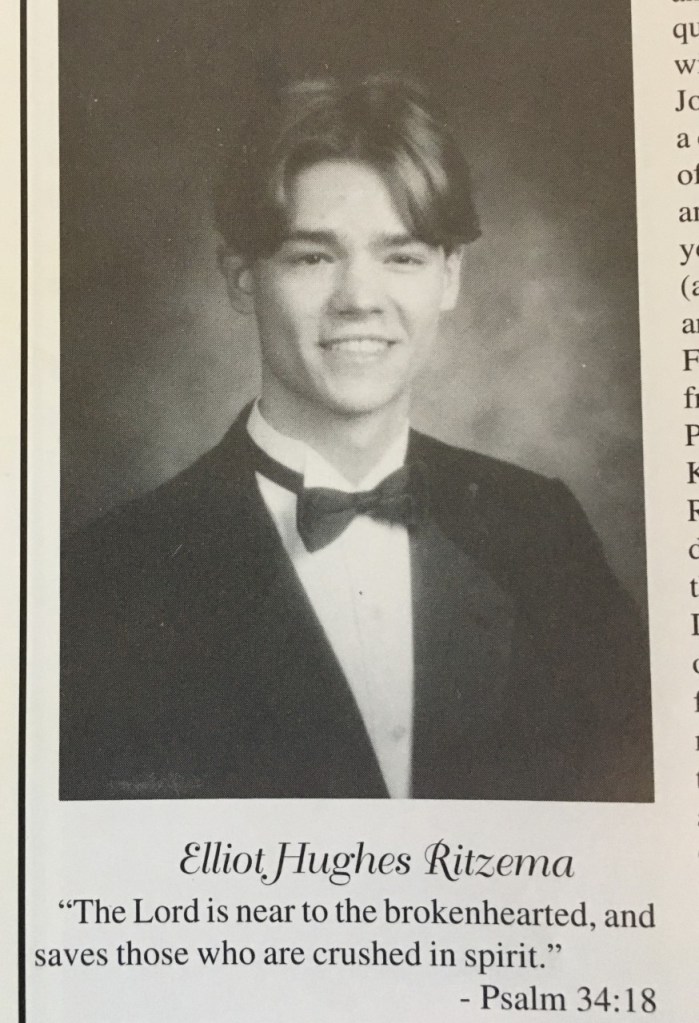
Beyond these cries, I found it hard to pray much, so I started to rely on the Psalms. In my senior year of high school, I put Psalm 34:18 (“The Lord is near to the brokenhearted and saves those who are crushed in spirit”) under my yearbook photo, which is about as emo a thing you can do in a small Christian school. But the truth is that, aside from a few verses, I never really embraced the Psalms as my own prayers in spite of a lifetime of Bible reading. They were too foreign to my experience for me to really “own” them. But that changed last summer and fall.
That’s right, ladies of my high school, I am Brooding and Serious
I also used the prayers of others to help me when I couldn’t pray my own words. In the very early days after the Great Terrible Thing, I was on my way to a meeting with my wife. I was still hopeful that maybe things could turn around, though I was not at all confident in my ability to affect the situation. On the way, I stopped at a park to try and calm my nerves. With my mind unable to formulate much of anything, I prayed the Jesus Prayer over and over: “Lord Jesus Christ, Son of the living God, have mercy on me, a sinner.” There have been many other times like that, where I have not known what to pray besides the Psalms, short repetitive prayers, and “wordless groans” (Rom 8:26).
Without Love, I Don’t Exist
Also significant during the past year have been the prayers others have prayed for me. In the weeks after the Great Terrible Thing, I wrestled with how to talk about it with people. I didn’t want to wait for people to contact me, since in times like these so many people just don’t know what to say. So I lined up conversation after conversation with friends and family, telling and retelling the story like I was rehearsing for a play, answering questions, praying, crying. To preserve my energy, and to escape innocent questioning regarding my wife’s whereabouts, for months I spent my day-to-day life only with those friends who knew what had happened. We have all experienced a shrinking of our social circles during COVID, but mine shrank long before that. A couple of these friends gave me an open invitation to come by their house any night and drink bourbon with them. I have taken them up on it more times than I can count. It was good to process what was going on, but it was also good to talk about something, anything, else and feel normal for a little bit.
I also had to navigate church. Leaving church altogether, while it might have saved me from some awkwardness in the short term, I didn’t see as an option. These were my people, and I was committed to them. I couldn’t handle the full Sunday morning experience for a long while, though. Walking into the church building was an anxiety-inducing experience: What would people say? What would they ask? During the late summer and fall I would sometimes skip, and other times show up late, sit in the foyer, and watch the service through an open door. Sometimes, someone who knew what had happened would come sit with me. Other times I would be alone, but occasionally someone would pass by and give me a hug or say “I’m glad you’re here,” or “I’ve been praying for you,” or simply “This sucks.” After many months, I finally felt comfortable enough to sit with a couple from my small group and participate in the service again.
Church was further complicated by the fact that, at the time, I was the chair of the leadership team (what might be called the elder board at another church). At the beginning of our August meeting, I shared what had happened and offered to resign if the rest of the team thought it was best. A couple of them who I’d already spoken with had tears in their eyes as I began to share, and when I was done they didn’t hesitate to affirm that they saw no reason for me to step down. Serving out the remainder of my term, which ended in February, was a welcome distraction as the divorce proceeded and the outward effects of the life we’d built together vanished all too easily. In this and so many other ways, my church family met my shame and embarrassment with love, grace, and wisdom.
I have been carried by others for the last year, and am only here now because of them. I have learned time and time again, after all that has happened, that I am loved and accepted by God and by my small tribe of people, and that is enough. While I am growing again in my eagerness to make new friends and to listen to people who are not currently in my orbit (hampered, unfortunately, by COVID), my sense of identity is anchored in the love of God and the love of my people.
Falling Down Without Regrets
Rich Mullins has long been a favorite musician of mine, and even now, over twenty years after his death, I return to his music often. I think it is because so many of his songs are packed with raw, honest faith in the teeth of disappointment and longing (for example, no matter how many times I’ve listened to it, it’s hard for me to get through this one—demo version only, please—without tearing up). A number of them were influenced by a broken engagement. A few lines from the chorus from one of these, “The River,” have stayed with me these last months:
And I may lose every dream
I dreamt that I could carry with me
But I have failed so many times
And You’ve never let me fall down alone.
I’m now forty-one years old. By this time of my life, I had dreamed that I would be married with children, and that dream has turned out to be one that I could not carry with me. I didn’t lose that dream slowly over many years; I lost it in the six months between last July and the day in January when I got a call from my wife’s lawyer’s office saying that the court had processed the final paperwork. But even in this year of failure and dream-loss, I can still say I have not fallen down alone.
More than once last fall a friend commented to me, “I don’t know how you’re still walking around.” At the time, I didn’t know how to respond. I was just muddling through, and didn’t really know either. But it has now been a year since the Great Terrible Thing, and I think I have an idea now.
The vague answer, which is no less true for being vague, is “the grace of God.” But more specifically, this grace has been mediated to me through commitments. When I was a child I committed to faith in Jesus, and as an adult I committed to a community in which to live out that faith, to work that I find useful, to a place—and, yes, to a marriage. All of those commitments have been God’s means of communicating grace to me. When one of those commitments ended, as gut-wrenching as it has been, my life was kept from spinning out of control by my other commitments. Making these kinds of commitments is scary because there is no guarantee that they will work out well: marriages break down, jobs are lost, church communities don’t always behave in a Christlike manner. But I still believe that it’s important to enter into these commitments—making the wisest decision we can at the time, while not ignoring red flags—even though we don’t know what the future holds, and sticking by them. Making commitments and sticking by them has not saved me from rejection, but it has saved me from regret. I don’t regret making any of them—not even the marriage.
The commitments I’ve made have shaped my identity. Losing a marriage has felt like part of me has been lost, because it has. I am still fumbling toward finding out who I am without it, without her, without us. It has only been in the past month or so that I’ve been able to go beyond putting one foot in front of the other and lift my eyes toward the future (maybe it would have happened sooner without a global pandemic, but who knows?). Yet my other commitments have preserved enough of my sense of identity that I have not felt completely adrift (not for long, anyway).
Make Commitments, Resist Despair
I hesitate to give anyone advice on how to work through their own experiences of trauma and loss. I admit that if my personal history or brain chemistry were different, things could have gone a lot worse. But I can point to two things that I hope will help. First, you may not have to endure a Great Terrible Thing—a divorce, a diagnosis, a death—where your life changes in an instant. But you will most assuredly have to endure small terrible things. There is no way around suffering in this life; the only way is to go through it. So do what you can, now, to make commitments that will help you weather it. Yes, some of those commitments will fail you. At some point you’ll be disappointed at best or traumatized at worst. But in spite of the risks, I don’t know of a better way to navigate life than by boldly committing yourself to God, to people, to place, and to work.
Second, resist despair as much as you can. Grieve, but do not grieve without hope (1 Thess 4:13). You might have moments, days, weeks, even months where you’re just stuck in despair and can’t get out, but please, please don’t resign yourself to it. Even when your despair-soaked mind wants to give up, I hope that you can say to yourself, “This is not normal. This is not permanent.” Hang on to hope however you can, and “do not move from the hope held out in the gospel” (Col 1:23). In moments of despair you will lack the energy or awareness to preach the gospel to yourself, but I hope and pray you have someone in your life who can preach—and embody—the gospel to you.
Despair can feel like it will last forever, but it passes. My overtaxed brain couldn’t have gotten enough thoughts together to write all this down even at the beginning of June, but here I’ve written an essay that is probably too long. I still have moments and days where I hear the siren song of despair, but the volume has decreased over time. It has been replaced by a growing sense of gratitude for the mere fact of existence. I am not where I dreamed I would be. I have lost so much. But having lost so much, the fact that I get to experience anything feels like a gift. In spite of everything, it is a blessing to be alive—to be back from the dead and walking around in God’s good world.






 Elliot Ritzema