 The problem that Scot McKnight’s The King Jesus Gospel is intended to address is that the way evangelical Christians preach the gospel doesn’t often lead to lives characterized by discipleship. Evangelical evangelism has been geared toward getting people to make decisions (“accepting Jesus into your heart”), but “we lose at least 50 percent of those who make decisions” (20, italics in original). People become “saved,” but they don’t become disciples of Jesus. Clearly, the evangelical understanding of gospel and evangelism is not leading to changed lives as often as it should.
After calling attention to this problem, McKnight asks, “What is the gospel?” He turns to the New Testament–Paul, Jesus, and Peter–and concludes that the gospel “is declaring the story of Israel as resolved in the Story of Jesus” (79). He argues that Christianity left behind the emphasis on story in favor of an emphasis on salvation during the Reformation; the story-formed Creeds were de-emphasized in favor of confessions (McKnight mentions in particular the Augsburg Confession and the Genevan Confession). He takes pains to point out that the Reformers can’t be blamed for the “salvation culture” that we’ve ended up with. However, the seeds of a salvation culture were planted during the Reformation’s shift from an emphasis on story (of which salvation is a part) to an emphasis on salvation (without the rest of the gospel).
McKnight closes the book with five things that are necessary to regaining a gospel culture:
1. We have to become people of the Story (153).
2. We need to immerse ourselves even more into the Story of Jesus (153).
3. We need to see how the apostles’ writings take the Story of Israel and the Story of Jesus into the next generation and into a different culture, and how this generation led all the way to our generation (155).
4. We need to counter the stories that bracket and reframe our story (157).
5. We need to embrace this story so that we are saved and can be transformed by the gospel story (158).
I would recommend this book, but not on its own. It needs other books to flesh out the full picture. It does a good job of arguing that evangelical understandings of the gospel have led to a salvation culture rather than a gospel culture, but doesn’t go into detail about what a gospel culture looks like when it is lived out (McKnight himself has written a book on that subject called One.Life: Jesus Calls, We Follow). Also, and this is not really a fault of the book, but I am concerned that as a result of McKnight’s argument there may be people who get an impression that the gospel is “either/or”: that is, it is either the story of Jesus fulfilling the story of Israel, or it is salvation. In reality, salvation is part of the gospel. McKnight makes that point (88), and I think it is very important that we do not lose sight of it.
 This is the third volume in David J.A. Clines’s monumental study of Job. The first volume came out in 1989, the second in 2006, and though the final volume was delivered to the publisher in 2008, it has finally seen the light of day here at the end of 2011. It consists of commentary on Job 38-42 (God’s response to Job, and the epilogue) in the first half of the book, and an extensive bibliography takes up the second half.
 Instead of proceeding chronologically, George W. Bush structures this memoir of his presidency around the various “decision points” from his time as president and before: his decision to quit drinking, to run for governor and then president, to put the United States on war footing after 9/11, to invade Iraq, how to deal with the financial crisis in 2008, etc.
  This is the fifth Dorothy Sayers mystery I’ve read, and it was different from the rest. In the first place, as the title indicates, it is not a straightforward third-person narrative. It is a series of documents (some letters, some written statements) regarding a man’s mysterious death. In the second place, it is the only book which Sayers co-wrote. And in the third place, it does not involve Sayers’s famous detective, Peter Wimsey.
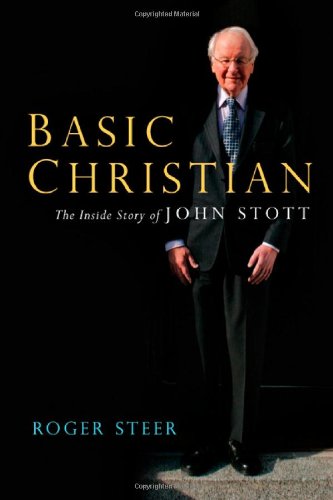 John Stott had gradually slipped off the world stage over the last few years. But when he died at the age of 90 this past July, suddenly he became an object of conversation. He was without peer as an evangelical Christian leader in Britain and the world. It is a testament to his talents as a bridge-builder that tributes to him came from all over the world and all over the spectrum of political and religious belief. There was even
  Martin, a Jesuit priest who has been called “The Official Chaplain of Colbert Nation,” is convinced that joy, humor and laughter are central to spirituality. He calls readers’ attention to humor in the Bible and in the lives of spiritual leaders throughout the centuries.
  We all know people who could best be described as “deep.” They know who they are; they live their lives with wisdom; they give good advice; they respond to life’s difficult situations in a way that most of us could only dream of.
  Popular psychology books get a bad rap. So do business books. That means Henry Cloud’s Integrity: the Courage to Meet the Demands of Reality, which fits in both categories, is not supposed to be a good book. But it is.
 I read three articles recently that put me in mind of the fairy tale “Goldilocks and the Three Bears.” In it, three bears head out for an afternoon trip to the mall or someplace while a local vagrant, Goldilocks, breaks into their home. She tastes the porridge they have left out, saying that Papa Bear’s is “too hot,” Mama Bear’s is “too cold,” and Baby Bear’s is “just right.” She does a similar thing with the bears’ three chairs and beds, finding two extremes before settling on the third one that is “just right.” Eventually the bears come back and find her in their home. She is scared straight and becomes a productive member of society.
 Elliot Ritzema