Author: Elliot

  • October 2008: Books Read

    1. Craig Allert, A High View of Scripture? I had heard good things about this book (after all, one of the blurbs on the back is from a professor at Regent, Hans Boersma), and I saw it on sale in a seminary bookstore, so I picked it up. Allert, who teaches at Trinity Western University in Langley, BC, argues in this book that evangelicals who have a “high view of scripture” rarely investigate the historical process of how the Bible came to be. Instead, they first argue from a certain view of inspiration (that is, verbal plenary) that they call the “high view of scripture.” This intimidates others into taking the same view, for fear of having a dreaded “low view of scripture.” The end result is that everybody agrees, but nobody is actually helped to make sense of the Bible. Allert insists that a high view of scripture should be “just as concerned with how the New Testament came to exist in the form we have it as with what it says.” (173)

    So how did it come to exist? The important thing for Allert is that there was nothing that was universally recognized as a New Testament “canon” for the first four hundred years of the church’s existence. This means that the early church’s sole rule for faith and life was not the Bible (which didn’t exist yet), but the teaching of the apostles as passed down by the churches. Further, people who would be called heretics (like Marcion) appealed to books that would later become part of the New Testament, so it would be difficult for us to maintain now that the Bible was the early church’s only rule for faith and life. Also, Allert makes note of a stunning amount of citations from early church fathers in which they call non-canonical writings “scripture” or “inspired.”

    Allert’s book resonated with me, because even before I read it, I was not entirely comfortable with the notion of “inerrancy.” It’s not that I think the Bible is riddled with errors. Rather, I think that the word itself has been used in different ways by so many people that it has ceased to have a definite meaning other than this one: People who use the word “inerrancy” are evangelicals and have a high view of scripture, and people who don’t are not and do not. It has become a shibboleth: a word whose primary meaning is to indicate group membership (see Judges 12:6). Rather than continuing to argue about this word, it would be better to come up with a doctrine of inspiration that deals more directly with both the history of the Bible and its text, so that people can better understand what the Bible is.

    2. A.J. Jacobs, The Year of Living Biblically: One Man’s Humble Quest to Follow the Bible as Literally as Possible. I got this book from the library, so I don’t have it in front of me to refer to, but I’ll soldier on and tell you what I remember. Jacobs is a thoroughly secular New Yorker who writes for Esquire magazine, and who is steadily making a career for himself out of writing autobiographical books. He decided to follow the commands in the Bible as literally as he could for a year. In part I suppose he did it because he knew it would just be a great book idea, and in part he did it to show how ridiculous religious fundamentalism was.

    The results are nothing if not entertaining. As a Christian, I expected a book written by a confirmed secular person about following the Bible literally to be smug and condescending. To my surprise, I found Jacobs to be a winsome and funny writer. He also has a lot more respect for religious people than I thought he would. For example, at one point he goes down to Kentucky to visit a Creation Museum. He doesn’t come away convinced that creationists are right, but he readily admits that they are not stupid. That’s all one can hope for, really.

    In the end, Jacobs is changed by his experience, and not changed at the same time. He is still an agnostic at the end of the book, but he writes that he has opened himself more to the notion of the sacred. Whether sacredness is a result of God’s presence and action in the world or just human decision, he can’t say.

    3. Gary Thomas, Sacred Marriage. The tag line at the bottom of the book’s cover says it all: “What if God designed marriage to make us holy more than to make us happy?” Thomas sets out in this book to argue, negatively, that the romantic idea of marriage that has become so prevalent in our society – the idea that the primary purpose of marriage is to provide passion, fulfillment and excitement for the individuals involved – is destructive. He also argues that the long Christian tradition of exalting celibacy as the only way to be holy is not the way to go, either. Positively, he argues that marriage is meant to teach us to be holy: to love, to respect others, to pray, to deal with our sin, to persevere, to build character, to forgive, to serve, to be aware of God’s presence, to develop our calling… He even argues that marital sexuality can provide spiritual insights and character development.

    I haven’t read a lot of books on marriage, so it is hard to compare this one to others, but I recommend this one highly. Instead of emphasizing romance in a marriage (which is not a bad thing, but can become a bad thing when romance is elevated to ultimate importance), Thomas sees marriage as a way to make us more loving, more unselfish, holier people.

  • The System is Down

    There might be a conspicuous lack of updates for the next little while. My computer, after serving me faithfully for about 2 years and 4 months, has succumbed. To what, I don’t know. I need to call a computer guy. I don’t know whether it will be fixed, or whether I will want to fix it. After all, 2 years and 4 months, in computer years, is 136. So it has already had a long life.

    If I do get a new computer, does anyone have any suggestions?

  • September 2008: Books Read

    I’m a little behind again this month, but here they are: the books I read in September.

    1. Elaine Pagels, The Gnostic Gospels. This book, published in 1979, has been discussed rather a lot for its argument about early Christianity, and so when I saw it being given away by a retiring pastor, I grabbed it. Pagels takes as her starting point the collection of texts found near Nag Hammadi, Egypt, in the 1940s, and uses them to argue that early Christianity was much more diverse than it is today. The eventual “winners,” the orthodox, suppressed the scrappy Gnostics and destroyed their sacred writings – or so it was thought, until those writings were discovered at Nag Hammadi. She argues, in short, that the rise of what would eventually be Christian orthodoxy was a power play on the part of bishops, who claimed to be the only legitimate heirs of the apostles. Christ’s bodily resurrection, monotheism, the orthodox view of martyrdom, and male-only priesthood were doctrines that emerged over time as the proto-orthodox squashed dissent. Not surprisingly, her argument didn’t convince me. I thought that she misrepresented orthodox beliefs in several areas, and that her conclusions were far from inevitable based on the data she did present. She didn’t really seem to consider the possibility that the early church actually did preserve the teachings of Jesus and his apostles. Since that is so central to its claims to legitimacy, it’s surprising that she didn’t address this argument and instead characterized its doctrines as nothing more than a grab for power.

    Nevertheless, I’m glad that I read it. It is a book that could only have been written in our postmodern times, when distrust of institutions and authority is at an all-time high. It is good to think about such arguments, to weigh whether they have validity, and to decide how to respond when they don’t.

    2. Bart Ehrman, Misquoting Jesus. This book could have been a great popular introduction to the textual criticism of the New Testament, but it isn’t. The problem is that Ehrman, who was once a Christian fundamentalist and is now an agnostic New Testament scholar and text critic, has an ax to grind. As he writes in the Introduction of this book, he once believed that each and every word of the New Testament had to be the very words of God, and as such could contain no mistakes, no matter how minor. When he discovered an apparent mistake in the text while writing a paper in graduate school, his tenuous faith was shattered. I first heard of Ehrman when I was in college, when one of his books served as a textbook for a religion class called “Intro to the Early Christian Era.” Back then, even as a college freshman, I was frustrated by how Ehrman would leap to his preferred conclusions from insufficient data. Everyone has biases, but you can’t make a good argument if you leave out inconvenient data and don’t address counter-arguments on their own terms. When I saw this book in an airport bookstore a couple of years ago, I decided that it would be good to read it and get re-acquainted with Ehrman, since if a book is in an airport bookstore (and on display at the front, no less), it is bound to be popular and affect the way people think about the Bible.

    Ehrman is a good writer, and an entertaining writer, who makes his subject interesting by telling stories. He also brings up some difficult textual issues that have all too often been glossed over by people in the church. In the end, though, I was once again frustrated in places by his leaping to unwarranted conclusions. For example, he points out that I Timothy 3:16 should read “He [Jesus] was revealed in flesh,” rather than “God was revealed in flesh,” as some scribes transmitted it. He then proceeds to imply that the Christian doctrine of Jesus’ divinity is based on doubtful passages like this one – which is simply not true, as a scholar like him ought to know. Even though this book had great potential, in the end it was marred by Ehrman’s deep desire to cast doubt on Christian origins. My guess is that the primary people who will be impacted by this book are those who already dislike the church and are predisposed to accept its conclusions without thinking critically, and those Christians who have not been taught well by their churches. I hope that this book serves as a challenge to churches to explore the issues of textual criticism and what it means for the Bible to be inspired, instead of letting those who are critical of the church set the agenda.

    In the end, I think that Ehrman is to be pitied. He went from being a Christian fundamentalist with an inadequate doctrine of scripture to being an agnostic fundamentalist who has spent nearly his entire career reacting against an inadequate doctrine of scripture. This review has been necessarily short, but if you are interested in reviews that are more in-depth, one can be found here.

    3. Jeffery L. Scheler, Is the Bible True? I picked up a pre-publication copy of this book seven years ago, and only now got around to reading it. I’m glad I did. It was written by a religion writer for U.S. News & World Report, who brings his mainstream journalist’s eye to examining whether the historical claims of the Bible are true. He looks at the Bible and history, the Bible and archaeology, the Bible and the Dead Sea Scrolls, the Bible and the Historical Jesus, and the Bible Code. (remember that?) He concludes by saying that many of the Bible’s central claims – that there is a God and he is personal, that this God became incarnate in Jesus Christ, that he died and was raised from the dead – are theological in nature and can’t be incontrovertibly historically verified. However, the Bible is not completely immune from historical scrutiny, and when it is scrutinized with regard to the historical claims that it makes, it holds up remarkably well. I’d recommend this book as a popular-level introduction to the background behind a lot of the public controversies going on about the Bible. I wonder, though, if there has been a new edition in the past seven years…

    4. Gerald May, Addiction and Grace. While I was in class at Regent last fall, the professor made a statement that stuck with me: he said that if he could include any book at the end of the Bible, as an appendix, it would be this book. Now, he wasn’t making an argument that it should seriously be considered to be added to the canon, but nevertheless his high regard for it made me sit up and take notice. Not long after that, I found it on sale at Amazon, and got myself a copy.



    I found that it was, in fact, very good. May casts the net wide when he defines addiction; he’s not just talking about alcohol, drugs and sex. Addiction, for him, is anything that has these five characteristics: tolerance, withdrawal symptoms, self-deception, loss of willpower, and distortion of attention (that is, we can become preoccupied with it). He says that virtually anything can become an addiction, but just because we have strong feelings doesn’t mean we’re addicted. The difference is that with addiction, we lose freedom. Our addictions become gods. Grace comes in because, May says, addiction can’t be defeated by the human will acting on its own. There is a lot more to be said, but it is hard to summarize his argument beyond that.

  • Christian First, American Second

    I’ve said before on this blog that I’m not a political junkie, and that I don’t follow politics all that closely. And yet, in recent months, I couldn’t help but write a few posts that dealt with political issues. I think that I owe it to the regular readers of this blog (thanks to all 5 or so of you) to say more about what is behind the statements that I make about politics.

    First, some personal history: I grew up in a Christian home in the South, and my parents tended to vote Democrat. At the same time, I went to a Christian high school, where political issues were often presented in a pro-conservative light. In part because of these different messages that I got from different influences, I registered to vote as an Independent when I turned 18. Since then, I’ve voted for a mix of Republican, Democrat and third-party candidates.

    Over time, as I’ve grown in my Christian faith, I’ve continued to think about how it should affect how I vote, and how I think Christians should conduct themselves in public life. Instead of believing that my faith aligned me completely with one political ideology, I decided that I should make decisions on political matters on a case-by-case, issue-by-issue basis. Whenever it comes time to vote, I take a good look at each candidate’s stances on various issues that are important to me as a Christian (like the environment, war, and the economy, as well as the classic personal morality issues like abortion and gay marriage). Usually, after nearly despairing, I come to a decision and vote for the person I disagree with least.

    Recently, I’ve been having a very negative reaction to associating the Christian faith closely with a particular political point of view, or even with the United States. This goes back at least to the time I was at a service one Fourth of July weekend at a megachurch in southern California in 2001, and they raised a 110-foot American flag to the ceiling at the end of the service, as the big finale. Something seemed wrong about that to me. I think that the fusing together of Christianity with the state has always been dangerous. The reason why I’m troubled by this is that I think, historically, whenever the church and state have been aligned, the church has always suffered. It always fails to preach the gospel the way that it should. The enemies of the state become the enemies of the church, and Jesus’ way of sacrificial love is not followed. In this presidential election cycle, I’ve been bothered by things like Obama’s misinterpreting the Bible in the service of the state, and also by statements like the one made by Sarah Palin that “We see America as the greatest force for good in this world.” (McCain expanded that to say America was the greatest force for good in the history of the world in the final presidential debate.) As a Christian, I think that the gospel of Jesus Christ is the greatest force for good in the world. The impact of America on the world is a mixed one, in my opinion, and I am disappointed that professed Christians like Palin and McCain have made the statements they have. I’m concerned that those who say that their nation is the greatest force for good in the history of the world may not be able to see where their country has made mistakes. Putting America first means putting the kingdom of God second. There is a word for putting the kingdom of God second to something else, and that word is “idolatry.”

    In contrast, I’ve had a positive reaction to the stances on politics articulated by such people as Scot McKnight, a New Testament scholar who teaches at North Park University in Chicago, and Greg Boyd, pastor of Woodland Hills Church in Minnesota. McKnight wrote a post on his blog, JesusCreed, a couple of years ago that argues four things: 1. Churches should educate Christians on what the Bible says and how the Church has thought about various political issues. 2. Christians should remain independent enough to provide a prophetic stance. 3. It’s irresponsible to say that we can be completely apolitical. We need to address political issues, but from an independent stance that allows us to speak prophetically. 4. (and related to 1.) Each person is responsible for where he or she stands politically. Churches should educate, not indoctrinate. If churches say that responsible Christians should only vote a certain way, they end up demonizing the opposing view and contributing to the widespread lack of respect and civility in our culture today. McKnight wrote another post more recently, on October 3 of this year, which asks the question, “Where is our hope?”

    Where is our hope? To be sure, I hope our country solves its international conflicts and I hope we resolve poverty and dissolve our educational problems and racism. But where does my hope turn when I think of war or poverty or education or racism? Does it focus on November 4? Does it gain its energy from thinking that if we get the right candidate elected our problems will be dissolved? If so, I submit that our eschatology has become empire-shaped, Constantinian, and political. And it doesn’t matter to me if it is a right-wing evangelical wringing her fingers in hope that a Republican wins, or a left-wing evangelical wringing her fingers in hope that a Democrat wins. Each has a misguided eschatology.

    Four years ago, Greg Boyd preached a sermon series at his church called “The Cross and the Sword.” Later, this turned into a book called “The Myth of a Christian Nation.” I haven’t read the book, but I have listened to the sermon series, and I resonated with what he was saying. What he was saying was that for Christians, the Kingdom of God that Jesus spoke about is central, and it must not be confused with other kingdoms. Here is a quote from Greg Boyd:

    Matthew (a Tax Collector) and Simon (a Zealot) were much farther apart in their views about political issues than (say) a Liberal Democrat and a Conservative Republican would be today. Yet, we never read a word about which view was “better” in the Gospels. And the reason is that their widely different political views are insignificant next to the one thing they are called to do as followers of Jesus: express God’s love for others the sacrificial way God expressed his love for them.

    So, if we’re thinking biblically about the kingdom of God, we have to conclude that it just doesn’t matter whether you’re a conservative “Matthew” or a liberal “Simon.” If you’re a follower of Jesus Christ, committed to building the Jesus-looking Kingdom by sacrificing for others, there’s room in the kingdom for you.

    The kingdom of God is different from the platforms preached by Republicans and Democrats, liberals and conservatives. Of course, Christians should be involved in political issues – because we are commanded to love our neighbor, we should be involved in the lives of our fellow women and men – but the kingdom of God must never be confused with the kingdoms of this world.

    This is why I don’t write a lot about politics on this blog. But when I do, I am highly critical of the longstanding tendency in American politics toward civil religion – blending the kingdom of God with other things. In spite of its long tradition, it amounts to idolatry.

  • Bozeman to Bellingham

    It is now about a month and a half since my brother and I drove my car to Washington, but now I am finally writing about our last day.

    We left Bozeman in the morning without knowing exactly where we were going to spend that night. When we first planned the trip, we were thinking about staying with friends in Coeur d’Alene, ID. But as the day went on, and we were in Coeur d’Alene by the early afternoon, we decided to just go for it and drive all the way to Bellingham.

    From Bozeman, we drove west through Butte. A friend had told me about something interesting they had in Butte: a huge statue of the Virgin Mary up on a mountain, called “Our Lady of the Rockies.” You can see it as you drive through town, but it is kind of hard to pick out at first. It is possible to go up onto the mountain and see the statue close up, but you have to pay to take a tour bus from Butte because the road is not open to everyone. So we had to settle for stopping at the Butte visitor’s center and buying a postcard. I did manage to take a couple of pictures from the car, but we were moving, and she was far away, so the pictures are blurry and badly lit. She kind of looks like the Abominable Snowman. Maybe I could sell them to the National Enquirer:

    Our next stop, after stopping for lunch at a rest area in far western Montana and noting how much colder it was becoming, was Spokane. My brother is a big Bing Crosby fan, and Bing grew up in Spokane, so we wanted to see what the city had done to commemorate its favorite son. His childhood home, it turns out, is now at the edge of the campus of Gonzaga University, on Sharp Avenue. It now functions as an alumni center. We stepped in and looked around; it looks remarkably like a regular old house, with some Bing memorabilia on the walls.

    Then we went further in to campus and visited the Crosby Student Center. This building, built in 1957, was originally the school library. Now it is a student center, and houses part of the university’s collection of “Crosbyana” – Bing memorabilia.

    Here is the “Crosbyana” room. Mary, my girlfriend and archivist extraordinaire, notes that there is way too much direct sunlight, and way too much memorabilia close to the heater. Go see this memorabilia while it lasts.

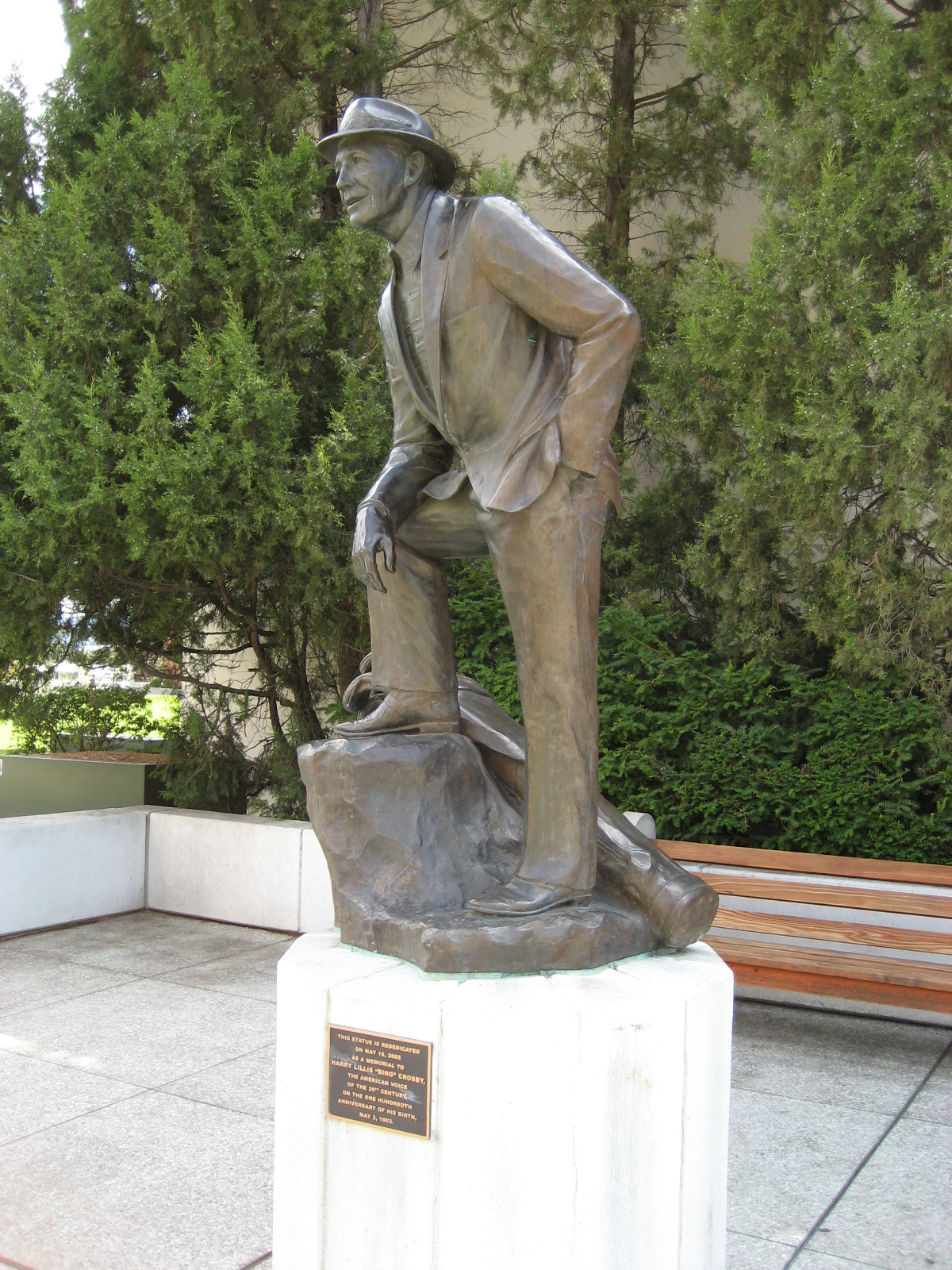
    There is a statue of Bing, the quintessential man of leisure (note the golf clubs at his feet) outside the building. He is supposed to have a pipe in his mouth, but it has been repeatedly stolen. I guess they just don’t replace it anymore.

    Before we left, we wandered over to the church and took a picture or two:

    Then we got in the car, drove across the lovely state of Washington (with a brief stop at the Columbia River Gorge), and up to Bellingham. When we got over the Snoqualmie Pass into western Washington, it began to drizzle and didn’t stop until we got up to Bellingham. Apparently, despite it being August, western Washington wanted to show off its typical weather pattern for my brother, who was just visiting for a day. On the morning after that day, we drove back down to Seattle, he flew back to Wisconsin, and our road trip was ended.

  • Laing Lectures 2008: Walter Brueggemann (3 of 3)

    This is the third in a series of three summaries of the 2008 Laing Lectures given by Walter Brueggemann (part 1 is here, and part 2 is here). Update: the audio of all three lectures is available for purchase here.

    The third in Brueggemann’s series of biblical expositions was called “Receiving Salvation and Doing Justice: From Vision to Imperative in Isaiah.” It was given on Thursday night, and the place was packed. But unlike the first lecture on Wednesday (when I had to sit in overflow seating), I showed up 45 minutes early, got in line until the doors opened, and got a pretty good seat.

    Brueggemann opened with a couple of clarifications about how he was planning to interpret Isaiah. First, he wasn’t going to get into the issue of who wrote so-called 1, 2, or 3 Isaiah. He was going to view it as a whole, the way it was received into the canon. Second, it is popular among Christians to interpret many Isaiah passages Christologically. Brueggemann wanted to avoid interpreting Isaiah with reference to Christ, and attempt to look at it in its context.

    The book of Isaiah, said Brueggemann, is a rumination on the city of Jerusalem according to the dominant ideological claims of the Jerusalem establishment. These ideological claims were vindicated by the miraculous rescue of the city from the Assyrian threat in 701 BC. Some scholars believe that Psalm 46 was written in response to the deliverance of the city. Brueggemann believes that the book of Isaiah both appeals to this Jerusalem tradition, and also calls it into question.

    Brueggemann thinks that Isaiah is really about Jerusalem. The book has an initial harshness toward the city (chapter 1), shifts to promissory tenderness (chapter 40), and ends with ultimate hope (chapters 65-66). However, he suggests that Jerusalem, in Isaiah, represents an instance of a failed urban economy. He wants to extrapolate from this particular failed economy to talk about a failed economy of our own day: the United States, when its temples of the World Trade Center and Pentagon were attacked.

    First, the book of Isaiah is about loss. Chapters 1-39 are about loss as divine judgment.

    Second, the book of Isaiah is about grief. Some scholars, Brueggemann notes, think that we ought to insert the book of Lamentations between Isaiah 39 and 40. Loss that is grieved permits newness, but loss that is denied creates dysfunction and violence. In a failed urban economy in the West, pastors need to think about loss and public grief.

    Third, the book of Isaiah is about hope – but only hope that can happen after grief has been articulated. This is what chapters 40-45 are about. Verse 9 of chapter 40 contains the first intentional theological use of the word “gospel.” 52:7 is the second.

    There is a second aspect to hope: a challenge to imperial reality. Brueggemann here refers to 41:21 and following, where the author imagines a courtroom trial where the Babylonian gods are taunted. Verse 25 begins YHWH’s testimony, where he refers to Cyrus, who would deliver his people.

    The third aspect of hope is the presence of God; 41:13-14, “do not fear, for I am with you.” These words, spoken to exiles, are the most quintessential expression of the gospel.

    The fourth dimension of hope is the location of divine assurance in human agency. If you read this Christologically, it points to Jesus. But before Jesus, you come to Cyrus. 45:1 – Cyrus is God’s anointed. This is extraordinary, in that the poet can imagine that a Gentile can become the savior of the Jews. One can imagine some Jews protesting this, and Brueggemann thinks they do, in verse 9.

    The fifth dimension of hope: there is a contest between YHWH and Babylon. It’s the poet vs. the empire. The writer makes fun of Babylonian gods who have to be carried on the backs of donkeys in chapters 46-47.

    The sixth aspect of hope: a summons to depart from the empire. This can be seen in 51:17, 52:1, 52:11, and 52:12, where, according to critical judgment, 2 Isaiah ends. It is another exodus. Brueggemann suggests that it is the task of the followers of the gospel to depart – not in a physical way, but by imagining oneself in a context where one can obey in joy. These, he says, may be ways to practice evangelical faith in an economy that has failed.

    “So they departed.” Some did, at any rate. Brueggemann calls these who returned to Jerusalem the elite, or the fanatics, who became the principal bearers of Judaism. They left, dancing to the lyrics of 2 Isaiah, but then found Jerusalem in shambles. So when you move to 3 Isaiah, you move from the indicatives of the gospel to imperatives. 3 Isaiah begins in chapter 56 with commands.

    There are five ingredients of the imperatives of 3 Isaiah that are important to us (although I only caught four):

    1. Membership. Who is the pure Jew? Who is included? Those who keep Torah.
    2. Worship. Don’t be pious while oppressing workers. Worship has to do with the practice of neighborliness.
    3. The book of Isaiah imagines a Jubilee economy, as seen in chapter 61.
    4. Engage in a large vision of what is possible.

    Brueggemann concludes by saying that he has taken the leap of taking this as a paradigmatic script for us today. It is not clear that life can be construed beyond the empire. But poets have to try, because they are poets. They never arrive, because poetry would turn into a program if they did. The book of Isaiah is an argument that the old Jerusalem must be relinquished, and the new Jerusalem must be constructed. The poets (that is, the prophets) teach us to embrace the practice of loss, and grief, and hope, and eventually, to act.

    Phil Long characterized his responses in terms of “amens” and “ahems.” He did point out, though, that his responses were based on the printed text of Brueggemann’s lecture, rather than how it was delivered. There were a few things Long mentioned where I was thinking, “Huh? Did Brueggemann talk about that?” But apparently he did in the printed text of his lecture, so I’ll pass on everything that Long mentioned: First, the amens: Long liked Brueggemann’s emphasis on Sabbath rest, on the need to re-think worship (which in many contexts has devolved into self-indulgence), on his fresh reading of Isaiah as presenting Jerusalem as a city with a deep fissure.

    Long’s “ahems” were as follows: First, there was an exegetical point; Long wasn’t sure that the fissure in the center of the Isaiah narrative is in tension with the dynastic promise to David in 2 Sam. 7. The promise foresees just such failures as we see in Isaiah. Second, Long isn’t sure why we need to leave out Christological readings. If Christological readings were good enough for Jesus, they should be good enough for us. Third, Long appeared to be not sure what Brueggemann meant when he called divine wrath a rhetorical strategy. Long’s big question at the end was one Brueggemann did not answer: Where do we go from here? How do we live out our counter-loyalty in the face of empire? But, as Brueggemann said, the poets can only point. Brueggemann responded later with a good story: he had heard a preacher preaching about the exodus not long ago. He said that the water of the Red Sea didn’t open up until Moses had already waded in. We should begin to act now, rather than waiting for a whole program to be revealed.

    Paul Williams, the second respondent, had an observation, a question, and an affirmation. The observation: we need to relinquish the idea of Christendom. We still have the idea that the West is a Christian society gone bad. Instead of trying to regain control, we should embrace exile. We also need to relinquish rank individualism and the culture of therapy, in which Christianity is seen as a means to my own self-fulfillment.

    The Question: What is the basis of our hope? How do we move from indicative to imperative? We need the prophetic imagination, but we don’t only want to follow skillful rhetoric. Hananiah was skilled at rhetoric, but Jeremiah was the true prophet. Brueggemann then responded that in Jerusalem, the hope in YHWH became situated in human institutions, which was a mistake. Martin Luther, against Catholicism, thought the church should be classed along with fallible humanity rather than divine reality. This also applies to misplaced American hope in our Constitution and other institutions.

    The Affirmation: Loved the idea of insterting Lamentations between Isaiah 39 and 40. We’re often detached and separated, but we need to make an extra effort to hear the cries of suffering around us.

  • Laing Lectures 2008: Walter Brueggemann (2 of 3)

    Just like I did last year, I’m writing summaries of this year’s Laing Lectures. Update: The audio of all three lectures is available for purchase here.

    Brueggemann’s second lecture was called “Boasting in Power or Boasting in God? Jeremiah’s Either/Or of Public Faith.” In this lecture, Brueggemann continued his concern for the common good, and began to speak in threes.

    He said that in the Old Testament, Deuteronomy organized and institutionalized the concern for the common good into a social ethic: practice hospitality to runaway slaves, no withholding wages, no injustice to immigrants, and practice gleanings (Deut 24) – that is, don’t harvest all of your field, but leave parts of it for the widow, orphan and immigrant. This commandment names three money crops – grain, oil, and grapes – and juxtaposes them with the second triad of the widow, orphan and immigrant. This command, Brueggemann says, seeks to break down separation between commodity and consumer, and to situate the economy of Israel into the neighborhood.

    But the Israelites reject this vision. Moses urges them in Deuteronomy 15 to give liberally and ungrudgingly. Brueggemann pointed out that this passes has five unlimited infinitives, and is the only place in scripture that he knows of that has that. He didn’t explain exactly what this meant, aside from saying that it meant Moses was really serious. Moses connects this command to the fact that the Israelites were themselves slaves in Egypt. He never gets tired of saying it (Deut. 15:15, 16:12, 24:18, 24:22).

    The text, Brueggemann said, makes a connection between God (YHWH) and neighbor. However, there is a powerful counter-narrative that resists this connection, because the world of Pharaoh is powerful for all of us. This counter-narrative consists in three things:

    1. An imagined nostalgia for the “good old days.” The Israelites wanted to go back to Egypt, even though they were slaves there (Numbers 14).

    2. Graded holiness. Brueggemann claims that there came to be three levels of holiness in the tabernacle, and later the temple, because of the concern of the powerful to differentiate themselves from the less powerful. He compared this to the three divisions of people on a commercial airline. This differentiation in holiness concerns health care, moral ratings and economic possibility. The resistance to the common good, Brueggemann said, has cultic, moral and economic domensions.

    3. King Solomon stands at the center of the counter-narrative. In his life, there is a fresh enthrallment with Egypt and graded holiness. Egypt itself practiced graded holiness. Solomon himself is married to Pharaoh’s daughter and clearly wants to emulate his father-in-law.

    There are, not surprisingly, three aspects of this narrative of the royal regime.

    First, it is clear that Solomon is committed to the accumulation of wealth: both money and women (700 wives and 300 concubines).

    Second, it is clear that Solomon is committed to power. He was an arms dealer, importing horses and chariots. This wasn’t connected to a particular policy; just finance. He had, in Brueggemann’s words, created a national security state.

    Third, Solomon became a great practitioner of wisdom. It may just be a personal achievement, but Brueggemann says it was probably a celebration of Solomon’s patronage of the arts that enhanced his regime. It also could be seen as an accumulation of data so that the elite would have a monopoly on knowledge. Solomon may have been celebrated for his worldly awareness, but Brueggemann compares him to the Wise Men of the Vietnam era who didn’t know what to do.

    Brueggemann then continued to elaborate on Solomon. When David hands over power to Solomon (I Kings 2), he says, “Keep the Torah and you’ll be fine.” Then he proceeds to give Solomon a hit list. It is, Brueggemann said, like something out of The Godfather. Solomon would like to kill the high priest Abiathar, but can’t, so he banishes him to his home village of Anathoth (I Kings 2:26). Solomon’s perspective came to dominate urban Israel in an act of resistance to the neighborly demands of the law given at Sinai. The Jerusalem enterprise saw itself as entitled to privilege and security. This Brueggemann explicitly links to what we now call “civil religion.” Sinai, however, continues to have its advocates: the prophets.

    Jeremiah presided over the great crisis of his day (Brueggemann compares it to 9/11), the conquering of Jerusalem in 587 BC. Interestingly, Brueggemann points out that Jeremiah was from Anathoth, the very same village to which the high priest Abiathar was banished 400 years before. The text at the center of Brueggemann’s lecture is Jeremiah 9:23-24:

    “Thus says the LORD: Do not let the wise boast in their wisdom, do not let the mighty boast in their might, do not let the wealthy boast in their wealth; but let those who boast boast in this, that they understand and know me, that I am the LORD; I act with steadfast love, justice and righteousness in the earth, for in these things I delight, says the LORD.”

    Brueggemann calls wisdom, might and wealth the “royal triad,” against which YHWH sets his own triad of steadfast love (hesed in Hebrew), justice (mishpat) and righteousness (tsedaqah). One is a triad of death, and the other is a triad of life. The village voice from Anathoth, Jeremiah, was able to trace right from Solomon Jerusalem’s way of ignoring YHWH.

    Brueggemann then made four extrapolations:

    1. Brueggemann thinks that Paul has this passage in mind in 1 Corinthians 13. Paul understands that the way of the cross is an extension of the same contest between these two triads.

    2. In the United States since Teddy Roosevelt, we have been posturing as an empire. The national security state thrives on wisdom, might and wealth. In this passage, there is a clear summons for the people of God to be in tension with the theological claims of the national security state.

    3. Being out of sync with God’s holy agency is lethal. God’s holiness forms an alliance with pain. The alliance of holiness with pain generates truthfulness. The bodily performance of truth, Brueggemann says, is up to the people of God.

    4. As Jesus says, no one can serve two masters. Brueggemann points out how interesting it is that Solomon’s name is on Jesus’ lips in Matthew 6 (and its parallel in Luke 12) when he teaches his disciples to not be anxious.

    After Brueggemann’s lecture came the two responses, which I’ll mention briefly because this post is already too long.

    Phil Long said, positively, that Brueggemann has helped us hear with fresh ears the biblical call to stop worrying and trust God, who delights in being called “Father.” He also agreed with Brueggemann’s reading of Solomon. Negatively, though, he calls into question Brueggemann’s negative construal of sacred space. Even if sacred space eventually came to act in a discriminative way, laws about sacred space were not originally intended to function that way. The initiative came from YHWH to construct the temple, and also to set some men apart as priests. And priests were allowed to enter the holy place not because they were better, but because they were consecrated and represented Israel. Further, YHWH not only commissioned the tabernacle but validated it by visiting it after its completion. Brueggemann responded that while the text did say that, he had a hermeneutic of suspicion about those texts – implying, of course, that these texts were changed by those in power to validate their power.

    Paul Williams took up Brueggemann’s call to choose between two triads, and questioned whether our choice is as free as we assume. Isn’t our problem not that we make bad choices, but that we want bad things and keep wanting to get them? We can’t get out of this dead end on our own; we need to be rescued. Brueggemann responded that when he emphasized the choice between two triads, he had in mind the OT calls to Israel to choose (Josh. 24:15). Williams affirmed Brueggemann’s thoughts on the political nature of the church. It is only as the church that we can position ourselves vis-a-vis the nationalist state, and this can only happen if Christ is our head. Boiling things down to principles of neighborliness won’t work. This is how the Bible and the flag end up on the same platform. Williams then illustrated this with the religious history of Britain since World War I, beginning with close ties between religion and nationalism, and ending with hostility toward the church because of its association with the modern project. Williams can’t help but wonder if the current situation isn’t healthier, and hopes that the church in America will separate itself from nationalism sooner rather than later.

  • Laing Lectures 2008: Walter Brueggemann (1 of 3)

    Old Testament scholar Walter Brueggemann came to Regent College to give the Laing Lectures on October 8 and 9. I graduated from Regent in the spring, but currently I don’t live too far away, so I decided to hoof it up to Vancouver to see friends and listen to some good lectures.

    The lecture series was titled, “The Church in Joyous Obedience: Biblical Expositions.” Brueggemann lectured for about 50 minutes each time. Then he was responded to by Phil Long, who teaches Old Testament at Regent, and by Paul Williams, who teaches Marketplace Theology at Regent and is trained as an economist.

    The first lecture was titled “From Exodus to Sinai: The Journey to the Common Good.” I’m going to summarize the lecture here, but be warned: I’m working from my notes rather than a transcript, so I may not present Brueggemann’s, Long’s, or Williams’ ideas quite the way they would. But I’ll do my best. Update: The audio of all three lectures is available for purchase from Regent Audio here.

    Brueggemann began by saying that the great crisis among us is the crisis of the common good. The journey that we must make is the journey out of our selfishness to the common good. He then proceeded, in the first part of his lecture, to look at one impediment to the common good in the Old Testament: Pharaoh’s Egypt.

    Pharaoh’s Egypt, Brueggemann says, is the paradigmatic example of a threat to the common good. He begins looking at Egypt in the latter portion of Genesis, when Pharaoh has a nightmare about a coming famine (chapter 41). Joseph then interprets the dream and becomes Pharaoh’s second-in-command. He proceeds to create a food monopoly that makes Pharaoh wealthy and, by Gen. 47:25, creates a nation of slaves who are grateful to be slaves. We know of Exodus deliverance, but we don’t acknowledge that slavery to begin with was a result of manipulation in the interest of power. By the beginning of Exodus, everyone is anxious: the slaves, who have submitted themselves to the state monopoly, and Pharaoh, who is scared to death of his own workforce. This anxiety, Brueggemann says, produces insanity in policy. The anxiety system of Pharaoh precluded the common good.

    But then, he goes on, suffering comes to speech. There is a cry, a prayer, declaring publicly that the social system has failed. This cry reaches the ears of YHWH, whose ears are a magnet for the cries of the abused. YHWH then sends Moses, a human agent who can dream outside the imperial reality. There is a juxtaposition between Pharaoh’s nightmare of scarcity and Moses’ dream of liberation.

    The second part of the lecture has to do with God’s abundant provision. The plagues come, the Israelites are freed, but by Exodus 16 they want to go back. They are still living under Pharaoh’s terms of anxiety. God provides them with quail and manna, and in Brueggemann’s words, “they wondered what it was, and it turned out this wonderbread did not fit their categories.” Manna, Brueggemann says, “is a show of YHWH’s inestimable generosity that stands in contrast to Pharaoh’s nightmare of anxiety about scarcity.” In fact, bread is a recurring sign in the Old Testament of divine generosity: 2 Kings 4:42-44, Isaiah 55.

    All empires, says Brueggemann, act according to the principle of scarcity. All are anxious and think they need more, whether it be manpower, bread, oil, land, etc. But the quotas of the empire can never be met. So he asks, “Why do you bust your ass to serve the empire?” Why are baptized people in the rat race? The text issues a summons away from the ideology of scarcity.

    The third part of the lecture deals with God’s act of generosity breaking the anxiety of scarcity. The 10 Commandments, Brueggemann maintains, are about an alternative grounded in generosity. Commandments 5-9, for example, tell us that all kinds of neighbors are not to be exploited as they are in Egypt. Commandment 10 condemns predatory practices that make the little guy vulnerable to the big guy. This Brueggemann related directly to the recent economic collapse. Commandment 4 encourages the Israelites to undertake community enhancement and activities that have no production value.

    Brueggemann concluded his lecture with a few points of instruction: first, people who live in anxiety and fear have no time or energy for the common good. Second, it takes an immense act of generosity to break the grip of anxiety. Third, those who receive generosity can care about their neighbors. You can’t just preach to those wrapped up in the ideology of anxiety; they must be able to receive generosity.

    He also pointed out some applications: First, Pharaoh’s kingdom of anxiety is alive and well today. Second, there is an alternative to the kingdom of scarcity. Theological education is learning the act of departure from this kingdom. Third, the journey from scarcity to abundance to neighborliness is a journey that all must take. Fourth, this journey is entrusted to the church and its allies. Brueggemann referred here to the New Testament feedings of the 5000 and 4000. With these signs, Jesus says that wherever he is, the world of scarcity is transformed into the world of overwhelming abundance. In Mark 8:14-21, the disciples didn’t understand because their hearts were hardened – just like Pharaoh. But those who receive the bread of abundance, Brueggemann says, have energy beyond themselves for the sake of the world.

    After the lecture, Phil Long was given the chance to respond. Here are just a couple of things he pointed out, or asked questions about: first, was Pharaoh’s dream just a nightmare, or was it also a providential dream? Second, how do we understand the phrase “common good”? Even the builders of the Tower of Babel were working for their understanding of the common good. Third, how do we understand “abundance”? Is it to be seen in socioeconomic terms? Long hinted that he thought a good understanding of abundance is connected to the word “Shalom” in the Old Testament. This is deeper, and can exist even in socioeconomic adversity.

    Paul Williams had more things to say, but as with Long, I wasn’t able to write them down quickly. He asked whether it was the case that the crisis we’re in is that we’ve reached an ideological dead end, with multiple competing definitions of what the common good is. We should not just appeal to a vague common good, but to a particular good, and a particular God. Williams commended Brueggemann for using the phrase “consumer militarism,” rather than “consumer sovereignty.” Brueggemann responded that he came up with the phrase because of his observation that, in the United States, you can’t maintain our level of consumption without a strong military that wrests resources away from others. Finally, Williams also expressed surprise that Brueggemann had not mentioned the notion of Jubilee from the Old Testament as a way of further defining what the “common good” was.

  • Rapid City to Bozeman

    Soon I will get around to reviewing the books that I read in September, but I don’t have the time to do that right now. Here, then, is another post about the road trip I took with my brother in August.

    The first thing we did when we woke up in Rapid City was go to Mt. Rushmore.

    Scratch that.

    The first thing we did when we woke up in Rapid City was eat a continental breakfast at the hotel. Then we plugged Mt. Rushmore into the GPS and it led us southwest of town, past dozens of tourist traps, to Mt. Rushmore — the biggest tourist trap of them all. (I don’t mean to seem disrespectful, but after all, it was conceived to increase tourism in South Dakota. If that isn’t the definition of a tourist trap, what is?) We got there early, just after 8. It turns out this was a good call, since by the time we left, about an hour later, the place was packed.

    As you can see, it was a beautiful clear day.

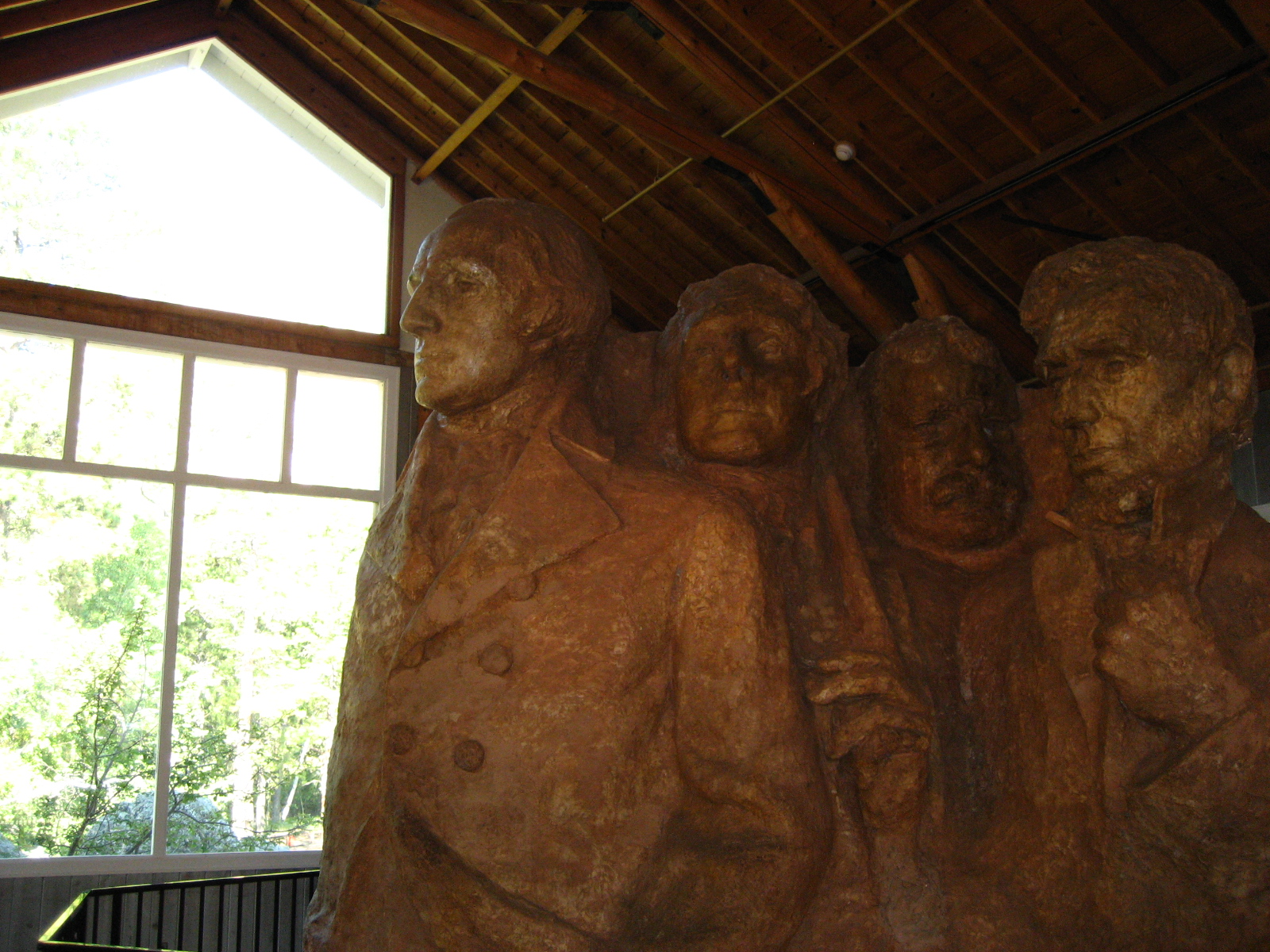
    Here is what Gutzon Borglum wanted the mountain to look like originally:

    There was a very patriotic soda machine outside the men’s restroom:

    When we were done looking around, we went back to the parking lot. We weren’t playing the license plate game on this trip, but we probably could have seen just about all the states in the parking lot. We decided not to go to the Crazy Horse monument for two reasons: 1) it is more expensive, and 2) it isn’t finished. If it were just one or the other, we might have gone. But the double whammy of expensive incompleteness kept us away.

    So we drove back through town on the way to the highway. Rapid City does something that I, in my historically nerdy way, think is really cool. They have (almost) life-sized statues of U.S. presidents on the street corners downtown. We saw many of them driving by, but we just had to stop and take pictures of a couple. Here is Teddy in his Rough Riders uniform:

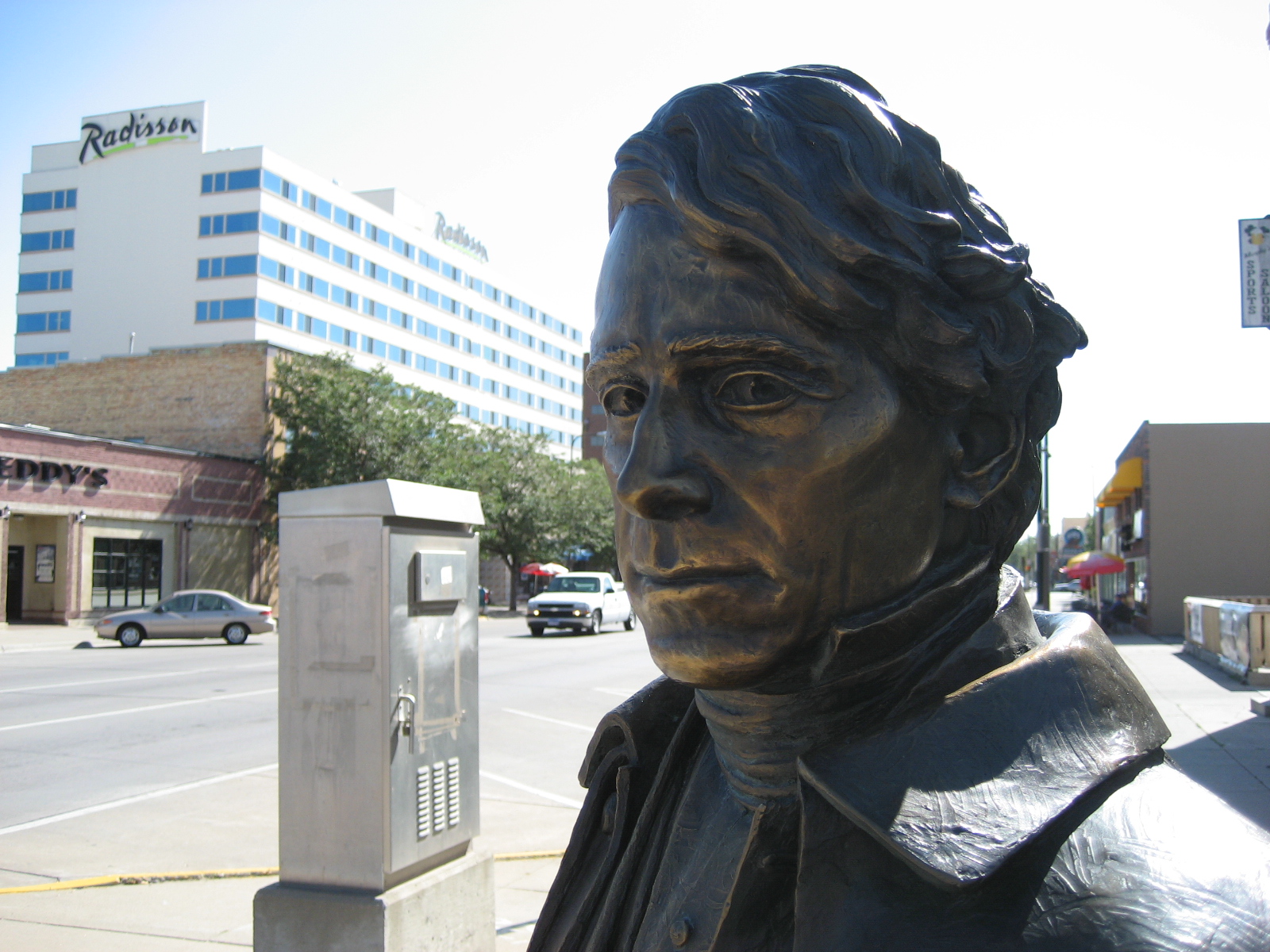
    Across the street, Franklin Pierce was hanging out (across the street you can see my car parked in front of Teddy’s Bar):

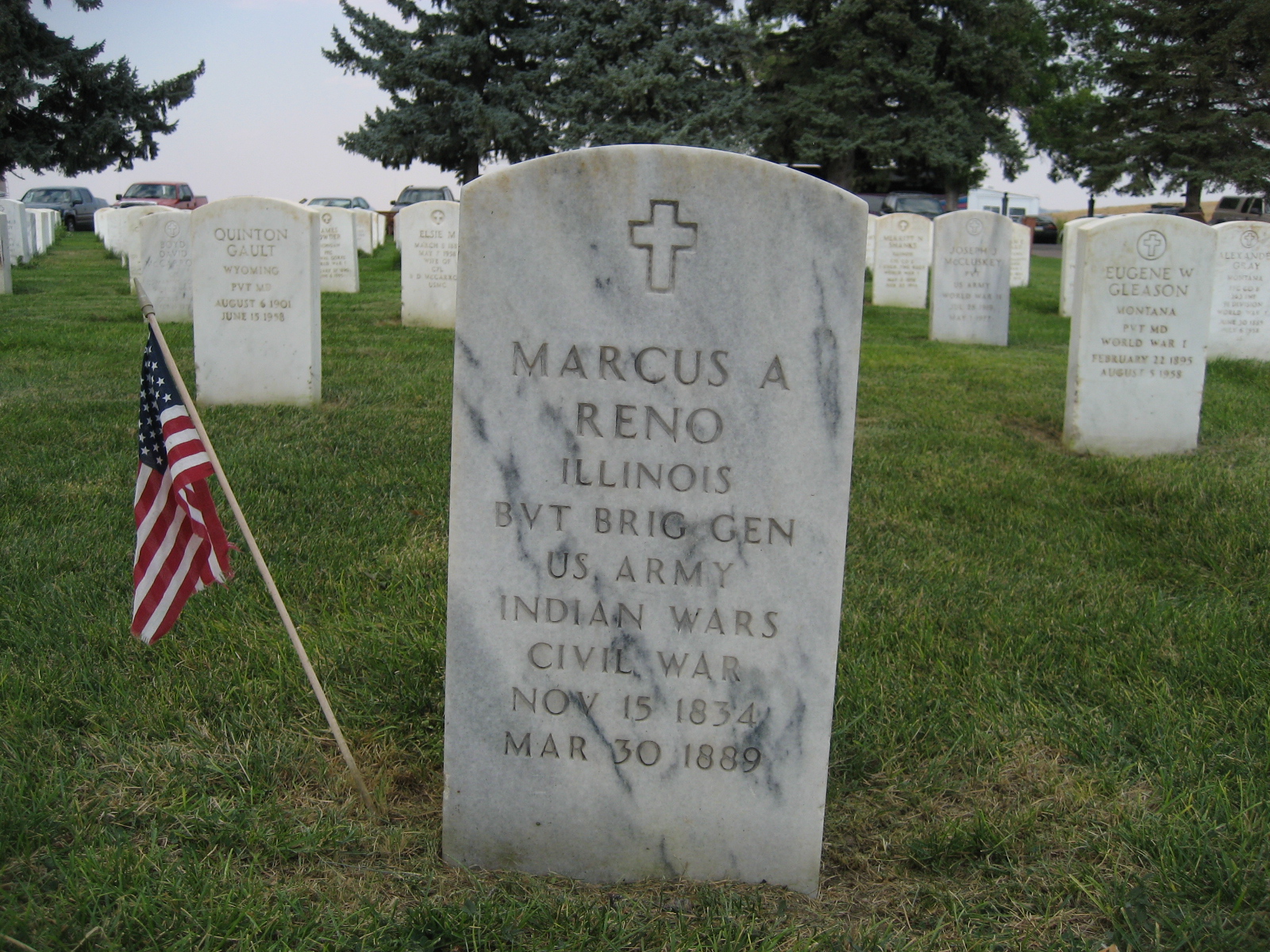
    After that stop, we left Rapid City and headed through the northeast corner of Wyoming and into Montana. In Montana, we stopped at the Little Bighorn National Battlefield. Here is where Custer’s second in command is buried:

    The black tombstone in this picture marks where Custer fell and was originally buried:

    Here is the memorial to the U.S. soldiers. Most of them are buried under this memorial, but the bodies of the officers were taken elsewhere. Custer, for example, is buried at West Point.

    Here is part of the native memorial, which is not far away from the other one:

    And finally, here is a view from Last Stand Hill toward the visitors’ center:

    After stopping at the battlefield, we drove through Billings to Bozeman, where we spent the night.

  • Economic Meltdown Song

    Apparently, humor can be found in just about anything.

    (Thanks to Ryan H. for telling me about these guys. Oddly enough, I had never heard about them until a month ago, even though they grew up in Buies Creek and now live in Lillington, which are both very close to Fayetteville, where I grew up.)