Author: Elliot

  • Adam and Eve—Just My Archetype (A Review)

    The work of Old Testament scholar John Walton has been on my radar at least since 2012, when I read his book The Lost World of Genesis One (I reviewed it on the blog here). The central insight of that book—that the creation account of Genesis 1 has to do with functional origins, not material origins—made sense of the text in its ancient context.  At about the same time, I went up to Regent College in Vancouver to see Walton deliver a talk called “Genesis Through Ancient Eyes.” In this talk, he presented much of the same material that he had presented in The Lost World of Genesis One, as well as indicated some of his thoughts on Genesis 2 and 3 that had not yet been published. A version of the talk that he gave elsewhere is embedded below (if for some reason the embedded video doesn’t work, just search for “Genesis Through Ancient Eyes” and you should be able to find it somewhere online).

    Last year, my small group at church went through Walton’s class “Origins of Genesis 1–3” from Logos Mobile Ed. Again, he presented much of the material that was in his book about Genesis 1 and indicated some of the arguments he would be making in a forthcoming book about Genesis 2 and 3.

    That book, The Lost World of Adam and Eve, came out in March of this year. It is laid out in much the same way as The Lost World of Genesis One was: each chapter title is a proposition that he argues in that chapter, and so a bird’s-eye view of his argument can be gained by looking at the table of contents. The first five chapters recap the argument from the earlier book, and he begins breaking new ground with proposition 6. Not surprisingly, he argues that Genesis 2 and 3 likewise deal with functional rather than material origins. Adam and Eve are presented as archetypes: “they embody all people, and the affirmations of the forming accounts are affirmations made of everyone, not uniquely of them” (199). While Walton believes that Adam and Eve are historical persons, he argues that their significance for the biblical text is found in their status as archetypes, not necessarily in their being the first humans or the ancestors of all humans.

    This is where things get tricky, since some New Testament passages appear to treat Adam and Eve as historical persons—forebears who sinned and passed on their propensity to sin to their offspring (e.g., Rom 5:12–21 and 1 Cor 15:21–22, 45–49). When addressing these passages, Walton writes that “our status as being ‘in Adam’ treats Adam as an archetype, though still a historical figure” (93). Again, he writes later that “the historicity of Adam finds its primary significance in the discussion of the origins of sin rather than in the origins of humanity” (203, italics original).

    I appreciate Walton’s respect for the biblical text and desire to base his arguments on exegesis. I think it is very likely that Genesis 2 and 3, like Genesis 1, have to do with functional origins rather than material origins, and I can see how Adam and Eve can be understood as archetypes. I think Walton is on the right track; nevertheless, I think there is more work to do, particularly with regard to the treatment of Adam and Eve in the New Testament and with regard to the theological understanding of sin. Some of that work has been done with regard to the New Testament by N. T. Wright’s contribution to this book; theologically, Walton briefly speaks about the difference between Augustine’s and Irenaeus’s conceptions of sin.  I would like to see fuller treatments of both of those angles in light of Walton’s arguments. Maybe Walton, as an Old Testament scholar, has done all he can do, and this work should be taken up and continued by New Testament scholars and theologians. (The only existing theological treatment that I can think of that reminds me of Walton’s is the chapter on the fall of man in C. S. Lewis’s The Problem of Pain, though I’m sure Lewis would hesitate to call himself a theologian).

    But even if some of the propositions in this book that touch on the New Testament and theology end up being revised in the future, I applaud Walton for what he has done: take an honest, irenic look at Genesis 2–3 in the light of what we now know about the ancient world and attempt to discern what it might mean for us today.

    Note: Thanks to InterVarsity Press for a review copy of this book. I was not asked to give a positive review.

  • Making Habits Easier to Break (and Make): A Review

    In recent years, Gretchen Rubin has turned herself into something of a happiness guru. She has written two books called The Happiness Project and Happier at Home, and even hosts a podcast called “Happier with Gretchen Rubin.” As part of her investigations into happiness, she has put some thought into how people form, change, and maintain habits. This has led to her book Better Than Before: Mastering the Habits of Our Everyday Lives.

    In the book, Rubin does not generally advocate particular habits to begin or end. She also doesn’t get into the neuroscience of habit formation (unlike Charles Duhigg’s book The Power of Habit). This book is all about changing behavior through specific techniques. She first advocates knowing yourself, and classifies people according to a fourfold typology based on how they respond to expectations. People are:

    • Upholders, who respond readily to both outer expectations and inner expectations;
    • Questioners, who question all expectations, and will meet an expectation only if they believe it’s justified;
    • Obligers, who respond readily to outer expectations but struggle to meet inner expectations; and
    • Rebels, who resist all expectations, outer and inner alike (16).

    Rubin goes on in the rest of the book to talk about nuts and bolts. She begins with what she calls the “Pillars of Habits” (Monitoring, Foundation, Scheduling, and Accountability), then proceeds to the best time to begin a new habit, strategies to cement habits by making them as enjoyable as possible, and ways to foster habits by seeing ourselves in the context of other people, and not just as individuals.

    I found this book to be helpful. In her fourfold typology, I tend to be an obliger, which helped me to better understand why I’ve been successful or unsuccessful at forming habits in the past and made me think about how best to form habits in the future. I am extremely good at meeting deadlines in situations where I will be letting someone down if I don’t meet them, and not so great at meeting self-imposed deadlines that no one knows about but me.

    While I enjoyed the book, I did come away with a mild sense of relief that I am not Rubin’s friend, since throughout the book she came across to me as slightly pushy when it comes to getting her friends to adopt a habit. Rubin also does not spend much time delving into the  “why” behind habit formation besides the pursuit of happiness, defined (as far as I can tell, not having read her earlier books) as a general sense of well-being. I think there are positives and negatives to this approach. On the positive side, she does not try to fit everyone into a single mold. She knows that people are different and form habits in different ways. On the negative side, I do think that there are good and bad habits, as well as better and worse goals to have, and Rubin’s reluctance to pay attention to the telos of human existence might make it harder for some people (especially questioners) to benefit from her advice.

    Here are a few other helpful reviews of this book:

    New York Times

    Brain Pickings

    NPR

    Note: Thanks to the publisher for a review copy of this book. I was not asked to give a positive review.

  • Words about Friends: A Review

    Wesley Hill is an assistant professor of New Testament at Trinity School in Ambridge, PA. He published a book with Eerdmans earlier this year called Paul and the TrinityBut in addition to his academic interests, he is also known for having written the book Washed and Waiting, which chronicles his journey toward identifying himself as gay.

    As a Christian who believes that the Bible and Christian tradition testify that the only legitimate expression of sex is within heterosexual marriage, however, Hill is also celibate. This book, Spiritual Friendship: Finding Love in the Church as a Celibate Gay Christian, is his attempt to revive a deeper practice of friendship within the church (he has also spent a lot of time wrestling with this subject on the blog Spiritual Friendship). As such, in spite of the subtitle, this book is really for anyone—gay, straight, single, or married—who has sensed there is something missing from friendship in the modern world but can’t put their finger on exactly what it is.

    The book comes in two parts: “one that focuses more on the cultural background, history, and theology of friendship and another that focuses more on the actual living out of friendship” (xviii). Hill writes that he is “someone who makes sense of life with the help of books” (90), and this book is a gratifying, if brief, exploration of a wide swath of literature on friendship.  Hill’s own style is enjoyable to read, and often contains word pictures that struck me with their truth. In the last chapter, he gives six practical suggestions for fostering “more committed, more sibling-like friendships” (106).

    1. Admit our need for friendship
    2. Renew the practice of friendship in the church by starting with the friendships we already have
    3. Remind ourselves that friendship flourishes best when it’s consciously practiced in community
    4. Understand the power of friendships for strengthening communities
    5. Imagine specific ways for friendships to become doorways for hospitality and the welcoming of strangers
    6. Resist the allure of mobility and choose to stay in one place with our friends

    As I mentioned above, while Hill may feel his need for friendship more intensely because he is celibate, this book is really for anyone in the church who knows they need deeper friendships but may be unsure how to go about fostering those friendships. May this book serve as an encouragement to many such people to be the kinds of friends they want to have.

    As with my previous review, my friend James read the same book and posted a nice, detailed review first.

    Note: Thanks to the publisher for a review copy of this book. I was not asked to give a positive review.

  • How to Be Mission-Oriented Elders: A Review

    When I read my friend James Matichuk’s review of Eldership and the Mission of God: Equipping Teams for Faithful Church Leadership, I wanted to get my hands on it as well. While, unlike James, I am not a pastor, I am on my church’s leadership team, and wanted to read something that would help me reflect on what it means to function faithfully in that position. I also was looking for something that I could recommend to the rest of the team, and after reading it I found that this book fits the bill.

    Eldership and the Mission of God is written by Bob Hyatt and J.R. Briggs, two pastors of missional churches who had met through their involvement in the Ecclesia Network. I had read Briggs’s previous book, Fail, and liked it. While I had not read anything Hyatt had written, I knew that he was the founding pastor of the Evergreen Community in Portland.

    The book deliberately looks at church leadership through a missional lens. Briggs and Hyatt write in the introduction:

    This book is not an exhaustive academic or theological treatise on biblical eldership. It is for church leaders and practitioners who want their faith communities to possess an ethos that is undeniably anchored in God’s mission. Good books have been written on eldership that approach the topic from a theological perspective. This book, however, seeks to do something few—if any—have done before: explore eldership through a missiological lens and discuss its practical implications within local congregations.

    They see elders as tasked with constructing “floating docks” (see the picture on the cover) that can remain anchored in God’s mission while adapting to the current cultural water levels. The book includes chapters on the nuts and bolts of eldership, such as how to select elders, what the qualifications of an elder are, and what the roles of elders are in leading the church and making decisions, but this emphasis on mission runs throughout the book.

    Briggs and Hyatt do not disqualify women as elders (they even include a chapter at the end called “What about Women Elders?” in which they make a brief case for this and include references for further exploration), so churches that do not permit women to be elders might not be able to endorse this book fully. Nevertheless, I would recommend this book to any pastor or church leader who is interested in exploring what eldership in their church would look like if it were primarily shaped by mission.

    Note: Thanks to InterVarsity Press for a review copy of this book. I was not asked to give a positive review.

  • Grandpa’s Notes in a Book about World War II

    Today is the 70th anniversary of VE Day, the day Germany surrendered and ended World War II in Europe. It has put me in a reflective mood, since my grandfather, who passed away last September, was in Europe that day. He was in Lippstadt, Germany, a few days away from turning 21 years old.

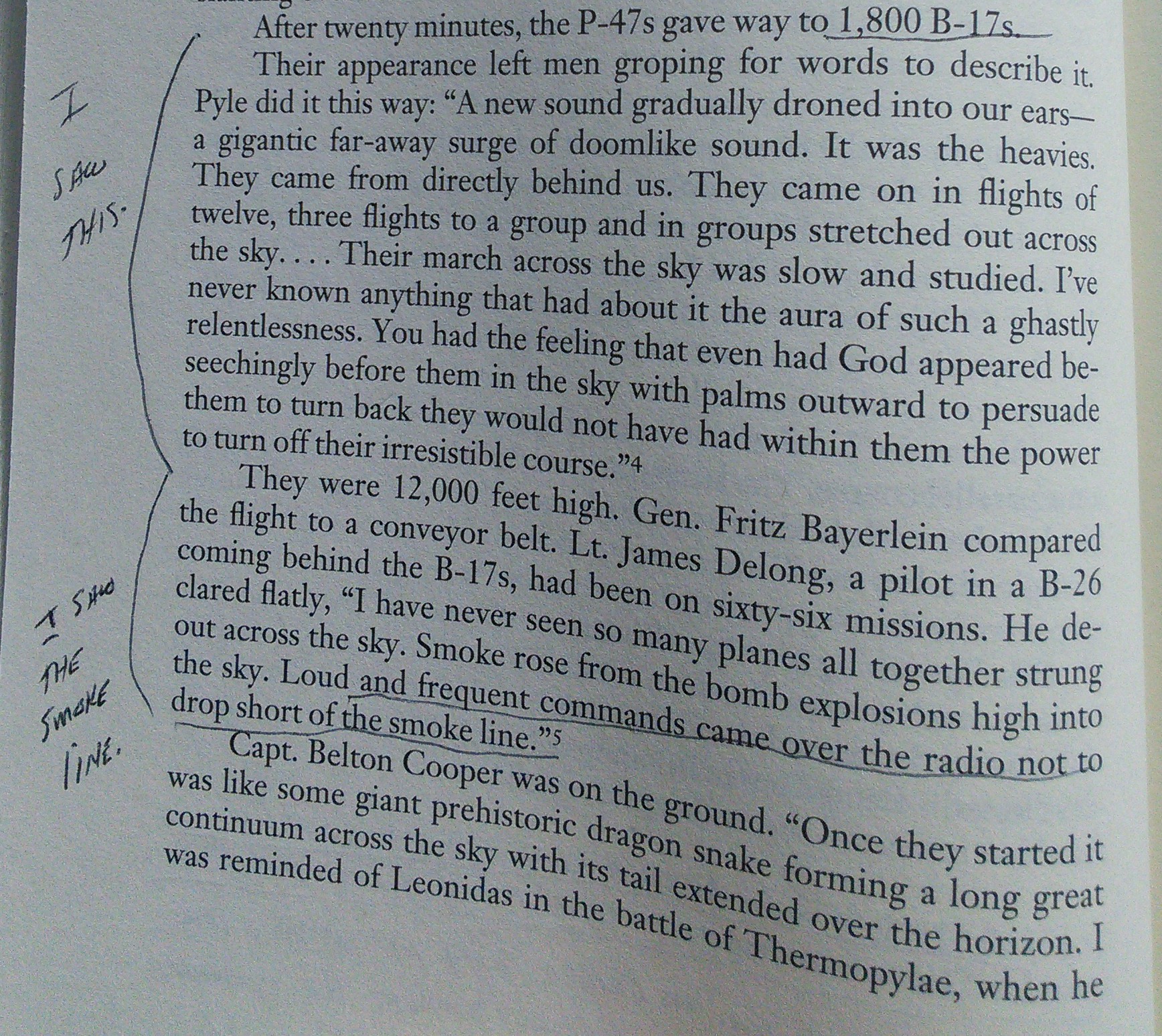
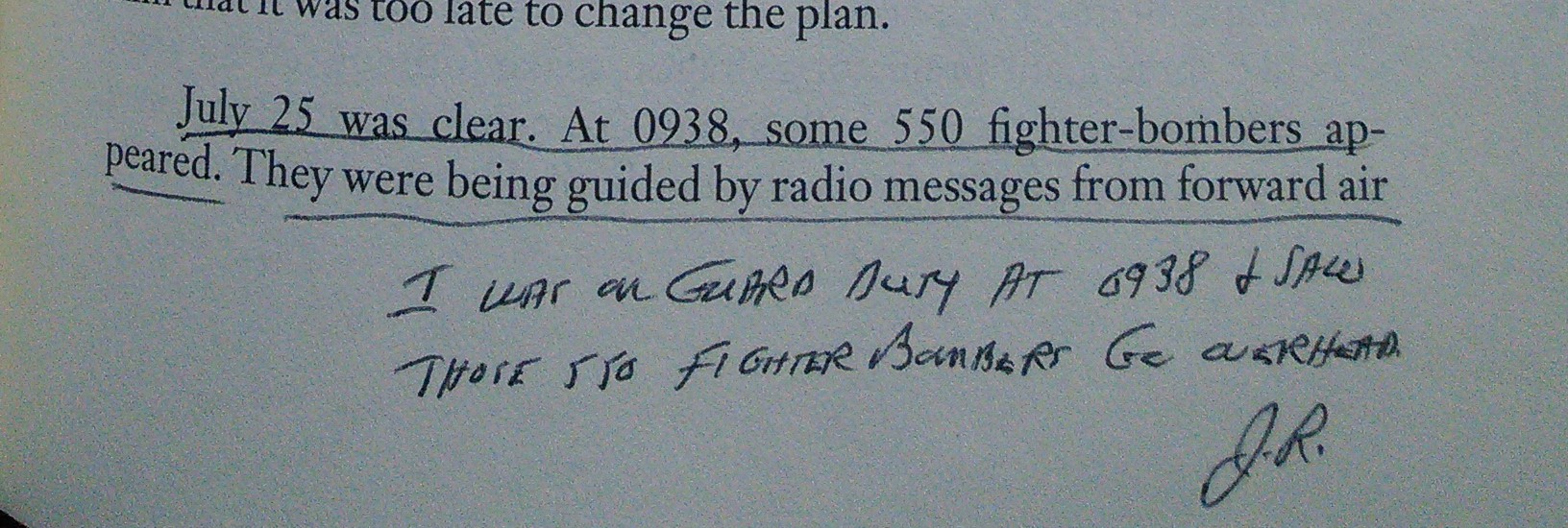
    Grandpa loved to tell stories of his time in the service during World War II, and his family loved to hear them. When I was in Grand Rapids for his memorial service, I pulled out one of his books about the war, Stephen Ambrose’s Citizen Soldiers. I found that he had occasionally underlined and written notes on events in the book that he had a personal connection to, particularly those having to do with Operation Cobra toward the end of July, 1944.

    IMG_20140906_065330

    Operation Cobra, July 25, 1944
    Operation Cobra, July 25, 1944
    Further description of Operation Cobra
    Further description of Operation Cobra
    Lesley McNair was killed July 25, 1944 near Saint-Lô, France
    Lesley McNair was killed July 25, 1944 near Saint-Lô, France

    Here is the description of Operation Cobra in my grandpa’s own words, from a booklet of reminiscences that he and my uncle Jim put together several years ago:

    I was on guard duty at our airfield as the sun came up one morning probably around the middle to the end of July 1944 when I heard the drone of bombers coming from England. There were probably about 150 planes in each separate formation. They flew over all day about 10,000 sorties in all. They were dropping bombs on the German divisions that were inland about 10 to 20 miles from the Normandy beaches. These divisions were blocking our ground forces who were trying to advance into France and unto Paris.

    I could see the smoke bombs and flares launched by Allied artillery to pinpoint where the front lines were. This enabled the Allied bombers to avoid our forces and drop their bombs on the German forces. The wind however carried some of the smoke back over into the Allied lines and caused our bombers to drop explosives on our troops. The commanding general at the front line of the battle was General McNair. A misplaced bomb killed him that day. A few weeks later I stood at General McNair’s grave in the American cemetery a short way in from the Normandy beach. A small wooden temporary cross listed his name only, not that he was the commanding general. In death he was the same as all of the soldiers he commanded.

    I’m thankful that my grandpa loved telling his story. Even from the way these notes are written, it seems to me that he wanted other people to see them. I know that, for one reason or another, many people don’t like telling their stories, especially the parts that are painful to them. My grandpa’s love for telling his own stories serves as a reminder to me that people’s stories are valuable. They help make sense of the world, help other people feel like they are not alone, and especially in my grandpa’s case, help to testify to God’s goodness.

  • Savor Every Day: A Review

    http://store.faithgateway.com/savorI picked up Shauna Niequist’s devotional Savor: Living Abundantly Where You Are, As You Are because I had read and heard her interviewed on various blogs and podcasts, and my wife is a fan of her writing. Niequist has developed a devoted following through her three previous books, Cold Tangerines, Bittersweet, and Bread & Wine. Much of this book is excerpted from those books, so those who have read them may find a lot of these devotions familiar.

    The hardcover is an attractive book, with a cloth cover, blue-edged pages, and a white ribbon marker. Each day’s reading is on a single page. It begins with a title and Bible verse, then two or three paragraphs of reflections on a subject related to that verse, and ends with a few reflection questions. While most of the people I know who are Shauna Niequist fans are women, I don’t think that she intentionally limits her audience. These are reflections on being human rather than being a woman. One of Niequist’s passions is hosting, and like Bread & Wine, there are recipes sprinkled throughout this book.

    As for the content, each devotion invites the reader into Niequist’s heart to ponder something about the human experience: forgiveness, busyness, marriage, singleness, creativity, friendship, faith. I have found them to be a helpful opportunity to pause, reflect, and pray in the midst of a busy and hectic life. However, it does seem that the format limits the content somewhat. Two or three paragraphs does not seem like enough time; it often feels like Niequist is really about to get going when the day’s reading is over. Those who are reading Savor every day may want to supplement it with something else, maybe by reading the larger section from which the day’s Bible verse is taken.

    Note: Thanks to the publisher for a review copy of this book. I was not asked to give a positive review.

  • A Case for Christian Nonviolence: A Review

    How should Christians respond to injustice and evil? Is it acceptable to use violence? How do you define violence, anyway? The debate over how to answer these and other questions has gone on for a very long time, with Just War theory holding the upper hand over pacifism since about the fourth century.

    Ron Sider’s contribution to this conversation has a provocative title: Nonviolent Action: What Christian Ethics Demands but Most Christians Have Never Really Tried. However, it cannot really be characterized as a contribution to the debate over whether Christians may justifiably use violence. And that is a good thing, since this debate usually spirals into dueling hypothetical situations that are ultimately unhelpful for giving guidance on how to live in the concrete situations of life.

    Rather, Sider challenges both Just War theorists and pacifists to explore the possibilities of nonviolent action. If Just War theorists argue that killing must be a last resort, he says, “after a century in which Gandhi, King, and a host of others demonstrated that nonviolent action works, how can Christians in the Just War tradition claim that the violence they justify is truly a last resort until they have invested billions and trained tens of thousands of people in a powerful, sustained testing of the possibilities of nonviolent alternatives?” (xiv) To pacifists he says that they should not just be anti-war, but pursue peace in ways that require risk and sacrifice: “How can their words have integrity unless they are ready to risk death in a massive nonviolent confrontation with the bullies and tyrants who swagger through human history?” (xiv)

    Sider spends the bulk of the book giving historical example after historical example of successful nonviolent campaigns, whether they were led by Christians or non-Christians: the aforementioned Gandhi and Martin Luther King, as well as the People Power Revolution in the Philippines, the Polish Solidarity movement, and the Liberian Mass Action for Peace. In multiplying these examples, Sider is essentially saying that if so many nonviolent campaigns have worked with a relatively small amount of committed practitioners, just think what could be accomplished if people were trained on a global scale to embrace nonviolent means of effecting change. In light of this history, Sider says, we need more study centers, training centers, and organizations for nonviolent peacekeeping.

    In all, this is a thought-provoking, challenging, and even inspiring contribution to contemporary Christian ethics. It is not likely that Sider will convince Just War theorists to change their thinking on war, but that is not his aim. Rather, his aim is to convince everyone, both pacifists and Just War theorists, that nonviolent action can work (and often better than violence) when it is backed with commitment and training.

    Note: Thanks to the publisher for a review copy of this book in exchange for an honest review.

  • Donald Miller Gets Close: A Review

    The sportswriter Red Smith once said that the writing process was easy: “You simply sit down at the typewriter, open your veins, and bleed.” Over the last dozen years, Donald Miller has shown through a series of memoirs just how far you can go by sitting down and bleeding for the benefit of your readers. The two of his previous books that I’d read, Blue Like Jazz and A Million Miles in a Thousand Years, were characterized by a blunt honesty that sometimes made me wish he’d kept his thoughts to himself, but was usually refreshing in the often too-sanitized world of Christian publishing.

    In his latest book, Scary Close: Dropping the Act and Finding True Intimacy, Miller opens up his veins on the subject of connecting with other people. Like his other books, the chapters largely stand on their own, but the relationship at the center of the book is with his fiancée, Betsy, as the two of them navigate their journey toward marriage. He writes, “These are snapshots of the year I spent learning to perform less, be myself more, and overcome a complicated fear of being known.” Over the course of this year, he goes to a retreat center for therapy, learns three things about relationships while swimming in a pond, comes up with a five-category typology for manipulators, and is generally quite vulnerable in describing his rocky relational history as well as his past and present shortcomings as he journeys from anonymity to intimacy.

    In all, this is an inspiring read for those of us who desire to be connected and known, whether in romantic relationships or friendships. The one element that I thought was missing from Scary Close was the church. This will come as no surprise to those who have followed Donald Miller’s writing; he even mentions in the book how he wrote a blog about not having attended church in five years. I know he has reasons related to his own story why this is the case, and I know that many churches are toxic environments that really should be avoided for the health of everyone involved. But in spite of the many difficulties with individual churches—even ones that are largely healthy—I still believe that the church as a whole is worth fighting for and investing in, since Jesus has promised that “the gates of Hades will not overcome it.”

    Toward the end of the book, Miller emphasizes that marriage is hard work, but it’s worth it: “It’s harder for marriages to work out these days than it’s ever been. We all need more of a miracle than we used to.” I would say that being part of the church is also hard work, but worth it. There is something that gathering together as Christ’s body, the church, gives us that we miss out on if our only community is our spouse and friends—people of our own choosing. We are forced to bump up against people we would never encounter otherwise, and this encounter is important for our becoming like Jesus; we learn to love sacrificially those who are different from us. Miller writes, “My faith teaches me that the path to join souls in love must of necessity involve a crucifixion, and I think there’s a metaphor in there for marriage.” And, I would add, the church.

    Note: Thanks to the publisher for a review copy of this book.

  • Transformed Together on the Emmaus Road: A Review

    Recently the leadership team at my church read Ruth Haley Barton’s book Pursuing God’s Will Together as part of our ongoing effort to be a community that is actively discerning God’s will rather than merely leading an organization. When I saw that Barton had released a new book about spiritual transformation in community, Life Together in Christ, I thought it would be a good way to continue that journey of discovering what it means to follow Jesus with other people.

    Barton begins the book by naming a problem that many people who have been part of churches for a long time have experienced: spiritual transformation is an “overpromised and underdelivered” part of church life. It is talked about a lot, but doesn’t always happen. If you hang around church long enough, you know people who don’t seem to have grown at all spiritually. And if many of us are honest, we know that we fall into that category as well. Barton defines spiritual transformation  as “the process by which Christ is formed in us—for the glory of God, for the abundance of our own lives and for the sake of others” (11). This process takes place over time with others as we engage in practices that open us up to God. The “with others” part is essential to the process and is central to this book. In an individualistic society, we too often think that spiritual transformation is just one more thing that we can get done on our own without other people holding us back. Even if we do engage with others, it is usually on our terms and at our convenience. But it has never worked that way, and we’re setting ourselves up for disappointment if we think it is going to start now.

    Throughout the book, Barton relies on the story of the disciples encountering the resurrected Jesus on the road to Emmaus in Luke 24 as a model for spiritual transformation. Like those disciples, in Christian community we are called to walk together, welcome the stranger, listen to each other rather than try to fix each other, gather together based on shared desire, embrace the gifts we bring to community as men and women, acknowledge that suffering is part of the journey, find our story in Christ’s story, discern Christ’s presence, and become witnesses of what we have experienced. It also seems that the “Life Together” in the title is no accident; Barton frequently cites Life Together, Bonhoeffer’s classic work on Christian community (though I have a minor correction: she gets the original context of that book wrong on p. 57; it was a clandestine seminary in Germany, not a concentration camp).

    At the end of every chapter is an “On the Road Together” section that gives instructions for how to engage with some of these practices as a group reading the book together. While reading these I was especially reminded that the book was not intended to be read alone (as I was doing it). Like spiritual transformation in general, the book is intended to be engaged in community with others. I would recommend it for any church or small group that wants to investigate what spiritual transformation might look like in their lives together.

    I’ve embedded a short video from the author below, and here is a Q&A on the book.

    Note: Thanks to the publisher, InterVarsity Press, for a review copy of this book. I was not asked to give a positive review.
  • I Need to Buy a Pair of Work Sweatpants: A Review

    In the time that I have been working at Faithlife, my workspace has changed several times. When I started, I was working in a sort of glorified hallway. But there was not a lot of traffic walking by, and I was interested in getting to know my coworkers (and glad to have a job), so I didn’t mind that much.

    After about a year, I moved to the fourth floor of another building. There were some private offices, but most people worked in an open office area that is divided into four sub-areas. The longer I worked on that floor, the more people were hired, and the closer we got squished together. Eventually I reached a tipping point: there were too many visual and auditory distractions in my workspace to do excellent work on a consistent basis. I spent time reading the occasional debate or hit piece on open offices to make myself feel less alone—and also working from home more. More recently, I’ve moved into a workspace with more privacy, but I still work remotely when I really need to focus on a single task.

    So I was drawn to the book Remote: Office Not Required by Jason Fried and David Heinemeier Hansson, the founders of the Chicago-based software company 37signals. Their company has extensive experience with remote employees that work all over the United States and all over the world, and this is their argument for why more companies should jump on the remote bandwagon.

    The book is a quick and enjoyable read. It is divided into numerous chapters that are about the length of a blog post (2–3 pages each), with each chapter prefaced by a full-page graphic on the subject of that chapter. Most of the book, as I mentioned, is devoted to presenting a case for why traditional companies should allow more of their employees to work remotely, and dealing with potential pitfalls along the way. For example, in the chapter “Great remote workers are simply great workers,” they argue that the work of remote employees stands on its own better than with traditional employees. You can tell right away if a remote employee is doing good work in a timely manner, whereas with a traditional employee you are more likely to be misled by their personableness and punctuality into thinking that they are actually doing a good job.

    The authors do give a few tips in the last section of the book on how to live life as a remote worker (like building a routine and separating work and personal clothes and computing devices). In skimming through a few other reviews, I noticed that the negative reviews seemed to focus on the fact that so little space was spent in this area and so much was spent on trying to convince employers that transitioning to remote employees was a good idea. If you know that this is what the book primarily focuses on, you’re less likely to be disappointed.

    As for myself, I thought it was a fun read. I am not planning on going 100% remote anytime soon, since I do like my coworkers and enjoy being in the office . But for the times when I absolutely must focus, I’m going to stay home, change into my work sweatpants, and get after it.

    Note: Thanks to the publisher for a review copy of this book. I was not asked to give a positive review.