Category: Bible

  • Adam and Eve—Just My Archetype (A Review)

    The work of Old Testament scholar John Walton has been on my radar at least since 2012, when I read his book The Lost World of Genesis One (I reviewed it on the blog here). The central insight of that book—that the creation account of Genesis 1 has to do with functional origins, not material origins—made sense of the text in its ancient context.  At about the same time, I went up to Regent College in Vancouver to see Walton deliver a talk called “Genesis Through Ancient Eyes.” In this talk, he presented much of the same material that he had presented in The Lost World of Genesis One, as well as indicated some of his thoughts on Genesis 2 and 3 that had not yet been published. A version of the talk that he gave elsewhere is embedded below (if for some reason the embedded video doesn’t work, just search for “Genesis Through Ancient Eyes” and you should be able to find it somewhere online).

    Last year, my small group at church went through Walton’s class “Origins of Genesis 1–3” from Logos Mobile Ed. Again, he presented much of the material that was in his book about Genesis 1 and indicated some of the arguments he would be making in a forthcoming book about Genesis 2 and 3.

    That book, The Lost World of Adam and Eve, came out in March of this year. It is laid out in much the same way as The Lost World of Genesis One was: each chapter title is a proposition that he argues in that chapter, and so a bird’s-eye view of his argument can be gained by looking at the table of contents. The first five chapters recap the argument from the earlier book, and he begins breaking new ground with proposition 6. Not surprisingly, he argues that Genesis 2 and 3 likewise deal with functional rather than material origins. Adam and Eve are presented as archetypes: “they embody all people, and the affirmations of the forming accounts are affirmations made of everyone, not uniquely of them” (199). While Walton believes that Adam and Eve are historical persons, he argues that their significance for the biblical text is found in their status as archetypes, not necessarily in their being the first humans or the ancestors of all humans.

    This is where things get tricky, since some New Testament passages appear to treat Adam and Eve as historical persons—forebears who sinned and passed on their propensity to sin to their offspring (e.g., Rom 5:12–21 and 1 Cor 15:21–22, 45–49). When addressing these passages, Walton writes that “our status as being ‘in Adam’ treats Adam as an archetype, though still a historical figure” (93). Again, he writes later that “the historicity of Adam finds its primary significance in the discussion of the origins of sin rather than in the origins of humanity” (203, italics original).

    I appreciate Walton’s respect for the biblical text and desire to base his arguments on exegesis. I think it is very likely that Genesis 2 and 3, like Genesis 1, have to do with functional origins rather than material origins, and I can see how Adam and Eve can be understood as archetypes. I think Walton is on the right track; nevertheless, I think there is more work to do, particularly with regard to the treatment of Adam and Eve in the New Testament and with regard to the theological understanding of sin. Some of that work has been done with regard to the New Testament by N. T. Wright’s contribution to this book; theologically, Walton briefly speaks about the difference between Augustine’s and Irenaeus’s conceptions of sin.  I would like to see fuller treatments of both of those angles in light of Walton’s arguments. Maybe Walton, as an Old Testament scholar, has done all he can do, and this work should be taken up and continued by New Testament scholars and theologians. (The only existing theological treatment that I can think of that reminds me of Walton’s is the chapter on the fall of man in C. S. Lewis’s The Problem of Pain, though I’m sure Lewis would hesitate to call himself a theologian).

    But even if some of the propositions in this book that touch on the New Testament and theology end up being revised in the future, I applaud Walton for what he has done: take an honest, irenic look at Genesis 2–3 in the light of what we now know about the ancient world and attempt to discern what it might mean for us today.

    Note: Thanks to InterVarsity Press for a review copy of this book. I was not asked to give a positive review.

  • Princes and Gods and Kings of Egypt: A Review

    A couple of years ago, I edited a commentary on Exodus. I had never taken the time to study the book that deeply before, and I enjoyed the experience. So when I heard that there was a new volume coming out in the Kregel Exegetical Library series on Exodus, I decided to pick it up.

    A Commentary on Exodus is by Duane A. Garrett, who teaches at the Southern Baptist Theological Seminary. He has previously published Song of Songs in the Word Biblical Commentary, Proverbs, Ecclesiastes, Song of Songs and Hosea, Joel in the New American Commentary, and A Modern Grammar for Classical Hebrew.

    He states at the outset of the commentary, “I have intentionally written this work to fill certain gaps within the literature. To this end, I have been selective and have not dealt with every possible issue” (9). So, for example, he spends a good deal of space in his introduction acquainting his readers with ancient Egypt, since he sees a lack in other commentaries in that regard. He also deals with controversial issues like the date of the exodus (he argues that the data is inconclusive, though the event did happen), the genealogy of Moses, and the locations of the Reed/Red Sea and Sinai. Even when he argues for one side over the other, I thought he still presented the other side of the debate thoroughly, so readers are able to make up their own minds. I would definitely classify him as a maximalist when it comes to the relationship between the Old Testament and archaeology.

    Each section of the commentary proper comes in five parts: an introduction, a translation of the passage with textual footnotes, the structure of the passage, a verse-by-verse commentary, and a theological summary of key points. Poems also include the Hebrew text and are broken up into stanzas. For pastors using this commentary, I think the theological summary of key points would be most helpful as they think of how to apply it to their audience. For example, in a section on the vestments of the high priest (28:1–29:37), he writes that “for Israel, the ordained means of approaching God is both personal (the Aaronic priest) and institutional (the whole Tent of Meeting complex). For Christians, analogously, the one access to God is the person of Christ and the one institution ordained by God for his worship is the church, as it was built by Christ himself (Matt 16:18)” (596). Comments like these are helpful for beginning the move from exegesis to application.

    The only complaint I have about the commentary is that the table of contents and running heads are not as detailed as I would like; readers who are looking for a particular passage will have to do some flipping to find it. But when the only bad thing you can say about a book is about small formatting issues, you know it is a very good book. I am sure that, if I am called to preach on a passage in Exodus in the near future, this will be one of the first commentaries I consult.

    Note: Thanks to the publisher, Kregel, for a copy of this book in exchange for an honest review.

  • Logos 6 Has Launched!

    If you read this blog regularly (or know me personally), you know that I work at Faithlife, the makers of Logos Bible Software. Today, we announced the latest version of that software: Logos 6!

    The list of cool new features is too long for a single blog post, and it has already been laid out very well elsewhere. Here I’ll just note a few that I’m most excited about:

    1. The Ancient Literature Tool

    The Bible wasn’t written in a vacuum, and hasn’t existed in a vacuum since it was written. It both drew on other forms of ancient literature and influenced later literature. Now you can explore how the Bible relates to other ancient literature (both contemporary to its writing and later) with the Ancient Literature Tool, which is part of the passage guide. You will need to own the resources it links to for them to work, but many of them are available in Logos base packages:

    2. Bible Book Guides

    The Bible Book Guides are a quick way to get an overview of any biblical book. Before you get into the text, you often have questions about who wrote it, where they wrote it, when they wrote it, and who the original audience was. The Bible Book Guides assemble that information and get you a jump start on presenting it to others with neat background slides (I wrote the text for these slides, and our awesome designers made them look cool).

    3. Psalms Explorer

    Logos 6 has lots of new interactive media features, some of which focus on particular biblical books. Some of my other favorites are the Weights and Measures Converter, Israelite Feasts and Sacrifices, and Canon Comparison. I also have a personal connection to the Psalms Explorer: at the 1-minute mark in the video below, the narrator points out how the Psalms are labeled by theme. I labeled all of the Psalms (and Proverbs, too) several years ago as part of my work on the Preaching Themes database.

    I have been using Logos for almost ten years, since before I was an employee. It is amazing to think about how far the software has come in that time. While it is not for everyone (I often compare it to a luxury car), I have found it to be an incredibly powerful tool for my own Bible study. I am glad that for the last four-plus years I have played a small part in bringing it to the world.

    If you would like to see more videos about what Logos 6 can do, you can do that here. If you want to see what books are in Logos 6 base packages, you can do that here (and keep an eye out for a few that I edited myself!).

  • The Lost World of Genesis One: A Review

    The relationship between scientific accounts of origins and the account found in Genesis is a controversial issue, and has been at least since the Scopes Monkey Trial. Every now and then it spills into the news here in the United States, when people who are firmly entrenched on either side come in conflict with one another.

    But what if there is really no conflict at all? That’s what Old Testament scholar John Walton argues in The Lost World of Genesis One: Ancient Cosmology and the Origins Debate. The main argument of the book is that the creation account in Genesis 1 is intended to communicate functional origins, not material origins. Since Genesis 1 is not concerned with material origins, we don’t need to be concerned about whether the universe was materially created in six days, however long those days might have been. Of course, the Bible as a whole does communicate that God materially created all that exists; it’s just that this isn’t the point of Genesis 1. Instead, according to Walton, Genesis 1 communicates that God brought order and function to a non-ordered and non-functioning cosmos, that the cosmos is God’s temple, and that God’s “rest” on the seventh day consists in his taking up residence in that temple and directing its functions.

    Walton admits this can be a hard pill to swallow for most people, but he claims this is because of the cultural presuppositions we bring to the text: “Most interpreters have generally thought that Genesis 1 contains an account of material origins because that was the only sort of origins that our material culture was interested in. It wasn’t that scholars examined all the possible levels at which origins could be discussed; they presupposed the material aspect” (43).

    In the latter part of the book, Walton explores the ramifications of his proposal (which he calls the “cosmic temple inauguration” view), including showing how it stacks up against other theories of origins, like Young Earth Creationism and Old Earth Creationism, and asserting that public science education should be neutral regarding purpose (151–160).

    This book is short (172 pages, plus endnotes) and accessible to a non-specialist audience, but it is powerful. I would even go so far as to say it is a must-read for anyone who is interested in the origins debate. It doesn’t answer all the questions readers might have, but I think it goes farther than a lot of other theories toward explaining what is being communicated in Genesis 1.

  • Book Review: Invitation to Biblical Interpretation

    First there was the hermeneutical circle. Then there was the hermeneutical spiral. Now, in Invitation to Biblical Interpretation: Exploring the Hermeneutical Triad of History, Literature and Theology, Andreas J. Kostenberger and Richard D. Patterson give us the hermeneutical triad.

    The hermeneutical triad, as the subtitle indicates, consists of history, literature and theology. History and literature are at the two lower points of the triangle, and they build up to theology. This book looks at each of them in turn, but spends the most time exploring three subsets of literature: canon, genre and language. It closes with a chapter on application and proclamation, since that is the ultimate goal of interpretation.

    The greatest strengths of this book are its readability and comprehensiveness. Though it is a mammoth textbook, I found that it was not a chore to read. It is well-organized and well-written. And it truly is a one-stop shop for anyone interested in biblical interpretation. The reader learns about historical backgrounds, different schools of interpretation, literary genres, exegetical fallacies, and more. It pulls together things that I was exposed to in different classes at different times of my seminary education.

    Negatively, some of the chapters (Like 12, on discourse analysis, and 15, on biblical theology) focused inordinately on the New Testament. Since this is an invitation to biblical interpretation, not just the New Testament, there should have been more balance here. I also wish the authors had spent a little more time interacting with other hermeneutical approaches—even approaches the authors disagree with. I understand that things must be left out even in such a large book, but it was a bit frustrating that in their brief overview of the history of hermeneutics, some approaches were dismissed without much discussion.

    In spite of that, this book is well worth the time spent reading it. It gives a solid method for interpretation of the biblical text, and it is so wide-ranging that it is almost a seminary education in itself. It is very well suited as a textbook for a college or seminary level biblical hermeneutics course. It includes key words, study questions, assignments and bibliographies at the end of every chapter.

    Note: Thanks to Kregel for a review copy of this book. I was not asked to give a positive review.

  • How Do You Evaluate a Bible Translation?

    I got the most recent issue of Christianity Today a few days ago, and found that they had weighed in on the Southern Baptist Convention’s recent resolution against the updated NIV. This is the best line of CT’s response:

    The only criterion for a good translation is this: Does it accurately convey what the authors said and what the original listeners heard?

    Matthew on the hunt for ‘gender neutral’ language in the latest translation

    That is the issue, and attention to it is curiously absent in many conversations I have observed about new translations, especially the 2011 NIV and before it, the TNIV. Too many people are not asking whether a new translation accurately conveys the intent of the original. They are instead asking how a new translation compares to their current favorite translation. If the new translation doesn’t measure up, it is given the label “gender neutral” (as is the case with the SBC’s resolution, though it is not a label the NIV translation committee uses), “politically correct,” “revisionist” or even “postmodern.” I’ve actually heard all of these.

    These labels aren’t helpful. It has been especially sad for me to see pastors and other influential people refuse to evaluate a translation based on its fidelity to the original languages, and instead evaluate it based on how it compares to other translations. If people don’t like the new NIV, or any other translation, fine. They don’t have to use it. Sometimes people just like translations to use, for example, “mankind” or “man” instead of “humanity” or “person.” It sounds Bible-ish to them. There’s no problem with that. But if people are going to argue against a translation like the new NIV, they should use a different argument.

    My point is not that the new NIV is perfect. I have not read it from cover to cover, and I am not in a position to defend each and every one of its translation decisions. I don’t believe any translation is perfect, and I’m sure there are decisions made in the new NIV that I will disagree with. My point is that evaluation of a translation should be based on how it translates.

    So how can someone without access to the original languages evaluate a new translation? By listening to scholars who thoughtfully examine translations based on how they convey the original. Even if you don’t know Greek or Hebrew, you can still tell when someone is being evenhanded, and basing their evaluation on how a translation translates. I commend to you New Testament scholar Craig Blomberg’s evaluation of how the new NIV translates several texts. Readers may find some of them more convincing than others, but all of them are thoughtful, and all of them evaluate the NIV the way a translation ought to be evaluated. Here are links to the series on his blog:

    Can Commas Be That Important?

    Victims of Adultery

    Wives, Women or Deaconesses?

    Deferring to Others or Keeping Score?

    Was Jesus Ever Indignant?

    Did Philemon Practice Outreach or Inreach?

    If you are interested in what I have said earlier on the subject of Bible translations, here is a post from 2008. If you know of any other evenhanded evaluations of recent translations, feel free to let me know.

  • How I Spend My Day

    I’ve been working at Logos Bible Software since April, and ever since then people have been asking me, “What do you do there?” I do my best to explain, but I’m not always sure that my explanation makes sense. For those of you to whom I’ve explained what I do but you didn’t quite understand, and for those of you whom I have not seen recently enough for you to ask me this question, here is what I do:

    I work in the Design and Editorial department (D&E). If we were a different sort of company, I suppose this would be called the Research and Development department. We work on new features to be included in the software. When we are done with putting together those new features, we hand them over to programmers who write the code that makes the program go.

    Within D&E, people specialize in different things. Some work with tools that help people get into the biblical languages, like reverse interlinears (which have the English words of the Bible on the main line with the corresponding Greek or Hebrew underneath them). One person designs what the software looks like on the user’s computer screen.

    What I have done so far, though, is work with sets of data that are behind some of the features in the software. For example, before I started working at Logos, D&E put together the data behind a Biblical People/Places/Things tool. With Biblical People, you can type in the names of people in the Bible and instantly get a brief description of who they are, a list of where they appear in the Bible, a family tree so you can see how they are related to other biblical people, and a list of entries for them in various Bible dictionaries. Here is the Biblical People result for John the Baptist:

    John the Baptist (Biblical People)

    Biblical Places and Biblical Things operate in a similar way.

    Behind these tools is data that had to be compiled by an actual person in D&E. For the Biblical People entry on John the Baptist, someone went through the Bible and made a list of the places where John the Baptist was mentioned. He also had to be differentiated from other Johns in the Bible, so that when people go looking for information on John the Baptist they are not getting information about another John, like Peter’s father.

    I am one of those people who goes through the Bible and compiles sets of data. I didn’t work on Biblical People/Places/Things, but that’s the sort of thing that I have been doing. I won’t talk about the data that I have actually been working on, because the feature it will be a part of hasn’t been released yet. When it is, though, I’ll write a post to give some background on it.

  • I’m in the Bible

    … sort of.

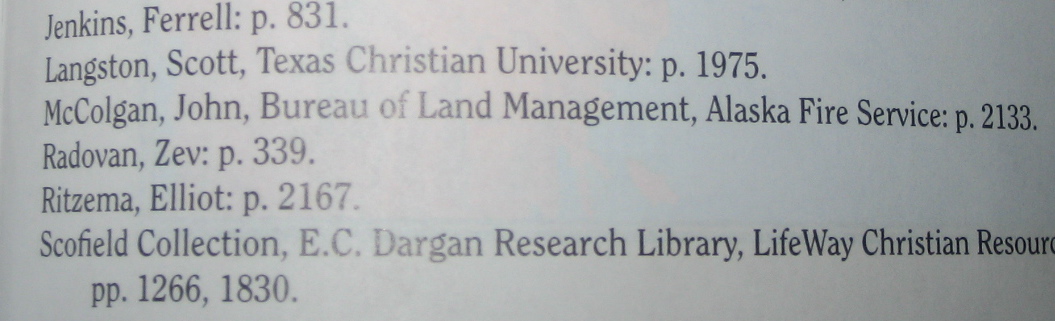
    When I went to Ephesus a couple of years ago with Mary and my dad, I took a picture of a cross-shaped baptistry in the Basilica of St. John and later posted it on my blog. Then, Steve Bond from LifeWay asked me if I would be willing to let them use it in the HCSB Study Bible that came out last month. I said yes, and I got my copy in the mail this week (Thanks, Steve!)

    Here is my photo credit:

    Here is the page my photo appears on:

    And here is the original: