Like many (maybe most) people who use social media, I have a like/hate relationship with it (“love” would be too strong, but “hate” isn’t). On the one hand, I find it useful for connecting in small ways to people I already know, and getting to know a few people I didn’t know before (although I never accept friend requests from people I don’t know on Facebook, and rarely interact with people I haven’t met in person on Twitter).
On the other hand, a whole lot of the time social media looks like everyone on it has collectively decided that the foolishness described in Proverbs 18:12 (“Fools find no pleasure in understanding but delight in airing their own opinions”) is actually wisdom after all. It seems that these days, in real life as well but especially on social media, there are only two options when you’re faced with a substantial area of disagreement with someone else:
- ignore it (this is for when you want to maintain cordial terms with someone you interact with in real life); or
- vanquish the enemy.
 In his book How to Think: A Survival Guide for a World at Odds, Alan Jacobs presents a third, seemingly forgotten way: thinking. Not burying your head in the sand, as in #1 above, and not assuming you know the solution from the beginning and using any means necessary to destroy those who stand in your way, as in #2 (what Jacobs calls “Refutation Mode”), but thinking. Using your noggin. Exerting the little grey cells, as Hercule Poirot used to say.
This is a short book, at just 157 pages. In spite of its somewhat grandiose title (but more in keeping with its more modest subtitle), this is not a book about how to think in general but more specifically about how to get past social and psychological barriers that prevent you from thinking in the first place. Because the problem is not merely that we aren’t trained to think very well, but that even if we have been trained, we don’t tend to do it. It’s hard. It doesn’t give us the rush of blood to the eyeballs that vanquishing the enemy gets us. But then, vanquishing the enemy doesn’t usually work either, since enemies almost always don’t stay vanquished for long.
Alan Jacobs tells us the circumstances in which we are most tempted not to think, so we will be on guard in just those situations. For example, when we are tempted to circle the wagons around our own group: “The person who genuinely wants to think will have to develop strategies for recognizing the subtlest of social pressures, confronting the pull of the ingroup and disgust for the outgroup” (23). And when we tend to repeat keywords, metaphors, and myths whose primary purpose is to communicate that we are part of a particular group: “In search of social belonging, and the blessed shortcuts that we can take when we’re in the presence of like-minded people, we come to rely on keywords, and then metaphors, and then myths—and at every stage habits become more deeply ingrained in us, habits that inhibit our ability to think” (105).
When it comes to advice on how to think, though, Jacobs doesn’t exactly give us a to-do list. There is a “Thinking Person’s Checklist” on page 155, but it is less a checklist and more a list of things to remind yourself of from time to time, like “4. Remember that you don’t have to respond to what everyone else is responding to in order to signal your virtue and right-mindedness,” and “Try to describe others’ positions in the language that they use, without indulging in in-other-wordsing,” and my favorite, “12. Be brave.”
This is a fun little book; Jacobs clearly derives a good deal of joy from writing, and it’s contagious. Sadly, though, I think the people who are most likely to need this book are the least likely to read it. They are still trying to vanquish the enemy, and they haven’t yet seen the shortcomings of this approach.
People who already show a degree of epistemic humility, who acknowledge that they don’t have the answers and like to seek out the best counterarguments, are most likely to read it but are the least likely to need it. You have to want to be that kind of person in the first place to derive benefit from this book. Somewhere in life, you need to be humbled. You need to come to the realization that the world is more complex than you can understand, that you can’t get everything you want by looking for the right levers to pull. It’s a good realization to have. I wish it for everyone, and myself on a daily basis most of all.
So here’s my recommendation: if you’re just starting to see the futility of “vanquish the enemy” mode, please please pick up this book.
Note: I received a review copy of this book from the publisher. I was not asked to give a positive review.
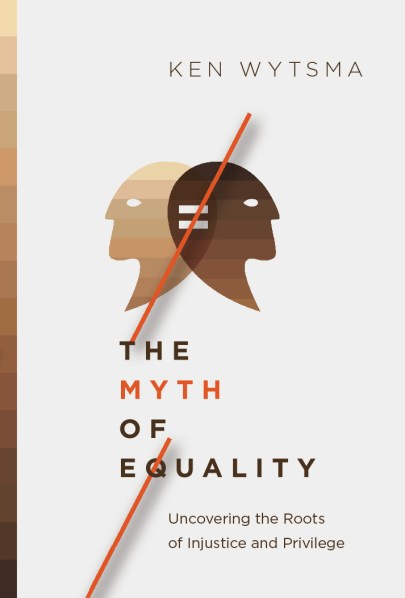 The book comes in three parts. In Part I, Wytsma briefly tells the story of race in America, from the age of exploration to modern segregation. In contrast to those who might argue that we have now largely moved on from our racist past, Wytsma maintains that “one of the central arguments of this book, as we uncover the roots of injustice and privilege, is that the effects of state-sponsored racism in America are very much present today” (75). But even now among the dominant evangelical culture, civil rights for minorities are not a priority: “A thin personal gospel, along with an oversimplified understanding of deeply entrenched racial systems (what I’ve called ‘the myth of equality’ in this book), has often allowed race to be made secondary to other foreign, domestic, and spiritual concerns” (65).
 But it is not a how-to book, and for that reason I had the hardest time getting into it. It comes in three sections: The first, called “Stigmas, Stereotypes, and Shame,” states the problem: single people are too often seen in American churches as problems, pariahs, or projects. In the second, called “How We Got Here,” Dalfonzo gives a history lesson that begins in the ’90s with the courtship craze started (or at least fueled) by Joshua Harris’s book I Kissed Dating Goodbye. In the third, called “Where Do We Go from Here?” Dalfonzo paints a picture of what churches could look like if they did really welcome single people for who they are, rather than as potential married people.
 This sort of thinking is also present in churches, although biblical qualifications for leadership have a bit to do with skills (“able to teach,” 1 Tim 3:2; 2 Tim 2:24) but much more to do with character (“above reproach,” “self-controlled,” “not quarrelsome,” “not a lover of money,” 1 Tim 3:2–3). My friend
  The main story Stevenson tells in the book is that of Walter McMillian, whom Stevenson began representing in the 1980s. McMillian, who is black, was on death row after being convicted of killing a white woman in Monroeville, Alabama—the hometown of Harper Lee, author of To Kill a Mockingbird, and the real-life model for its fictional town of Maycomb—but he didn’t do it. As Stevenson digs into the case, he finds evidence that, since it was a high-profile crime and the public was anxious for a conviction, the local authorities were more than willing to pin it on McMillian, despite the fact that witnesses saw McMillian elsewhere while the crime was being committed. During jury selection, the prosecution excluded African Americans. During the trial, the prosecution relied on two key witnesses who lied. And when the jury recommended life in prison, the presiding judge stepped in and escalated it to the death penalty. (State court judges in Alabama are elected by popular vote, and nobody who is looking to win an election wants to be seen as “soft on crime.”)
 If religion is inescapable because beliefs about ultimate reality are inescapable, then religion itself is not the problem and trying to get rid of all religion is not the solution. If you try your best to get rid of some forms of religion, other forms will pop up in their place. On the other hand, if you’re a religious person, then secularization is not the main problem. “The secular mistake has been to assume that every theology tends inevitably toward the same follies and fanaticisms, and to imagine that a truly postreligious culture is even possible, let alone desirable. The religious mistake has been to fret over the threat posed by explicitly anti-Christian forces, while ignoring or minimizing the influence that the apostles of pseudo-Christianity exercise over the American soul” (4).
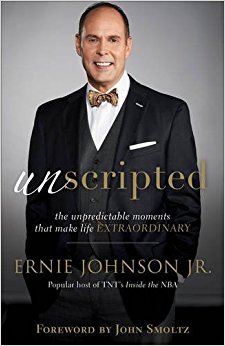 There are plenty such moments in the book, from Johnson’s childhood in Atlanta growing up as the son of the Braves’ play-by-play announcer, to his own work as a broadcaster, to his life with his wife and six kids (two biological and four adopted, including one with muscular dystrophy that keeps him in a wheelchair), to his becoming a committed Christian in the ’90s, to his fight against cancer between 2003 and 2006. There were difficult moments in all of these, but Johnson dwells on the unpredictable, joyful gifts—the blackberries—that he has received throughout his life and that have made it all worthwhile. He also tells a few “dad jokes” along the way, but rather than groaning at them, I found them to be an endearing part of his voice. They made him seem like a regular guy.
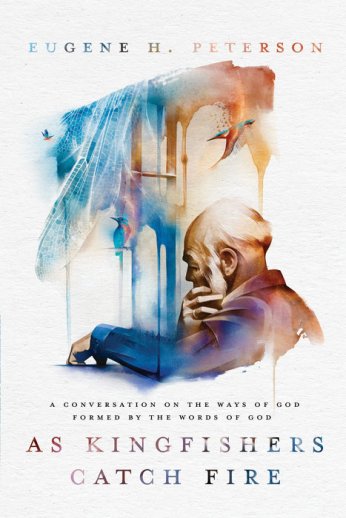 In mid-May this year, Waterbrook will publish
 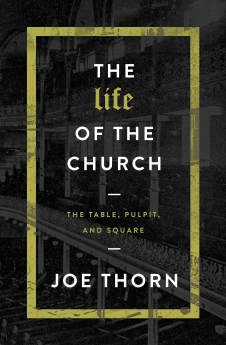 The book itself is short, almost a booklet (it’s 109 pages). It has a cool design that features the colors black and green, and Thorn himself seems like a cool guy (he has tattoos and wears shirts with epaulets). According to the book, the mission of the church is to follow Christ and make disciples in three environments: the table, pulpit, and square. The “table” is Thorn’s way of talking about a church’s inward community; “pulpit” represents the church’s worship gatherings; and “square” stands for the public square, i.e., the church’s activities in the surrounding community of participation, restoration, conversation, and multiplication.
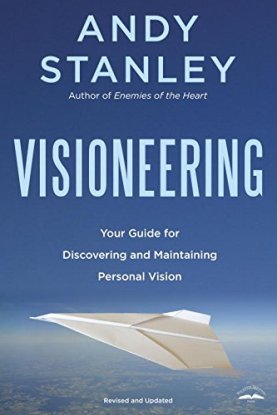 The book is loosely structured around the biblical book of Nehemiah, following Nehemiah’s transition from cupbearer to the king of Persia to governor of Judea as he sought to make the vision of rebuilding the walls of Jerusalem a reality. The “visioneering” of the title is “the course one follows to make dreams a reality. It is the process whereby ideas and convictions take on substance. … If I were to boil it down to a formula, it would look something like this: VISIONEERING = INSPIRATION + CONVICTION + ACTION + DETERMINATION + COMPLETION” (9). It is moving from what is to what can be in any area of life, big or small, in your career, family life, or church.
 Elliot Ritzema