Category: Books

  • 10 Books I’d Like to Read This Year

    In some ways I’m a desultory reader; I read what looks interesting or what is available to me at the time. I will continue to read that way this year, but I would also like to prioritize some books that I’ve been meaning to read for a while. Here is what is at the top of my reading list this year:

    1. Personal Knowledge by Michael Polanyi. It seems like this book is cited in every book written in the last 50 years that deals even a little bit with epistemology.

    2. God’s Word in Human Words by Kenton L. Sparks. I have a longstanding interest in biblical hermeneutics, and this one has looked interesting to me for a while.

    3. The Moral Vision of the New Testament by Richard Hays. Ethics is another longstanding interest of mine, and this is an important book on NT ethics.

    4. The Resurrection of the Son of God by N.T. Wright. I’ve read the first two volumes in Wright’s series “Christian Origins and the Question of God.” I’d like to read this third one before the fourth one comes out—which is supposed to happen this year.

    5. Church History by Eusebius. A classic that I’ve never read.

    6. The Idiot by Fyodor Dostoyevsky. I’ve read Crime and Punishment and The Brothers Karamazov, now it’s time to tackle this one.

    7. Pride and Prejudice by Jane Austen. I’ve never read anything by Austen. I figured this would be a good one to start with.

    8. Autobiography by G.K. Chesterton. Chesterton is one of my favorite authors, and I’ve read a couple of biographies of him, but I’ve never read his autobiography.

    9. Political Visions and Illusions: A Survey and Christian Critique of Contemporary Ideologies by Daniel Koyzis. Not a bad book to read in a major election year in the United States.

    10. What would you recommend?

  • Book Review: Jesus and the Victory of God

    I started reading this about a year ago, and finally finished it early in December. N.T. (Tom) Wright has become a book machine over the last few years, sometimes publishing three or four per year. Some of these are popular level re-workings of ideas that he has written about elsewhere, but Jesus and the Victory of God is one of his more massive and academic works. Published in 1996, it is the second volume in his “Christian Origins and the Question of God” series (the first is The New Testament and the People of God, the third is The Resurrection of the Son of God, and the fourth, Paul and the Faithfulness of God, is forthcoming).

    The underlying argument of the book is that the “historical Jesus” and the “Jesus of faith” don’t have to be separated, as they have been in so much recent scholarship. You can do rigorous historical study and end up knowing something about how Jesus presented himself to his contemporaries. That’s not to say that the book is devotional in tone. It is academic through and through. Wright simply says that it is possible to know with some degree of confidence who Jesus believed himself to be, and who his earliest followers believed him to be. This means that he invites criticism from two sides: scholars who think that he is too confident that historical questions have answers, and believers who don’t like historical studies that seek to fit Jesus into a first-century milieu. Wright begins with an overview of Jesus studies over the past 100 or so years. Then he argues that Jesus’ public persona was that of a prophet, and the content of his proclamation was the kingdom of God. Then he looks at what Jesus believed his role was with regard to Israel, and the reasons for his crucifixion. Finally, he argues that Jesus’ final journey to Jerusalem was intended to act out symbolically YHWH’s return to Zion.

    This is a fascinating book, and well worth the time and effort spent in reading it. Those less academically minded may find especially the initial review of Jesus studies tedious, but those already familiar with the likes of Schweitzer, Wrede and Bultmann will find it interesting. There are things about this book that I love and things that I am not sure about (e.g., that some of Jesus’ parables that the Church has traditionally thought are about his second coming are really about YHWH’s return to Zion as enacted by Jesus). Wright doesn’t talk much about Jesus’ resurrection in this book, but not because he doesn’t think it is important. It is because there was too much material to deal with it in one book, so he wrote The Resurrection of the Son of God over the next seven years. I’d recommend this book to anyone seeking to gain a greater understanding of how Jesus fit into first-century Judaism, and especially those who may be either enamored or troubled by proclamations from the likes of the Jesus Seminar or Bart Ehrman.

  • 2011: The Year in Reading

    I finished 44 books in the past year. There were a lot of good ones, and a few not-so-great ones. Here (in no particular order) are 10 that I would highly recommend:

    Biblical Studies:

    1. Jesus and the Victory of God by N.T. Wright. This is a large book, and not a fast or easy read, but it repays the effort spent on it.
    2. The King Jesus Gospel by Scot McKnight. It challenges Christians to have a fuller understanding of what the gospel is (i.e., more than just salvation). I hope that it bears much fruit in the year to come.
    3. Old Testament Ethics for the People of God by Christopher J.H. Wright. If you’ve ever wondered what God’s instructions to Israel in the Old Testament have to do with Christians today, this is the book to read.

    Business and Leadership:

    4. Integrity: The Courage to Meet the Demands of Reality by Henry Cloud. An unusually strong and deep entry from the business/leadership genre.

    Cultural Studies:

    5. The Tipping Point: How Little Things Can Make a Big Difference by Malcolm Gladwell. This was my first Gladwell book, and it won’t be my last. He’s a joy to read.
    6. Gods That Fail by Vinoth Ramachandra. Idolatry is not dead. It has just disguised itself. Another book in the same vein that I read this year was Counterfeit Gods by Timothy Keller.

    History:

    7. Was America Founded as a Christian Nation? A Historical Introduction by John Fea. A historian looks at a perennial question. What he says is sometimes surprising, and it won’t completely satisfy those who want to quickly say “Yes” or “No.” I’d recommend this to every Christian with an interest in American history.

    Memoir/Biography:

    8. Evolving in Monkey Town: How a Girl Who Knew All the Answers Learned to Ask the Questions by Rachel Held Evans. Evans speaks for a lot of people in her/my generation who grew up in the church and came to decide that things in this world are not always as they seem.
    9. The Pastor: A Memoir by Eugene Peterson. Peterson has a lot of knowledge and experience when it comes to both writing and pastoring, and I’m grateful that he has chosen to reflect on his life as a pastor in written form.

    Theology:

    10. Generous Justice: How God’s Grace Makes Us Just by Timothy Keller. Christians especially ought to ask the question, “What does it mean to be just?” Keller gives answers for those who ask. Like many good biblical answers, they don’t make ideologues on the right or the left very happy.

    Honorable Mention:

    Okay, I said 10, but I got to the end and couldn’t leave off these two:

    Surprised by Oxford by Carolyn Weber
    Radical: Taking Back Your Faith from the American Dream by David Platt

  • Book Review: Beyond Bumper Sticker Ethics

    This is the second edition of Steve Wilkens’s introductory survey of ethical theories. Wilkens, who teaches at Azusa Pacific University in southern California, devotes chapters to cultural relativism, ethical egoism, utilitarianism, behaviorism, evolutionary ethics, situation ethics, Kantian ethics, virtue ethics, narrative ethics, natural law ethics and divine command theory. The chapters on evolutionary ethics and narrative ethics are new in this edition.

    The idea behind this book is that various ethical theories can be summarized in short slogans, or “bumper stickers.” Even people who do not think about ethical systems organize their lives around one or more of these slogans, and Wilkens wants to bring the theories behind the bumper stickers out into the open so they can be evaluated. Wilkens writes from a Christian perspective, and places the ethical theories in the book into three categories: first he looks at ethical theories that contradict aspects of the Christian worldview, then theories that can be compatible with, but do not require, a Christian worldview, and finally theories that begin from a Christian standpoint.

    In each chapter, Wilkens introduces the reader to an ethical theory, primarily interacting with one or two proponents of that theory. For example, in his chapter on ethical egoism he interacts with Ayn Rand, in his chapter on evolutionary ethics he interacts with E.O. Wilson, and in his chapter on narrative ethics he interacts with Stanley Hauerwas. Then he gives the positive aspects of each theory—he believes that all of them have some truth; otherwise they would not be so attractive to so many people—and potential weaknesses.

    One potential weakness of the book is that dealing with just one or two proponents of an ethical theory can lead to oversimplification. Wilkens is conscious of that risk, but believes that it is a risk that must be taken in an introductory survey (217). Also, in the chapter on natural law, Wilkens talks about the U.S. Constitution setting forth the rights to life, liberty and the pursuit of happiness. He means the Declaration of Independence (185).

    In spite of small weaknesses, I highly recommend this book. All people organize their lives according to some ethical system, and relatively few people take time to reflect on where their ethical system came from and what its implications are. After reading this book, some Christians may realize that the ethical system they have adopted is not as rooted in a Christian worldview as it ought to be. This is a book that is especially well suited as a textbook for an introductory ethics class in a Christian high school or university.

  • Book Review: The King Jesus Gospel

    The problem that Scot McKnight’s The King Jesus Gospel is intended to address is that the way evangelical Christians preach the gospel doesn’t often lead to lives characterized by discipleship. Evangelical evangelism has been geared toward getting people to make decisions (“accepting Jesus into your heart”), but “we lose at least 50 percent of those who make decisions” (20, italics in original). People become “saved,” but they don’t become disciples of Jesus. Clearly, the evangelical understanding of gospel and evangelism is not leading to changed lives as often as it should.

    After calling attention to this problem, McKnight asks, “What is the gospel?” He turns to the New Testament–Paul, Jesus, and Peter–and concludes that the gospel “is declaring the story of Israel as resolved in the Story of Jesus” (79). He argues that Christianity left behind the emphasis on story in favor of an emphasis on salvation during the Reformation; the story-formed Creeds were de-emphasized in favor of confessions (McKnight mentions in particular the Augsburg Confession and the Genevan Confession). He takes pains to point out that the Reformers can’t be blamed for the “salvation culture” that we’ve ended up with. However, the seeds of a salvation culture were planted during the Reformation’s shift from an emphasis on story (of which salvation is a part) to an emphasis on salvation (without the rest of the gospel).

    McKnight closes the book with five things that are necessary to regaining a gospel culture:

    1. We have to become people of the Story (153).
    2. We need to immerse ourselves even more into the Story of Jesus (153).
    3. We need to see how the apostles’ writings take the Story of Israel and the Story of Jesus into the next generation and into a different culture, and how this generation led all the way to our generation (155).
    4. We need to counter the stories that bracket and reframe our story (157).
    5. We need to embrace this story so that we are saved and can be transformed by the gospel story (158).

    I would recommend this book, but not on its own. It needs other books to flesh out the full picture. It does a good job of arguing that evangelical understandings of the gospel have led to a salvation culture rather than a gospel culture, but doesn’t go into detail about what a gospel culture looks like when it is lived out (McKnight himself has written a book on that subject called One.Life: Jesus Calls, We Follow). Also, and this is not really a fault of the book, but I am concerned that as a result of McKnight’s argument there may be people who get an impression that the gospel is “either/or”: that is, it is either the story of Jesus fulfilling the story of Israel, or it is salvation. In reality, salvation is part of the gospel. McKnight makes that point (88), and I think it is very important that we do not lose sight of it.

  • Book Review: Job 38-42

    This is the third volume in David J.A. Clines’s monumental study of Job. The first volume came out in 1989, the second in 2006, and though the final volume was delivered to the publisher in 2008, it has finally seen the light of day here at the end of 2011. It consists of commentary on Job 38-42 (God’s response to Job, and the epilogue) in the first half of the book, and an extensive bibliography takes up the second half.

    The great strength of this commentary is its comprehensiveness. Perhaps no reader will agree with all of Clines’s interpretive decisions, but he does a good job of laying out the possibilities before he settles on a solution. While some readers might wish that Clines would “get to the point” a bit sooner (I did feel this way on occasion), the helpful aspect is that he leaves no stone unturned. Rather than offering a conclusion without justification, he interacts with other opinions. I came away with a much deeper knowledge of these five chapters, and how they have been interpreted, than I had before.

    Finally, a note about the format of the commentary. I’ve read several reviews of various volumes in the Word series that are critical of the format. For each passage (e.g, Job 38:1-40:2), there is a bibliography, the author’s translation, textual notes, notes on the form/structure/setting, verse-by-verse comment, and a final summary explanation. While the format is idiosyncratic, I think it is not so bad once you get used to it. If you are uninterested, for example, in the textual notes, they are all collected together so you can feel free to skip that section. Even if you don’t care for the format, this is still a commentary worth consulting.

  • Book Review: Decision Points

    Instead of proceeding chronologically, George W. Bush structures this memoir of his presidency around the various “decision points” from his time as president and before: his decision to quit drinking, to run for governor and then president, to put the United States on war footing after 9/11, to invade Iraq, how to deal with the financial crisis in 2008, etc.

    While he does express regret at times (e.g., that there was a “Mission Accomplished” banner on the USS Abraham Lincoln in 2003, that he flew over New Orleans after Katrina rather than landing), he is confident that the major decisions he made were the best ones to make under the circumstances. In other words, if a decision is big enough to warrant its own chapter, then it was the right decision. This confidence can sometimes be maddening, but I believe that it flows inevitably from Bush’s understanding of leadership as primarily concerned with decision-making. Since Bush believes that decision-making is what makes a good or bad leader, he is heavily invested in his major decisions being the right ones. Through much of the book, he comes across as a genuinely likable person: thoughtful, caring, empathetic, desiring to put the needs of others before his own. But when it comes to evaluating the consequences of his major decisions, it’s like he puts blinders on. He believes that major decisions are what make or break a leader, and he wants to think of himself as a good leader. Therefore, his major decisions were the right ones.

    I recommend this book, but not because I agree with every decision Bush made. In fact, I agreed with some and not others. This book is unique in that it provides a view of historic events from 2000 to 2008 that is available nowhere else, and for that reason it is valuable. Like him or not, Bush was the most powerful political figure in the world for eight years. Learning about his decisions, and the rationale behind those decisions, is important for anyone seeking to gain an understanding of what happened in the first decade of the 21st century, and why.

    Note: I received this book for free from WaterBrook Multnomah Publishing Group for this review.

  • Book Review: The Documents in the Case

    This is the fifth Dorothy Sayers mystery I’ve read, and it was different from the rest. In the first place, as the title indicates, it is not a straightforward third-person narrative. It is a series of documents (some letters, some written statements) regarding a man’s mysterious death. In the second place, it is the only book which Sayers co-wrote. And in the third place, it does not involve Sayers’s famous detective, Peter Wimsey.
    For all the unusualness, it was an interesting read. The earliest of the documents begins well before the man’s death, so the death itself does not take place until nearly halfway through the book. There are a few places where the narrative lags, but I’ve come to appreciate these places in Sayers’s books. They are where she (in the words of her characters) tends to make her most thought-provoking statements about the nature of human existence. For example, this conversation took place near the end of the book between Perry, a priest and Matthews, a biologist:

    “So here we all are. I never thought you’d stick to it, Perry. Which has made your job hardest–the War or people like us?”

    “The War,” said Perry, immediately. “It has taken the heart out of people.”

    “Yes. It showed things up a bit,” said Matthews. “Made it hard to believe in anything.”

    “No,” replied the priest. “Made it easy to believe and difficult not to believe–in anything. Just anything. They believe in everything in a languid sort of way–in you, in me, in Waters [a chemist], in Hoskyns [a physicist], in mascots, in spiritualism, in education, in the daily papers–why not? It’s easier, and the various things cancel out, and so make it unnecessary to take any definite steps in any direction.” (200-201)

    If you are a fan of Sayers, you’ll enjoy this book. But for those who are just starting with Sayers, I’d recommend beginning with a book that has Peter Wimsey in it.

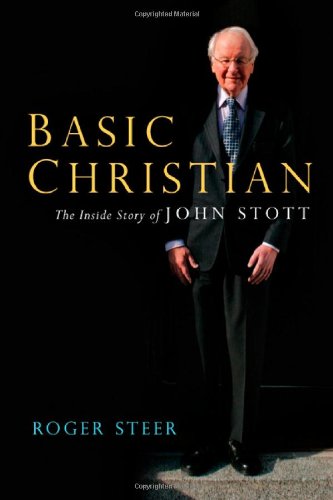
  • Book Review: Basic Christian

    John Stott had gradually slipped off the world stage over the last few years. But when he died at the age of 90 this past July, suddenly he became an object of conversation. He was without peer as an evangelical Christian leader in Britain and the world. It is a testament to his talents as a bridge-builder that tributes to him came from all over the world and all over the spectrum of political and religious belief. There was even a tribute from Nicholas Kristof in the New York Times. Reading it, I was reminded that David Brooks had said in the same newspaper in 2004 that “if evangelicals could elect a pope, Stott is the person they would likely choose.”

    This biography by Roger Steer was written in 2009, and was based in part on conversations with Stott and several of his friends. It traces Stott’s life from his early days as the son of a prominent physician, to his days at Cambridge and his decision to become a pastor, to his time as curate and rector of All Souls in London and his rise to international prominence. It gives details about his many travels, his contributions to the evangelical Christian movement and his friendships with other well-known people.

    In it, Stott comes across as a man with a gift for friendship, a sharp mind, a sense of humor and a deep commitment to Jesus as Lord of all of life. The book is not afraid to present Stott “warts and all,” but there really aren’t many warts. Despite his gift for friendship, Stott could be reserved. With his great intelligence and disciplined lifestyle, he could sometimes be impatient with those who were more sloppy in their thinking or less disciplined in their living than he was. However, he was a man who was conscious of his faults and humble enough to admit them.

    Stott has long been a hero of mine, and this book did nothing to change that. If anything, it made me miss Stott even more. He was able to remain biblically faithful and speak charitably with those whom he disagreed. The latter characteristic is in especially short supply these days, both in the church and the world. I’d recommend this book to anyone who is interested in Stott’s life, especially those who might be intimidated by Timothy Dudley-Smith’s larger two-volume biography.

  • Book Review: Between Heaven and Mirth

    Martin, a Jesuit priest who has been called “The Official Chaplain of Colbert Nation,” is convinced that joy, humor and laughter are central to spirituality. He calls readers’ attention to humor in the Bible and in the lives of spiritual leaders throughout the centuries.

    Most of the jokes that he tells and examples that he gives are from his own Catholic tradition – all the cartoons on the cover seem to be of Catholics, save Martin Luther, who had a well-known spat with the Catholic Church. However, he does give space to humor in Protestantism and even other religions. When writing about humor, there is always the danger of being unfunny. Thankfully, Martin escapes this danger. This was a fun read, and it was fun in large part because Martin is able to poke fun at himself. I had no idea there were so many jokes about Jesuits.

    Here is a link to an interview with Martin at Duke Divinity School’s Faith & Leadership blog. This is a great quote from that interview:

    We feel drawn to religious leaders with a sense of humor. It shows us that they understand their essential poverty of spirit and their own reliance on God. It shows humility, which is also essential in the spiritual life. You take God seriously, Jesus seriously and the gospel seriously, but you shouldn’t take yourself too seriously.

    To which I can only say: Amen.