I am not a regular reader of WORLD magazine, but when I picked up a copy of it a few weeks ago and saw that it was their yearly “books issue,” I was curious to see what they had named as their Book of the Year. When I read that they had named as their book of the year The Battle: How the Fight Between Free Enterprise and Big Government Will Shape America’s Future by Arthur C. Brooks, I was even more curious. WORLD is a Christian magazine, and The Battle is a book that deals primarily with politics and economics, but not from a distinctly Christian perspective.
 I was sufficiently curious after reading the article that I checked The Battle out of the library and read it.
The book is made up of four chapters. In the first, Brooks uses polling data in order to neatly split America into the 70 percent who think that free enterprise is a good idea, and the 30 percent who think that government-sponsored redistribution of wealth is a good idea. Brooks calls them the “70 percent majority” and the “30 percent coalition,” and argues that the 30 percent coalition has wielded a disproportionately large amount of influence, especially over young people. In the second chapter, he gives an example of this influence by detailing the narrative about the 2008 financial crisis given by the 30 percent coalition, and Barack Obama in particular. Brooks argues that the claims made by this narrative are false.
In the second half of the book, Brooks moves from directly criticizing the 30 percent coalition to making proposals for how the 70 percent majority can win the culture war. He argues that the 30 percent coalition has a worldview that is “fundamentally materialistic,” but the 70 percent majority has a worldview that is nonmaterialistic. Though they can sometimes have a reputation for only being concerned about money, they are really concerned with human flourishing. He argues that earned success, rather than money, is at the heart of free enterprise, and earned success is the key to happiness. In order to win the war, the 70 percent majority needs to “reclaim the morality of their worldview” (97). In addition to the claim that free enterprise is about human flourishing, four other principles he lists as central are 2) “We stand for equality of opportunity, not equality of income”, 3) “We seek to stimulate true prosperity, not treat poverty”, 4) “America can and should be a gift to the world”, 5) “What truly matters is principle, not political power” (103). He ends the book by calling for leaders who are committed to “expanding liberty, increasing individual opportunity, and defending free enterprise” (126).
The book is a quick read, an entertaining read, and in some places even an inspiring read. However, I still have many questions about why WORLD, as a Christian magazine, chose to endorse it as Book of the Year.
The dichotomy that Brooks draws between the 70 percenters and the 30 percenters makes for an appealing argument and even better rallying cry, but ultimately I think that his dichotomy is a false one. While socialists and free enterprisers do seem to be the ideologies that draw the most supporters at the moment, Christians should not be made to feel as if they are forced to choose between one or the other. Brooks spends the early part of his book citing polling data to make the case that free enterprise is really what the majority of Americans want. To me, this indicates nothing more than the fact that the false dichotomy between free enterprise and socialism has thoroughly permeated our culture, including many Christians. Rather than listen to the people, like Brooks, who seek to get them to choose between socialism and free enterprise, Christians should seek to find a way of living and doing economics that is genuinely Christian. While the Bible is not an economics textbook, we can glean some insight from it regarding what Christians should prioritize economically. And the Bible does not appear to be completely friendly to either free enterprise or socialism.
To be sure, there are some places where the Bible does seem to be friendly to free enterprise. Economist and theologian Johan Graafland, in his article, “Market operation and distributive justice: An evaluation of the ACCRA confession,” states,
The Bible indeed mentions many texts that express the right to private property, condemns stealing (Ex. 20:15, Lev. 19:11, Prov. 23:10, Ef. 4:28), require compliance to contracts (Jer. 22:13) and demand rectification if the principle of justice in transfers is violated (Ex. 22:4-7, Lev. 5:14-16, 6:1-5, 22:14, Num. 5:5-8, Prov. 6: 30-31)… There are also many texts that support the capitalistic principle of moral desert. Trade should be honest. One should use true and honest weights and measures and not cheat the other trading partner (Deut. 25:13-16, Ezek. 45:10, Mic. 6:10, Amos 8:5, Prov. 20:10). So one should be rewarded in accordance to what one really brings to the market. Many texts in the Old Testament and New Testament support the idea that effort or productivity should be rewarded. Jesus applies this principle in the parable of the three servants (Matt. 25: 29) and the parable of the Gold Coins (Luke 19:26). Also in the Kingdom of God, everybody shall be rewarded in accordance to his or her deeds (Matt. 6:3, 19:29, Luke 6:38, 18:29-30). The apostle Paul defends a similar standard (1 Cor. 3: 8, 12-15, 1 Tim. 5:18, 2 Thess. 3:10).
(Thanks to my friend Jeremy, by the way, for turning me on to Graafland’s work)
On the other hand, there are biblical texts that are less friendly to the sort of free enterprise that Brooks argues for. According to Graafland,
[T]he Bible commands several institutions that protect the poor, independently from the causes of their poverty…. For example, the poor received food during the sabbatical year (Ex. 23:10) and from what was passed over in the first harvest (Deut. 24:19-22). The hungry were to be allowed immediate consumption of food in the grain fields (Deut. 23:24) and farmers should not cut the corn at the edges of the fields, but leave them for the poor (Lev. 19:9-10). Other examples are the law of the tenth (Lev. 27:30, Num. 18:21, Deut. 12:6, Amos 4:4), the law to share with the poor food at the harvest festival (Deut. 16:11) and the prohibition on demanding interest from the poor (Ex. 22:25, Lev. 25: 36, Deut. 23:19, Prov. 28:8). Thus, aid to the suffering is not merely a matter of personal duty to be merciful.
Num. 26:52-56 shows us that upon entering the promised land, Israel was commanded to divide it so that every tribe would have land proportionate to its size. All tribes, clans and families were assured that they would have enough land for their needs. Also, in Dt 15:12-15 we find that slaveholders were required not only to free their slaves in the Sabbatical year, but to provide them with means of subsistence. Of course there is debate regarding the extent to which these Old Testament laws should be normative for Christians, but it seems at the very least that Christians have a duty to fulfill the basic needs of the poor. This was not just a matter of personal giving in the Old Testament; it was a matter of law. It should also be pointed out that the poor were still responsible to build up the capital they were given, and in this I do agree with Brooks.
By endorsing this book as Book of the Year, it seems to me that the editors of WORLD magazine have missed an opportunity. They could have used this book as a chance to talk openly as Christians about the best way to do economics. They could have praised The Battle for the ways in which it reflected a distinctly Christian view of economics, and critiqued the ways that it didn’t. Instead, there is only one criticism of Brooks’s book in WORLD’s review: “Brooks here should do more about the importance of biblical faith, since many people who have ‘earned success’ apart from a sense of God’s sovereignty and love hit a wall of meaninglessness as they age.” It seems to me that WORLD is wholeheartedly endorsing Brooks’s free enterprise worldview which claims that earned success is the key to happiness, but recommends he adds a little faith as a garnish. I don’t think this is an effective way to go about teaching and encouraging people to have a Christian worldview. Rather than starting with an unquestioned acceptance of free enterprise in forming our worldview, we should start with God’s story as it has played out primarily in the Bible and also in the history of the church. That should be our starting place, not adding faith to another worldview as if it were merely another ingredient. The Christian worldview centers on Jesus, and Jesus is not mentioned in The Battle. If nothing else, that ought to give us pause.
The mistake that the folks at WORLD make in naming this book as their Book of the Year is that they believe both the free enterprisers and the socialists when they say that there are only two ways to live. They chose the less offensive of the two options (and yes, despite my criticism I do think free enterprise is the less offensive option of the two), but in doing so they have taken their cue from the world and lost an opportunity to discern how to do economics in a Christian way.
 Max Lucado’s newest book, Outlive Your Life, is nothing short of a call to revival based on the book of Acts. This isn’t an old-fashioned revival like the kind I grew up with, where the main concern is all about the individual getting right with God (though Lucado does not overlook this important aspect). Rather, it is about Christians acting out their commitment to Christ through compassion and acts of service.
 2. Hannah’s Child: A Theologian’s Memoir by Stanley Hauerwas. Theologian Stanley Hauerwas’s memoir is called Hannah’s Child, but it could easily have been called Things that Didn’t Occur to Me At the Time. Out of the long list of things in his life that he acknowledges he was clueless about, a few are that a person would go to divinity school in order to prepare for ministry, that Protestants would not be allowed to partake in Catholic Mass, or that he would have to get used to the differences between Durham and South Bend when he moved from Notre Dame to Duke.
 5. The Richest Man in Babylon by George S. Clason. While Buckley’s book was a fictionalized history of mid-20th-century conservatism, this book was fictionalized financial advice. Clason wrote this book in the 1920s, but in a stroke of genius he set it in Babylon and told it as a set of ancient parables. His advice is nothing new, but striking because it is so seldom followed: save 10% of all you earn. Be conservative rather than greedy in your investments. Seek investment advice, especially in areas you are not familiar with. Not particularly exciting stuff, but this book has had enduring popularity in part because of its brilliant presentation. It’s a story, which is always more interesting than straight advice, and it is presented as wisdom from the ancients. The edition I read was even in King James English, though I believe there is a modern-English version.
 6. The Prodigal God: Recovering the Heart of the Christian Faith by Tim Keller. In this short book, Keller focuses on the familiar parable of the “prodigal son,” but presents it in an unusual way. That difference can be seen in the title: “prodigal” doesn’t mean “lost,” as so many people assume, but rather “recklessly extravagant; having spent everything.” This is why Keller applies the word to God, who as the father in the parable is extravagant both in giving his son his inheritance prematurely and in welcoming him back when he returns.
 This is the second book that I have read in the Christian Encounters series from Thomas Nelson, and I must admit that the idea behind the series is a good one: short biographies of well-known people, with an emphasis on their Christian faith. The first book in this series that I read was Peter Leithart’s biography of Jane Austen.
 1. Fire Someone Today by Bob Pritchett. When I began reading Fire Someone Today, I had two questions:
 2. Here Comes Everybody by Clay Shirky. Organizing large numbers of people has always been hard work, as anyone trying to find a place for a group to eat can attest (“I hate Italian.” “I’m allergic to anything on a stick.” “I only eat fish on alternate Thursdays during months ending in -y.”). Fortunately, says Clay Shirky, new social tools are enabling people to cooperate in ways (and on scales) that were impossible even 15 years ago. Today, large groups can assemble more easily than ever before. This gives rise to new possibilities in what groups can accomplish – a phenomenon that Shirky refers to using the phrase “More is different.”
  3. Made to Stick: Why Some Ideas Survive and Others Don’t by Chip and Dan Heath. In this book, the Heaths set out to describe why it is that certain things (whether they are ad campaigns, urban legends or things we learn in school) stick in our heads or get us to change our behavior, and others don’t. Ideas that stick have the following things in common: they are
 4. Talent is Overrated: What Really Separates World-Class Performers from Everyone Else by Geoff Colvin. This book’s central premise is that what separates world-class performers from everyone else is not innate talent, as so many of us believe. Rather, what makes people great at what they do is practice – but not just any practice. Deliberate practice. It isn’t just repeating something over and over; it is “activity designed specifically to improve performance, often with a teacher’s help; it can be repeated a lot; feedback on results is continually available; it’s highly demanding mentally, whether the activity is purely intellectual, such as chess or business-related activities, or heavily physical, such as sports; and it isn’t much fun” (66). Colvin fleshes out his argument throughout the book with a lot of data and anecdotes.
 5. Discourse Grammar of the Greek New Testament: A Practical Introduction for Teaching and Exegesis by Steve Runge. This book was written by someone I work with, and it has the honor of being the first book I read completely on my computer using Logos Bible Software. I was able to highlight and write notes, the same as I would have been able to if I were reading a hard copy.
  This is the story of the friendship between a poor black man and a rich white man. It's about reconciliation, about the courage to step outside your comfort zone and trust another person, and about not judging people by appearances. It's also about perseverance, and coming to terms with death and the presence of evil in the world. It's a fascinating story, and one that you should read for yourself. I'm not going to give any more of it away than I already have.
 1. Letters and Papers from Prison by Dietrich Bonhoeffer. I’d had this book on my shelf for a while, and after reading Eric Metaxas’ excellent biography last month, I decided to stay in the mental world of Bonhoeffer for a little longer by reading this book. As the title indicates, this is a collection of letters and papers that Bonhoeffer wrote beginning in the spring of 1943, when he was arrested and held in Tegel Prison in Berlin. He was a prisoner until his death two years later.
 2. Just How Married Do You Want to Be? by Jim and Sarah Sumner. This is a marriage book that I read out loud to my wife over several months. It is unique among marriage books mostly because of the couple who wrote it: she has a PhD in theology from Trinity Evangelical Divinity School, and he is a former stripper who was only a Christian for a few years when they met. They have had a lot of struggles in learning how to relate to one another, and they share what they have learned in this book. It is well worth reading because of her insights into biblical passages that deal with marriage, as well as their honesty about their struggles and the wisdom they have gleaned from working out their differences in community with others.
 4. Peace Like a River by Leif Enger. I’d been hearing good things about this novel for a long time, and I finally picked it up for $1 at a library book sale this spring. I usually don’t read many recently published novels, but the buzz about this one was so consistent that I decided to give it a read.
 1. Colossians Remixed: Subverting the Empire by Sylvia Keesmaat and Brian Walsh. This is an unusual book. It is about the letter of Paul to the Colossians, but it is not a commentary in the usual sense of the word. In fact, the authors in the Preface call it an “anti-commentary.” Rather than digging into the technical details that commentaries usually deal with, their main goal is to read Colossians in such a way as to make it relevant to our current postmodern and globalized context.
 Mind Your Own Mortgage is a tract for the times. It was written in light of the recent financial meltdown, and seeks to get the U.S. economy in better shape by encouraging people to get their home economies in better shape.
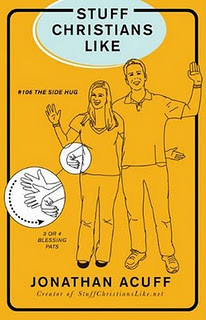 Mary and I went to Lake Chelan over Memorial Day weekend, and on the drive we listened to the audiobook of Stuff Christians Like by Jonathan Acuff. It is a book spun off of the
  Elliot Ritzema