Category: Culture

  • Truth Project 8: Unio Mystica (Am I Alone?)

    In the eighth tour of the Truth Project, Del (the presenter) looks at the mystical union between God and humans. He begins by talking about mysteries, saying how much he loved Hardy Boys books when he was a kid, and referring to Ephesians 5:31-32, which says that the mystery of marriage “is profound, and I am saying that it refers to Christ and the church.” God, Del says, have given us a mystery and has also written the end of that mystery.

    Much of the early part of this tour consists of laying a biblical foundation for the doctrine of the mystical union between God and humans. Del cites Colossians 1:27, John 15:5, 2 Corinthians 5:17, Galatians 2:20, and John 14:16-17, all in the interest of showing that “the God of the universe dwelling inside us is the greatest mystery.” God has invited us into the Godhead.

    Another aspect of this mystery is that the church is the body of Christ, and God is interested on oneness in that body (1 Corinthians 12:27, Romans 12:4-5, 1 Corinthians 10:17). There is another aspect, which Del calls the “Mystery of Christ.” Citing Romans 16:25-26, Ephesians 1:9-10, 3:6 and especially Galatians 3:28-29, Del says that this mystery is that there are no racial barriers in Christ, no economic or class barriers, and no gender barriers. God wants his church to be united in him and with one another (John 17:20-23). This, Del says, is why you see so many “one another” commands in the New Testament (e.g. 1 Peter 1:22, Galatians 6:2, James 5:16), especially “Love one another” (John 13:34-35).

    After setting forth what our relationship with Christ and one another ought to be, Del looks at the pathologies that keep us from intimacy, fellowship and unity. The major pathology that Del mentions is our hunger for significance, for people to notice us. God has given us this hunger, but it needs to be satisfied within the covenant relationships God gives. Del gives a few biblical examples of how this hunger can become a pathology, like Saul’s jealousy of David and Jesus warning people to not do their “acts of righteousness” to be praised by others (Matthew 6:1-4). What keeps us from intimacy, Del says, is that we abandon God and prostitute ourselves. Our greatest desire should be for God (Psalm 42:1-2).

    Overall, I liked this tour. There was a lot of scripture quoted in it, which for a Christian worldview curriculum like the Truth Project is very good. I had never seen the various mysteries mentioned in the New Testament rolled up into one the way Del did it. This is not necessarily a bad thing; I had just never seen it before.

    Even though the title of the tour could appear individualistic (“I” rather than “we”), I found that the tour itself was not particularly individualistic.

    I also liked that Del, in addition to telling about what God wants for us, talked about those pathologies that keep us from being what God wants us to be. If he had ended after the first part of the tour, viewers would have been left with the issue of how the church all too often doesn’t look how it is meant to look. As it is, we can see that God intends for his people to be united to him, but we fail to be what we are meant to be. The fault lies with us and our pathologies, rather than with God.

    This was one of my favorite tours of the Truth Project. It lacked some of the things that have caused me to have a mixed reaction to several other tours. For one thing, it was saturated with scripture, and Del did not go farther than scripture warranted. It also did not include negative comments about people with differing worldviews, or who have other opinions. All in all, a very good tour.

  • Truth Project 7: Sociology (The Divine Imprint)

    The beginning of the seventh tour of the Truth Project sounded like we were revisiting the topic of the fifth tour: science. Del began by quoting Psalm 19, about the heavens declaring the glory of God, and talked to his audience about the design of a chicken egg. The chicken egg, he said, poses a problem: the problem of order. What we have is an orderly cosmos, and “God is not a God of disorder” (1 Cor. 14:33). Del doesn’t just say that God is a God of order, but also says (quoting James 3:16) that disorder is a vice.

    Here is where he makes the transition to the current topic. God is “displayed in great glory through the physical creation, but even more so in the order that He has created in the social realm.” God’s social system, Del says, is where “the real battleground lies.” Since God is triune, he is social by nature. And the way that he has ordered society is bound up in his Trinitarian nature. Del quotes the Westminster Confession:

    In the unity of the Godhead there be three persons, of one substance, power and eternity: God the Father, God the Son, and God the Holy Ghost; the Father is of none neither begotten, nor proceeding; the Son is eternally begotten of the Father; the Holy Ghost eternally proceeding from the Father and the Son.

    Del then looks at how this Trinitarian nature of God plays out in social systems, beginning with the family. In the family, the husband and wife are one in the same way that the Father and Son are one. The wife submits to the husband in the same way that the Son submits to the Father. Authority, submission, oneness and unity are shared by the Trinity and the family.

    Then he turns to look at the church as social institution, comparing it to the Trinity and to the family. Christ he puts at the top (where the Father and the husband are in the other spheres), then he puts the leaders (in the place of the Son and the wife, respectively), and then he puts the flock (in the place of the Holy Spirit and the children). The flock is supposed to honor elders the way children honor their parents (1 Timothy 5:17).

    Relationships are important, Del says, but at the Fall, relationships were severed: God and Man, Man to Man, Man and Creation, and Man internally. Social order is bound up in the nature of God because he created social institutions with the divine imprint of who he is.

    Then Del argues that our culture attacks the sphere of family. Divorce is commonplace, though God says “I hate divorce” (Malachi 2:16). Husbands are inconsiderate of their wives, though Peter says that their prayers will be hindered if they do that (1 Peter 3:7). The family, Del concludes, is serious business.

    The way that Del draws parallels between God’s Trinitarian nature and various social systems is, I think, problematic. When he diagrams the Trinity, he draws a triangle within a circle with the Father at the top, the Son below that and to the right, and the Holy Spirit at the bottom. He draws the same diagram when he describes social institutions. The problem with this is that he gives the impression that, simply because the Son submitted to the Father in his earthly life, there is inequality within the Trinity. When he says that the Son submits to the Father the same way that wives submits to husbands, and the same way that elders in a church submit to Christ, he is coming dangerously close to the heresy of subordinationism. I say “coming dangerously close” because Del may not believe that the Son is eternally unequal with the Father. But what he says does give that impression.

    I admire Del’s effort to show that God’s concern for order proceeds from his nature, but I think that he went about it in entirely the wrong way. When you see Trinitarian relationships in anything but the Trinity itself, I think that you are treading on very dangerous ground, because you are making a parallel that the Bible itself does not make. The Trinity is mysterious, so comparing it to things that we know more about can be helpful at times. But comparisons are only just that: comparisons. When we really start to think of the relationships within the Trinity in terms of relationships within the family, we have diminished the Trinity. I know that Del is only trying to show his audience that God is a God of order, but I’m afraid he does more harm than good here.

  • Truth Project 5: Science (What is True?)

    The fifth tour of the Truth Project is a two-part lecture dealing with science. Del begins with the Bible’s statement, “The heavens declare the glory of God” (Psalm 19), and points out that there has been a tendency since the Fall to look at what is plain (i.e., God’s creation and ordering of the world) and ignore it. Del notes the difficulty of answering the question, “Why is there something rather than nothing?” from a purely naturalistic point of view. He also points out that if what we see in the world is random, then we would have no need to study it. But since we can see that the universe has order, that makes it difficult to claim that it is the product of chance.

    Del then turns to look specifically at Darwin’s theory of evolution. He cites several sources as saying that evolution is a fact beyond dispute, then attempts to undermine it by appealing to William Paley’s argument for design. Such modern apologists for evolution as Richard Dawkins define biology as “the study of complicated things that give the appearance of having been designed for a purpose,” and Del thinks that he (and others like him) are ignoring the obvious: namely, that if the universe looks designed, then it must have been designed.

    In the second half of the science tour, Del continues to take aim at evolution. He questions it first based on molecular biology, then the fossil record. Before looking at molecular biology, he quotes Darwin as saying, “If it could be demonstrated that any complex organ existed which could not possibly have been formed by numerous, successive, slight modifications, my theory would absolutely break down.” This, Del says, is precisely what has happened through study of molecular biology. He cites Michael Behe as saying that the flagellum and the inner workings of the cell are “irreducibly complex,” meaning that they could not have come about through the kinds of modifications that Darwin wrote about.

    Del then turns to question evolution through appeal to the fossil record. He points out the paucity of evidence gathered through the fossil record and scoffs at Stephen Jay Gould’s “punctuated equilibrium,” which was presented as a possible way around the lack of transitional forms. He also argues that the difference between the beaks of the varieties of the Galapagos Finch that Darwin observed can be explained as temporary differences that oscillate back and forth depending on the availability of certain types of food.

    Del then wraps up by saying that statements like these made against evolution are met with derisive comments. Why? Because, Del says, we are not just dealing with a scientific truth claim, but a philosophical truth claim. Evolution, he says, is a worldview which people will desperately hang on to because the consequences of rejecting it turn them face-to-face with the reality of a creator. If evolution is true, then there was no Adam and Eve and original sin. If there is no original sin, then there was no reason for Jesus to be a redeemer. And if there was no reason for Jesus to be redeemer, then there was no reason for him to come, and Christianity is nothing.

    To his credit, Del realizes that this is a controversial subject. Before the tour started, he included a statement to the viewer asking him or her to hear him out and weigh whether his argument is true. I hope that I was able to give him a fair hearing, and here is what I came away with:

    I agree with Del that science has a great deal of difficulty explaining why there is something rather than nothing, and even how life came from non-life. And I agree with Del on the reason for this: namely, that science is not capable of addressing philosophical issues like that. Because of the success of science coming out of the Enlightenment, some began (and continue) to claim that science is omnicompetent – that is, that it can do anything, including providing explanations for philosophical questions like why we are here. Del is right to point out this shift and the difficulty involved in it.

    I also think that Del is right to point out the willful ignorance of people like Dawkins and Francis Crick, who say that biology studies things that appear to be designed, but really are not.

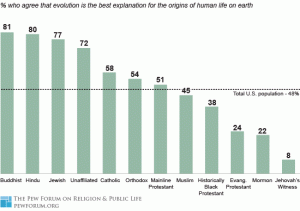
    However, I’m not so sure that Del is adopting the best strategy by taking on evolution lock, stock and barrel. One reason for this is that there are many intelligent Christians (including many Christians who work in the sciences) who find no contradiction between their Christian faith and a belief in evolution. I am no scientist – the only science courses I took in college were a biology class and a chemistry class, which were enough to satisfy the general education requirement – but if people like Francis Collins, the former head of the Human Genome Project and an evangelical Christian, find no contradiction between their faith and their support of evolution, then I am all right with that.

    58% of Catholics, 54% of Orthodox, 51% of mainline Protestants and 24% of Evangelical Protestants believe in evolution
    58% of Catholics, 54% of Orthodox, 51% of mainline Protestants and 24% of Evangelical Protestants believe in evolution

    Another reason that I’m not sure that attacking evolution by substituting Intelligent Design is the best strategy is that it seems to me like a “god of the gaps” way of viewing science. If we believe in a “god of the gaps,” we believe that those natural phenomena that we can’t explain otherwise must have been brought about by God. But what happens when we are able to explain those natural phenomena? Our “god” is diminished.

    I think that Del is right in many of the things that he says about science, but he has unfortunately chosen the wrong “bad guy.” The bad guy here is not the theory of evolution, which, as I mentioned, many Christians who work in the sciences believe in. No, the bad guy is scientific naturalism, which says that the only real things are the things we can examine through science. This is the worldview that needs to be addressed. In this debate, evolution is just a red herring. Unfortunately, many young people who have been raised in the church are taught to believe that their faith is incompatible with evolution, and then go to college and become convinced that evolution must be true. Then they are faced with a false dilemma between science and faith, and guess which one loses?

  • An Overdose of Hungarian Culture

    This story, about the “Hungarian Seabiscuit” (a horse named Overdose) made me smile.

    But Overdose’s one setback may have done more to cement his reputation in Hungary than his dozen straight victories. At the prestigious Prix de l’Abbaye at Longchamp in Paris, Overdose appeared to win the premier sprint race with a time just shy of the 25-year-old course record.

    But the seeming victory was nullified because a malfunctioning gate prevented one of the other horses from starting. Overdose’s team decided he had expended too much effort to be allowed to run again. His rival, Marchand D’Or, went on to win the race, and later the title of best European sprinter.

    Tivadar Farkashazy, a Hungarian television commentator and journalist, compared the debacle to the Treaty of Trianon, signed in 1920 at Versailles, which whittled Hungarian territory down to a fraction of its size and remains a source of national outrage.

    “Again the tough luck, again in France,” said Mr. Farkashazy, who has also written a book about the horse.

    It is so appropriate that the Treaty of Trianon is mentioned. In Hungary today, you can walk around and see bumper stickers on cars that have an outline of Hungary – not the way it looks today, but the way it looked in 1914 – before that cursed Trianon!

  • Truth Project 2: Philosophy and Ethics (Says Who?)

    The second tour in the Truth Project examines Philosophy and Ethics. Del (in my review of the first tour, I called the presenter by his last name, Tackett, but I’m thinking that is a tad impersonal) starts out with a couple of Bible verses, one of them being Colossians 2:8: “See to it that no one takes you captive through hollow and deceptive philosophy.” One example of a hollow and deceptive philosophy, says Del, is Carl Sagan’s popular Cosmos series. In it, Sagan says that “The Cosmos is all that is, or ever was, or ever will be.” This statement assumes there is nothing outside the physical universe – what Del calls the “Cosmic Cube,” or “the box.”

    Del argues that modern philosophy has taken God out of the equation in its search for reality, and is therefore bound to fail. The philosophical “holy grail,” says Del, is the Universals, but all that we can directly observe are particulars. Del says that in secular philosophy, there is a gap between the tradition of Plato (which focuses on ideals, or universals) and the tradition of Aristotle (which focuses on particulars). Secular philosophy begins with particulars and tries to move to universals, which is not possible when you only look inside the box. God’s approach, according to Del, is to begin with universals (accessible through revelation) and move to particulars.

    The implications of naturalistic philosophy, because of its limitation, are that there can be no gods or purposive forces, no ultimate foundation for ethics, no free will, no life after death, and no ultimate meaning in life. The problem with Christians in America, says Del, is that we have been taken captive by this philosophy and don’t have a biblical worldview. The solution is that, according to Romans 12:2, we should be transformed by the renewing of our minds.

    Overall, I liked this tour. It set forth the issues clearly and simply and issued a clarion call for Christians to not be deceived by hollow and deceptive philosophy but be transformed by the renewing of our minds. Also, I think that it gives us a great starting place when dialoguing with people who have a naturalistic worldview. If secular philosophy leads inevitably to a loss of meaning and an inability to have an ultimate foundation for ethics, then a good place to start dialogue would be to push philosophical naturalists to accept the implications of naturalism. All too often, philosophical naturalists “cheat” in order to give their lives meaning. That is, they borrow ideas from Christianity that are not consistent with their stated worldview.

    I think, however, that Del misses an opportunity in this tour to show his audience how to interact with a secular philosopher. He tells the story of a freshman philosophy class that he was in at Kansas State where the professor told him, “You don’t have any way of knowing that the chair you’re sitting on is really real.” Instead of telling his audience how to start a conversation with someone like that, Del dismisses that statement by merely saying, “How foolish!” Instead of being dismissive, he would have served his audience (and any non-Christians they come in contact with) better by speaking with them about how to open a dialogue about the important things of life with someone who has been influenced by deceptive philosophy.

  • Truth Project 1: Veritology (What is Truth?)

    There has been an unusually slow trickle of posts lately, for which I do not apologize. Real-life obligations trump blogligations for me, and there has been a lot going on in real life lately. But that said, let me try to catch up on this Truth Project review thing.

    On March 4 we watched the first Truth Project DVD at our church, and then split up into small groups to discuss it. My group was one of the smaller ones, with about eight people in it, with two more to join us when they return from out of town.

    The first DVD is called “Veritology: What is Truth?” Veritology is not a word that can be found in the dictionary; it’s a combination of the Latin word for truth, “veritas,” and the suffix “-ology” The viewer is introduced to Del Tackett, the presenter, who delivers the lesson in a lecture-style format in front of a group of students.

    The point of this “tour,” as Tackett calls it – the whole series – is to “gaze upon the face of God.” Tackett is not interested in the participant filling up his or her notebook with useful stuff, but wants total transformation for the viewer. He wants us to see Christianity as an all-encompassing worldview – a way of seeing all of life.

    After giving a brief introduction, Tackett asks his students why Jesus came into the world. After answering “no” to several suggestions (“to redeem us,” “to fulfill prophecies,” “to save the world,” etc.), he refers us to John 18:37, where Jesus says to Pontius Pilate, “For this reason I was born and for this I came into the world, to testify to the truth.” Tackett then proceeds to show how important truth is to Jesus and to the biblical writers by pointing out several verses in which “truth” is mentioned. A few examples are John 1:17 (“For the law was given through Moses; grace and truth came through Jesus Christ”), John 14:6 (“Jesus answered, ‘I am the way and the truth and the life. No one comes to the Father except through me.’”) and I Timothy 2:3-4 (“This is good, and pleases God our Savior, who wants all men to be saved and to come to a knowledge of the truth.”).

    Tackett then asks how people react to the truth, and the answer is that often they “turn aside to myths,” (2 Tim. 4:4), “suppress the truth” (Rom. 1:18), “distort the truth” (Acts 20:30) and “exchange the truth of God for a lie” (Rom. 1:25). Jesus said that he came to testify to the truth when he was on trial. The real trial, Tackett says, is truth vs. lie. There is a “cosmic battle” between truth and reality, on the one side, and lies and illusions on the other. Sin is deceitful (Rom. 7:11; 2 Thess. 2:10; Eph. 4:22; Heb. 3:13) and takes people captive (2 Tim. 2:24-26). There is a battle between truth and lies, and Tackett calls this a “battle of worldviews.” Today’s world is still struggling to answer Pilate’s question, “What is truth?” – and this question, according to Tackett, could well be the most important question that we and our culture must answer.

    Tackett then enlists the help of Ravi Zacharias, Os Guinness and R.C. Sproul to define truth. He also enlists the help of the 1828 edition of Webster’s Dictionary, which defines truth as “conformity to fact or reality.” He alters this slightly to say that truth IS reality. By contrast, insanity is losing touch with reality and believing that lies are real. We all suffer, Tackett says, from common insanity: losing touch with reality. Our actions, Tackett says, reflect what we believe to be really real, and often we don’t act on what we profess to be real. The question Tackett leaves us with is, “Do you believe that what you believe is really real?”

    Positively, I thought that first, the DVD is extraordinarily well-presented. Focus on the Family has done a great job in packaging this product. Tackett is a winsome, likable presenter, and you get the sense in this first tour that he deeply cares for people, both Christians and non-Christians.

    Second, I think that Tackett presents his case very well. He relies heavily on Scripture for his discussion of truth, which is important when dealing with Christians, the intended audience. He frames the conflict that we face in our own lives, of truth vs. lie and reality vs. illusion, in a compelling way. Most of what Tackett says I don’t have any problem with at all.

    However, there are a few things about the first tour that rubbed me the wrong way. First, one of the earliest slides that Tackett presents is a compass. On the four ends of the compass are: Truth to the north, God to the east, Social Order to the south, and Man to the west. I found myself chafing against the idea that Truth is due north – it’s what we use to orient ourselves – and God is at another point of the compass.

    Second, I wasn’t sure I liked how Tackett responded to the suggestions of his students on why Jesus came into the world. I don’t think he was trying to be mean or dismissive, but nevertheless it came across that way. Perhaps, I thought when I watched it, this is because it is not really a classroom. Or rather, it is and it isn’t. It is a classroom, but it is also a recorded DVD lesson, and I’m sure Tackett had to move along with the lesson in order to keep it snappy and interesting. I’d like to think that if it really were a classroom, he would have come off as being less dismissive.

    Third, Tackett says that

    the truth claims of God are consistent and logical. They make sense. They work. And even in a fallen world, when we follow them, they lead to peace and prosperity and happiness.

    I think that following Jesus is the best thing we humans can do, but I would question whether this inevitably leads to “peace and prosperity and happiness.” It doesn’t seem to me that Jesus promised peace and prosperity and happiness in this world. If anything, he promised persecution to his followers (John 15:20, 16:33).

    Fourth, he states in the course of his lecture, “We think that postmodernism is so new. It’s not new at all! It’s the same old lie!” The problem that I have with this is that he has not given any indication of what he means when he says “postmodernism.” Making statements like this one, without defining terms, is bound to generate misunderstanding. I suspect that when Tackett says “postmodernism,” he means “relativism.” There are problems with equating postmodernism with relativism, but it would be helpful if he would at least make clear what he means.

    Finally, I agree with Tackett that truth is important, and I know that Jesus said he came into the world to testify to the truth, but I think that Tackett’s definition of truth has some problems. For one thing, the word “objective” kept creeping into his presentation. This threw up a red flag because I think the notion of objective access to truth and knowledge is a distinctively modern approach that is no more compatible with Christianity than its opposite: total subjectivity. Of course, when he uses the word “objective,” it is possible that he simply means “independent of the knower.” I would agree with this definition, though I think it would be best to leave out the word “objective” altogether. Overall, he is not clear what he means when he uses the word “objective,” and so I must caution against the idea of an objective knower. Tackett seems to be saying that there are only two choices when it comes to epistemology: objectivity or subjectivity. Instead, I would have appreciated it if Tackett had explored the third way of critical realism, which is a much more promising view of epistemology.

    Ravi Zacharias, in the course of the tour, defined truth as “that which affirms propositionally the nature of reality as it is.” This definition has problems both because truth is not exclusively propositional (I would say that the Bible is true, but it only partially consists of propositional statements), and humans should be humble about our access to reality as it is. Sin, after all, has affected our rational faculties and darkened our understanding. God says in Isaiah 55:9 that “as the heavens are higher than the earth, so my ways are higher than your ways and my thoughts than your thoughts.” Truth may well be conformity to fact or reality (or, as Tackett re-words the definition, simply “reality”), but then the question must be asked: which one of us has objective, exhaustive access to reality? I think that while Christians can have confidence that the Christian story is true, and that what God has told us about himself is true, grasping after the ideal of knowing objectively, of having a “God’s eye view,” will lead us right back into the dead end of modernity. It looks to me like Tackett is dealing with the problems he sees with postmodernity by trying to lead his audience back into modernity, which has its own problems.

    Even though Jesus said that he came into the world to testify to the truth, he also said that HE was the truth (Jn 14:6). Instead of focusing on exclusively propositional truth, I think it is time we stopped overlooking the personal dimension: Jesus himself is the truth.
  • The Truth Project Review


    Beginning later this month, my church will be going through a 12-lesson DVD curriculum put out by Focus on the Family called The Truth Project. During the first six weeks (those that take place during Lent), we will gather on Wednesdays to have dinner together, watch one of the lessons, and then discuss it afterwards in small groups. After a two-week break around Holy Week and Easter, we’ll pick back up again, except some of the small groups will move to homes instead of everyone getting together at the church.

    I’m very excited about this. I have not gone through the curriculum with a group, but I have watched all of the DVDs and think that overall it is a very well-done curriculum. It is designed to help Christians have a Christian worldview, to transform them into people who follow Christ in all of life, and I hope that this will be the effect in our church.

    While this is going on at church, I’m going to be reviewing each lesson on this blog. I looked around the Internet and couldn’t find a good review of the whole curriculum, so I hope to provide that here. Overall, as I said, I think it is very well done, but I don’t agree with everything in it, and I plan on making note of those things that I think could have been done better or those things that I think could cause problems in the long run. I don’t want to do this in order to gripe at Focus on the Family or the people behind the Truth Project, because as I mentioned, I think this is a very good curriculum overall. I just hope to provide some good critical reflection on it. After all, this series seems designed to help Christians think critically, and so I will approach it with a critical eye – not to tear down, but in hopes of building up.

    Update: I’m going to put links here to my reviews of each individual lesson.

    1: Veritology (What is Truth?)

    2: Philosophy and Ethics (Says Who?)

    3: Anthropology (Who is Man?)

    4: Theology (Who is God?)

    5: Science (What is True?)

    6: History (Whose Story?)

    7: Sociology (The Divine Imprint)

    8: Unio Mystica (Am I Alone?)

    9: The State (Whose Law?)

    10: The American Experiment (Stepping Stones) – Summary

    10: The American Experiment (Stepping Stones) – My Thoughts

    11: Labor (Created to Create)

    12: Community (God Cares, Do I?)

  • Leadership Summit

    On Thursday and Friday this week, I went to the annual Leadership Summit put on by Willow Creek Church of Chicago. There is a large event held at their campus in Chicago, and they broadcast it live to various other locations around North America. One of the places where they broadcast it is Cornwall Church in Bellingham, and one of the churches that sends people there is my church, Bellingham Covenant. The associate pastor asked me last week if I wanted to go, and I said yes. I found myself on Thursday afternoon (I missed the morning sessions because of a prior commitment) watching the summit take place on a big screen.

    I thought it was great, honestly. Ever since I was in college at the University of Richmond, with its Jepson School of Leadership Studies, I’ve tended to become a bit suspicious whenever I hear the word “leadership” bandied about too readily. Perhaps it is because I met too many Leadership Studies majors who weren’t necessarily good leaders; they were really just overbearing. Perhaps it is because I got the impression that studying leadership was an easy way to breeze through college after hearing it derisively called the “group project major.” Perhaps its because too many uses of the word “leadership” smack of elitism.

    Whatever the reason, I have often scoffed whenever I heard people talk about leadership, its training or techniques. It may be that that impulse will never completely go away. But I will tell you that my experience at the Leadership Summit was overwhelmingly positive, and I am actually hoping to go again next year. I had heard of a few of the speakers involved, but interestingly enough, the sessions that I was most impacted by involved people I had never heard of. Here are just a few highlights for me:

    On Thursday afternoon, Bill George talked about “finding your true north.” What really stuck out to me about what he said was his emphasis on character and humility in leadership. Instead of getting people to follow them, leaders are meant to empower others.

    After an interview with the founder of “Teach for America,” Wendy Kopp, John Burke and Efrem Smith spoke on leading in new cultural realities. Burke spoke mostly about our postmodern environment, and Smith about our multicultural environment. In both their talks, I was struck by the need for church leaders to abide in Christ, and to interact in a non-antagonistic way with our culture. Some culture is good, some is bad, and some is neutral. We need to embrace as much as we can of the good and neutral stuff, lest we make it more difficult than necessary for people to become Christians.

    On Friday, the two people who stuck out to me the most were Craig Groeschel and Catherine Rohr. Groeschel is the pastor of lifechurch.tv, a multi-site church in Oklahoma and a few other states. He’s a great communicator, but what stuck out to me the most about him was his honesty and transparency. Rohr founded the Prisoner Entrepreneurship Program, which equips Texas prison inmates with “values-based entrepreneurial training” in order to reduce recidivism and help them to re-enter society productively. Her story, and the stories of the graduates of her program, was inspiring.

    Even though I still think the word “leadership” can be abused, I found that what I learned at the Leadership Summit was valuable. Maybe leadership doesn’t have to be a dirty word, after all.

  • Alexander Solzhenitsyn Dies at 89

    Yesterday morning, I read in the newspaper that Alexander Solzhenitsyn died on Sunday in Moscow. He was most famous as an author and dissident in the Soviet Union, and in my estimation was one of the greatest men of the twentieth century.

    I first heard about Solzhenitsyn in college, when I read his most famous book, One Day in the Life of Ivan Denisovich for a Twentieth Century Russian Lit class. I was fascinated by the man and his story, and decided to read a lot more of his work. I have bought several of his books at used book stores, but up to now the only other full-length book of his that I have read is A Warning to the West, which contains five speeches that he delivered in the United States and Britain after he was exiled from the Soviet Union in the ’70s.

    I like Solzhenitsyn so much because of his accurate diagnosis of the problems of our age, and his fearlessness in denouncing those problems. He was so fearless in the face of opposition because, as he stated in his 1970 Nobel Prize acceptance speech, he believed that “One word of truth outweighs the world.” Chuck Colson has written an article in the August edition of Christianity Today that draws parallels between Solzhenitsyn and the prophet Jeremiah. Unfortunately, like Jeremiah, after a while many people stopped listening to Solzhenitsyn because he always seemed to have bad news.

    After he was exiled from the Soviet Union in 1974, he moved to the United States and spent the next 18 years in Vermont. Although he was celebrated for his defiance of the Soviet Union, his honeymoon with the West didn’t last long. The substance of his famous 1978 Harvard commencement speech was, “Communism may be bad, but the West isn’t doing so well itself.” He denounced the West for falling into a “despiritualized and irreligious humanistic consciousness.” While there is no official state censorship as in the Soviet Union, Westerners are slaves to fashionable ideas. I think that much of that 1978 address still holds up, and can still serve as a warning to us to abandon unrestrained materialism and freedom without accountability. Here is Solzhenitsyn’s conclusion to that speech, which could also serve as a fitting coda for his own life:

    If humanism were right in declaring that man is born only to be happy, he would not be born to die. Since his body is doomed to die, his task on earth evidently must be of a more spiritual nature. It cannot be unrestrained enjoyment of everyday life. It cannot be the search for the best ways to obtain material goods and then cheerfully get the most of them. It has to be the fulfillment of a permanent, earnest duty so that one’s life journey may become an experience of moral growth, so that one may leave life a better human being than one started it. It is imperative to review the table of widespread human values. Its present incorrectness is astounding. It is not possible that assessment of the President’s performance be reduced to the question how much money one makes or of unlimited availability of gasoline. Only voluntary, inspired self-restraint can raise man above the world stream of materialism.

    It would be retrogression to attach oneself today to the ossified formulas of the Enlightenment. Social dogmatism leaves us completely helpless in front of the trials of our times. Even if we are spared destruction by war, our lives will have to change if we want to save life from self-destruction. We cannot avoid revising the fundamental definitions of human life and human society. Is it true that man is above everything? Is there no Superior Spirit above him? Is it right that man’s life and society’s activities have to be determined by material expansion in the first place? Is it permissible to promote such expansion to the detriment of our spiritual integrity?

    If the world has not come to its end, it has approached a major turn in history, equal in importance to the turn from the Middle Ages to the Renaissance. It will exact from us a spiritual upsurge: We shall have to rise to a new height of vision, to a new level of life where our physical nature will not be cursed as in the Middle Ages, but, even more importantly, our spiritual being will not be trampled upon as in the Modern era.

    This ascension will be similar to climbing onto the next anthropologic stage. No one on earth has any other way left but — upward.