Category: sermons

  • Worthy Conduct (Phil 1:27–2:4)

    I preached this sermon on June 28, 2020, at Bellingham Covenant Church.

    There’s a famous quote from Martin Luther King that says 11 a.m. on Sunday morning is the most segregated hour in America. It’s still a famous quote because, even though he said it in the ‘60s and official segregation ended a long time ago, churches still tend, by and large, to sort themselves out along racial lines. And it isn’t just racial lines; we also tend to sort ourselves out along political and economic lines, as well. We’re drawn to people like ourselves. In fact, in the church-growth movement of the late twentieth century, this kind of sorting was encouraged. It was called the “homogeneous unit principle,” which says that it’s easier to grow your church if you’re reaching people who are just like you. Now, here at BCC we don’t subscribe to the “homogeneous unit principle”; we want to include all kinds of people because we know that all kinds of people are part of the kingdom of God. But there is always a gravitational pull in our society to divide ourselves up according to race, economic status, or political affiliation, and the church will only succeed in our efforts to better reflect God’s kingdom if we’re intentional about resisting this gravitational pull.

    We are currently in a series on the book of Philippians. In it, Paul writes from prison to encourage a church he founded in the Greek city of Philippi. Philippi was a colony of Rome, and its residents were proud of that fact. Not everyone in the Roman Empire had the privilege of being Roman citizens, but the Philippians had that privilege. The reason Paul wrote to encourage the Philippian church was that they were being opposed, by their neighbors and possibly even by city officials. We see some of this kind of opposition in Acts 16:20–21: “These men are Jews, and are throwing our city into an uproar by advocating customs unlawful for us Romans to accept or practice” (Acts 16:20–21). Do you see the civic pride there, and the resentment of the Christians for upsetting the way things were normally done? The Philippian Christians were probably refusing to take part in the things that their neighbors took for granted as good Romans, like making offerings to the emperor at the local temple. In addition, early Christian churches were places where Jews and Gentiles gathered together in one body, whereas in the rest of society they were usually separate. All of this added up to tense times between the Philippians and their neighbors.

    As Steven mentioned in his sermon last week, the pressure that came from opposition threatened to divide the Philippian believers. When you’re suffering, you want to make it stop, and different people come up with different plans for the way forward. Paul writes to the Philippians to help them maintain unity in the good news about Jesus that he had preached to them. Paul seems to indicate in 2:3 that there was a danger among the Philippians of “selfish ambition” (which is a spirit of rivalry, of seeing others in the church as competitors or even enemies) and “vain conceit” (which is a “hunger for glory,” wanting to be seen and to receive praise).Paul’s goal in this passage is to keep the Philippian church from splitting into factions, so he tells them four things to do:

    First, “Whatever happens, conduct yourselves in a manner worthy of the gospel of Christ” (1:27). Behind “conduct yourselves” is the Greek politeuesthe, which refers to citizenship. Paul is taking the background of civic pride in the city of Philippi and saying, “You know what it means to be good citizens of Rome, and what privilege that grants you. What you need to do now is live as citizens worthy of the good news of Jesus. Take on the obligations, and enjoy the privileges, of living in his kingdom.” As he says later in 3:20, “our citizenship is in heaven.” He’s saying, in everything you do, live like you know Jesus is your king and savior, superior to all other authorities. Live there in Philippi, and live here in America, as worthy citizens of your heavenly homeland. Jesus is not something that we can strap onto the top of our current citizenship, where we care about all the same things that our non-Christian neighbors care about, but we just have this hobby of going to church on Sunday. No, it involves a different way of life, a different set of priorities, one that is modeled on the life of Jesus himself. Living like this, Paul says, will give the Philippians strength to endure when their neighbors are ridiculing them for being disloyal to Caesar.

    Second, he says, stand firm and united. In verse 27 we read, “Then, whether I come and see you or only hear about you in my absence, I will know that you stand firm in the one Spirit, striving together as one for the faith of the gospel” (1:27). He later says in 2:2, “… having the same love, being one in spirit and of one mind.” (2:2). He knows that pressure from outside can lead to warring factions inside. The world is always trying to squeeze you into its mold, to split you into groups who treat other groups with contempt. If you’re on the Right, you’re taught and encouraged to hate people on the Left, to see them as a threat. And if you’re on the Left, you are discipled—I use that term deliberately—you are discipled into seeing the Right as reactionary, and standing in the way of progress. Paul says, don’t let that attitude into the church. If you begin to feel contempt for another person or another group of people, especially in the church, where you have the Spirit of God in common, resist it. That is not the way of the gospel.

    Third, he tells the Philippians to accept suffering as a gift. “… without being frightened in any way by those who oppose you. … For it has been granted to you on behalf of Christ not only to believe in him, but also to suffer for him.” (1:28–29) Don’t panic, says Paul. I grew up reading the Hitchhiker’s Guide to the Galaxy books, and one thing that was always mentioned about the Guide was that it said “Don’t Panic” in large, friendly letters on the cover. Maybe we should start printing Bibles that way, or at least Paul’s letter to the Philippians. Paul says to the Philippians, What do you have to be afraid of? Even if you do end up suffering for doing good, it will help you to grow more fully into the people God intends you to be. And in our suffering, we can identify with Christ. We ultimately don’t have to be frightened of suffering because Jesus has gone before us and suffered on our behalf. God may not cause our suffering, but when we receive it as a gift, we gain the courage to endure when things look bleak. Suffering is not in any way a sign that God has abandoned us. It is an opportunity to identify with Jesus.

    The fourth thing Paul tells the Philippians to do is be humble and service-minded. In 2:3–4 he says, “In humility value others above yourselves, not looking to your own interests but each of you to the interests of the others.” This was countercultural: Humility was frowned on in the ancient world; it was not seen as a virtue. And it is increasingly frowned on today. But for Christians, we have the example of Jesus, which Paul proceeds to lay out in the following verses.

    Now, most Christians would agree with Paul’s advice to the Philippians. So why is it so hard to follow? Why do we continue to struggle with our own rivalries and hunger for glory? We are afraid that if we’re humble and put others first, we’ll be taken advantage of. We don’t want to be dependent on God; we want to be self-sufficient. We want to look out for number 1; if we don’t do it, who will? To get the strength to resist these temptations and remain united under pressure, we first need the four things Paul mentions in 2:1.

    First, “encouragement from being united with Christ” We need to remind ourselves continually that we are one with Christ. If we are united with Christ, we are also united with one another, as members of his body. That is the truest thing about us, not all of the attributes that we tend to divide over.

    Second, “comfort from his love” If we receive the comfort of knowing that Jesus loves us on a regular basis, we are less likely to be hungry for glory. We’ll be less likely to try and justify ourselves or seek the approval of others. We’ll be less likely to try and get the credit, because we know deep down that we are loved already and do not need accolades from other people.

    Third, “common sharing in the Spirit” As one of our Covenant affirmations puts it so well, we need a “conscious dependence on the Holy Spirit.” The Holy Spirit is a person, and if we are united with Christ we have access to him at all times. When we divide, it is often because we don’t take advantage of that resource of the Spirit but try to do things in our own strength. But this will never work. Our sharing is in the Spirit; if we try to base our unity on something else, like the “homogenous unit principle,” it’s not going to work—not over the long haul, anyway. God has not intended for his church to work that way. He made us so that we have to rely on the Spirit to preserve unity.

    Fourth, “tenderness and compassion” Here Paul is appealing to the shared history they have with each other and with him. He’s saying, “I know you love each other, and your love is rooted in the love God has for you. You’ve shown that love time and time again. Don’t forget that now that you’re experiencing opposition and suffering.” In the heat of the moment, where you’re feeling threatened, you start to act out of self-preservation. Paul says, in that moment, step back and remember the love and shared history you have.

    New Testament scholar Ralph Martin sums up Paul’s advice in 2:1 when he writes,

    “The gift of the Holy Spirit and the believer’s conscious experience of his indwelling and activity are the starting-points of the apostle’s appeal. He takes it as a commonly accepted truth which can be verified by personal experience that the believers know this koinōnia [“common sharing”] with the Holy Spirit in all his gracious ministry to their hearts and lives.”

    Ralph P. Martin, Philippians: An Introduction and Commentary, 99

    If we focus on those things Paul talks about in verse 1, we’ll be able to remain unified and put the interests of others in front of our own. Without that, we don’t have a chance.

    The German theologian Dietrich Bonhoeffer was interested in Christian community for his entire adult life. His doctoral dissertation was called Sanctorum Communio, or “communion of the saints.” When he became the director of a small seminary at Finkenwalde, he put into practice many of the things he had learned. Later, he wrote about that experience in his short book Life Together. He has wise words for all of us who would try to seek unity in the church apart from union with Christ and reliance on the Spirit:

    “Those who love their dream of a Christian community more than the Christian community itself become destroyers of that Christian community even though their personal intentions may be ever so honest, earnest, and sacrificial. … Because God already has laid the only foundation of our community, because God has united us in one body with other Christians in Jesus Christ long before we entered into common life with them, we enter into that life together with other Christians, not as those who make demands, but as those who thankfully receive.”

    Dietrich Bonhoeffer, Life Together and Prayerbook of the Bible, 36

    Here’s what this all means for us. We are not facing the persecution that the Philippians were, but like the church in all ages we are always facing pressure to mimic in the church the divisions we see elsewhere. So much of the media that we watch and listen to encourages us to become angry and resentful at people who are regarded as our enemies, and try to humiliate them. And the truth is, this is to be expected of the world. In the world, the closest you can come to unity is an absence of conflict, a kind of cease fire.

    But we have the resources for true unity in the church. To maintain unity as a church, we need constant reliance on the Spirit of God to be encouraged and comforted by Christ’s love for us and remind us of his love for others. This doesn’t mean we’ll agree about everything. But reliance on the Spirit will give us the resources to discuss differences without seeing each other as a threat. Without comfort and encouragement from the Spirit, we’ll keep seeing people as rivals and enemies. And we won’t be able to be humble; we’ll keep trying to grab glory for ourselves, wanting to look good and unable to admit when we’re wrong. And we won’t be able to withstand the pressure to treat those who disagree with contempt. The way to kingdom diversity is to first unify around Jesus, and following him in this world together.

  • Christ and the Powers (Colossians 2:6–15)

    About a month ago I preached a sermon on the concept of the principalities and powers, taking Colossians 2:6–15 as my text. When I’m given the opportunity to preach on whatever I want, I usually explore questions I have. The main question that led me to look at the principalities and powers is, “Why do groups and systems behave the way they do, and why is it so hard to change?”

    I think of the 1994 genocide in Rwanda, which at the time was one of the most Christian countries in Africa. I think of Enron, whose CEO, Ken Lay, was a leader in his church, and yet he and others forged a culture of systematic deception. I also think of Congress, where only 9 percent of people approve of the job they are doing. And yet when we vote in new people, nothing seems to change. The culture persists, even despite efforts to move in a different direction.

    The usual Christian answer to this question is sin. We humans have rebelled against our Creator and gone our own way, and we suffer the consequences of living out of step from the way we were meant to. But there’s more to it than that. I’m tempted to sin in certain ways as an individual, but groups and societies can be tempted to sin in persistent ways. Racism looks different in the US than it does elsewhere. Gun violence looks different in the US than it does elsewhere. The New Testament sheds light on this question with what the apostle Paul calls the “principalities and powers.”

    In Colossians, for example, Paul is fighting against a system of thought that included elements of Judaism but also magic and interest in a variety of spiritual forces. It may not seem like this could apply to the secular West, but even here you still hear people talk about the universe telling them things or guiding them. Even for those who are spiritual but not religious, there seems to be a sense that there are larger forces at work in our lives.

    What are the powers?

    There is a continuum of thought among Christians as to what the powers are. On the one end, you have personal demons spitting sulphur. If you grew up in church in the ’90s like I did and read any Frank Peretti novels, that is the idea. On the other end, you have impersonal social and cultural forces, structures, and institutions. You tend to find this in more theologically liberal writers like Walter Wink.

    There is some truth in both. The first gets right that the powers are supernatural and greater than human, but can only focus on how they work on individuals. The second gets right that the Bible seems to talk about them differently than angels and demons, and they affect more than individuals. But this end of the spectrum tends to minimize or forget that these really are supernatural forces, not merely a term for the way human institutions behave.

    Here’s what we can learn from a few texts about the principalities and powers:

    They were created good.  They did not always behave the way they do now. Just as there was a fall in the human realm, there was also a kind of fall in the spiritual realm. “For in him all things were created: things in heaven and on earth, visible and invisible, whether thrones or powers or rulers (archē) or authorities (exousia); all things have been created through him and for him” (Col 1:16).

    They function in human political and religious spheres. Elsewhere, Paul writes that the powers were at work in Christ’s crucifixion. It wasn’t just Pilate, Herod, and the crowd. There were spiritual forces working behind them that wanted Christ put to death: “We declare God’s wisdom, a mystery that has been hidden and that God destined for our glory before time began. None of the rulers (archōn) of this age understood it, for if they had, they would not have crucified the Lord of glory” (1 Cor 2:8).

    They have been disarmed but not destroyed. In his death and resurrection Christ has plundered the powers, disarming them and leading them in a victory parade: “Having disarmed the powers (archē) and authorities (exousia), he made a public spectacle of them, triumphing over them by the cross” (Col 2:15).

    They are subject to Christ. Because of the system of thought Paul is fighting against in Colossians, he repeatedly stresses Christ’s supremacy over all other spiritual powers. “In Christ you have been brought to fullness. He is the head over every power (archē) and authority (exousia)” (Col 2:10).

    Our struggle is against them. Colossians and Ephesians both mention the powers several times. The two cities were relatively close together, and it seems like many of the cultural forces that were at work in one were also at work in the other. Toward the end of Ephesians Paul says, “For our struggle is not against flesh and blood, but against the rulers (archē), against the authorities (exousia), against the powers of this dark world and against the spiritual forces of evil in the heavenly realms” (Eph 6:12). This is important. If we forget this, we are likely to continue to get really angry at our fellow image-bearing humans and even unintentionally contribute to evil ourselves.

    The church’s job is to make manifest to them God’s wisdom. Ephesians again: “His intent was that now, through the church, the manifold wisdom of God should be made known to the rulers (archē) and authorities (exousia) in the heavenly realms, according to his eternal purpose that he accomplished in Christ Jesus our Lord” (Eph 3:10–11). This is the wisdom of the cross and resurrection.

    David Garland, in his commentary on Colossians, sums it up well: “The stoicheia, powers, and authorities come in all sorts of guises, and in different cultures they receive different names and definitions. But they share a common characteristic in that humans take them to be unrelenting forces that suppress us and squelch our happiness. More important, humans open themselves up to their power through sin and ignorance. But to those who are in Christ, these forces, powers, and authorities are completely impotent.”

    Upon hearing about these powers, some people may become obsessed with classifying and resisting them, but that’s never the point when the New Testament talks about the powers. The point is if we rebel against God and take matters into our own hands, we don’t become free individuals. We submit ourselves to the powers. We don’t have to know exactly what they are. But we should be able to recognize them at work.

    How do we recognize the powers at work?

    In my reading on this subject in preparation for the sermon, I found many authors gave examples of things that can function as powers: Government is necessary, but it may become tyrannical. Universities can become places of indoctrination rather than education. Companies can begin to serve the greed of a few instead of serving their customers or helping their employees flourish. Money is useful for facilitating exchange, but it can exert control. Communication can function as propaganda and obscure the truth. Tradition may devolve into traditionalism.

    It seems almost anything can function as a power. But as I read through these examples, a few traits emerged over and over.

    1. The powers tend to cheapen human life. Technology is not bad, but when it divides us and takes priority over people it functions as a power. Family, kinship, tribe are not bad, but they may turn into racism and xenophobia in which we see other people as subhuman. I even saw numbering called a power. One example of this comes from Ken Burns and Lynn Novick’s excellent Vietnam War documentary, in which you hear several veterans talk about “the body count.” Counting dead bodies was the only measure they had for determining how successful they were. Over time this tempted them to exaggerate, and it blinded them to the larger reality of war. Numbering can become a power when the only thing that matters is what can be measured and quantified.
    2. The powers ignore sin and give us false ways of fixing things. In politics we tend to think a regime change will fix things, that seizing the levers of power will fix things, but throughout history the oppressed tend to turn into oppressors. In Colossae Paul’s opponents gave a list of things you had to do to get right with God, but they misunderstood who Christ was and what he had done. Without understanding sin, we adopt false goalposts, false hopes, while all the time we are still enslaved by the powers.
    3. The powers cause frustration, fear, and despair. When we want to do the right thing but don’t think we can, the powers are at work. When we’re afraid that what we do doesn’t matter, the powers are at work. The powers want us to feel despair and helplessness, like going along with evil is our only choice. Pay attention to those feelings, because they may be an indication that the powers are active.

    How do we struggle against the powers?

    In Ephesians 6, Paul’s famous passage about putting on the armor of God is all about resisting the powers. But my sermon was based in Colossians, so I came up with a few other things.

    Remember the supremacy of Christ. Powers tell us we can move on past the cross, or need to have Christ plus something else to be accepted by God. So Paul told the Colossians by being united to Christ, they’re no longer subject to the powers. By submitting to the powers, Christ exposed them and disarmed them. Missiologist Lesslie Newbigin wrote in his book The Gospel in a Pluralist Society, “God still upholds the structures; without them the world would collapse and human life would be unthinkable. But the structures lose their pretended absoluteness. Nothing now is absolute except God as he is known in Jesus Christ; everything else is relativized.” We don’t need to fear powers. The worst has already happened, and Christ won.

    Remember that Christ works through weakness: the cross’s and our own. Marva Dawn writes in Powers, Weakness, and the Tabernacling of God, her book on the powers, “Our churches act as fallen powers when they forget the cross at their center.” The powers tell us the cross’s weakness is shameful, that it’s better to be strong. When we believe that, we’re more liable to be deceived by charismatic personalities, money, and the need to keep secrets to protect our institution. But it is by weakness that Christ disarmed the powers and put them on display for what they really are, and his church disarms the powers in the same way. Newbigin writes that the Christians conquered the powers behind the Roman Empire not by seizing power but by kneeling in the Colosseum and praying for the emperor in Jesus’ name.

    Remember to pray. Speaking of prayer, it’s crucial when discerning and fighting the powers. In Colossians 4:2 Paul says, “Devote yourselves to prayer, being watchful and thankful.” It’s easy, even for Christians, to vacillate between two poles: we think we can handle life through our own ingenuity, or we think we’re at the mercy of impersonal forces. Sometimes we feel both these things in the same day. Both times we need prayer.

    Life is complex—too complex for us to understand everything on our own. There are unseen forces that are hostile to us. We can’t discern and defeat these fallen powers on our own, but in prayer we have access to one who has.

  • As Kingfishers Catch Fire (Review)

    Eugene Peterson has long been one of my heroes. As I was studying to be a pastor, I would sometimes become anxious, thinking that I would have to become an über-extroverted CEO to keep up with contemporary expectations for what a pastor should be. I would be filled with dread and second-guessing until I went back and read some of Peterson’s writing on pastoring (like The Contemplative Pastor), and I would be reassured that I was not crazy to think that someone with my personality could do it, even in America.

    Since then, I haven’t followed the path I thought I would. I love and am committed to the local church, but so far I haven’t ended up serving as a pastor. Peterson is still a hero, though, and I still turn to his writings for guidance not just on how to be a pastor in today’s world, but how to be a Christian—or even a human—as well.

    9781601429674In mid-May this year, Waterbrook will publish As Kingfishers Catch Fire: A Conversation on the Ways of God Formed by the Words of God, a collection of Peterson’s sermons from when he served Christ Our King Presbyterian Church in Bel Air, Maryland. It’s the second of his books whose title comes from a single poem by Gerard Manley Hopkins (the first being Christ Plays in Ten Thousand Places). In the preface, he writes that the goal of all his pastoral work, including the sermons he preached, was congruence:
    The Christian life is the lifelong practice of attending to the details of congruence—congruence between ends and means, congruence between what we do and the way we do it, congruence between what is written in Scripture and our living out what is written, congruence between a ship and its prow, congruence between preaching and living, congruence between the sermon and what is lived in both preacher and congregation, the congruence of the Word made flesh in Jesus with what is lived in our flesh. (xviii)

    There are forty-nine sermons in this collection from the twenty-nine years Peterson was a pastor. They are divided into seven parts, with seven sermons each. Each part is focused on the books associated with a biblical figure: Moses, David, Isaiah, Solomon, Peter, Paul, and John. There is an introduction to each of these parts that sets the passages the sermons are based on in their biblical context. Peterson states outright that this is not a “best of” collection; rather, they are a representative sample.

    Something is always lost when sermons are printed in a book, and no doubt that is the case here. But at the same time, getting a taste of these sermons is better than nothing, and I for one am grateful to have them. Each sermon is between five and six pages long, which is a good length to take one at a time as devotional reading.

    Note: Thanks to the publisher for a review copy of this book. I was not asked to give a positive review.

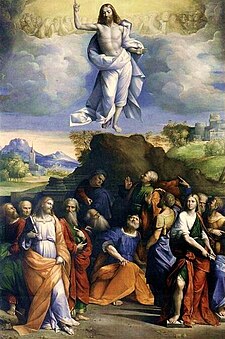
  • “He Will Come Again” — An Ascension Sunday Sermon

    I preached two weeks ago at my church, Bellingham Covenant Church. Normally the audio of every sermon goes up on the church web site, but there were problems recording this one. For those who are interested in what I said, here are my notes:

    “He Will Come Again in the Same Way You Have Seen Him Go”
    Acts 1:6–11 and 1 Thess 4:13–18

    I’ve heard my preaching style described as “professorial.” Pay attention, because there will be a test at the end.

    Today is Ascension Sunday, which commemorates the day that Jesus ascended (went up) into heaven after his resurrection. The book of Acts says that Jesus spent 40 days after his resurrection with his disciples. 40 days after Easter was actually last Thursday, but since none of us were here, we can celebrate today. We’re going to celebrate Jesus’ ascension by talking about his return.

    1 Thessalonians is Paul’s earliest letter that we have. He wrote it to the believers in Thessalonica, a church he had founded on his second missionary journey. They had apparently asked Paul a question about what happened to those Christians who died before Jesus’ return. They were concerned that those who had died would miss out in some way. Paul is NOT interested in giving a precise timeline about Jesus’ return. That’s sometimes what we want when we come to this passage & others like it, but Paul doesn’t tell us. This passage breaks down into two broad categories.

    1. Paul encourages the Thessalonians regarding those who have died:

    Verse 13 He doesn’t want them to mourn like those who have no hope.

    Paul doesn’t say all mourning is bad. Jesus himself mourned at the grave of Lazarus.
    “Those who have no hope” are the pagans, who did not believe in resurrection. Some believed that the dead continued in some kind of existence, but it wasn’t anything to look forward to. A letter from the second century AD, addressed to a couple who had lost a son by a friend of theirs who had suffered a similar bereavement herself, says, “I sorrowed and wept over your dear departed one as I wept over Didymas, … but really, there is nothing one can do in the face of such things. So, please comfort each other.”

    Verse 14 the dead in Christ will be raised in the same way Jesus was raised.

    The Christian hope is in resurrection. There are two kinds of hope. When I was first getting to know my wife, I hoped we would be able to start dating… Fast forward to when we got engaged. I hoped we would get married, but it was a different kind of hope. It was based on a promise we had made to each other. Christian hope is the latter kind of hope. It is based on Jesus’ promise.

    Verse 18 Paul wants them to comfort one another with the words he says.

    That is the main point. This text doesn’t tell us all we want to know b/c telling us everything is not the point of the text.

    2. Paul sets forth in very broad strokes the way Jesus’ return will happen:

    Verse 16 The Lord Jesus will come down from heaven.

    Is heaven “up there” somewhere? No, it’s an alternate reality where Jesus lives and reigns now. In the ‘60s, Nikolai Kruschev said about the Soviet Union’s first cosmonaut, “He went into space, and he didn’t see God anywhere.” You wouldn’t expect to. Heaven isn’t a place in the physical universe. When we “go to heaven,” we don’t sit on clouds and play harps. We are just fully present in the place where Jesus reigns. Eventually, Revelation tells us there will be a new heavens and new earth where Jesus’ reign will be open and explicit.

    Verse 16 The dead in Christ will rise first.

    Are they currently with Jesus or not? It seems they are, in some way. The Bible is clear that those who die in Christ are immediately in Jesus’ presence. Jn 8:51: “whoever keeps my word will not see death.” We don’t know when they get resurrection bodies, or how long this intermediate state is. The Bible is not interested in giving us this information.

    Verse 17 The ones still alive will be caught up and meet the Lord in the air.

    The word for “meet” is a term (apantesis) used 2 other times in the NT. When a dignitary paid an official visit to a city, they would send out a delegation to meet him. Then they would turn around and escort him into the city:

    • Matt 25:6; parable of the ten virgins. They go out to meet the bridegroom and escort him to the banquet.
    • Acts 28:15; Paul approaching Rome. Roman Christians come out to meet him and escort him to the city.

    Is that what Paul is getting at? He isn’t specific enough. I can only say it’s a possibility.

    Verse 17 So we will be with the Lord forever.

    The important thing is being with Jesus forever, along with those who have died in him. We don’t know how long this “meeting in the air” will be. Eventually we will all have resurrection bodies (Phil 3:20-1) and live on the new heavens and new earth.

    3. What does this mean for us? I have one application:

    We have hope in Jesus. Jesus is our only hope. We’re not going to save ourselves, and we’re not going to save the world ourselves. Hope in Jesus works itself out both on a social level and on an individual level.

    Social Level: Too often we adopt Viking Christianity: we go around in this big boat, the Church. Sometimes we come ashore, find the nearest village, and raid it, tossing a few people over our shoulders and hurrying back to the boat so their souls can be saved. But acting this way shows a limited view of how God is moving in the world.
    Here is a different model: A few years ago there were many commemorations of the 20th anniversary of the fall of the Berlin Wall, and each one proposed a theory about why the wall fell when it did. One article focused on spiritual influences:

    “The many anniversary celebrations, documentaries and discussions now underway across Germany seem to focus mostly on how fearless street protesters and astute politicians pulled off the “peaceful revolution” that ended communism. Films and photos of dissidents packed into the Gethsemane Church in East Berlin or Leipzig’s St. Nicholas Church, the leading houses of worship that sheltered them until the Wall opened, are among the trademark images. But those crowded “peace prayer” evenings were only the tip of the iceberg of behind-the-scenes work by pastors and lay people who considered it their Christian duty to promote civil rights and human dignity in a rigid communist society.”

    This is hope in Jesus as it is worked out on a social level.

    Individual Level: A lot of people are without hope in this world. This is why you see an increase of people who believe in things like reincarnation. People don’t like to believe that death is the end. But reincarnation is ultimately a hopeless teaching. The idea behind it is that if you are good enough in this life, you get to advance to a higher life form in the next life. Well, who is going to guarantee that you’re good enough? Who is going to guarantee that you’re going to pass the test? This is like going to the gym and getting on a treadmill with no guarantee that you are ever going to get off. Jesus is the only true source of hope.

    I mentioned that there would be a test at the end; here is the test:

    What we need to do to pass this test is live a life that makes us acceptable before God. If we pass the test, we get to be raised from the dead and live forever in the new heaven and new earth. Since God is perfect, he requires that we get a perfect score. The bad news is, we’re not prepared. Some of us didn’t study at all. Others of us studied really hard, but we were studying the entirely wrong subject. The good news is, Jesus took this test for us, and he aced it. If we take his “A” instead of the “F” that we were going to earn on our own, we pass, and we get to live forever with him. That’s our only hope.

  • Road to Emmaus: Your Typical Post-Easter Sermon

    It has taken me a while to get around to it, but the audio of the sermon I preached the week after Easter can be found here. It is on Luke 24:13-35, the story of Jesus appearing to his disciples on the road to Emmaus. I titled it, with apologies to Marcus Borg, “Seeing Jesus Again for the First Time.”

  • Matthew 13:1-23 – Listening that Leads to Living

    I preached this sermon on April 25 at Bellingham Covenant Church, as part of a series on Jesus’ parables. These are my notes, and not necessarily exactly what I said.

    We are spending Easter season this year focusing on Jesus’ parables. Today we will look at the Parable of the Sower, which is a parable about parables. Jesus here talks about why people respond the way they do to his teaching, and he does this by saying that there are four groups of people represented by four different kinds of dirt. Jesus goes through these dirts progressively, from least receptive to most receptive.

    As I go through these kinds of dirt, I want you to recognize that we’re all one kind of dirt. The question to ask ourselves is, “What kind of dirt are we?”

    Soil 1 – This is the soil along the path, on which the seed falls but birds take it away.

    These are the people who don’t understand. Some people think that this is a passage about predestination. These people couldn’t understand because they had no choice but not to understand. God decided before they were born that some people would understand and some people wouldn’t, and too bad for the people who don’t. After all, Jesus says in verse 11, “the secrets of the kingdom of heaven have been given to you, but not to them,” doesn’t he?

    But I don’t think this passage is about God condemning people unfairly. Jesus wants people to hear his message, and when we look at Jesus we see what God is like. I think we get a clue of what this parable is about based on where it is placed in Jesus’ ministry. Matthew, Mark and Luke all have this parable, and they put it in slightly different places, but they all have one thing in common: they start out talking about how everyone responded positively to Jesus’ teaching, then Jesus starts to encounter some opposition from religious leaders, and then – the parable of the sower.

    This means, I think, that Jesus isn’t deliberately trying to keep people out. He is trying to explain why some people respond to his message and some don’t. The ones who don’t, the ones who are the first kind of dirt, are people who have hardened their own hearts. They decided that Jesus can’t teach them anything, so they don’t listen. The difference between the disciples and the people who didn’t understand isn’t that the disciples were so smart (If the gospels teach us anything about the disciples, it is that they were certainly not the smartest). It’s that the disciples cared enough to stick around for the explanation! Anybody could understand parables if they think they have something to learn. The focus here is not predestination, but revelation. God has revealed himself. How do people respond? Today, just like in Jesus’ day, some people are receptive to learning more, but others are just not interested. They think they have it all figured out. They trust their own wisdom, and don’t feel like they have anything to learn. The way to avoid being this first soil is to be receptive. You don’t have to have it all figured out. Just be receptive to Jesus and what he wants to teach you.

    These next two kinds of dirt that end up responding negatively actually start out positively. We in the church need to pay close attention to them.

    Soil 2 is the soil that is shallow. The seed springs up, but is quickly withered by the sun because of shallow roots. These people start out hearing the message with joy. But we find that hearing with joy is not enough. Trouble and persecution cause people to drop out if they have no roots. Fortunately we live in a place where there is no official government persecution of Christians. But it is still possible to be looked down on for being a Christian, and this can sometimes be the case. It’s not popular to believe that following Jesus is the only way for people to be saved. It’s also not popular to believe that there is even a need for people to be saved. This kind of persecution can happen to anyone, but I especially want to highlight those people who are raised in the church, but fall away once they move out of their parents’ house. I want to tell you my story, and contrast it with the story of others.

    I grew up in a Christian home, and we went to church every Sunday. When I was 11, I accepted Jesus as my savior and was baptized. But as is the case with many people, my teenage years were difficult ones. My parents divorced when I was 13. I had a lot of the same problems many teenagers faced: I lacked self-confidence, I had acne. I didn’t have a great relationship with my parents because I had lost my trust in them. When I was 16 I got my first job. It was nice to have a little money, and the more I worked, the more money I got. At first I didn’t work on Sundays because I would go to church, but after a little while I started working on Sundays. They were between youth pastors at the church, and they had been for a couple of years. I didn’t feel like anyone would miss me there if I didn’t go, so I stopped and started working on Sundays instead.

    But after several months, I came to a point where I felt I had to make a decision. I still considered myself a Christian, even though I didn’t go to church and rarely read my Bible. I decided that either I was going to give up on Christianity, or I was going to start living it – which meant going back to church, praying, trying to grow closer to God and find out what he wanted me to to with my life. And what it came down to for me was Jesus. I couldn’t give up on Jesus. I didn’t trust my parents anymore, and I didn’t feel that people at church cared about me all that much, but I had to stay a Christian because I loved Jesus and I knew that he loved me, even if I didn’t feel loved.

    That was a turning point for me. I went back to church, got to know the new youth pastor, and when I went to college, I decided that I wanted to seek out a group of Christians on campus that I could be a part of. When I got to school, I found out that my RA was a Christian who was active in InterVarsity, so I joined InterVarsity, went on retreats, went to Bible studies, and eventually led a Bible study.

    The more time I spent at college, the more I met people who had very similar backgrounds to mine. They were raised in Christian homes, going to church every Sunday. But when they got to college, they stopped going to church. In fact, they stopped having any sort of community with other Christians. They weren’t involved in InterVarsity or any of the other Christian student groups on campus. Some of them spent most weekends drunk at parties on Fraternity Row.

    What’s the difference between them and me? Am I smarter? Did my parents work harder than theirs? Did my church work harder than theirs?

    No.

    The only difference between us is that, for some reason, my roots went deeper. Does this mean that there’s no hope for them? Not at all. I still think that God is working on everyone. I still think that they can soften their hearts. I still pray that they do.

    Soil 3 is the soil on which the seed grows up, but is eventually choked by thorn bushes. We’re moving farther up the ladder of accepting Jesus’ message. These people can make it through the persecution, no problem. In their early days they maybe go out evangelizing on street corners, and they go on mission trips – but then something happens. Maybe they get married; maybe they get a nice house; maybe they get a mortgage; maybe they have to save up to send their kids through college. They start to worry about the future. They try to get as much money as they can to ensure that bad things don’t happen to them.

    In other words, they turn into respectable, middle class people. Worries and the deceitfulness of wealth trip them up and they become unfruitful.

    Notice Jesus’ choice of words: unfruitful. He doesn’t say they stop going to church. He doesn’t say they stop calling themselves Christians. He says they stop producing fruit. Their faith doesn’t show itself in good works, which means they really don’t have faith at all.

    Soil 4 is the soil that produces fruit. These are the people who don’t just hear, but understand. Hearing with understanding is enough, Jesus says in verse 23. What is hearing with understanding? Hearing that leads to action. Listening that leads to living. That is what Jesus wants from us.

    New Testament scholar Klyne Snodgrass, whose book Stories with Intent is a wonderful resource on Jesus’ parables, says this: “Churches should not be complicit in allowing people to think an initial response unaccompanied by productive living is saving faith” (176).

    This parable encourages us to internalize the seed so that it affects everything we do.

    So what does the seed represent? Jesus says it is God’s Word. When we as Christians think of God’s Word, we think of the Bible – and rightly so, since we believe that it is inspired by God and that he still uses it to speak to us today. But in Jesus’ day the Bible didn’t exist yet. When Jesus uses the phrase “God’s Word,” he’s referring to revelation – not the last book of the Bible, but God revealing what he is like. Jesus’ person and message are the word that he is speaking about.

    And Jesus’ message is that he is God in human form, and it is his job to set the world right. God has given him authority to teach, to work miracles, and to forgive people of what they have done wrong. When he was crucified, he served as a sacrifice that brought about forgiveness, the same way sacrifices worked in the Old Testament, only better. Because this time, God was sacrificing himself in order to forgive people. Because forgiveness always hurts. And when Jesus rose from the dead, God vindicated him. Jesus’ resurrection was God’s way of saying, “He was right. He really was speaking for me, and acting for me.” And if you listen to him, and trust him, and understand to the point of staking your whole life on him, you too will have life in the same way that Jesus now has life. That’s the seed.

    There were a lot of people in Jesus’ day who heard his message with joy. But they never let their hearing turn to action. They didn’t let their roots go deep into God’s Word and a community of disciples. They let themselves get distracted. We run the same risk today. Pride, persecution and the deceitfulness and distractions of wealth can keep us from being fruitful.

    I’ll close with another quote from Klyne Snodgrass, because he says it so well:

    “The parable is about hearing that leads to productive living, and adapting the parable will mean enabling people to move past merely hearing words – even with joy – to hearing that captures the whole person. People think they can look like giant oaks without putting down deep roots. When they realize how much effort it takes to put down deep roots, they too often settle for being bramble bushes” (176).

    In the words of Jesus: Whoever has ears to hear, let them hear.

  • Easter Sunrise Devotional 2010

    Easter Sunrise Service / 7:30 a.m. / 4-5-10 / Bellingham Covenant Church

    When I was asked to share a devotional for this service, I tried to think of a funny story about an Easter celebration from when I was young.

    I wasn’t able to think of one.

    But I can share with you what Easter meant to me as a child:

    Every year at church, they would give the children colored hard-boiled eggs. I remember sitting in the pew for the rest of the service, cradling the cool egg in my hands. I don’t really remember any of the Easter sermons I heard growing up.

    But my parents made sure that I understood what Easter was about. Although I did participate in things like Easter egg hunts, my parents always emphasized that Easter was about Jesus’ resurrection. This began with my first birthday. My first birthday was on Easter, and my mom made me a cake in the shape of a lamb.

    Another way they did this was that instead of getting an Easter basket filled with candies, instead it would be a Spring Basket. I’d get it on March 21st, the first day of spring, instead of Easter.

    I’m glad my parents made a distinction between the ways Easter is celebrated sometimes, and the real meaning of Easter.

    We live in a time and a culture where there is a memory of Christianity, but it is very weak.

    Because it is so weak, Christian celebrations like Easter and Christmas get diluted. Christmas becomes about giving gifts to loved ones, instead of God’s gift of his Son. Easter becomes about spring as the celebration of new life in the natural world, instead of about celebrating Jesus’ conquering death with his resurrection.

    An interesting tradition that I learned about when I lived in the Czech Republic was the pomlazka. It is a whip made out of willow branches, and traditionally boys are supposed to whip girls on the day after Easter because it was thought that this brought youth and health – besides being a good excuse to flirt with girls. Another tradition is dousing people with water. This also was supposed to bring youth and health.

    Every country has traditions like these, but they don’t have anything to do with the reason why we as Christians celebrate Easter.

    So why do we celebrate Easter? There is one main reason, and two other reasons that flow out of it.

    1. Jesus conquered death. Some churches teach that Easter is about Jesus’ teaching living on in the hearts of his followers. But Paul says in 1 Corinthians 15 that if Jesus has not been raised, our faith is worthless. Sin has brought death to every human being who ever lived, and Jesus’ resurrection means that sin has been defeated. Death has been defeated. Death didn’t just take its hands off Jesus for a little while; Death’s hands were broken. This is in contrast to Lazarus, whom Jesus raised from the dead in John 11. Death took its hands off Lazarus for a while, but it came for him again. When Jesus rose from the dead, death never came for him again.

    Another way that Jesus’ and Lazarus’ resurrections were different is the kind of body they had. Lazarus had the same body he had always had, and he needed people to take the grave clothes off of him when he came out of the tomb. By contrast, Jesus had a new body that mysteriously used up the material of his old body. He was able to pass through solid objects. He didn’t need to have the stone rolled away. It was for our benefit. So we could see that he had overcome death.

    2. Jesus will raise us from the dead. Jesus’ resurrection means that if we have faith in him, we will rise from the dead the same as he did. With the same kind of body he had.

    One of my favorite Easter songs over the past few years is a song written by my friend, Ben Keyes, called “From the Grave.” The chorus goes:

    Hallelujah we will rise again
    Angels, roll the stone away
    Lord has raised his Son
    Victory is won
    He’s gonna call us from the grave

    The verses are on this same theme, of God’s raising us from the dead. One verse goes:

    I want to work in your kingdom
    Give me back my hands
    I want to work in your kingdom
    Roll the stone away for me
    I want to clap my hands in glory
    Give me back my hands
    I want to clap my hands in glory
    Roll the stone away for me

    At the resurrection, we’re not going to be playing harps on clouds. We’re going to have resurrection bodies, and we are going to be working in God’s new heavens and new earth.

    3. Jesus’ resurrection also means that what we do in our lives today matters. Matter matters. Paul talks for 57 verses in 1 Corinthians 15 about the resurrection. In the very last verse of that chapter, verse 58, he follows all that indicative with an imperative. He tells the Corinthians what all that talk about the resurrection means for them: “Therefore… stand firm. Let nothing move you. Always give yourselves fully to the work of the Lord, because you know that your labor in the Lord is not in vain.”

    I can’t say this any better than N.T. Wright said in his book, Surprised by Hope:

    But what we can and must do in the present, if we are obedient to the gospel, if we are following Jesus, and if we are indwelt, energized, and directed by the Spirit, is to build for the kingdom. This brings us back to 1 Corinthians 15:58 once more: what you do in the Lord is not in vain. You are not oiling the wheels of a machine that’s about to roll over a cliff. You are not restoring a great painting that’s shortly going to be thrown on the fire. You are not planting roses in a garden that’s about to be dug up for a building site. You are – strange though it may seem, almost as hard to believe as the resurrection itself – accomplishing something that will become in due course part of God’s new world. Every act of love, gratitude, and kindness; every work of art or music inspired by the love of God and delight in the beauty of his creation; every minute spent teaching a severely handicapped child to read or to walk; every act of care and nurture, of comfort and support, for one’s fellow human beings and for that matter one’s fellow nonhuman creatures; and of course every prayer, all Spirit-led teaching, every deed that spreads the gospel, builds up the church, embraces and embodies holiness rather than corruption, and makes the name of Jesus honored in the world – all of this will find its way, through the resurrecting power of God, into the new creation that God will one day make. That is the logic of the mission of God. God’s recreation of his wonderful world, which began with the resurrection of Jesus and continues mysteriously as God’s people live in the risen Christ and in the power of his Spirit, means that what we do in Christ and by the Spirit in the present is not wasted. It will last all the way into God’s new world. In fact, it will be enhanced there (208, italics original).

    I don’t remember any Easter sermons from when I was growing up, but I remember what my parents taught me:

    Jesus conquered death.

    Because Jesus conquered death, we will rise from the dead.

    Because Jesus conquered death and he will raise us from the dead, how we live our lives matters.