Category: sermons

  • More is Never Enough: 1 Timothy 6:6-10, 17-19

    Preached at the Lighthouse Mission (3/19/10) and Bellingham Covenant Church (3/21/10)

    Introduction: Today I’m going to speak to you on a famous passage. It is also a famously misquoted passage. Many of us have heard someone say, “Money is the root of all evil!” But that is not what the passage says. This text is not saying that money is bad. This text is all about the love of money. An interesting thing about verses 17 to 19 is that Paul doesn’t command rich people to give everything away because money is evil. He commands them to be generous, but that’s not the same thing.

    We might object and say, “Well look at Jesus and the rich young ruler. Didn’t Jesus command him to give away everything to the poor?” He did. Because Jesus always knew the right thing to say to people. But Jesus also accepted the financial support of several rich women, Luke 8 tells us.

    So this text is about the love of money, but you could also say that it is about more than that. It is about the intense and selfish desire for more of anything, which we call greed.

    Why am I talking to you about greed? Sermons on greed are for everyone, whether rich or poor. This passage is one that everyone needs to hear, because wealthy people are not the only ones who are susceptible to greed. Paul talks both about “those who want to become rich” and “those who are rich in this present world.” Greed can get into us whether we have a lot of stuff or not. Whether we’re rich or poor, the selfish desire for more can get into us and ruin us.

    Before we get into the text, I want to give you some background. 1 Timothy is a letter that Paul wrote to his young friend Timothy. Paul had left Timothy in Ephesus and asked him to take care of the church there. Paul’s advice in this letter primarily has to do with how Timothy should deal with false teachers. One thing that characterized these false teachers was that they thought they could get rich from their teaching. They were first-century versions of televangelists; they were people who said, “If you give me your money, the Lord will bless you with whatever you want!” This kind of teaching was appealing to people then, just like it is appealing to people now, because it is a half-truth. Sometimes God does reward us financially. But he never promises to do that all the time, because that is never the point. The point is we should be more interested in the Giver than in the gifts he gives.

    Paul here wants to fight against these false teachers by telling Timothy what the right attitude toward possessions is. He tells Timothy two things that I’ll draw out in this sermon: He tells him that greed is a trap, and he tells him how to keep from falling into that trap.

    First, greed is a trap. It’s a trap in at least four ways.

    It’s a trap because it warps our desires. The text calls them “foolish and harmful” desires. Here is how it works: When we get a little money, we are able to buy things we couldn’t before. That feels good. Soon we can’t live without the things we used to live without quite well. Before long, luxuries become necessities.

    John Ortberg reproduces a chart in his book, When the Game is Over, It All Goes Back in the Box. In it, he shows how in 1970, not many Americans thought things like a second car or a second TV were necessities. 11% of people thought air conditioning in their car was a necessity in 1970.
    In 2000, it was 65%. He says that “in a Gallup poll, the respondents, on average, said that 21 percent of Americans are rich.” (194) But do you know how many people said they were rich?

    0.5%

    Then Ortberg sums it up: “Everybody thinks he needs one thing to make himself rich: more.”

    In our culture, advertising promotes this warping of desires. Ads used to talk about the product: how useful it was, how superior it was to other products of its kind. You don’t see that much anymore. Today’s ads take good things: love, friendship, belonging – and tell you that you can have them if you buy their product.

    Have you ever noticed that you don’t actually see people sitting around drinking beer in a beer commercial? Instead, they show people having fun. The point is to make us think that a particular product will make us happy. But it won’t. We end up moving from one product to another, thinking that each new one will bring us happiness. It’s a trap.

    The second reason It’s a trap is because it blinds us to the truth about ourselves. I mentioned that only .5% of Americans think they are rich, and this is clearly not true. This blindness to our own situation happens without us noticing, because there’s no objective way to measure greed.

    Tim Keller, who is pastor of a church in New York, said that once he was speaking at a series of men’s breakfasts on the Seven Deadly Sins. His wife asked him one day if they advertised which ones were coming up next. He said yes. She said, “You wait. When you do the one on greed, you’ll get the lowest attendance out of all of them.”

    And she was right. Why?

    Because everyone thinks greed is a problem, but no one thinks they are greedy. We always compare ourselves favorably to others when it comes to greed.

    Jesus says in Luke 12:15, “Watch out! Be on your guard against greed!” He doesn’t say, “Watch out for adultery,” because people know when they are committing adultery.

    How do people know if they are being greedy? Nobody says, “If you make a 4 percent profit, that’s not greedy. But 5 percent, well, that’s greed!” Nobody says, “Saving up this much is not greedy, but five dollars more than that – that’s greedy.” Jesus tells us to watch out for greed because there’s no way to measure greed. And that makes it so much easier to deceive ourselves.

    We may not feel greedy, but the more we have the more we’ll start to feel self-sufficient. And when we feel self-sufficient, we feel like we’re in control, like we can handle anything that comes along. And when we feel like we are in control of our lives, we become overconfident and we lose humility and teachability.

    Jesus talked about this in the parable of the rich fool: Luke 12:16-21. We can deceive ourselves about how greedy we are just like the rich man in the parable. It’s a trap.

    The third reason It’s a trap is because it promises security but doesn’t give it. Ecclesiastes 5:12 says, “The sleep of laborers is sweet… but the abundance of the rich permits them no sleep.” We think that if we only have enough money, we will be able to relax and enjoy life. But the truth is, when we have a lot of stuff, we worry more because we have more to lose. We think that just a little bit more money will make us secure, so that nothing can happen to us. This is true, within limits. For example, If I can’t afford to pay rent this month, a little more money will keep me from getting kicked out. But we make the mistake of thinking that more money always equals more security.

    But if we look for security in our stuff, we will never feel at ease. Even if we had all we wanted, that would not guarantee that nothing bad would ever happen to us. It’s a trap.

    The last reason It’s a trap is because more is never enough. Greed is addictive. Ecclesiastes 5:10 says: “Those who love money never have enough / Those who love wealth are never satisfied with their income.”

    It’s an itch that can’t be scratched.

    It’s a desire that can never be satisfied.

    One story that illustrates all of the ways the desire for more is a trap is a story by Leo Tolstoy: “How Much Land Does a Man Need?” It’s about a Russian peasant farmer who is proud of his simple lifestyle. All he needs is some land. He says at the beginning of the story, “If I only had plenty of land, I wouldn’t fear the Devil himself!” He starts off with no land, but buys a few acres from a local landowner. But he becomes possessive, and has conflicts with his neighbors. So he moves somewhere else where he can have more land. He is successful, but he doesn’t like farming on rented land.

    So he moves again and meets some nomads who have no use for farmland. They tell him that for 1000 rubles, he can spend a day walking around a parcel of land. He can mark his path with a spade along the way, and if he can make it back to where he started by sundown, he gets the land he covered.

    He starts out, trying to get as much land as possible. But he keeps on going farther and farther because he keeps seeing land ahead that he wants. When it comes time to turn back, he has to run as fast as he can back to his starting point. When he gets there, he falls down exhausted, and the nomads congratulate him. But he doesn’t hear them, because he’s dead.

    Greed had killed him. Not quickly, but a little bit at a time.

    2. How do we avoid this trap of the desire for more?

    First, learn contentment from Jesus – Hebrews 13:5 says, “Keep your lives free from the love of money, and be content with what you have, because God has said ‘Never will I leave you; never will I forsake you.’” Note that word “because.”

    The reason why we can be content is because God is with us. We can be content because he will take care of us. We don’t have to get while the getting’s good. We don’t have to look out for number one.

    Paul says in Philippians 4:11 that he has learned the secret of being content in any and every situation. Here is a man who is writing from prison! But he had learned that godliness with contentment is great gain. The ability to be content no matter what our circumstances is real wealth.

    When we look to Jesus for our security, we can begin to use the word “enough.” When we don’t have to always worry about how to get ahead, we can relax and live with simplicity.

    The second way we can escape the trap of greed is to Learn generosity from Jesus. Once we find our contentment and security in Jesus, we can be more generous.

    We know that God knows what we need, and we can trust God for what we need, and we can give any extra resources to people who need them more than we do. But it’s hard for us to be generous on our own, because we can always find reasons to keep what we have. The way we learn generosity is to receive generosity.

    Jesus told us in Matthew 6 not to worry. Why?

    Because our Father takes care of the birds and the flowers, so he’s certainly going to take care of us. If we believe that God is in charge of the universe, and we believe that God has abundant resources that he freely gives to us, how can we not be generous? If we believe that Jesus didn’t have to become human, didn’t have to save us, but he did anyway, and gave his own life to do it, how can we not be generous?

    The more we understand how generous God is to us, the more we can be freed up to be generous to others.

    A final way we can escape the trap of greed is to put our hope where it belongs – in Jesus.

    The last part of this text tells us to put our hope in God, who “richly provides us with everything we need for our enjoyment.” God cares about our enjoyment!

    Wealth is uncertain.

    Stuff is uncertain.

    We eventually lose all our stuff, either before we die or after. The last line of Tolstoy’s story says it well: “[The man’s] servant picked up the spade and dug a grave long enough for [him] to lie in, and buried him in it. Six feet from his head to his heels was all he needed.”

    He had all this land, this stuff, and people patted him on the back because he’d earned so much. And then he died and lost everything.

    Underneath our desire for more there is a good desire: a desire to make our lives better. But if we spend our lives just trying to get more, eventually it will all be taken away.

    We need to put our hope where it belongs. Paul says we brought nothing into the world and we can take nothing out of it.

    There is one thing that can’t be taken away from us, and that is Jesus’ love and forgiveness. That’s our firm foundation. Putting our hope in Jesus is how we take hold of the life that is truly life. We can’t take any of our stuff with us, but that’s the thing – the one thing – that we can take with us.

    He is the giver of all good things, including his own life.

    Doesn’t it make sense for us to put our hope in that?
    Let us pray.
  • For Unto Us a Child is Born – Isaiah 9:1-7

    Below are the notes for the sermon I preached at Bellingham Covenant Church on November 29, 2009 – the first Sunday of Advent. As I was just beginning to prepare this sermon, I bought and started to read Darrell Johnson’s book The Glory of Preaching. Handily enough, the book included a sample outline of this very passage. So I used that as a base, modified it and expanded on it.

    Unfortunately, there will be no audio posted on the Internet, because there was a problem with the sound that day.

    Isaiah 9:2-7 – “For Unto Us a Child Is Born”

    Intro: Happy New Year! This is the first Sunday of Advent, the time leading up to our celebration of Christmas. It’s the time when we start to think about what we are celebrating, and why we celebrate it. This is a well-known text that you see on greeting cards, and that you hear in the music of Handel’s Messiah. Today we’ll talk about why it is important.

    We are going to start, though, by talking about fear. The phrase “Do not be afraid” occurs in the Bible 74 times, and it is usually God who says those words. We’re going to talk about fear today, but we are also going to talk about a reason why not to be afraid.

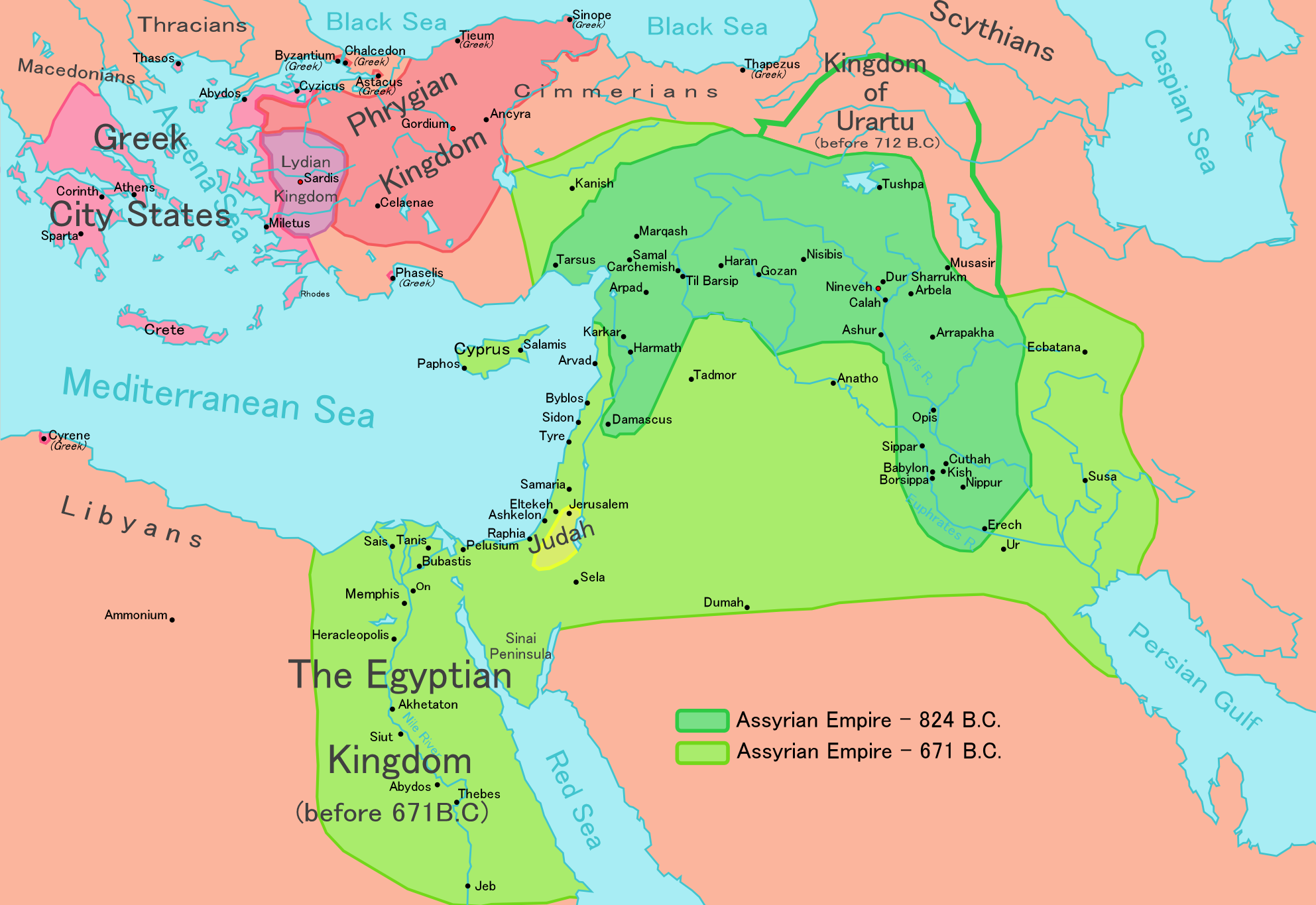
    Background: Assyria was the greatest empire at the time this passage was written. On the map, the dark green was the Assyrian territory in 824 BC. The light green was the Assyrian empire in 671 BC. This prophecy was given around 730 BC. That means the Assyrian empire had been expanding for 100 years before this, and would continue to expand for another 60 years. Everyone was terrified of Assyria, and the Northern and Southern Kingdoms of Israel (Judah, the southern kingdom, is the yellow blob on the map) were right in the middle of everything.

    Tiglath-Pileser III, the Assyrian king, took part of Galilee, which was in the northern kingdom, sometime before 731 BC (2 Ki 15:29). Ahaz, who was king of Judah beginning in 735 BC, saw what was happening to the Northern Kingdom and was afraid. Because of this fear, he adopted a pro-Assyrian foreign policy. Pekah king of Israel and Rezin king of Damascus (Aram) attacked Judah because of this pro-Assyrian policy in 735 BC (2 Ki. 16:5, 2 Chr. 28:5-15)

    Ahaz was terrified by the Syro-Ephraimite threat, and sent to Tiglath-Pileser for help (Is. 7:2, 2 Ki. 16:7-9). It is here that this passage (9:1-7) lies: about 735 BC.

    Isaiah comes to the king and says: you are not depending on God to save you. You are depending on Assyria. You want Assyria to come; well, Assyria will come, all right. He’ll come like a flood, and the waters are going to be up to your neck! (8:8). The problem with King Ahaz was that he was depending on the power of Assyria to defend him and take away his fear instead of on the Lord. He didn’t want to give God control of the situation; he wanted to keep control for himself. This prophecy was fulfilled 30 years later under Sennacherib of Assyria (ca. 704 BC) (Is. 36). He invaded Judah, and was at the gates of Jerusalem, but in the end, he mysteriously withdrew. But that is another story (found in Is. 36-37).

    But despite his message of judgment, Isaiah is ultimately hopeful. Judah has leadership that tries to keep control instead of relying on God, but these verses look ahead to a child who will be born and change everything.

    Verses 4, 5 and 6 of this passage all begin with the Hebrew word ki. It’s a “key” word. It means “for,” or “because.” The things that happen in verses 2 and 3 happen because of what we find in verses 4, 5 and 6. And they escalate, building up to verse 6, which presents the central idea of this passage: Because this Child is born, everything changes; because the son is given, there is hope in the face of fear.

    Four things happen because the child is born. Because the child is born:

    Light shines in the darkness (9:2)

    Chapter 8 ends with the words, “they will be thrust into utter darkness.” There is ultimately no hope for those who do not consult God. Ahaz wanted to do everything in his own power. He didn’t consult God because he didn’t want to depend on God. He didn’t want God to ask him for anything he didn’t want to give. He would rather rely on his own skills and intelligence. But his own skills and intelligence were not good enough.

    But chapter 9 begins with the word, “Nevertheless.” Nevertheless, God will shine a light for those who can’t see for themselves. These people did not create this light for themselves. God gives his presence, his light, to people who are groping in the darkness. They can continue to grope around in the dark, or they can walk by the light.

    Joy emerges in the gloom (9:3)

    This is an incredible contrast with what has come before. Isaiah has just prophesied destruction, and here he is talking about joy.

    The tense these verbs are in is the perfect. “You HAVE enlarged the nation.” God is giving his people hope. Even though there will be judgment, it will be followed by joy. It will surely come. Joy emerges, even in the gloom.

    Freedom breaks through the oppression (9:4)

    Why is there joy? FOR God has delivered his people from oppression. Too often, Christians think that true oppression, true bondage is to personal sin from which Jesus frees us. Other people say that Jesus came to free people from political oppression. Which one is it? The answer is: both. Jesus came to free people from bondage to sin. The main reason for the conflict between people is first that people are in conflict with God. But we can’t get right with God and act like that is the end of the story. When we love God, we have to love our neighbor. And part of loving our neighbor means participating with God in freeing people from oppression. This means fighting against human trafficking. This means fighting against poverty. There are two yokes that God frees people from. We can’t forget either one.

    “Midian’s defeat” is talking about Judges 6-7, where he delivered his people from a real-life oppressor. In case the people of Isaiah’s day didn’t believe him, he points to a concrete example that everyone would recognize: Remember when God came into this hopeless situation and freed you? He did it then, and he can do it again.

    Peace overcomes strife (9:5)

    How is God going to get rid of oppression? He’s going to get rid of war.

    Earlier in this book, Isaiah said that armies would beat their swords into plowshares and their spears into pruning hooks (2:4). But here he goes even further. Not just the weapons, but even the boots and the bloody garments will be burned. There will be absolutely no warfare.

    There is joy BECAUSE God has delivered from oppression, and he does that BECAUSE he has brought an end to war. How can this happen? Because of the son with all the names:

    Wonderful Counselor – “wonder of a counselor”
    wonder – power (as in God showing his wonders in Egypt).
    counselor – wise. The kings of Israel and Judah lacked wisdom, but this figure is perfectly wise.

    Mighty God – The person who is being talked about is none other than God in human form. He is not just a great person.

    Father of Eternity – He is father forever. Many ancient kings called themselves fathers to their people. In the ancient world, fatherhood is about taking care of people. This person will be a father, a protector, forever. Some people have difficulty thinking of God as father. When the Bible talks about God as father, it is not saying that he is a father like any other father, or even a king like any other king. He is the father that other fathers were meant to look like, and the king that other kings were meant to look like. He will protect and take care of his people forever. He will never fail. Earthly fathers fail. Earthly leaders fail. God will never fail.

    Prince of Peace – He is not the kind of prince who squashes all defiance. He doesn’t throw his weight around, like the king of Assyria. He doesn’t rely on the strength of others, like the king of Judah. He will base his kingdom on justice and righteousness, rather than violence and coercion. And he will do this forever.

    Now that we know what this child does, we can ask: Who is this child? Ahaz’s son Hezekiah was a good king, but he didn’t do all the things that this passage talks about.

    No one fits the bill until the night Jesus was born, when the sky filled with angels saying, “Do not be afraid. I bring you good news of great joy that will be for all people.” (Luke 2:10)
    Matthew makes this explicit in 4:15-16, when he describes the beginning of Jesus’ public ministry by quoting this very passage.

    If we follow Jesus and put our trust in him, this passage applies to us. So because Jesus has been born, and the government is on his shoulders,

    We can know light in the darkness.
    We can know joy in the gloom.
    We can know freedom in the oppression.
    We can know peace in the strife.

    The theme of this section of Isaiah, is “trust.” King Ahaz needed to trust God rather than his own wisdom. That is still the message for us. Where do you need to give Jesus “the government” today?

    When he is given control, everything changes. It isn’t easy. It wasn’t easy in Isaiah’s day. Even when Isaiah confronted him, Ahaz wouldn’t give up control.

    It’s scary for us to give up control, but that is because we’re selfish and have trouble trusting.
    But Jesus is trustworthy, and giving him control of all of life is the only thing that gives life.
    Invite him into the darkness. Invite him into the gloom. Invite him into the oppression. Invite him into the strife. Give him the government. His shoulders are big enough to carry it.

    “For unto us.” Because unto us. Everything can be different.

  • The Bible as Story

    Here are the notes for the sermon I delivered today at Bellingham Covenant Church. Again, these are just the notes, so they may seem cryptic at times.

    (Hebrews 1:1-2, Acts 17:22-33)

    Intro: This short sermon series (three weeks) draws on the book “The Blue Parakeet” by Scot McKnight. The title comes from a bird that he saw in his backyard one day… …he calls “blue parakeet passages” the parts of the Bible that we are uncomfortable with and don’t know what to do with.

    Today’s sermon is about how to read the Bible in the right way so there aren’t passages that we ignore because we’re uncomfortable with them. The best way to do this is to see the Bible as Story.

    The Big Story: Creation (Genesis 1-2), Crack-up (Genesis 3-11), Covenant Community (Genesis 12-Malachi), Christ Redeems (Matthew-Revelation 20), Consummation (Revelation 21-22).

    Reading the Bible as a Story is difficult, because it means that we need to know the Bible. It has to be in our bones. It has to shape our imaginations, and how we see the world. But that’s hard, and Scot McKnight in his book points out five shortcuts we take around reading the Bible as Story:

    1. the Bible as Lawbook: People come to the Bible saying, “Just tell me what to do.” The Bible does have laws in it, but when you treat the Bible as lawbook only, you distort it. Laws are ALWAYS in context. They are expressions of how the people of God are to live at a particular time in history. Examples: Exodus 20:2 – “I am the LORD your God, who brought you out of Egypt, out of the land of slavery.” Matthew 5:1-2 “His disciples came to him, and he began to teach them.”

    2. the Bible as Catalogue of Blessings and Promises – When you read the Bible as catalogue of blessings and promises, there are a lot of passages that are useless, like Job or Ecclesiastes or anything about exile. Or anything in the New Testament about persecution. When we treat the Bible as a catalogue of blessings and promises, we don’t know what to do when life gets rough.

    3. the Bible as Rorschach Inkblots – The Rorschach test is a series of inkblots, where the psychologist asks you what you see. When we read the Bible like this, we see what is in our head. Republicans think Jesus is a Republican. Democrats think Jesus is a Democrat. We see what we want to see, and ignore everything else. People who read the Bible like this open the Bible and say, “Tell me I’m OK.” They don’t want to be challenged. But the Bible should challenge us.

    4. the Bible as a Puzzle – These people cut out certain verses and organize them in stacks. In the end, the Bible doesn’t have to be read, because they already know what it says. If you read the Bible like this, you end up having to bend over backwards to explain away passages that don’t fit in with your puzzle. These people put the Bible in a cage.

    5. the Bible through the eyes of a Maestro – There are two main maestros in the Bible: Jesus and Paul. The Reformers read everything in the light of what Paul said. Martin Luther wanted to cut James out of the Bible because he was reading the whole Bible through what Paul said. We have to embrace each biblical author in order to get a sense of the whole Story. Each biblical author told his part of the story in his day in his way, and we need to listen to each of them to get a sense of what the Story is about.

    We just read two passages that show the Bible is a story.

    The first one is the author of the letter to the Hebrews saying that God speaks in various days in various ways. He spoke in Moses’ days in Moses’ ways, in David’s days in David’s ways, and so on.

    The Bible is a big Story, but in every age there are different expressions of it. It is a Big Story made up of little stories. God always speaks in a way that people can understand. Now God speaks to us in our day in ways that we can understand. He’s not too proud to come down to our level; he has never been too proud to do this.

    The key to these stories is Jesus. He is the ultimate revealing of what God is like.

    The second passage we read is Paul telling the Story to one group of people – non-Jews in Athens – in a way that they can understand.

    The next time you read the book of Acts, focus on all the different sermons. You will see that Peter, Stephen, Philip and Paul preach basically the same story, but they tell a slightly different version every time so that the people they are speaking to can understand it. When Peter speaks to Jews, he draws on the Jewish scriptures (our Old Testament) to show that Jesus is the Messiah prophesied in those scriptures.

    Here, when Paul talks to Greeks, he quotes Greek poets in verse 28. But he’s not saying, “What you believe is OK.” He speaks to people in a way that they can understand, but he challenges them by criticizing their idolatry and talking about Jesus’ resurrection.

    These two passages (and many others!) show what reading the Bible as Story is all about. It is about understanding that the Bible is a Big Story that is made up of little stories held together by that Big Story. And the only way to make sense of the blue parakeets (the passages that we don’t understand or that make us uncomfortable) is to set each in the context of the Big Story.

    In closing, I want you to take away a few points about seeing the Bible as a Story:

    1. In order to know the Bible’s story, you need to spend time with the Bible. No Shortcuts! Otherwise it won’t make sense, and there will be blue parakeets flying all over the place.

    Example: Scholars say that the book of Revelation contains over 500 allusions to the Old Testament, and not one of them is a direct quote. It never says, “Isaiah said this,” or “The Psalms said that.” John assumed that his audience would get his references. If we don’t know the Bible, including the Old Testament, we won’t understand how each book fits into the whole.

    You can read through the Bible in a year if you read about four chapters a day, or in two years if you read two chapters a day. Study Bibles are very helpful for background information.

    2. The Story continues. The last two chapters of the Bible, Revelation 21-22, tell about the end of history, and we’re not there yet. That means the church is part of the Story, and you and I are part of the Story.

    If we want to make sense of our stories, we need to know the Big Story. When we know the Big Story, we will be better able to understand how our stories fit in.

    The Story continues in the church. “Sola scriptura” doesn’t mean we should only have the Bible. It means that the Bible trumps tradition and can correct it. If we act like we are the first people to ever be able to read it correctly, we have made a mistake. This is how cults get founded.

    3. When we share the Story with others, we need to do our best to tell the story in a way that people can understand.

    Peter spoke to Jews one way in Acts 2, and Paul spoke to Greeks a different way in Acts 17. And they both told the story differently from the way the Old Testament prophets told it. They were telling the same story, but in different ways so that different people could understand it.

    Telling the story so people can understand it does not mean that we take the plot out of the story. We need to say, “Your story gets some things right, but here’s a story that gets everything right.” This is offensive to some people. We should be humble and say something like, “There are some things I don’t know about the Bible’s Story, but what I do know is true.”

    When we share the Story with other people, we need to listen to them and do our best to figure out what parts of the Story will grab them. In all this, we trust the Holy Spirit to open people’s hearts. We can’t do that. All we can do is tell the story the best way we know how: as the story of God’s rescue mission to save a hurting and broken world.

  • “A New Kind of Normal” – Loneliness

    I preached this sermon yesterday at my church. It was a difficult one to write. I think this is because it was more topical instead of being based on a single Bible passage. That made it harder for me to decide what to put in and leave out. In the end, I may have put too much in. In spite of that, my prayer is that God spoke through a fragile instrument.

    p.s. – These are my notes, slightly fleshed-out so that they make sense. Not the entire text of the sermon.

    Introduction:
    We are in the midst of a series called “A New Kind of Normal,” based on the book by Carol Kent. We are examining places where our lives are not what we would want. We would prefer for things to return to our definition of “normal.” Instead, we sometimes need to redefine “normal” based on our actual experience.

    Often when we think of people who are alone, we think of single people, divorced people and widowed people. But those are not the only people who struggle with loneliness. Married people can also be lonely. This sermon is directed toward all people who experience loneliness, whether they are single, divorced, widowed or yes, even married. The sermon is in three parts: the first looks at our experience of loneliness, the second looks at what the Bible says about loneliness, and the third presents two steps to a “solution” for loneliness.

    Our experience of loneliness

    Loneliness is a big part of our society, and it has become bigger in the last 50 years or so.

    The most recent census showed that 25 percent, or 27.2 million of U.S. households consisted of just one person. In 1950, it was just 10 percent.
    Robert Putnam wrote a book ten years ago called Bowling Alone, about the loss of community in American life. The book gets its title from the fact that the number of people who bowl in America has gone up in recent years, but the number of bowling leagues has gone down. People today are less likely to form associations with others than they were a generation ago.

    Loneliness has even become more prevalent in the last 20 years or so.
    A study in the American Sociological Review from 2006 showed that the average American had just 2 friends with whom they could discuss matters important to them. The number of people with NO close friends in 1985 was 10 percent. In 2006 – 25 percent. Another 19 percent said they had just one: their spouse.

    This may seem strange, because we have much more connecting technology now than we used to: cell phones, e-mail, Facebook. And yet people are lonely. People have an itch for community, but it’s not being scratched by how we use technology. Why is that?

    What the Bible says about loneliness

    Let’s look for an answer in what the Bible says about loneliness. If you look up “loneliness” in a concordance, you won’t find much. The Bible was addressed to a culture that was much different from our own. It’s not that people didn’t experience loneliness back then. It’s that if you were on your own, loneliness was the least of your problems. The three most vulnerable types of people in ancient societies were widows, orphans and aliens – people who didn’t have the support structure of family.

    But the Bible does have something to say about loneliness. Let’s begin at the beginning. You may want to write these passages down to look at later.

    Genesis 2:18
    In the beginning, God made Adam, the first human, and put him in the Garden of Eden. After he put him there, God said, “It is not good for man to be alone.” Then, after having Adam look at and name all the animals, God created woman.

    Then along came the serpent and convinced them to eat of the Tree of the Knowledge of Good and Evil, which God had told them not to do. Then come the events of Genesis 3:8-13. They hear God coming, and for the first time they hide. They are alienated from God. Adam blames the woman, the woman blames the serpent, and the serpent didn’t have a leg to stand on, as the old joke goes.

    The roots of loneliness are right here: because our ancestors suspected God was not working in their best interests, there is now a loss of intimacy between humans and God. Our natural inclination now is to be alienated from God and from other people. Is it any wonder that people struggle with loneliness?

    Leviticus 13:45-46
    In the rest of the Old Testament, from time to time you see people who have lost family or community. Here in Leviticus, people with leprosy or other skin diseases are told they must live alone. This gives new meaning to the fact that Jesus healed lepers in his earthly ministry. Part of his purpose was to restore community. But we’re getting ahead of ourselves.

    1 Kings 19:1-5a, 13b-18
    Here we see the prophet Elijah after he had killed 450 false prophets. Despite this great victory, he was afraid of Jezebel and ran away. This is a kind of loneliness that was his own fault. He was not really alone, but he had pity on himself and was afraid of the queen more than he was afraid of God.

    The Psalmist’s loneliness: Psalms of Lament. Two good examples: Psalm 88:8, 15-18, 102:1-11. In psalms of lament, the psalmists feel abandoned by God and by other people. So far we’ve seen at least two kinds of loneliness: sometimes loneliness happens because community is taken from us, but sometimes loneliness happens because we are feeling frightened and sorry for ourselves.

    New Testament loneliness: Jesus did not experience loneliness for most of his life. The only time he experienced loneliness was on the cross. In Matthew and Mark’s accounts of the crucifixion, Jesus calls out, “My God, my God, why have you forsaken me?” He is quoting the opening of Psalm 22. Jesus was experiencing a distance from his Father that he had never known. Jesus always referred to God as his Father, but here he uses the less intimate term “God.” At the end of Psalm 22, the psalmist is vindicated by God, and Jesus knew that he, too, would be vindicated by his resurrection. All the same, he experienced abandonment on the cross, even if he knew it was temporary.

    2 Timothy 4:9-18. The final stop on our tour of loneliness in the Bible has us look at Paul’s loneliness at the end of his second letter to Timothy. Paul is in prison and writes to his protege Timothy toward the end of his life. He expresses the desolation that several of his friends and associates have left him. He knows that God is always with him, but that doesn’t take away the pain of being betrayed and deserted by humans.

    So what do we learn from this crash course in what the Bible says about loneliness? We learn that:

    1. Loneliness is a result of alienation from God and other people.
    2. Loneliness can happen because of self-pity and self-absorption (as in the case of Elijah).
    3. Loneliness can happen because we lack a community, or have been abandoned by our friends (as in the case of Paul).
    4. Loneliness can happen if we feel abandoned by God.

    The “solution” to loneliness: moving from loneliness to solitude with God and from solitude to community.

    “Solution” is in quotes because there is no permanent solution to loneliness in this life. It is part of the human experience. Even if we go through long stretches where we don’t experience loneliness, none of us is completely immune.

    Some of you may ask “Why isn’t marriage a solution to loneliness?” Two reasons: First, we’re not in the Garden of Eden anymore. Even if we get married, it’s still possible to feel lonely. Loneliness has a lot to do with our expectations of other people. If we expect a marriage partner to ease our loneliness and make us feel good all the time, we are going to be disappointed. Second, not everyone is going to get married. I don’t want to present marriage as a solution for single people, because we will not all experience marriage.

    The first step in the “solution” is solitude. When we’re lonely, the biggest temptation is to distract ourselves. We call or e-mail people; we check our Facebook. But the way to make loneliness productive is to turn that loneliness into solitude. We need to go into the desert of loneliness and turn it into a garden of solitude. Henri Nouwen wrote,

    “When we live with a solitude of heart, we can listen with attention to the words and the worlds of others, but when we are driven by loneliness, we tend to select just those remarks and events that bring immediate satisfaction to our own craving needs.” – Henri Nouwen, Reaching Out

    When we are lonely, we are restless and unhappy, and we reach out to other people in order to have them meet our needs. When we are in solitude, we are content, we are listening to God, and we are able to listen to, care for and be present with people. What does solitude look like? Jesus gives us an example. He often sought solitude with his Father:

    Mark 1:35 – “In the morning, while it was still very dark, he got up and went out to a deserted place, and there he prayed.”
    Luke 5:15 -”Jesus often withdrew to lonely places and prayed.”
    Luke 6:12 – “One of those days Jesus went out to a mountainside to pray, and spent the night praying to God.” Jesus led a very busy life, but always made time for solitude. When we’re lonely, shouldn’t we at least ask ourselves: am I reaching out to people for selfish reasons? Do I need solitude with God right now?

    There are lots of ways to practice solitude. Spending daily time in prayer is one. Setting aside regular time to go on silent retreats is another. People who are really experienced with solitude can do it even in the midst of people. Richard Foster wrote:

    Solitude is more a state of mind and heart than it is a place. There is a solitude of the heart that can be maintained at all times. Crowds, or the lack of them, have little to do with this inward attentiveness. It is quite possible to be a desert hermit and never experience solitude. But if we possess inward solitude we do not fear being alone, for we know that we are not alone. Neither do we fear being with others, for they do not control us. In the midst of noise and confusion we are settled into a deep inner silence. Whether alone or among people, we always carry with us a portable sanctuary of the heart.” – Richard Foster, Celebration of Discipline

    The second step in the “solution” is moving from solitude to community. And it’s really a two-step. We go from solitude to community, then back to solitude then back to community.

    The Bible tells us that God’s people ought to be a community that reaches out to the lonely. God’s people ought to be a family:
    Matthew 12:46-50 – Jesus: “Whoever does the will of God is my brother and sister and mother.”
    John 19:26-27 – Jesus on the cross: “here is your mother,” and “here is your son.”
    Acts 2:45-47 – “All who believed were together and had all things in common; they would sell their possessions and goods and distribute the proceeds to all, as any had need.”
    Galatians 6:10 – “let us do good to all people, especially those who belong to the family of believers.”
    Eph. 2:19 – “you are members of the household of God.”
    The early Christians knew this. When there were plagues in the cities of the Roman Empire, nearly everyone cleared out, except for the Christians. They stayed behind to take care of the sick and dying, whether they were biological family or not. Julian the Apostate at one point wrote to his pagan priests, saying that Christians put them to shame because Christians took care of everyone. The reason why pagan priests couldn’t do this as naturally is because their gods didn’t humble themselves and die like outcasts.

    Julian’s question to the pagan priests is a good question for us in the 21st century: “Why can’t we do the same thing?” We need to look to Luke 5:12-16 for guidance. Like the leper, we need to turn to Jesus to heal us from sin and the things that make us lonely, whether it is our self-pity, or whether we have been abandoned by others. When Jesus heals us, he always restores us to community. We always go from loneliness to solitude, and from solitude to community.