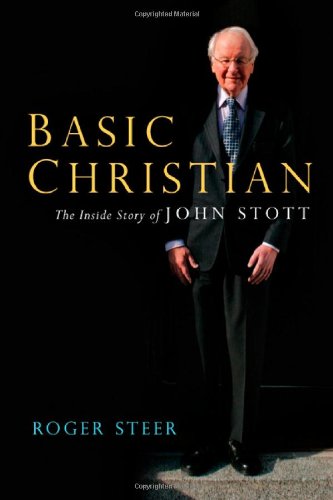
 John Stott had gradually slipped off the world stage over the last few years. But when he died at the age of 90 this past July, suddenly he became an object of conversation. He was without peer as an evangelical Christian leader in Britain and the world. It is a testament to his talents as a bridge-builder that tributes to him came from all over the world and all over the spectrum of political and religious belief. There was even a tribute from Nicholas Kristof in the New York Times. Reading it, I was reminded that David Brooks had said in the same newspaper in 2004 that “if evangelicals could elect a pope, Stott is the person they would likely choose.”
This biography by Roger Steer was written in 2009, and was based in part on conversations with Stott and several of his friends. It traces Stott’s life from his early days as the son of a prominent physician, to his days at Cambridge and his decision to become a pastor, to his time as curate and rector of All Souls in London and his rise to international prominence. It gives details about his many travels, his contributions to the evangelical Christian movement and his friendships with other well-known people.
In it, Stott comes across as a man with a gift for friendship, a sharp mind, a sense of humor and a deep commitment to Jesus as Lord of all of life. The book is not afraid to present Stott “warts and all,” but there really aren’t many warts. Despite his gift for friendship, Stott could be reserved. With his great intelligence and disciplined lifestyle, he could sometimes be impatient with those who were more sloppy in their thinking or less disciplined in their living than he was. However, he was a man who was conscious of his faults and humble enough to admit them.
Stott has long been a hero of mine, and this book did nothing to change that. If anything, it made me miss Stott even more. He was able to remain biblically faithful and speak charitably with those whom he disagreed. The latter characteristic is in especially short supply these days, both in the church and the world. I’d recommend this book to anyone who is interested in Stott’s life, especially those who might be intimidated by Timothy Dudley-Smith’s larger two-volume biography.


 I have been a fan of G.K. Chesterton ever since I picked up a copy of Orthodoxy while I was in college. Since then, I’ve read several books by or about him, including The Man Who Was Thursday, The Everlasting Man, St. Thomas Aquinas, Francis of Assisi, The Napoleon of Notting Hill, Joseph Pearce’s biography Wisdom and Innocence, Garry Wills’s literary study, and several of the Father Brown stories.
 This is the second book that I have read in the Christian Encounters series from Thomas Nelson, and I must admit that the idea behind the series is a good one: short biographies of well-known people, with an emphasis on their Christian faith. The first book in this series that I read was Peter Leithart’s biography of Jane Austen.
 Elliot Ritzema