June 22, PM
This is the ninth post in a series of reflections on my recent trip to Israel (to read them all, click here).
Our group’s last stop of the afternoon, before getting on the bus and heading north along the Jordan River Valley to Galilee, was at the top of a windy hill. To the south you could see the city of Arad. It turns out what used to be on top of that hill was a southern Judean border town also called Arad. It is not unusual for a city bearing the name of an ancient one to be built in the same vicinity, but not quite the same spot.
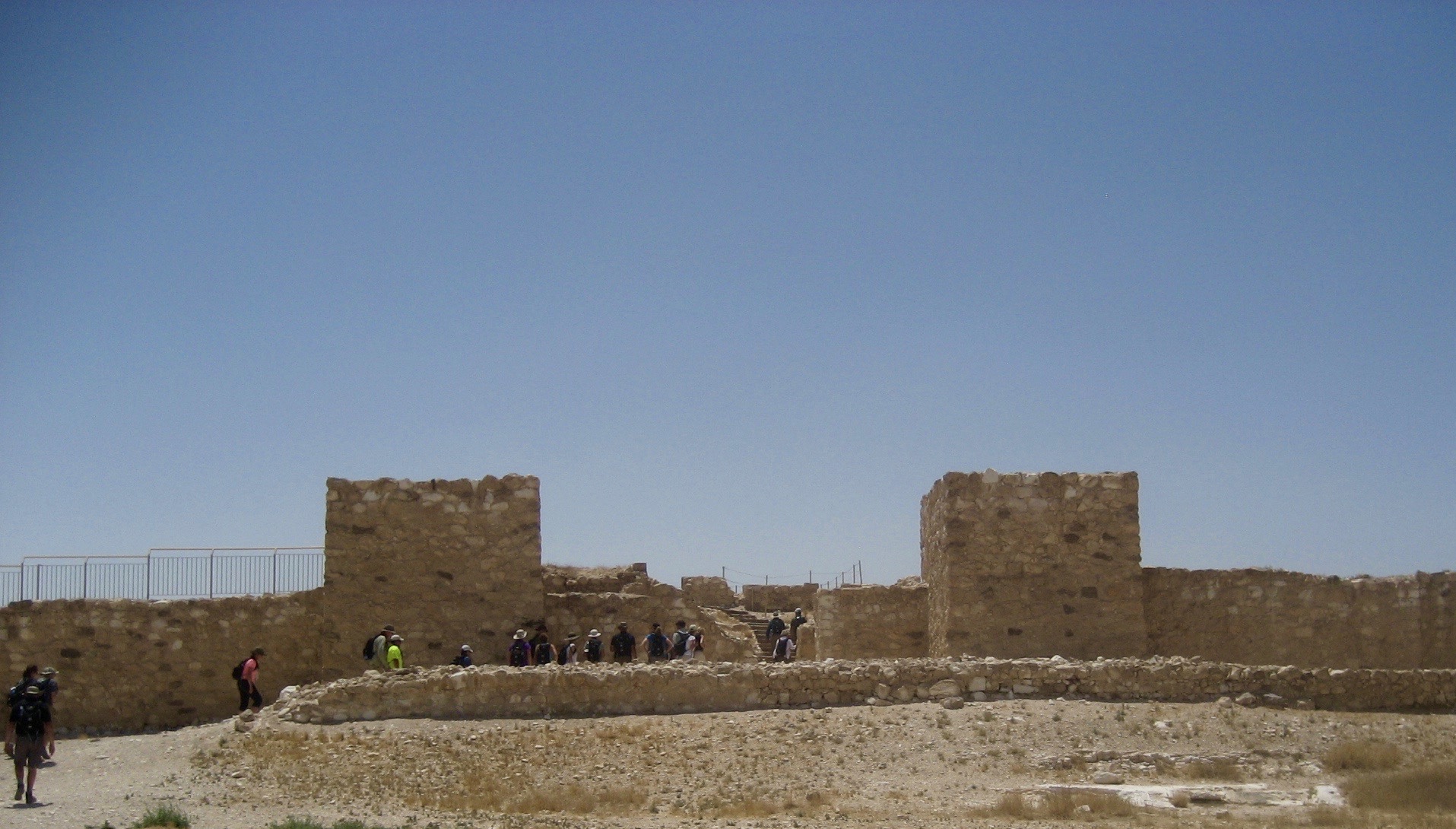 The most interesting find at Arad is a temple that bore some similarity to the one in Jerusalem. There was an altar in a courtyard (with the same dimensions as the one in Exod 27:1), a holy place, and a holy of holies, where a tablet and two small incense altars were found. This temple, which seems to have been dedicated to the worship of Yahweh, was not destroyed or gradually dismantled. It was carefully buried. In the eighth century BC, King Hezekiah of Judah tried to centralize Yahweh worship in Jerusalem and put a stop to syncretism—worshiping Yahweh along with other gods. The burial may have been part of this reform, which is referenced in 2 Chronicles 32:11–12 (see also 2 Kgs 18:22; Isa 36:7; 2 Chr 31:1):
When Hezekiah says, “The Lord our God will save us from the hand of the king of Assyria,” he is misleading you, to let you die of hunger and thirst. Did not Hezekiah himself remove this god’s high places and altars, saying to Judah and Jerusalem, “You must worship before one altar and burn sacrifices on it”?

As we sat in what used to be the courtyard of this temple, our tour leader, Tim, talked to us about the ancient practice of sacrifice. Why did the Israelites sacrifice animals? I’ve never been entirely satisfied with the typical Christian answer to this question: “It foreshadowed Jesus’ perfect sacrifice.” Well, sure. The New Testament, especially the book of Hebrews, tells us that. But even though we now know these sacrifices ultimately found their fulfillment in Jesus, it’s still worthwhile to ask why the Israelites thought they were doing it. How did it make sense to them?
Tim’s answer was that sacrifices were signs and reminders of the covenant God made with Abraham in Genesis 15. Sacrifice was an aspect of covenants that was already part of ancient Near Eastern cultures. All the surrounding cultures made sacrifices to appease the gods. God included it in his covenant with Israel so they could understand what he was doing with them. He used something they knew from their culture. But as we see God doing in various other places in the Old Testament, he took up something people were familiar with and made subtle changes to it to make a point about how he differed from other gods.
One example of this is in Genesis 1:21, where God creates “great creatures of the sea.” In other cultures, these were sea monsters that represented chaos, and the same Hebrew word is translated “monster” elsewhere in the Old Testament (Job 7:12; Isa 27:1). In the Genesis creation story, though, great frightening monsters are no threat to God; he makes them cavort in the sea.

There were likely other things going on with regard to the significance of sacrifices in the Old Testament, and there are many scholarly rabbit holes to go down. I went down some of them while I was thinking about this blog post, which is why there is a gap of several days between this post and the previous one. In the end, I decided that I just couldn’t do a good job of addressing that question here.
What I’ll say instead is that Arad reminded me that God loves to contextualize. He loves to condescend, to speak to us in terms we can understand, in ways that both use and challenge our cultural patterns of thought.When it comes to sacrifice, while other cultures saw it as a way to feed their gods, it does not appear to have been the case in Israel. The one God does not need people to feed him or sustain him. He used ancient ways of seeing the world to reveal himself, but staying within those cultural thought forms was not the goal. Showing himself to people, having a relationship with them, was the goal.
This is part of the reason why Jesus had such trouble with religious authorities who were so focused on following rules that they missed the heart of God behind those rules. It wasn’t that rules were bad. Jesus himself appears to have been a good first-century Jewish man who followed the rules. The conflict lay in the fact that Jesus’ religious opponents used the rules as a means of self-justification. But even though Jesus followed the rules, people who were very different from him—people who were not good at following the rules—were attracted to him. They wanted to be with him because he was primarily focused on what the law was intended to do: reveal God’s loving heart to them. It makes me wonder: Am I adopting a cultural pattern of thought that God is challenging? How can I speak to people in a way they will understand?



 Elliot Ritzema