
When you hear the word “angels,” what do you think of? Some spiritual being that accompanies people as their guardian? The chubby cherubs from that painting by Raphael? Or do you dismiss them as credulous superstition, the product of overactive imaginations, and leave it at that?
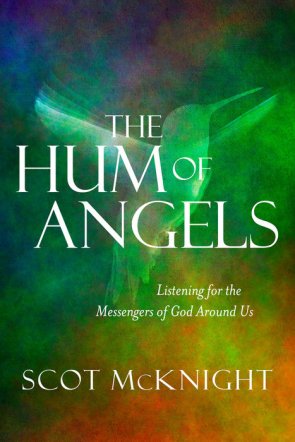 New Testament scholar Scot McKnight has set out to clear up what exactly angels are in a book published last month called The Hum of Angels. The “hum” of the title comes from a story that he tells at the outset about a visit to a pet store. He was telling the attendant that there were no hummingbirds where he lived, but the attendant told him there most definitely were. You just had to have the eyes to see them. McKnight went home determined to attune his eyes to see hummingbirds, and now he sees them everywhere.
In that way, angels are like hummingbirds. They are all around us, McKnight says, but we need to train our eyes to see them. He doesn’t set out in this book to prove to the skeptical that a spiritual realm exists. Rather, his audience is people who already believe in something beyond the physical but aren’t so sure whether angels exist or what they are. “If you believe in God,” he says, “you also believe in angels.”
But how do you know what to believe about angels? You could listen to stories about angel encounters, but without some kind of other foundation for identifying what angels are it won’t be clear whether some of these experiences really involve angels or not. As a Christian (and a biblical scholar at that), it isn’t surprising that McKnight turns to the Bible to find out what it teaches about angels. And the Bible has a lot to say about angels. McKnight puts the core of what the Bible has to say about angels this way:
God is love.
All that God does is loving.
God sends angels to us because God loves us.
Love is a rugged commitment to be With,
to be For us so that we can
progress Unto Christlikeness.
Angels are sent to express God’s love
by being God’s presence with us,
by being God’s presence for us, and
to lead us into the redemption of Christlikeness.
He spends most of the book unpacking what the parts of this statement (which he repeats, with some variations, in almost every chapter) say about what angels are. I won’t get into the specifics, but here are a few takeaways from the book:
The Bible nowhere teaches that people become angels when they die. According to McKnight, “the model for what we will be like after death is not angels but the resurrection body of Jesus—who, again, did not become an angel” (20). Just in case it needs to be said, the moment when a friend says on Facebook about a departed loved one that “heaven gained an angel” is NOT THE TIME to instruct them on this point. But in light of how widespread this misunderstanding is, I do think churches ought to make a point of teaching on it.
Not all angelic visitations are from good angels. Angels always point to God, and “angels that don’t summon us to see God are not doing God’s work” (27). Angels are messengers of God’s love, and God’s love is more than the presence of positive feelings about someone. Love, McKnight says, “has a goal.” It “is not tolerance or deciding to put up with one another or doing our best to get along. Love, if it is Christian love, leads to mutual growth into Christlikeness” (42). Angels who do not point us toward God in Christ are what the Bible calls demons, or evil spirits. So modern-day “angel experiences that do not draw us to God’s Son must be held either loosely or not at all” (125).
The Angel of the Lord in the Old Testament is not a pre-incarnate Jesus. Now, not all biblical scholars agree about this, so this shouldn’t be asserted dogmatically. But after looking at several passages, McKnight comes down on the side of believing that while “God becomes present to us in special ways in the Angel of the Lord” (85), that is not the same as saying it is the pre-incarnate Jesus.
The Bible isn’t clear about whether people have guardian angels assigned to them. It is clear that God does send angels to protect and guard and guide us, but it stops short of saying that each person has an assigned guardian angel. Basil the Great and John Chrysostom believed in guardian angels, though, if their opinion matters to you.
They probably don’t look like the chainsmoking angel on the cover of the classic Van Halen album 1984. Okay, McKnight actually doesn’t address this. But I think it’s a pretty safe assumption.
Should you read this book? There are many books about angels out there, and I honestly haven’t read many of them so I don’t know how it compares to others. But if you are curious about angels, and what the Bible says about angels is an important consideration for you (and if you are a Christian, it should), then you may find this book helpful.
Note: Thanks to WaterBrook, the publisher, for a review copy of this book. I was not asked to give a positive review.
 The problem that Scot McKnight’s The King Jesus Gospel is intended to address is that the way evangelical Christians preach the gospel doesn’t often lead to lives characterized by discipleship. Evangelical evangelism has been geared toward getting people to make decisions (“accepting Jesus into your heart”), but “we lose at least 50 percent of those who make decisions” (20, italics in original). People become “saved,” but they don’t become disciples of Jesus. Clearly, the evangelical understanding of gospel and evangelism is not leading to changed lives as often as it should.
 This is the second book that I have read from Thomas Nelson’s Ancient Practices series (the first was The Liturgical Year), and I have enjoyed both of them. The purpose of the series is to encourage Christians to incorporate ancient spiritual disciplines like sabbath, tithing or fixed-hour prayer into their lives. All of these have a rich tradition from Judaism and the early church, and modern-day Christians could benefit from having a greater exposure to them.
 1. Rich Christians in an Age of Hunger: Moving From Affluence to Generosity by Ronald J. Sider. This book came out in 1977, and is regarded by many as a “classic.” The version I read was the fifth edition, updated in (I think) 2004.
 2. Praying With the Church: Following Jesus Daily, Hourly, Today by Scot McKnight. McKnight was raised in a Christian tradition that had no use for daily set prayers, but as an adult he has come to appreciate and even love them. Like McKnight, I was raised in a Christian tradition that did not have set prayers (though we did recite the Lord’s Prayer and the “Gloria Patri” every week in church). As an adult, I have been more and more interested in the practice of daily prayer times as I have come to understand how deep they go in the Christian tradition.
 3. The Ascent of a Leader: How Ordinary Relationships Develop Extraordinary Character and Influence by Bill Thrall, Bruce McNichol and Ken McElrath. Throughout my time in graduate school, I felt that it was more important to spend my time reading deep theology books than leadership books. But as I grow closer to (hopefully) taking on more leadership in a church setting, and as I become more aware that it is rarely bad theology that gets pastors kicked out of churches, I’ve become more interested in leadership literature. Earlier this year I read Now, Discover Your Strengths, and I’ve just recently completed The Ascent of a Leader.
 4. The Blue Parakeet: Rethinking How You Read the Bible by Scot McKnight. I’d heard a lot about this little book in recent months, and when I was at the Covenant’s annual meeting in Portland this summer, I was able to pick it up. The title comes from a time when McKnight was sitting in his backyard and saw a strange blue bird that he had never seen before. Turns out it was a parakeet that had escaped from someone’s cage. The “blue parakeets” of the title are “oddities in the Bible that we prefer to cage and silence rather than to permit into our sacred mental gardens” (208). Issues like Sabbath, foot washing, tithing and women in ministry are blue parakeets that many of us don’t quite know what to do with: do we try to retrieve all practices from biblical times? Do we try to retrieve only what we can salvage for our day and our culture? Do we read through tradition? Or do we read in dialogue with tradition? McKnight counsels us to read the Bible as a Story. We should read this Story in order to get to know the God behind it. And we should discern through God’s Spirit and in the context of our community how to continue living that Story in our own day. McKnight provides an example of discernment in the issue of women in ministry.
 5. Gone With the Wind by Margaret Mitchell. I have never seen the movie version of this book, and I was surprised on reading it to find that Scarlett O’Hara is one of the more malevolent and despicable literary protagonists I have ever read about – and I have read Anna Karenina. Like Anna Karenina, the real hero of this book is someone besides the main character: in Anna Karenina it is Levin (who, I’ve heard, Tolstoy modeled after himself), and in Gone With the Wind, it seems to me that the heroine is really Melanie Wilkes. But in both books, the intended hero is far overshadowed by protagonists who are such finely written, true-to-life characters that, despite their badness, they steal the show. It’s a great credit to Margaret Mitchell that she could create such a believable character as Scarlett – even if she is so believable that I genuinely didn’t like her.
 6. The Theology of the Book of Revelation by Richard Bauckham. We have been reading through the book of Revelation in our Bible study, and I have taken it on myself to do background reading and lead the discussion. Part of that background reading has been this fantastic little book (it’s only 169 pages). Bauckham, who retired a couple of years ago from being Professor of New Testament at St. Andrews, digs into the theological content of Revelation and finds that it has perhaps the most developed trinitarian theology in the New Testament. He doesn’t spend a lot of time criticizing various interpretations of the book, but it’s clear that he doesn’t think futurist or historicist interpretations do a very good job of making sense of the imagery in the book. This is a dense little book, and it doesn’t move chronologically through the text. For those who want to read it, I’d recommend reading Revelation first to get a sense of it, then read this book, and then go back and read Revelation again with new eyes.
 Elliot Ritzema