Author: Elliot

  • Princes and Gods and Kings of Egypt: A Review

    A couple of years ago, I edited a commentary on Exodus. I had never taken the time to study the book that deeply before, and I enjoyed the experience. So when I heard that there was a new volume coming out in the Kregel Exegetical Library series on Exodus, I decided to pick it up.

    A Commentary on Exodus is by Duane A. Garrett, who teaches at the Southern Baptist Theological Seminary. He has previously published Song of Songs in the Word Biblical Commentary, Proverbs, Ecclesiastes, Song of Songs and Hosea, Joel in the New American Commentary, and A Modern Grammar for Classical Hebrew.

    He states at the outset of the commentary, “I have intentionally written this work to fill certain gaps within the literature. To this end, I have been selective and have not dealt with every possible issue” (9). So, for example, he spends a good deal of space in his introduction acquainting his readers with ancient Egypt, since he sees a lack in other commentaries in that regard. He also deals with controversial issues like the date of the exodus (he argues that the data is inconclusive, though the event did happen), the genealogy of Moses, and the locations of the Reed/Red Sea and Sinai. Even when he argues for one side over the other, I thought he still presented the other side of the debate thoroughly, so readers are able to make up their own minds. I would definitely classify him as a maximalist when it comes to the relationship between the Old Testament and archaeology.

    Each section of the commentary proper comes in five parts: an introduction, a translation of the passage with textual footnotes, the structure of the passage, a verse-by-verse commentary, and a theological summary of key points. Poems also include the Hebrew text and are broken up into stanzas. For pastors using this commentary, I think the theological summary of key points would be most helpful as they think of how to apply it to their audience. For example, in a section on the vestments of the high priest (28:1–29:37), he writes that “for Israel, the ordained means of approaching God is both personal (the Aaronic priest) and institutional (the whole Tent of Meeting complex). For Christians, analogously, the one access to God is the person of Christ and the one institution ordained by God for his worship is the church, as it was built by Christ himself (Matt 16:18)” (596). Comments like these are helpful for beginning the move from exegesis to application.

    The only complaint I have about the commentary is that the table of contents and running heads are not as detailed as I would like; readers who are looking for a particular passage will have to do some flipping to find it. But when the only bad thing you can say about a book is about small formatting issues, you know it is a very good book. I am sure that, if I am called to preach on a passage in Exodus in the near future, this will be one of the first commentaries I consult.

    Note: Thanks to the publisher, Kregel, for a copy of this book in exchange for an honest review.

  • Alcohol from A to Z: A Review

    On the day that I turned 21, some friends took me out to celebrate. Even though it is customary to have something alcoholic on the day that you can imbibe legally, on that day I really just felt like a milkshake. So that’s what I had.

    That early experience sums up my relationship to alcoholic drinks for the early part of my adult life. I liked them all right, but most of the time I could take them or leave them. I was too cheap to get the expensive stuff, and getting drunk has never been attractive to me, so I didn’t drink the cheap stuff either. But in the last few years I’ve started to take an interest in the varieties of alcoholic drinks, compare them to one another, and think about my preferences. I’ve also started to take an interest in mixed drinks, though my frugal self would really rather try to make them at home than order them when I’m out at a restaurant.

    That personal history is what drew me to The Essential Bar Book by Jennifer Fiedler. Its subtitle calls it “an A-to-Z guide to spirits, cocktails, and wine, with 115 recipes for the world’s great drinks.” It’s a nicely bound hardcover book, with definitions of everything from absinthe to zymurgy. The 115 cocktail recipes also feature a historical introduction. For example, here is the introduction for the Manhattan:

    One of the enduring heavyweights in the cocktail world, the Manhattan is something of a twist on the Old Fashioned, most likely spurred by the arrival of sweet vermouth in the United States in the latter part of the nineteenth century. The too-good-to-be-true story surrounding this drink’s origins—that it was invented at the Manhattan Club for an event with Winston Churchill’s mother as hostess—is just that: a tall tale. Although cocktail historians are still debating the subject, current theories favor either the Manhattan Club (though for an occasion not involving a British political figure) or a waiter named Black who worked in lower Manhattan in the 1870s as the source for the original recipe. There are other cocktails named for each of New York’s boroughs, but none are as popular as the Manhattan.

    You can find definitions, recipes, and even the history of various drinks and terms online, so what is the benefit of this book? I would say it is the same benefit that you get from a brick-and-mortar bookstore over Amazon: the joy of serendipitous discovery. If you know everything you’re looking for, then this book will have less appeal for you. But especially if the world of drinks is a new one to you, it is fun to browse through this book and find new recipes and terms you didn’t think to look for.

    Here is a look at the first 20 pages of the book.

    Note: Thanks to the publisher for a review copy of this book. I was not asked to give a positive review.

  • Interior Design for the Literature Lover: A Review

    I review a lot of books here, but I don’t think I have ever reviewed a book on interior design. However, I was drawn to Lisa Borgnes Giramonti‘s book Novel Interiors: Living in Enchanted Rooms Inspired by Literature by my love of classic novels. What keeps me reading a novel is mostly the plot and characters, but what makes me return to a novel again (or continue reading more works by the same author) is the setting, the world the author has created. Giramonti and photographer Ivan Terestchenko have delivered a gift for all literature lovers in this book, described on the back cover as “the ultimate book-lover’s guide to decorating.”

    The book comes in six chapters, each of which explores a different style inspired by well-known authors. Giramonti explains them as follows in her introduction:

    • In “Shall I Put the Kettle On?” I’ll give you the decorating basics that authors like Charles Dickens, Jane Austen, and Elizabeth Gaskell consider essential to a home that’s cozy and unpretentious. You’ll learn how to create the ultimate reading refuge, how to organize the perfect kitchen pantry, and why threadbare rugs have so much soul.
    • If you’re more drawn to the refined interiors of Edith Wharton, Evelyn Waugh, or Henry James, then start with “Remembrance of Things Past.” In it, you’ll discover the visual power of symmetry, why buying gold-rimmed china is something you’ll never regret, and how to live like you’re in a stately home even if you’re in a third-floor walk-up.
    • Maybe you favor an unvarnished approach to life like Thomas Hardy, D. H. Lawrence, and Willa Cather. In the “Living au Naturel” chapter, it’s all about handmade over man-made. You’ll learn why a pared-down room feels sacred, how to keep a neutral room from turning ten shades of blah, and how to set your table for a perfect rustic feast.
    • Perhaps you’re like F. Scott Fitzgerald, W. Somerset Maugham, and Beverley Nichols and love sleek interiors, geometric patterns, and lots of white and black. In “Oh, the Glamour of It All,” I’ll explain why reflective surfaces add sophistication to a space, what a great room has in common with a well-tailored wardrobe, and how to set up a classic cordial bar for your next cocktail party.
    • Do you embrace color, chaos, and the unconventional? You’re in good company—so do Isak Dinesen, Katherine Mansfield, and Lawrence Durrell. In the “Anything Goes” chapter, you’ll learn how to mix patterns like a pro, how to re-create some of Virginia Woolf’s favorite flower arrangements, and why floor cushions are an absolute must for your home.
    • If you appreciate drama in your interiors, chances are you have a little pleasure seeker in you. Head straight to the “Sometimes a Fantasy” chapter and take a cue from authors like Oscar Wilde, Marcel Proust, and Ronald Firbank. Here, you’ll discover the genius of a draped wall, how to add some theatricality to your dinner table, and ways to turn a bedroom into one that’s totally Proust-worthy. (16–19)

    The book has many lovely full-color photos, as well as numerous notes on style and quotes from classic books. This is a great hardcover coffee table book for anyone who enjoys both literature and interior design. I should point out, however, that the subtitle is clear that these rooms are inspired by literature. They’re intended to evoke the style of particular works, not to be exact replicas of particular rooms from favorite books. I think, coming at this book as a literature aficionado rather than an interior design one, actual replications of rooms in classic works would have been more intriguing to me. Nevertheless, I can see this book appealing to the right audience of people who care deeply about both literature and interior design.

    Note: Thanks to the publisher for a review copy of this book through the Blogging for Books program.

  • Taught by Children: A Review of Small Talk

    As a married man with no children, I am probably not the primary intended audience for Amy Julia Becker’s Small Talk: Learning from My Children about What Matters Most. But I had read some of her writing on Christianity Today’s her.meneutics blog as well as her own blog, Thin Places, and I enjoyed her writing style, so I decided to pick this book up.

    Small Talk is arranged chronologically, beginning when Becker and her husband Peter had two small children and she was pregnant with their third. It comes in three parts: Holding On, Letting Go, and Growing Up. Each part has several chapters with one-word titles like Christmas, Prayer, Sin, Happiness, Friendship, and Tragedy. In each chapter, Becker writes about her interactions with her children on these subjects, and what she learns from these interactions. For example, her oldest, Penny, has Down syndrome, and so in the “Disability” chapter she tries to help her middle child, William, understand what that means. In the process, she reflects on the importance of treating people as individuals rather than stuffing them into a category—we are unique in that we all have our own gifts, and we all have our own brokenness.

    Even though, as I said above, I am probably not the main audience for this book, I greatly enjoyed it. While I do not play the same roles in my life as Becker does in hers, I too enjoy reflecting on and learning lessons from everyday experiences. Becker is a thoughtful parent who is not afraid to share her weaknesses and struggles, and sprinkles in just enough humor to lighten the mood from time to time. I recommend this book to everyone, especially mothers of young children.

    Note: Thanks to Zondervan for a review copy of this book in exchange for an honest review.

  • Christian Faith in the Future: A Review of Renaissance by Os Guinness

    I have long enjoyed the writings of cultural critic Os Guinness. The first book I read of his, in college, was The Call: Finding and Fulfilling the Central Purpose of Your Life (a good time to read such a book). Since then, I’ve read Time for Truth, The Gravedigger File, A Free People’s Suicide, and two books that he compiled as curriculum material for the Trinity ForumThe Great Experiment and Doing Well and Doing Good. I haven’t agreed with everything he’s written, but he is always a thought-provoking and talented writer.

    His latest book is Renaissance: The Power of the Gospel However Dark the Times. In it, he asks the question: “Can the Christian church in the advanced modern world be renewed and restored even now and be sufficiently changed to have a hope of again changing the world through the power of the gospel? Or is all such talk merely whistling in the dark—pointless, naive and irresponsible?” I really enjoy his writing style, so here is a brief rundown of the contents with a few quotes mixed in:

    In chapter 1, he explores what he calls “Our Augustinian Moment.” He calls it an Augustinian moment because, like in the time of Augustine, he sees Western civilization beginning to crumble around us from the threats of Islamism, “illiberal liberalism,” and self-destructive Western ideas and lifestyles. Therefore, like Augustine, it is possible to see renewal. In fact, he writes that “in many ways St. Augustine throws more light on our age than Karl Marx, Sigmund Freud and all our noisy new atheists combined.” However, Guinness emphasizes that the book is “not an argument for ‘Christian civilization,’ let alone Western civilization. My supreme concern is the first term rather than the second, and therefore the church rather than civilization.” Guinness is ultimately hopeful as he ends the chapter with the challenge before us: “It is, I believe, that we trust in God and his gospel and move out confidently into the world, living and working for a new Christian renaissance, and thus challenge the darkness with the hope of Christian faith, believing in an outcome that lies beyond the horizon of all we can see and accomplish today.”

    In chapter 2, Guinness looks at the “Grand Global Tasks” before the church in the West: preparing the global south for the challenges of modernity, winning back the Western world, and contributing to the human future.

    In chapter 3, “Unnecessary, Unlikely, Undeniable,” he explores more fully what the relationship between Christianity and culture really is, and argues that it is marked by the three characteristics of the chapter’s title. He writes, “Our aim should always be to advance the kingdom of God rather than create culture. But on the other hand, Christian faithfulness will always have cultural consequences, if only as a by-product of Christians following the call of Jesus and aiming for higher and other things.”

    In chapter 4, he reveals “The Secret of Cultural Power.” The secret is that “when followers of Jesus live out the gospel in the world, as we are called to do, we become an incarnation of the truth of the gospel and an expression of the character and shape of its truth. It is this living-in-truth that proves culturally powerful.” Yet Guinness does not want to seem triumphalistic here; he emphasizes that Christianity always has a means of self-criticism, and that means is found in God’s revealed Word: “It is that supreme power and authority of the Word of God—powerful, objective and standing above the flux and flow of history and human culture—which is the true source of Christian self-criticism and the true hope of ongoing Christian renewal.”

    In chapter 5, “The Dynamics of the Kingdom,” Guinness looks at various lessons we have learned from the world about the process of cultural change, and how those lessons interact with the way of God in the world. In the world, the ideas of leaders always outweigh the ideas of followers, ideas are always more powerful when they are exerted at the center of a society, and ideas spread best through networks. But in the kingdom of God, “God himself leads, and he leads his church and his people through his Spirit.” Also, the kingdom is characterized by “surprising reversals” of the way we think things will go: “We are … always ready for the surprising voice, the far-from-obvious leader, the last-person-you-would-ever-think would be the key player. And yes, we are always ready to recognize God’s nobodies and God’s fools. For these may be the truly anointed ones prepared to be seen and treated as nobodies and fools for Christ’s sake, whom God uses far more than we who are the obvious ones for God to use.” The third feature of the kingdom way is that “distinctive culture is more often a by-product than a goal.”

    In chapter 6, the final chapter, Guinness argues that “Our Golden Age Is Ahead.” But while he is optimistic about the prospect of cultural renewal, he doesn’t ultimately put his hope there. He writes, “There is no one Christian culture and there is no perfect Christian culture, so there is no golden age behind us. Our golden age lies ahead—when, and only when, our Lord returns.” Until then, “our highest endeavors must always be regarded with realism and a wry humility.” Thus, the church goes forward best by going back first—but not to any imagined golden age: “We are talking about a return to God, not an era.” Paradoxically, by going back to God and moving in concert with his Spirit, “The Christian faith becomes the most progressive faith in history—though, and here is the crucial difference from modern progressivism, the Christian faith always has a standard by which to assess the purported progress.”

    In his concluding postscript, Guinness asks whether it is “conceivable that God will revive the Western church a third time, after it has gone cold twice.” He also asks (and in particular it seems he is in dialogue with James Davison Hunter’s book To Change the World) whether it is possible to change the world. He answers, “Yes, we can, because God can—and he has in the past, and he is doing so elsewhere in the world, and he is able to do so again even here in the advanced modern world, because God is God, and his is the last word in human affairs.” So our hope in a renaissance in the church, and by extension in the West, is dependent on whether God wants it to be so: “The time has come to trust God, move out, sharing and demonstrating the good news, following his call and living out our callings in every area of our lives, and then leave the outcome to him.”

    At the end of the book is the full text of “An Evangelical Manifesto” (2008), which Guinness helped to draft. If you have read that manifesto and liked it or disliked it, that will likely be an indication of whether you will like or dislike this book.

    As for myself, I found this to be a realistic yet ultimately hopeful book, and the hope is put in the right place. It is a helpful corrective to nostalgia for an imagined golden age on the one hand, and irrational optimism about the future prospects of Western civilization, on the other. He doesn’t wring his hands about the direction the world is headed, because he knows history well enough to see that the world has been pulled back from the edge of the abyss before. Of course, the fact that Guinness ultimately decides that our hope can only be placed in God’s will is going to make non-Christians and even some nominal Christians uncomfortable. But if you are a Christian who trusts in the character of God as revealed in the Scriptures and your own life, it is a much easier pill to swallow.

    Note: Thanks to InterVarsity Press for a review copy of this book. I was not asked to give a positive review.
  • Spurgeon and the Lazy Monk

    One of the more consistently popular posts on this blog is this one from 2012, in which I showed the two versions of Charles Spurgeon’s famous illustration that compares the gospel to a lion. In honor of the fact that the Spurgeon Commentary New Testament Letters collection is now compiled and should be on its way to customers soon, I thought I would share another one of Spurgeon’s illustrations that he told multiple times.

    The point is that being spiritual should not be opposed to being practically useful, and he told it three times. This first is from Lectures to My Students:

    To these people who never labour because they are so heavenly-minded, I would tell the story of a certain monk, who entered a monastery, but who would not work in the fields, or the garden, or at making clothes, or anything else, because, as he told the superior, he was a spiritually-minded monk. He wondered, when the dinner-hour approached, that there came to him no summons from the refectory. So he went down to the prior, and said, “Don’t the brethren eat here? Are you not going to have any dinner?” The prior said, “We do, because we are carnal; but you are so spiritual that you do not work, and therefore you do not require to eat; that is why we did not call you. The law of this monastery is that, if any man will not work, neither shall he eat.”[1]

    The second is from a sermon on Matthew 6:31–33 called “Though Condemned, Yet Commanded.”

    You have heard, perhaps, of the very pious man, who entered a monastery in order that he might spend all his time in devotion; so, when the time came for the brethren to go into the fields to work, he did not leave his cell; he was too spiritual to handle a hoe or a spade, so he continued in communion with angels. He was very much surprised, however, when the time came for the brotherhood to assemble in the refectory, that he was not called; and after waiting till the demands of hunger overcame the claims of his spiritual being, he went to the prior, and asked why he had not been called to the meal, and he was informed that, as he was so not work, it was thought that he was probably so spiritual that he could not eat; and, at any rate, the laws of the monastery did not permit him to eat until he had earned what he needed. There was much commonsense in that reply.[2]

    The third, and longest, version is from a sermon on Proverbs 20:4 called “The Sluggard’s Reproof.”

    I have no faith in that man’s religion who is lazy. He reminds me always of a certain monk, who went to a monastery, determined to give himself up entirely to contemplation and meditation. When he reached the place, he saw all the monks at work, tilling the ground, ploughing, or trimming the vines round the monastery, so he very solemnly observed as he entered, “Labour not for the meat that perisheth.” The brethren smiled, and they still continued their labours. He thought it his duty to reprove them a second time by saying, “Martha is cumbered with much serving, but I have chosen the good part, which shall not be taken from me.” However, it was taken from him, for the bell did not ring for him at the usual time for meals; and our brother, after waiting some few hours in his cell in prayer, beginning to feel certain calls within, came out, and accosting the prior of the monastery, enquired, “Do not the brethren eat?” “Do you eat?” said he; “I thought you were a spiritual man, for you said to the brethren, ‘Labour not for the meat that perisheth.’ ” “Oh, yes!” he replied, “I know I said that, but I thought the brethren ate.” “Yes,” answered the prior, “so they do, but we have a rule in our monastery that none eat but those that work. There is such a rule to be found in Scripture, too,” he reminded the monk; “Paul himself hath said it, ‘If any man would not work, neither should he eat.’ ” I think the master of that monastery acted and spoke wisely. A man must work in this life. He was sent to this world that he might be diligent in his calling, in the position in life in which God has been pleased to place him.[3]

    [1] C. H. Spurgeon, Lectures to My Students: The Art of Illustration; Addresses Delivered to the Students of the Pastors’ College, Metropolitan Tabernacle, vol. 3 (London: Passmore & Alabaster, 1905), 44.

    [2] C. H. Spurgeon, The Metropolitan Tabernacle Pulpit Sermons, vol. 52 (London: Passmore & Alabaster, 1906), 62.

    [3] C. H. Spurgeon, The Metropolitan Tabernacle Pulpit Sermons, vol. 48 (London: Passmore & Alabaster, 1902), 74.

  • Be Anxious for Nothing: A Review

    Modern Americans are able to control vastly more of our lives than our ancestors could. There is little chance of a large-scale epidemic, most of us don’t personally experience the effects of war, and while natural disasters continue, most of us are more likely to have property destroyed in them than actually lose our lives.

    But as our ability to control the world around us has grown, our penchant for worrying about the shrunken share of life that we cannot control has also grown. And for American Christians, that’s a major problem. Because God has specifically told us to knock it off.

    In her book Anxious: Choosing Faith in a World of Worry, Amy Simpson takes a clear-eyed look at our proneness to worry and provides guidance on what we can do about it. But it is in no way a how-to book. In fact, Simpson states on the first page that “it is focused less on changing behavior and more on letting God transform the way we see him—and ourselves by comparison” (9). The best thing for us to do about worry is not to follow five easy steps, but begin to see God and ourselves in the right light. The book is also not aimed at people who have anxiety disorders; Simpson specifically urges them in an appendix to not feel ashamed and to seek treatment. This book is for the rest of us who are swimming in worry so deep that we sometimes don’t even recognize when we are worrying.

    The plan of the book is straightforward. In the first three chapters, she diagnoses our problem with worry. In chapters four and five, she looks at what the Bible says about worry. In chapters six through eight, she looks at three specific things that cause us to worry: “a faulty perspective, a desire to possess and control the future, and a possessive attachment to the people and things of this world” (110). A brief final chapter asks point blank: “Who do you trust?” Perhaps my favorite passage from the book is from the chapter on faulty perspective:

    When we keep our eyes on the world around us, we see plenty of reasons to worry. And without the assurance of God’s character and his great plan for our world, there’s really no reason not to worry. Yet as believers covered by his grace and living under his promise, we are called to see, live and think differently. Choosing to worry is a sin, an act of rebellion against God, a rejection of our assigned place in the universe, a barrier in our relationship with a God who wants us to live in bold purpose rooted in his character. Worry is essentially a spiritual problem, which ultimately cannot be overcome through an act of the will—the solution is rooted entirely in who God is. (127)

    Throughout the book, Simpson points out that we need to be especially aware of those sins that are overlooked and even encouraged in our culture. That is why this book is so useful: it is a call to become freshly aware of the ways in which we subtly worry every day. I plan on re-reading it to remind me what a Christian response to worry ought to be, and I recommend it to others who need to be reminded what is real, and how foolish and destructive worry really is.

    Note: Thanks to the publisher: InterVarsity Press, for a review copy of this book.

  • ReFrame ReView: Living Out of the Christian Story

    Many Christians are wondering how their faith can possibly relate to their everyday life. Often we see our faith as private—something that we do in our spare time or on the weekends, not something that shapes how we work and play every day. Even if we do bring faith into our everyday lives, it can seem tacked on. It is as if faith is limited to certain activities, and not something that comes out of the core of who we are.Screenshot 2014-11-13 20.50.55

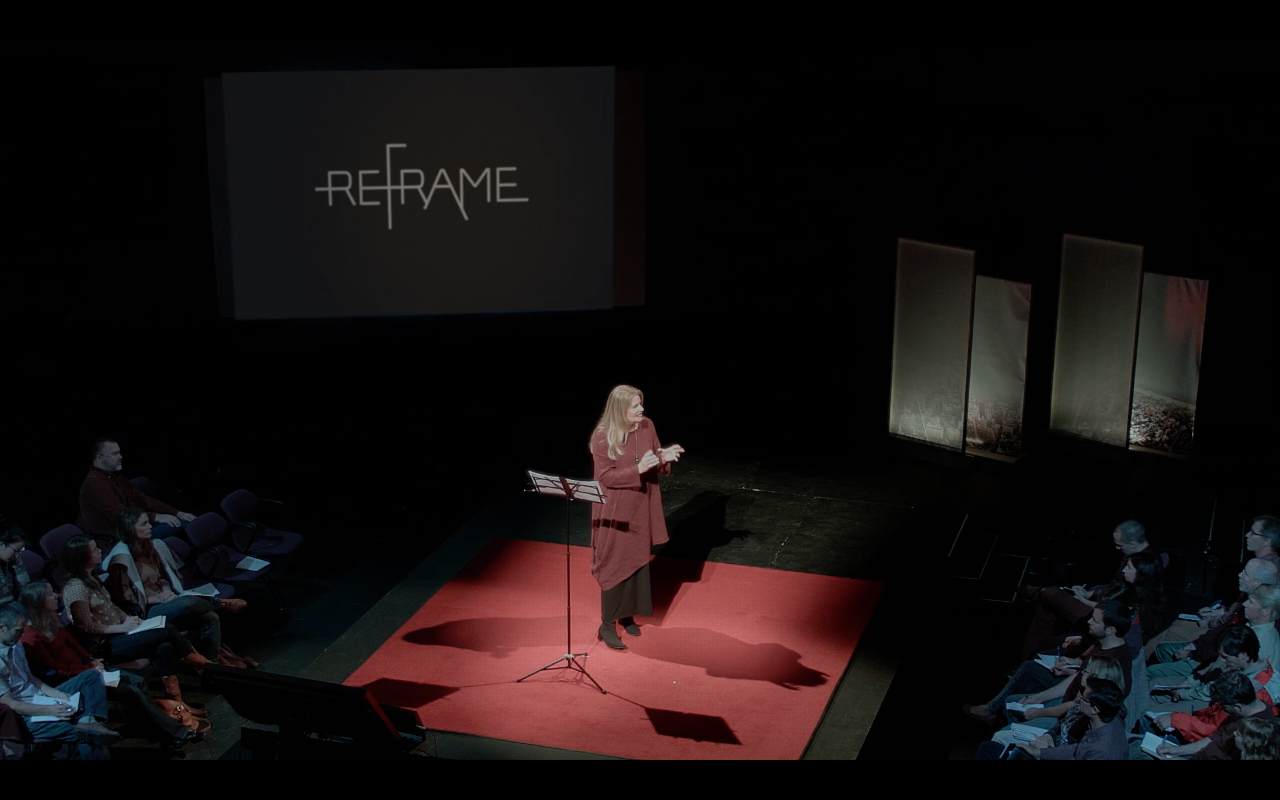
    To help us learn how faith relates to all of life, the folks at the Regent College Marketplace Institute (RCMI) have released ReFrame, a video course that explores what it means to follow Christ today. ReFrame seeks to explore how, in the words of Colossians 1:17, “in [Christ] all things hold together.” The introduction to each video in the course includes the following words, spoken by presenter Mark Mayhew:

    The life, death, and resurrection of Jesus Christ reframes everything, bringing hope, life, and meaning to every part of human culture. And yet many of us can’t see how our faith shapes much of everyday life and experience. What are God’s purposes for us? What does it mean to be made in the image of God? How do we live in the world but not of the world? We’re exploring, “How does the biblical story reframe our story?”

    The course comes in ten episodes, each about 40 minutes long. Each episode includes a TED-style talk as well as brief interviews with various people like Eugene Peterson, Scot McKnight, Ruth Padilla DeBorst, Andy Crouch, Loren Wilkinson, J. I. Packer, Krish Kandiah, Soong-Chan Rah, and Katherine Leary Alsdorf. Since ReFrame is a product of the RCMI, it is not surprising that most of these have a connection to Regent College, whether they have been professors or taught summer school courses. I was very excited about this because of my own connection to Regent (I attended there 2004–08 and graduated with an MDiv), but I think this will be exciting to a much broader audience than just Regent nerds like myself.

    The ten episodes are as follows; I’ve included the speakers in the list so you can see what an all-star cast it is:

    1. The ReFraming Story (Speaker: Paul Williams)

    2. Cultural Stories (Speaker: Sarah Williams)

    3. Creation & Fall (Speaker: Iain Provan)

    4. Israel’s Calling (Speaker: Phil Long)

    5. Jesus the King (Speaker: Rikk Watts)

    6. New Heavens & New Earth (Speaker: Rikk Watts)

    7. The Church & the Spirit (Speaker: Bruce Hindmarsh)

    8. Strangers & Exiles (Speaker: Paul Williams)

    9. Ambassadors (Speaker: Paul Williams)

    10. Joyful Living (Speaker: Polly Long)

    In addition to the talks and brief interviews, each episode also features the story of (usually one) person who is trying to live out his or her Christian faith in a particular area. For example, Strangers & Exiles features the stories of teacher George Sanker, physicist Jennifer Wiseman, and car dealer Don Flow. Here is a promo for the series, and as you can see, the production value is great:

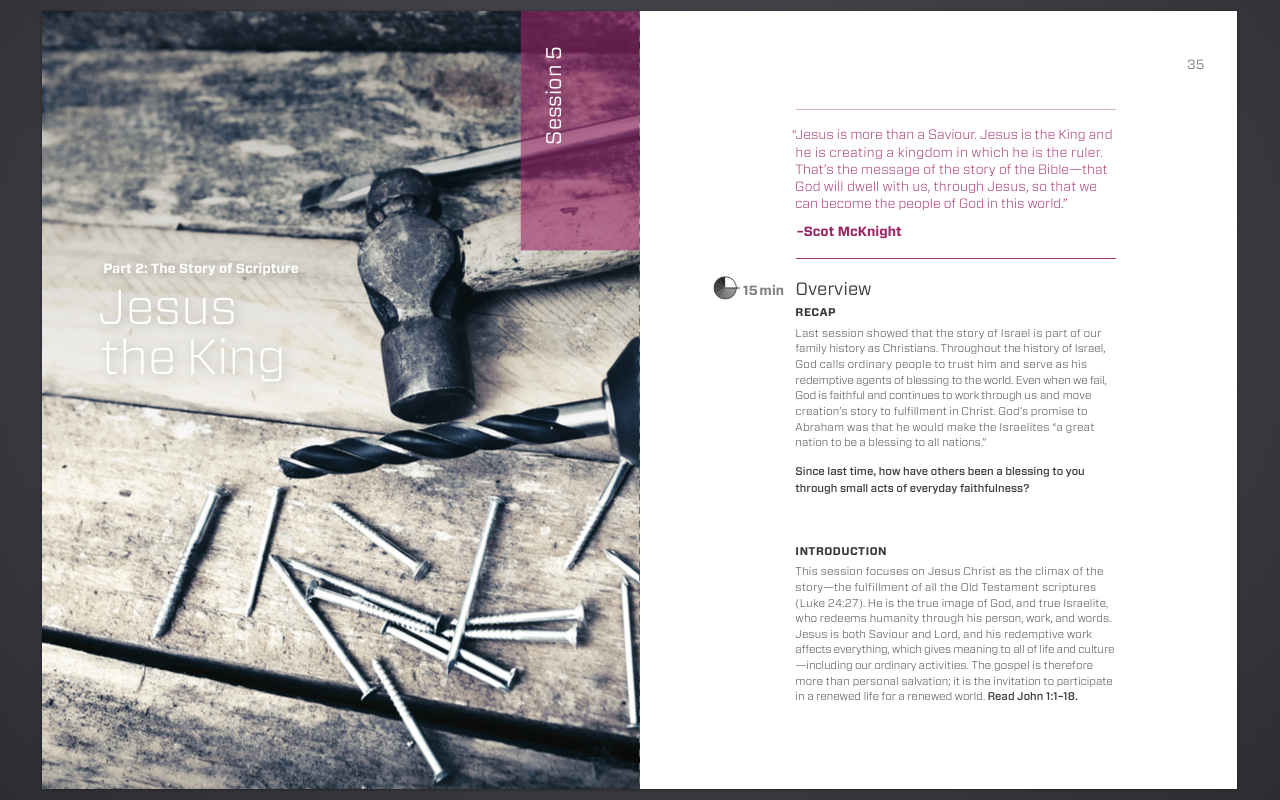
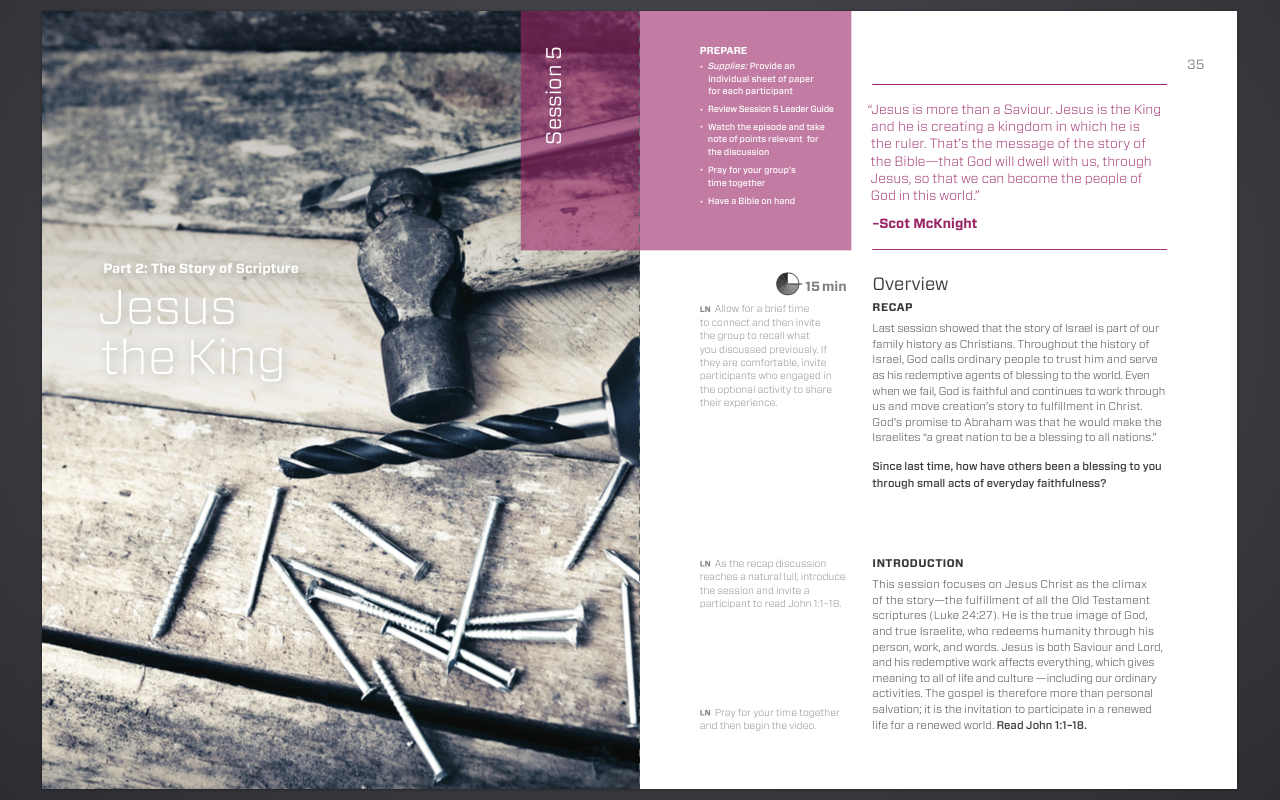
    In addition to the videos, ReFrame comes with a Leader’s Guide and Participant’s Guide. Each session is intended to take about two hours, including the watching of the 40-minute video. The Leader’s Guide looks very similar to the Participant’s Guide, but includes notes for leaders next to the main text. Here is a page from the Participant’s Guide:

    Participant Guide Sample

    Here is the same page from the Leader’s Guide:

    Leader Guide Sample

    If you have been following this blog for a while, you know that back in 2009 I reviewed a video series called The Truth Project that was billed as a “Christian worldview experience.” I anticipate that, since the two may be seen to have similar goals and I have seen both, I might be asked which one I would prefer. I would definitely say ReFrame, not least because it has a better flow from being built around a story rather than topics. Also, while The Truth Project is very well done in many ways, there are a few spots where it has trouble differentiating between a Christian worldview and the worldview of culturally conservative Baby Boomers (for example, in its treatment of American history). As such, while much of the series is very valuable, I believe that it is unlikely to have much lasting cachet outside that demographic.

    I wish that I could go through every episode of ReFrame in detail, but I don’t have the space or time to do that here. Perhaps if I go through the course with my small group or a larger group from my church (which I definitely want to do), I’ll be able to sit down and write an episode-by-episode review. In the meantime, if you want to get a closer look for yourself, you can watch episodes one and five in their entirety at this link.

    I highly, highly recommend this course for group study, whether it is as a small group or as a church. I pray that God will use ReFrame to powerfully influence Christians around the world to live more fully out of, and show others how to live more fully out of, the most compelling and beautiful story there is.

    Note: Thanks to the Regent College Marketplace Institute for a copy of ReFrame for the purpose of review, with no expectation as to the nature of the review.

  • Evangelii Gaudium Is Not All about Economics: A Review

    Around this time last year, there was a flurry of media coverage about Pope Francis’s first major writing of his pontificate, the apostolic exhortation Evangelii Gaudium (“The Joy of the Gospel”). While he had previously released an encyclical, Lumen Fidei (“The Light of Faith”), that was largely the work of his predecessor, Benedict XVI. When Evangelii Gaudium released, many saw it as an indication of what was important to this new pope.

    Unfortunately, much of the media attention that Evangelii Gaudium garnered tended to focus on the same 16 paragraphs (the ones numbered 52–60 and 202–208) of a 288-paragraph document (I read a nice hardcover version of it, but the entire text is available online here).  Those paragraphs contained Francis’s critique of economic practices that dehumanize both the poor and the rich. Many on the American right hated it, many on the American left loved it, and media watchers told us who got it right and who got it wrong. It was another distressing example of how ideologies distort people’s perceptions of reality. Interestingly enough, Francis saw it coming:

    In today’s world of instant communication and occasionally biased media coverage, the message we preach runs a greater risk of being distorted or reduced to some of its secondary aspects. In this way certain issues which are part of the Church’s moral teaching are taken out of the context which gives them their meaning. The biggest problem is when the message we preach then seems identified with those secondary aspects which, important as they are, do not in and of themselves convey the heart of Christ’s message. We need to be realistic and not assume that our audience understands the full background to what we are saying, or is capable of relating what we say to the very heart of the Gospel which gives it meaning, beauty or attractiveness. (34)

    So what is Evangelii Gaudium really about? Thankfully, Francis doesn’t keep it a secret:

    Here I have chosen to present some guidelines which can encourage and guide the whole Church in a new phase of evangelization, one marked by enthusiasm and vitality. … I have decided, among other themes, to discuss at length the following questions:

    a) the reform of the Church in her missionary outreach;
    b) the temptations faced by pastoral workers;
    c) the Church, understood as the entire People of God which evangelizes;
    d) the homily and its preparation;
    e) the inclusion of the poor in society;
    f) peace and dialogue within society;
    g) the spiritual motivations for mission (17)

    It is, as the title indicates, about preaching the gospel with joy. The other subjects that are treated in the document (missions, church structure, preaching, and, yes, economics) are all dealt with through that lens. I encourage anyone with an interest in Pope Francis, whether they are Catholic or not, to spend some time with this document. It is simple and straightforward, and often quite devotional. Though I am not a Catholic, I was warmed and encouraged by it.

    Note: Thanks to the publisher for a review copy of this book. I was not asked to give a positive review.

  • Logos 6 Has Launched!

    If you read this blog regularly (or know me personally), you know that I work at Faithlife, the makers of Logos Bible Software. Today, we announced the latest version of that software: Logos 6!

    The list of cool new features is too long for a single blog post, and it has already been laid out very well elsewhere. Here I’ll just note a few that I’m most excited about:

    1. The Ancient Literature Tool

    The Bible wasn’t written in a vacuum, and hasn’t existed in a vacuum since it was written. It both drew on other forms of ancient literature and influenced later literature. Now you can explore how the Bible relates to other ancient literature (both contemporary to its writing and later) with the Ancient Literature Tool, which is part of the passage guide. You will need to own the resources it links to for them to work, but many of them are available in Logos base packages:

    2. Bible Book Guides

    The Bible Book Guides are a quick way to get an overview of any biblical book. Before you get into the text, you often have questions about who wrote it, where they wrote it, when they wrote it, and who the original audience was. The Bible Book Guides assemble that information and get you a jump start on presenting it to others with neat background slides (I wrote the text for these slides, and our awesome designers made them look cool).

    3. Psalms Explorer

    Logos 6 has lots of new interactive media features, some of which focus on particular biblical books. Some of my other favorites are the Weights and Measures Converter, Israelite Feasts and Sacrifices, and Canon Comparison. I also have a personal connection to the Psalms Explorer: at the 1-minute mark in the video below, the narrator points out how the Psalms are labeled by theme. I labeled all of the Psalms (and Proverbs, too) several years ago as part of my work on the Preaching Themes database.

    I have been using Logos for almost ten years, since before I was an employee. It is amazing to think about how far the software has come in that time. While it is not for everyone (I often compare it to a luxury car), I have found it to be an incredibly powerful tool for my own Bible study. I am glad that for the last four-plus years I have played a small part in bringing it to the world.

    If you would like to see more videos about what Logos 6 can do, you can do that here. If you want to see what books are in Logos 6 base packages, you can do that here (and keep an eye out for a few that I edited myself!).