Author: Elliot

  • 2009 Books

    Here are the books I read in 2009, in chronological order. I’ve put in bold the ones I particularly enjoyed or found the most helpful. Not putting a book in bold doesn’t mean I didn’t enjoy it, though. After all, these are the books I read cover to cover this year, and I wouldn’t have finished them if I didn’t like them.

    Since it’s New Year’s Eve, I’m tempted to make a book-reading resolution for 2010, but I think I will refrain. It would be an accomplishment to read a book every week this coming year, but then I look at some of the books I’d like to read (like Jesus and the Victory of God by N.T. Wright or The Mission of God by Christopher J.H. Wright), and I don’t think I’m likely to finish those in a week. So I’ll just keep reading what I want and what I have time to read, and posting short reviews each month.

    1. Between Two Worlds: The Art of Preaching in the Twentieth Century by John Stott
    2. The Rise of Christianity: How the Obscure, Marginal Jesus Movement Became the Dominant Religious Force in the Western World in a Few Centuries by Rodney Stark
    3. Not Even A Hint: Guarding Your Heart Against Lust by Joshua Harris
    4. A Holy Meal: The Lord’s Supper in the Life of the Church by Gordon T. Smith

    5. A Primer on Postmodernism by Stanley Grenz
    6. Prisoner of Trebekistan: A Decade in Jeopardy! by Bob Harris
    7. Now, Discover Your Strengths by Marcus Buckingham and Donald O. Clifton

    8. Total Truth: Liberating Christianity From Its Cultural Captivity by Nancy Pearcey
    9. John Stott: The Making of a Leader by Timothy Dudley-Smith

    10. Brainiac: Adventures in the Curious, Competitive, Compulsive World of Trivia Buffs by Ken Jennings
    11. The Language of God: A Scientist Presents Evidence for Belief by Francis S. Collins
    12. The Jeopardy! Book by Alex Trebek and Peter Barsocchini

    13. A Prayer for Owen Meany by John Irving
    14. Surprised by Hope: Rethinking Heaven, the Resurrection, and the Mission of the Church by N.T. Wright
    15. The Book of the Dun Cow by Walter Wangerin Jr.
    16. God Will Make A Way: What to Do When You Don’t Know What to Do by Drs. Henry Cloud and John Townsend

    17. The Reason for God: Belief in an Age of Skepticism by Timothy Keller
    18. A Peculiar People: The Church as Culture in a Post-Christian Society by Rodney Clapp
    19. Culture Making: Recovering Our Creative Calling by Andy Crouch
    20. Anne Frank: The Diary of a Young Girl by Anne Frank
    21. The Long Loneliness by Dorothy Day

    22. Landscapes of the Soul: The Loss of Moral Meaning in American Life by Douglas V. Porpora
    23. The Essential Shakespeare Handbook by Leslie Dunton-Downer and Alan Riding

    24. Rich Christians in an Age of Hunger: Moving From Affluence to Generosity by Ronald J. Sider
    25. Praying With the Church: Following Jesus Daily, Hourly, Today by Scot McKnight
    26. The Ascent of a Leader: How Ordinary Relationships Develop Extraordinary Character and Influence by Bill Thrall, Bruce McNichol and Ken McElrath
    27. The Blue Parakeet: Rethinking How You Read the Bible by Scot McKnight
    28. Gone With the Wind by Margaret Mitchell
    29. The Theology of the Book of Revelation by Richard Bauckham

    30. Under the Overpass: A Journey of Faith on the Streets of America by Mike Yankoski
    31. Saving Your Marriage Before It Starts: Seven Questions to Ask Before (and After) You Marry by Les and Leslie Parrott
    32. Traffic: Why We Drive the Way We Do (and What It Says About Us) by Tom Vanderbilt

    33. The Jungle Books by Rudyard Kipling
    34. The Heart of a Goof by P.G. Wodehouse

    35. The Irresistible Revolution: Living As an Ordinary Radical by Shane Claiborne
    36. The Unlikely Disciple: A Sinner’s Semester at America’s Holiest University by Kevin Roose
    37. The Anglo Files: A Field Guide to the British by Sarah Lyall

    38. What Should I Do With My Life? by Po Bronson
    39. Prayer: Does It Make Any Difference? by Philip Yancey
    40. Introverts in the Church: Finding Our Place in an Extroverted Culture by Adam S. McHugh
    41. A Guide to Biblical Prophecy: A Balanced and Biblical Assessment of the Nature of Prophecy in the Bible edited by Carl Armerding and Ward Gasque
    42. Discipleship on the Edge: An Expository Journey Through the Book of Revelation by Darrell Johnson

  • December 2009: Books Read

    1. What Should I Do With My Life? The True Story of People Who Answered the Ultimate Question by Po Bronson. Since I have been thinking a lot lately about the question from this book’s title, it jumped out at me when I was at the library one day. Bronson, an author who was asking himself that very question in 2002, set out to interview scores of people who were wondering what to do with their lives.

    The subtitle is not entirely reflective of what the book is about. Not that many people Bronson interviewed had actually decided what they were going to do with their lives, or had started doing it. Several people knew what they wanted to do, or had a vague sense of it, but were unable to go out and do it for various reasons: doubts, insecurities that go back to their family of origin, etc. Nevertheless, I found this book to be worth reading simply because of the sheer breadth of stories Bronson told. The book is made up entirely of people’s stories, and this made it hard to put down. At times, Bronson would philosophize about what he was learning from hearing all these stories, and one of these philosophical moments stuck with me. It was the idea that everyone has an “inner circle,” a table of people in their head that they are trying to please or keep up with. Sometimes this is a good thing, but other times it is a bad thing, as in the case of the inner-city schoolteacher who found his job fulfilling – but was always comparing himself to his rich, jet-setting classmates at Yale.

    This book is a lot different from other books about guidance that I have read. The reason for this is that other books I’ve read are written from a Christian perspective, and talk about being called and a Caller (God). Bronson, who is not a Christian, does not use this language, but I thought he did talk about calling in an indirect way. Here is a paragraph from his summing-up chapter, addressing the question, “What do people really want?”:

    They want to find work they’re passionate about. Offering benefits and incentives are mere compromises. Educating people is important but not enough – far too many of our most educated people are operating at quarter-speed, unsure of their place in the world, contributing too little to the productive engine of modern civilization, still feeling like observers, like they haven’t come close to living up to their potential. Our guidance needs to be better. We need to encourage people to find their sweet spot. Productivity explodes when people love what they do. We’re sitting on a huge potential boom in productivity, which we could tap into if we got all the square pegs in the square holes and round pegs in round holes. It’s not something we can measure with statistics, but it’s a huge economic issue. It’s a great natural resource that we’re ignoring. (363-4)

    I don’t know that I’d recommend it for anyone who is looking for what to do with their life, but I did enjoy it because I enjoy hearing about people’s stories.

    2. Prayer: Does It Make Any Difference? by Philip Yancey. When I was in high school and college, I was a Philip Yancey junkie. The first book that I read by him was What’s So Amazing About Grace? This was followed quickly by The Jesus I Never Knew, The Bible Jesus Read, and Reaching for the Invisible God. The first two are still two of my all-time favorite books on Jesus and the Christian life. The latter two were good, but not incredible. After reading those four, I got away from Philip Yancey for a while. Every now and then, I would pick up one of his newer books in a bookstore, leaf through it, and decide that the subject matter wasn’t compelling enough for me to get it.

    Then I came across this book, which did have a compelling subject matter to me, and furthermore, was being sold for $2 at the library. So I bought it early this fall, and started reading it in October.

    Reading it was like getting acquainted with an old friend. Yancey has always included personal anecdotes and demonstrates a wide range of reading in his writing, and those traits were evident throughout this book. He also evinces a humility that says he doesn’t have it all together when it comes to his subject. This attitude is good, but it is found throughout the book and I started to find it repetitive by the end.

    I love Yancey’s writing style, anecdotes and humility, but to me the book lacked a compelling organization. Of course it had chapters and those chapters were grouped into sections, but I put the book down for several days at a time because I just wasn’t that interested to see what came next. I’m glad to have read it, but it doesn’t rank up there with the first two of Yancey’s books that I read.

    3. Introverts in the Church: Finding Our Place In An Extroverted Culture by Adam S. McHugh. I was interested in this book from the first time I heard about it earlier this year. It is on a huge subject – so huge that it’s surprising that no one seems to have written an entire book about it. I was also interested in it because I am an introvert, and I have spent a lot of time in the church.

    The book did not disappoint. McHugh starts off with the problem: we live in a culture that is geared toward extroversion, and this is also the case in many churches. How do we make it so that introverts can thrive in the church? I loved this book, especially the chapters on introverted leadership and evangelism (no, they’re not oxymorons).

    This book was needed by the church, and needed by me personally. As a person who has felt called to ministry in the church since my college days, but who has also felt a persistent sense of inferiority because of my introverted personality, I needed the encouragement that this book provided. In the past, I leaned heavily on the writings of Eugene Peterson to assure me that introverts could be pastors. Now, I can lean on this book as well.

    4. A Guide to Biblical Prophecy: A Balanced and Biblical Assessment of the Nature of Prophecy in the Bible, edited by Carl Armerding and Ward Gasque. I picked this up at a used book store a year ago for two reasons: I wanted to learn more about the nature of biblical prophecy, and I trusted Armerding and Gasque, who are both retired professors from Regent College, where I went to grad school.

    As mentioned above, though, Armerding and Gasque are editors of this volume, not writers. It contains 16 articles from 16 different authors, ranging in subject matter from the Old Testament (“Messianic Prophecies in the Old Testament”) to the New Testament (“The Millennium”) to the historical (“Nineteenth-Century Roots of Contemporary Prophetic Interpretation”). I thought it was an interesting and helpful volume, but because of its nature as a collection of essays, it wasn’t comprehensive. If you are looking for a passage-by-passage guide to prophecy in the Bible, this isn’t it.

    5. Discipleship on the Edge: An Expository Journey Through the Book of Revelation by Darrell Johnson. I’ve been reading this book slowly throughout the fall as my small group has been making its way through the book of Revelation (note: there is no “s” at the end). I read the last few chapters this week to help prepare for the class on Revelation I’m teaching at church starting in January, and also so I could include it on the list of books I read this year.

    This book is exactly what the subtitle says it is: an expository journey through the book of Revelation. Johnson preached through the book in 1999, and then turned that series of sermons into this book in 2004. It is called Discipleship on the Edge because Johnson insists throughout the book that Revelation is not a “crystal ball” (as many interpreters would have us believe), but rather it is a discipleship document. It is meant to encourage (and challenge) Christian believers who are facing (or about to face) persecution by pulling back the curtain and showing what is really going on. I sometimes wished that there were a little bit more detail, but this is not a commentary. Each chapter, not surprisingly, reads like a sermon, and includes application of each text to our lives. I would recommend it, primarily because Johnson focuses on Jesus rather than on predicting catastrophic events.

  • We Say “Happy Washington’s Birthday”

    This year there is once again a hoo-ha over whether people and retailers say “Merry Christmas” or “Happy Holidays.” (for a sane perspective on this, see here and here) Some people even go so far as to encourage you to steer your consumer dollars away from retailers who do not greet you with “Merry Christmas.” I don’t particularly care about whether people greet me with “Merry Christmas” or “Happy Holidays,” for the following reasons:

    1. “Holiday” comes from the Old English for “holy day.” Even though most people now take it to mean “vacation,” if taken in its original sense it’s just as good as “Merry Christmas.”

    2. There actually is more than one holiday this time of year, and three that most U.S. Christians celebrate: Thanksgiving, Christmas and New Year’s Day. The latter two are only a week apart, so “Happy Holidays” could just be shorthand for “Merry Christmas and Happy New Year.”

    3. When people and organizations make a big fuss about whether retailers say “Merry Christmas,” retailers are going to start saying “Merry Christmas” – not because they care about the True Meaning of the Season, but because they care about the bottom line. Therefore, putting pressure on retailers to say “Merry Christmas” is indirectly, but effectively, encouraging people to worship Mammon instead of Jesus.

    4. Not everyone I encounter celebrates Christmas, so it would be manipulative of me to insist on everyone greeting me with a “Merry Christmas.” If I owned a business in a Hindu-majority country, how would I feel about it if everyone around me insisted that I wish them a “Happy Diwali,” and threatened to take their business elsewhere if I didn’t? I might do it, but I wouldn’t have a particularly high opinion of people who forced me to. Christians who insist on everyone greeting them with “Merry Christmas” may win a cultural battle, but I don’t think they win anyone’s heart for Christ.

    No, it doesn’t matter to me whether someone wishes me “Merry Christmas” or “Happy Holidays.” The real travesty, in my opinion, comes in February. George Washington’s birthday, February 22, was made a federal holiday in the 1880’s. Since the 1980’s, though, many states have begun to call the third Monday in February “Presidents’ Day,” and many car dealerships have taken advantage of this holiday by using it as an excuse for sales. Never mind that Washington’s birthday never actually falls on the third Monday in February. I think that this is a conspiracy by Washington-haters, for one of three reasons:

  • they don’t like it that he mentioned God in his speeches,
  • they don’t like it that he owned slaves, or
  • they don’t like it that he had wooden teeth.
  • So I invite you to take back Washington’s Birthday. He is the Father of our Country, and lumping him together with all the other presidents is an affront to the history of the United States and all our nation stands for. Fight back in the War on Washington’s Birthday by purchasing my “We Say Happy Washington’s Birthday” bumper stickers for only $5.95. Then go in to an auto dealership and buy a car to put it on. But please, only buy from a dealer who greets you with “Happy Washington’s Birthday!”

  • Heard on the Bus

    My school bus route can be a difficult one, especially when it comes to taking the elementary school kids home in the afternoon. They can get pretty worked up, and I spend a lot of time telling them to sit down, face the front and stay out of the aisle.

    Every now and then, though, the kids say things that make me laugh. Here are a few from recent weeks:

    Girl: “They call him Ham, but his real name is Hambone.”
    “Hambone”: “My real name is JAMES!”

    One first grader to another: “Hey, let’s talk about awesome stuff!”

    A fifth grader, to me: “Elliot, you should install machine guns on the bus. That way, when war breaks out with Skyline [another elementary school down the road], we can fight them.”

  • For Unto Us a Child is Born – Isaiah 9:1-7

    Below are the notes for the sermon I preached at Bellingham Covenant Church on November 29, 2009 – the first Sunday of Advent. As I was just beginning to prepare this sermon, I bought and started to read Darrell Johnson’s book The Glory of Preaching. Handily enough, the book included a sample outline of this very passage. So I used that as a base, modified it and expanded on it.

    Unfortunately, there will be no audio posted on the Internet, because there was a problem with the sound that day.

    Isaiah 9:2-7 – “For Unto Us a Child Is Born”

    Intro: Happy New Year! This is the first Sunday of Advent, the time leading up to our celebration of Christmas. It’s the time when we start to think about what we are celebrating, and why we celebrate it. This is a well-known text that you see on greeting cards, and that you hear in the music of Handel’s Messiah. Today we’ll talk about why it is important.

    We are going to start, though, by talking about fear. The phrase “Do not be afraid” occurs in the Bible 74 times, and it is usually God who says those words. We’re going to talk about fear today, but we are also going to talk about a reason why not to be afraid.

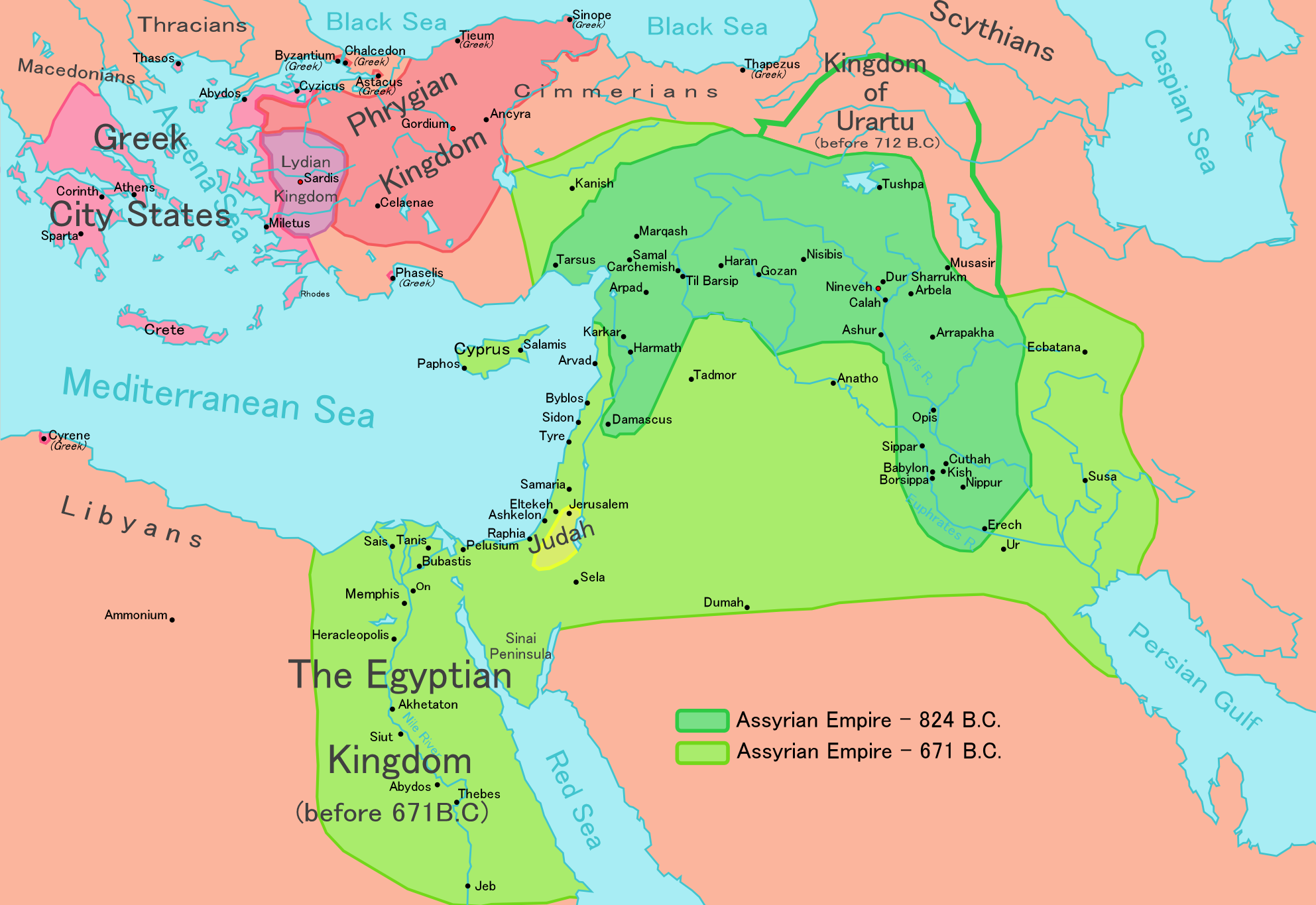
    Background: Assyria was the greatest empire at the time this passage was written. On the map, the dark green was the Assyrian territory in 824 BC. The light green was the Assyrian empire in 671 BC. This prophecy was given around 730 BC. That means the Assyrian empire had been expanding for 100 years before this, and would continue to expand for another 60 years. Everyone was terrified of Assyria, and the Northern and Southern Kingdoms of Israel (Judah, the southern kingdom, is the yellow blob on the map) were right in the middle of everything.
    Tiglath-Pileser III, the Assyrian king, took part of Galilee, which was in the northern kingdom, sometime before 731 BC (2 Ki 15:29). Ahaz, who was king of Judah beginning in 735 BC, saw what was happening to the Northern Kingdom and was afraid. Because of this fear, he adopted a pro-Assyrian foreign policy. Pekah king of Israel and Rezin king of Damascus (Aram) attacked Judah because of this pro-Assyrian policy in 735 BC (2 Ki. 16:5, 2 Chr. 28:5-15)

    Ahaz was terrified by the Syro-Ephraimite threat, and sent to Tiglath-Pileser for help (Is. 7:2, 2 Ki. 16:7-9). It is here that this passage (9:1-7) lies: about 735 BC.

    Isaiah comes to the king and says: you are not depending on God to save you. You are depending on Assyria. You want Assyria to come; well, Assyria will come, all right. He’ll come like a flood, and the waters are going to be up to your neck! (8:8). The problem with King Ahaz was that he was depending on the power of Assyria to defend him and take away his fear instead of on the Lord. He didn’t want to give God control of the situation; he wanted to keep control for himself. This prophecy was fulfilled 30 years later under Sennacherib of Assyria (ca. 704 BC) (Is. 36). He invaded Judah, and was at the gates of Jerusalem, but in the end, he mysteriously withdrew. But that is another story (found in Is. 36-37).

    But despite his message of judgment, Isaiah is ultimately hopeful. Judah has leadership that tries to keep control instead of relying on God, but these verses look ahead to a child who will be born and change everything.

    Verses 4, 5 and 6 of this passage all begin with the Hebrew word ki. It’s a “key” word. It means “for,” or “because.” The things that happen in verses 2 and 3 happen because of what we find in verses 4, 5 and 6. And they escalate, building up to verse 6, which presents the central idea of this passage: Because this Child is born, everything changes; because the son is given, there is hope in the face of fear.

    Four things happen because the child is born. Because the child is born:

    Light shines in the darkness (9:2)

    Chapter 8 ends with the words, “they will be thrust into utter darkness.” There is ultimately no hope for those who do not consult God. Ahaz wanted to do everything in his own power. He didn’t consult God because he didn’t want to depend on God. He didn’t want God to ask him for anything he didn’t want to give. He would rather rely on his own skills and intelligence. But his own skills and intelligence were not good enough.

    But chapter 9 begins with the word, “Nevertheless.” Nevertheless, God will shine a light for those who can’t see for themselves. These people did not create this light for themselves. God gives his presence, his light, to people who are groping in the darkness. They can continue to grope around in the dark, or they can walk by the light.

    Joy emerges in the gloom (9:3)

    This is an incredible contrast with what has come before. Isaiah has just prophesied destruction, and here he is talking about joy.

    The tense these verbs are in is the perfect. “You HAVE enlarged the nation.” God is giving his people hope. Even though there will be judgment, it will be followed by joy. It will surely come. Joy emerges, even in the gloom.

    Freedom breaks through the oppression (9:4)

    Why is there joy? FOR God has delivered his people from oppression. Too often, Christians think that true oppression, true bondage is to personal sin from which Jesus frees us. Other people say that Jesus came to free people from political oppression. Which one is it? The answer is: both. Jesus came to free people from bondage to sin. The main reason for the conflict between people is first that people are in conflict with God. But we can’t get right with God and act like that is the end of the story. When we love God, we have to love our neighbor. And part of loving our neighbor means participating with God in freeing people from oppression. This means fighting against human trafficking. This means fighting against poverty. There are two yokes that God frees people from. We can’t forget either one.

    “Midian’s defeat” is talking about Judges 6-7, where he delivered his people from a real-life oppressor. In case the people of Isaiah’s day didn’t believe him, he points to a concrete example that everyone would recognize: Remember when God came into this hopeless situation and freed you? He did it then, and he can do it again.

    Peace overcomes strife (9:5)

    How is God going to get rid of oppression? He’s going to get rid of war.

    Earlier in this book, Isaiah said that armies would beat their swords into plowshares and their spears into pruning hooks (2:4). But here he goes even further. Not just the weapons, but even the boots and the bloody garments will be burned. There will be absolutely no warfare.

    There is joy BECAUSE God has delivered from oppression, and he does that BECAUSE he has brought an end to war. How can this happen? Because of the son with all the names:

    Wonderful Counselor – “wonder of a counselor”
    wonder – power (as in God showing his wonders in Egypt).
    counselor – wise. The kings of Israel and Judah lacked wisdom, but this figure is perfectly wise.

    Mighty God – The person who is being talked about is none other than God in human form. He is not just a great person.

    Father of Eternity – He is father forever. Many ancient kings called themselves fathers to their people. In the ancient world, fatherhood is about taking care of people. This person will be a father, a protector, forever. Some people have difficulty thinking of God as father. When the Bible talks about God as father, it is not saying that he is a father like any other father, or even a king like any other king. He is the father that other fathers were meant to look like, and the king that other kings were meant to look like. He will protect and take care of his people forever. He will never fail. Earthly fathers fail. Earthly leaders fail. God will never fail.

    Prince of Peace – He is not the kind of prince who squashes all defiance. He doesn’t throw his weight around, like the king of Assyria. He doesn’t rely on the strength of others, like the king of Judah. He will base his kingdom on justice and righteousness, rather than violence and coercion. And he will do this forever.

    Now that we know what this child does, we can ask: Who is this child? Ahaz’s son Hezekiah was a good king, but he didn’t do all the things that this passage talks about.

    No one fits the bill until the night Jesus was born, when the sky filled with angels saying, “Do not be afraid. I bring you good news of great joy that will be for all people.” (Luke 2:10)
    Matthew makes this explicit in 4:15-16, when he describes the beginning of Jesus’ public ministry by quoting this very passage.

    If we follow Jesus and put our trust in him, this passage applies to us. So because Jesus has been born, and the government is on his shoulders,

    We can know light in the darkness.
    We can know joy in the gloom.
    We can know freedom in the oppression.
    We can know peace in the strife.

    The theme of this section of Isaiah, is “trust.” King Ahaz needed to trust God rather than his own wisdom. That is still the message for us. Where do you need to give Jesus “the government” today?

    When he is given control, everything changes. It isn’t easy. It wasn’t easy in Isaiah’s day. Even when Isaiah confronted him, Ahaz wouldn’t give up control.

    It’s scary for us to give up control, but that is because we’re selfish and have trouble trusting.
    But Jesus is trustworthy, and giving him control of all of life is the only thing that gives life.
    Invite him into the darkness. Invite him into the gloom. Invite him into the oppression. Invite him into the strife. Give him the government. His shoulders are big enough to carry it.

    “For unto us.” Because unto us. Everything can be different.

  • November 2009: Books Read

    1. The Irresistible Revolution: Living as an Ordinary Radical by Shane Claiborne. I bought this book at a small used book shop in Hanapepe, when Mary and I were on Kauai for our honeymoon. It is very engaging and story-driven, which made it a very fast read, and I finished it on the plane ride home.

    Shane, who grew up a Christian in Tennessee, is part of the Simple Way community that lives among the poor in inner-city Philadelphia. I found his account of this life, and how he got there, to be fascinating and compelling. I agree with much of what he wrote in this book about the life-transforming power of the gospel, about how Christianity has been married to political power, and about the biblical mandate to serve the poor.

    But I didn’t like everything about this book. It may seem like a small thing, but Claiborne’s folksy tone (literally – he uses the word “folks” 165 times in the book) was annoying after a while. I mean, did he really have to call Mother Teresa “Momma T”? I also got the impression that he looked down on his fellow Christians who were rich, or who were Republicans. He seemed quite willing to love his enemies when they had names like Osama bin Laden and Timothy McVeigh, but I was left with some doubt as to whether he loved his enemies named George W. Bush and Dick Cheney. This was unfortunate, given the fact that Claiborne’s activist lifestyle by no means requires him to look with scorn on other people. Last summer I read Dorothy Day’s memoir The Long Loneliness, and I did not detect a self-righteous tone in her at all. Even though Claiborne’s irresistible revolution is in many ways compelling, and what the church in North America deeply needs, the tone he sometimes adopts isn’t.

    2. The Unlikely Disciple: A Sinner’s Semester at America’s Holiest University by Kevin Roose. The premise: Roose, a student and aspiring writer at Brown University, decides that he wants to spend a “semester abroad” at conservative evangelical Liberty University, founded by Jerry Falwell. Though raised in a household he identifies as Quaker, Roose seems thoroughly secular in his outlook at the beginning of the book. While working as an assistant to A.J. Jacobs (author of The Year of Living Biblically), he visits Liberty and comes to think that spending some time at Liberty would be a good way to understand the evangelical Christian subculture in America (and a good premise for a book).

    The result: a highly entertaining read. I did not attend a Christian university, but I am an evangelical Christian, and I understand the sort of subculture that Roose enters when he enrolls at Liberty. I found his outsider’s observations about dating life (he finds that the option of sex being off the table is strangely freeing – i.e., two people can just get to know each other without ulterior motives), battling with lust (he visits a support group for what he calls “chronic masturbators”) and evangelical attitudes toward homosexuality (he finds that the subject comes up way more often at Liberty than at Brown, where there actually are gay students) to be illuminating and, at times, hilarious. My favorite passages in the book are his account of going on a Spring Break mission trip to Daytona Beach with a group of his fellow students, and his account of meeting Falwell himself and interviewing him for the school paper – just a few weeks before his death in May of 2007.

    Roose is surprised to find some diversity at Liberty, including students who experience doubt and regularly break the social rules. He is also surprisingly charitable toward the people at Liberty, with whom he ultimately disagrees about many things. He even has kind words for Falwell, about whom he writes,

    Realizing that Dr. Falwell isn’t a fraud – as troubling a notion as that is – has helped me solve one of the great mysteries of this semester. For months now, I’ve been puzzled by the thousands of good, kindhearted believers at Liberty who follow a man who seems, to my mind, to be almost unredeemable. They like him, I’ve learned, because he’s a straight shooter. In half a century of preaching, Dr. Falwell has said some outrageous things, and he’s angered Christians and non-Christians alike, but he’s never revealed himself as a hypocrite. He’s never been caught in sexual sin, and he’s been as transparent in his financial dealings as you could reasonably expect. And in the world of televangelism, a world filled to the brim with hucksters and charlatans and Elmer Gantry-type swindlers, a little sincerity goes a long way. (261)

    All in all, this was a highly entertaining book and a compulsive read; I was sad when I reached the end. I’ll certainly take a look at Kevin Roose’s next book.

    3. The Anglo Files: A Field Guide to the British by Sarah Lyall. Lyall is an American journalist who has lived in England for several years, is married to an Englishman, and has two daughters. Her book pokes fun at various British idiosyncrasies, such as their attitude toward sex (covered in a chapter titled, “Naughty Boys and Rumpy Pumpy) poor dental hygiene (“I Snapped It Out Myself”), the House of Lords (“Lawmakers from Another Planet”), and their stiff upper lips (“By God, Sir, I’ve Lost My Leg!”).

    Mary took this book along on our honeymoon for some light beach reading, and it certainly fit the bill. I found many passages to be incredibly funny. I also found some of them to be discomforting, such as those on drunkenness and sex. It isn’t that I’m particularly prudish (that is, I’m not shocked at what I read). Rather, what made me uncomfortable is that those passages depict the British to be singularly unattractive. Also, Lyall doesn’t use profanity in her narration, but she certainly doesn’t shy away from reporting what others say, especially in her chapter on British journalists.

    The question that I was primarily left with at the end of the book was, “Is it accurate? Or is she merely embellishing on her own experience in order to get a laugh?” Not being British, and never having even traveled to Britain, I can’t say. I can only say that, having lived for a year in Prague, I found her description of British stag and hen parties (in the chapter “Distressed British Nationals”) devastatingly accurate. Almost every time I walked around the city center at night, I would see (and more often, hear) a crowd of drunken, boorish men, often dressed alike (except for the groom-to-be, who was more often than not in drag), making lewd comments to passing women and generally making fools of themselves. They were always, ALWAYS British. So perhaps her descriptions of Britons are accurate, but in the same way that descriptions of “Ugly Americans” are accurate. That is, there is an uncomfortably large slice of the population in both countries that makes everyone else look bad. A more accurate title for this book would have been Ugly Britons. But that probably wouldn’t sell.

  • October 2009: Books Read

    October was a light reading month for me – you know, because of getting married on the 24th and all. I did manage to finish a couple of books, though (and both of them on the honeymoon).

    1. The Jungle Books by Rudyard Kipling. A lot of people have heard of The Jungle Book from the Disney movie of the same name, so you may be wondering why the title of this book is plural (at least, I was when I picked it up). The reason for this is that Kipling wrote two Jungle Books: one in 1894, and a sequel in 1895. Both are collections of short stories, and both deal primarily (but not exclusively) with the world of Mowgli, the boy raised by wolves. The edition that I read combined both of them in one volume.

    The book is a fun read. It is fascinating to enter into the jungles of colonial India and learn about the various animals. Kipling is very good at giving the animals voices and personalities of their own. His great gift in these books is to imaginatively project himself into the world of animals, and show how they would talk if they had human personalities and emotions.

    As I said, not all the stories deal with Mowgli and his world. A couple of the stories are not set in India at all, but the Arctic. My favorite of all the stories is one that was also translated into a cartoon: “Rikki-Tikki-Tavi,” the story of the pet mongoose who becomes a hero to an English family.

    2. The Heart of a Goof by P.G. Wodehouse. This is a collection of nine stories about golf by that great master of the English language, P.G. Wodehouse. They all start out in a fictional country club, in which the Oldest Member relates a story to a reluctant hearer. As with so many of Wodehouse’s stories, many of them involve a couple who nearly does not get together, but eventually does. In this collection, the thing that generally gets them together one way or another is golf.

    I’ve read enough P.G. Wodehouse books by now to be able to say what I liked and didn’t like about each one (which is hard, since so many of them involve such similar characters). While I found this collection entertaining, I don’t know that I would recommend it to someone who was just getting to know Wodehouse. There is, in my opinion, too much golf jargon intruding on the plots. This may appeal to an avid golfer, but I much prefer his stories about Blandings Castle or Jeeves, which are (deservedly, I think) more popular.

  • Why Did the Wall Fall?

    Twenty years ago today, the Berlin Wall came down. I don’t remember it. That is, I don’t remember it being a single cataclysmic event which I have a distinct recollection of hearing about, but I do remember hearing about it over and over for months. Perhaps I would have understood its significance more if I had not been 10 years old at the time.

    Even if I don’t have a distinct memory of how significant it was, I am now aware of the various causes that people have attributed it to. I read an article today in the NY Times that talks about various answers to the question, “What made the Berlin Wall fall down?” (and what triggered the fall of communism throughout Eastern Europe?)

    The article says that “different groups in different countries see the anniversary differently, usually from their own ideological points of view.” The two main points of view mentioned in the article are these:

    1. The fall of Communism can be attributed to Ronald Reagan, with his “aggressive military spending and antagonism toward Communism.” Most people in the United States tend toward this view, according to the article.

    2. On the other hand, most people in Europe don’t think that Communism fell because the West was hard – they think it happened because the East was soft. It was really Ostpolitik and West German TV that brought about the softening and eventual collapse.

    I’m not going to argue for which of these is the correct interpretation. But as a Christian, I wonder: where is the spiritual interpretation of events? I don’t expect the New York Times to come forward with it, so here is a quote from a different article found on a Reuters blog called FaithWorld:

    The many anniversary celebrations, documentaries and discussions now underway across Germany seem to focus mostly on how fearless street protesters and astute politicians pulled off the “peaceful revolution” that ended communism. Films and photos of dissidents packed into the Gethsemane Church in East Berlin or Leipzig’s St. Nicholas Church (Nikolaikirche), the leading houses of worship that sheltered them until the Wall opened, are among the trademark images. But those crowded “peace prayer” evenings were only the tip of the iceberg of behind-the-scenes work by pastors and lay people who considered it their Christian duty to promote civil rights and human dignity in a rigid communist society.

    This article was about Christians in Germany. I have read a couple of biographies of Pope John Paul II, and I cannot help but think that the millions of Poles who greeted him on his official visit to Poland in 1979 with chants of “We want God!” had something to do with the fall of Communism in that country (Peggy Noonan wrote an article about it shortly after John Paul’s death in 2005).

    When I lived in Hungary, I also learned about Jozsef Mindszenty, the head of the Hungarian Catholic Church and an adamant opponent of Communism.

    And I read this in Revelation 8:3-5:

    Another angel,​​ who had a golden censer, came and stood at the altar. He was given much incense to offer, with the prayers of all God’s people,​​ on the golden altar​ before the throne. The smoke of the incense, together with the prayers of God’s people, went up before God​​ from the angel’s hand. Then the angel took the censer, filled it with fire from the altar,​​ and hurled it on the earth; and there came peals of thunder,​​ rumblings, flashes of lightning and an earthquake.​

    In other words, this passage teaches us that the prayers of God’s people are taken up, filled with fire, and hurled back onto the earth. How many people, both inside and outside of Soviet-dominated Eastern Europe, prayed for the end of Communism?

    I don’t think that we will ever know beyond argument what caused the fall of the Berlin Wall. But in all of these debates about who or what caused Communism in Eastern Europe to end, let us not forget the prayers and efforts of thousands of Christians all over the world. They believed that each human being is made in the image of God, and they believed that that image was being squashed by Communism. Before we declare an unqualified victory for Reagan or militarism or Ostpolitik or anything else, let’s remember that.

  • One Week

    … until Mary and I get married. The big things (like where to have the wedding and reception, who else will be involved in the ceremony, etc.) have been taken care of. Now it’s the time to look at other things, such as

    What music are we going to play?

    I’ve been mostly put in charge of making this decision. I’ve spent time coming up with a 4-hour “background music” playlist for the reception, and another 4-hour “dance music” playlist. That has been a lot of fun. What has been a little more difficult has been trying to decide what music will play at particular moments, like our first dance and our dance with our parents (Mary with her dad and me with my mom).

    The first thing we decided was that there was going to be only one song for us to dance to and one song for us to dance with our parents to. Some weddings make it a more drawn-out process, where the bride dances with her father for a whole song and then the groom dances with his mother for a whole song. That’s not going to happen.

    We also decided that we’re not going to have a separate announcement, “And now it’s time for the dance with the parents!” Once the song we’re dancing to is over, it’ll go right to the next song and we’ll grab our respective parents.

    So what songs are we going to play? For our dance with each other, we’re going to go with a song by Bing Crosby, “Constantly.” We both like Bing’s style and voice – and after all, he is a native Washingtonian!

    The decision about what song to play next was more difficult. There are a few lists around the Internet of “Father-Daughter Dance Songs,” and they generally have “Butterfly Kisses” at the top of the list. I’m sure it is very special to a lot of people, and maybe I will understand it better if I have a daughter – but I would rather elope than have “Butterfly Kisses” played at my reception. And the rest of the songs on these lists are no less sappy. We decided, in the end, to go with Glenn Miller’s “Moonlight Serenade” – a classic, and instrumental.

    We’re still working on what to play during the ceremony itself. Any suggestions?

  • If you can’t use words properly, you shouldn’t write books

    Last week I checked the book Empire’s Workshop: Latin America, the United States, and the Rise of the New Imperialism out of the library and started reading. On page 15, after reading about Henry Ford’s failed attempt to start a rubber plantation in South America to provide his cars with tires, I read this paragraph:

    As a parable of empire, Fordlandia captures well the experience of the United States in Latin America. The quixotic faith that led Ford to try to remake the Amazon in an American image – a truly utopian endeavor considering that he never set foot in Brazil – reflects a broader belief that the United States offers a universal, and universally acknowledged, model for the rest of humanity. In turn, Ford Motor Company’s subsequent support of death-squad regimes demonstrates how that kind of evangelicalism easily gives way to brute coercion.

    The book went back to the library immediately. Why? Because Greg Grandin, the author, used the word “evangelicalism” in what I thought was an inappropriate way. I’ve studied Christian history, and I know that Evangelicalism is a movement within the Christian church. And while many people may not work with a very precise definition (see here for a very good attempt at defining it), I think that Grandin creates confusion by using the word the way that he does. There was nothing specifically Christian about what Ford was doing. My guess is that Grandin intended to convey the idea that Ford was zealous in advocating the greatness of the United States. If that was his intent, I would suggest he use a broader term that doesn’t have such specific connotations.

    I read a lot, and I read a lot of stuff that I don’t necessarily agree with. I even read a lot of stuff that is explicitly critical of groups with which I identify. But if I can’t trust an author to use words with care, I don’t read the book. Even if I disagree violently with what an author is saying, I have to trust him or her to use words coherently and with care. If that trust is broken, I will move on to an author who does use words carefully.

    Can you tell this is a major pet peeve? Does anybody else feel as strongly about this as I do?