For those of you who haven’t seen it yet, I wrote this post for the Logos blog last week.
And it was successful: the book I was trying to get into production received enough orders over the weekend to put it over the top.
For those of you who haven’t seen it yet, I wrote this post for the Logos blog last week.
And it was successful: the book I was trying to get into production received enough orders over the weekend to put it over the top.
Note: all the books I read this month (except for the discourse grammar) were for the Read for Cash program at work. For a limited time, Logos employees get to read pre-approved books and get paid for it if they write a book review and e-mail it to everyone in the office. Pretty cool, huh? These are the books I picked out:
 1. Fire Someone Today by Bob Pritchett. When I began reading Fire Someone Today, I had two questions:
If I don’t like this book, do I have the guts to be honest about it?
Would it be wise to write a negative review when the author is my boss and the title is Fire Someone Today?
Thankfully, I didn’t have to answer either of those questions because I liked the book. Bob’s target audience is entrepreneurs; every time he says “you” throughout the book, he is talking to small business owners. Despite not being a small business owner, I enjoyed the book for the following reasons:
I am a relatively new employee at Logos, and I learned from the book about the history of the company and why it is the way it is today.
It is well-written. The chapters are short and to-the-point, Bob uses humor effectively, and there are few extraneous words. In the genre of business writing, this is never a given. Business writers didn’t spend their formative years sitting in a lonely garret, chewing on pens and crumpling up pieces of paper; they were out learning how to build a successful business. This means that finding a well-written business book is like finding a four-leaf clover (or, to use Bob’s analogy, like panning for gold).
It is an atypical business book in that Bob doesn’t try to tell his readers that he has something new to say. Ironically, this is an original tack. He just gives advice from what he has learned as an entrepreneur, and he does it in an interesting way. Although some of the chapter titles can seem vaguely Machiavellian (“Fire Someone Today,” “There Can Be Only One – Plan for Your Partner’s Departure,” “In the Ladder of Life, You’ve Got to Step on Some Fingers” – OK, I made that last one up), he is really just giving good advice.
I’d recommend it for entrepreneurs, as well as all Logos employees and anyone wanting to learn more about the life of an entrepreneur from someone with experience.
 2. Here Comes Everybody by Clay Shirky. Organizing large numbers of people has always been hard work, as anyone trying to find a place for a group to eat can attest (“I hate Italian.” “I’m allergic to anything on a stick.” “I only eat fish on alternate Thursdays during months ending in -y.”). Fortunately, says Clay Shirky, new social tools are enabling people to cooperate in ways (and on scales) that were impossible even 15 years ago. Today, large groups can assemble more easily than ever before. This gives rise to new possibilities in what groups can accomplish – a phenomenon that Shirky refers to using the phrase “More is different.”
Not all of this new group activity is equal. There are three levels, in ascending order of difficulty: sharing (Flickr is one example), collaborative production (Wikipedia, Linux) and collective action. It is this last level that most interests Shirky. He begins the book by telling the story of a woman who loses her cell phone in a taxi, finds out who has it, and begins to exert enormous social pressure on that person to give it back by gathering people on a Web site and message board. Later, he tells the stories of several other groups who have organized and taken action using new social tools: “flash mobs” in Belarus, disgruntled airline passengers who came up with the Passengers’ Bill of Rights, Catholics unhappy with the Boston pedophilia scandal who started Voice of the Faithful, etc.
This book has a lot of interesting stories of how social tools have enabled people to organize like never before, but by the epilogue I found that Shirky’s vision had become too utopian for me to buy into it completely. While I think that new social tools have made a huge difference in the ease with which people relate and form groups, I don’t think that we’re going to see a “revolution in collective action” (313) as a result. Call me a pessimist (though I prefer “realist”), but I think that social tools of the kind Shirky describes are just amplifiers. They don’t improve people’s behavior. They magnify what is already going on in people’s hearts and minds. For example, that lost phone would never have been returned if there had not been a huge number of people who felt that it was unjust for someone to find a phone and refuse to give it back to its rightful owner.
At the end of this book, I wasn’t left with an exclamation (“Here comes the revolution!”). I was asking a question: “How can we use communication tools to amplify what is good?”
 3. Made to Stick: Why Some Ideas Survive and Others Don’t by Chip and Dan Heath. In this book, the Heaths set out to describe why it is that certain things (whether they are ad campaigns, urban legends or things we learn in school) stick in our heads or get us to change our behavior, and others don’t. Ideas that stick have the following things in common: they are
Simple – like proverbs, they are boiled down to the core, with no extraneous information to distract from the main point.
Unexpected – they break patterns in a compelling way. They highlight gaps in people’s knowledge in order to make them curious.
Concrete – they take abstract concepts and apply them to real situations.
Credible – they convince. They are testable. They use statistics accessibly.
Emotional – they make people care. They appeal not just to self-interest, but to people’s idealized version of themselves.
Stories – they are narratives that help people know how to act and give people the courage, creativity or energy to act.
The great enemy of a sticky idea, according to the Heaths, is the Curse of Knowledge: once you know something, it is hard to remember what it is like to not know it. This, in turn, makes it hard to present to someone else in a way that grabs their attention.
The Heaths spend 300 pages fleshing out the six qualities above, but the book never drags. They provide interesting examples of each quality, and they also include sidebars where they edit sample messages in order to make them better exemplify the six qualities of a sticky idea.
In short, they have taken their own advice and written a compelling book. Marketers who read it might have the most immediate payoff, but I would recommend it to all people who have an idea, specialty, or area of interest that they would like to present in a captivating way.
 4. Talent is Overrated: What Really Separates World-Class Performers from Everyone Else by Geoff Colvin. This book’s central premise is that what separates world-class performers from everyone else is not innate talent, as so many of us believe. Rather, what makes people great at what they do is practice – but not just any practice. Deliberate practice. It isn’t just repeating something over and over; it is “activity designed specifically to improve performance, often with a teacher’s help; it can be repeated a lot; feedback on results is continually available; it’s highly demanding mentally, whether the activity is purely intellectual, such as chess or business-related activities, or heavily physical, such as sports; and it isn’t much fun” (66). Colvin fleshes out his argument throughout the book with a lot of data and anecdotes.
The idea that deliberate practice is what makes a world-class performer is encouraging and discouraging at the same time. It is encouraging in that anyone can be a world-class performer at anything if they have enough deliberate practice. It is discouraging in that it really does take a lot of work over a long time before a person is capable of world-class performance or innovation – about 10 years in most of the fields Colvin looked at, and longer in some. Persevering at deliberate practice over that amount of time requires passion, and Colvin is honest that he isn’t quite sure why some people have that drive and others don’t (204).
This is a fascinating book, and the only reason I didn’t give it 5 stars is that I don’t think it is a book-length idea. It could have been stated in a much shorter format – say, an article in Fortune magazine. I’d recommend it to anyone, but especially to young people. Since deliberate practice takes so much time and effort, the younger you start, the better.
 5. Discourse Grammar of the Greek New Testament: A Practical Introduction for Teaching and Exegesis by Steve Runge. This book was written by someone I work with, and it has the honor of being the first book I read completely on my computer using Logos Bible Software. I was able to highlight and write notes, the same as I would have been able to if I were reading a hard copy.
He uses linguistic analysis to shed light on biblical Greek. That is, he looks at how languages operate in general, and applies it to the New Testament. This means that it is accessible to a wide variety of people, from New Testament scholars to people who have very little language training. The only prerequisite for reading this book is an interest in its subject. I found a lot of interesting information in the book, but it is a grammar, so it can be dry at times.
 1. Colossians Remixed: Subverting the Empire by Sylvia Keesmaat and Brian Walsh. This is an unusual book. It is about the letter of Paul to the Colossians, but it is not a commentary in the usual sense of the word. In fact, the authors in the Preface call it an “anti-commentary.” Rather than digging into the technical details that commentaries usually deal with, their main goal is to read Colossians in such a way as to make it relevant to our current postmodern and globalized context.
I really enjoyed this book. It is creative, and it did a lot to convince me that Colossians can in fact address contemporary concerns. I’m always skittish when the word “empire” gets thrown around, though. To their credit, at least Walsh and Keesmaat specify what they are talking about when they use the word. Empires, for them, are “(1) built on systemic centralizations of power, (2) secured by structures of socioeconomic and military control, (3) religiously legitimated by powerful myths, and (4) sustained by a proliferation of imperial images that captivate the imaginations of the population” (58). In parts of the book, it seems that when Walsh and Keesmaat talk about empire, they are talking about globalization. In other parts (like on pages 62 and 187), they attach the word to the United States. I think that the United States can be empire-ish in some of the things that it does, but making a one-to-one correlation between the United States and ancient empires is overstating the case. It’s bombastic, but ultimately unhelpful, in my opinion.
That is my main gripe about the book. Aside from that, I think this is a creative book that challenges Christians to think of ways to live more faithfully (if less comfortably) in our present context. For that, Walsh and Keesmaat should be commended.
2. Bonhoeffer: Pastor, Martyr, Prophet, Spy by Eric Metaxas. Reviewed earlier here.
Preached at the Lighthouse Mission (3/19/10) and Bellingham Covenant Church (3/21/10)
Introduction: Today I’m going to speak to you on a famous passage. It is also a famously misquoted passage. Many of us have heard someone say, “Money is the root of all evil!” But that is not what the passage says. This text is not saying that money is bad. This text is all about the love of money. An interesting thing about verses 17 to 19 is that Paul doesn’t command rich people to give everything away because money is evil. He commands them to be generous, but that’s not the same thing.
We might object and say, “Well look at Jesus and the rich young ruler. Didn’t Jesus command him to give away everything to the poor?” He did. Because Jesus always knew the right thing to say to people. But Jesus also accepted the financial support of several rich women, Luke 8 tells us.
So this text is about the love of money, but you could also say that it is about more than that. It is about the intense and selfish desire for more of anything, which we call greed.
Why am I talking to you about greed? Sermons on greed are for everyone, whether rich or poor. This passage is one that everyone needs to hear, because wealthy people are not the only ones who are susceptible to greed. Paul talks both about “those who want to become rich” and “those who are rich in this present world.” Greed can get into us whether we have a lot of stuff or not. Whether we’re rich or poor, the selfish desire for more can get into us and ruin us.
Before we get into the text, I want to give you some background. 1 Timothy is a letter that Paul wrote to his young friend Timothy. Paul had left Timothy in Ephesus and asked him to take care of the church there. Paul’s advice in this letter primarily has to do with how Timothy should deal with false teachers. One thing that characterized these false teachers was that they thought they could get rich from their teaching. They were first-century versions of televangelists; they were people who said, “If you give me your money, the Lord will bless you with whatever you want!” This kind of teaching was appealing to people then, just like it is appealing to people now, because it is a half-truth. Sometimes God does reward us financially. But he never promises to do that all the time, because that is never the point. The point is we should be more interested in the Giver than in the gifts he gives.
Paul here wants to fight against these false teachers by telling Timothy what the right attitude toward possessions is. He tells Timothy two things that I’ll draw out in this sermon: He tells him that greed is a trap, and he tells him how to keep from falling into that trap.
First, greed is a trap. It’s a trap in at least four ways.
It’s a trap because it warps our desires. The text calls them “foolish and harmful” desires. Here is how it works: When we get a little money, we are able to buy things we couldn’t before. That feels good. Soon we can’t live without the things we used to live without quite well. Before long, luxuries become necessities.
John Ortberg reproduces a chart in his book, When the Game is Over, It All Goes Back in the Box. In it, he shows how in 1970, not many Americans thought things like a second car or a second TV were necessities. 11% of people thought air conditioning in their car was a necessity in 1970.
In 2000, it was 65%. He says that “in a Gallup poll, the respondents, on average, said that 21 percent of Americans are rich.” (194) But do you know how many people said they were rich?
0.5%
Then Ortberg sums it up: “Everybody thinks he needs one thing to make himself rich: more.”
In our culture, advertising promotes this warping of desires. Ads used to talk about the product: how useful it was, how superior it was to other products of its kind. You don’t see that much anymore. Today’s ads take good things: love, friendship, belonging – and tell you that you can have them if you buy their product.
Have you ever noticed that you don’t actually see people sitting around drinking beer in a beer commercial? Instead, they show people having fun. The point is to make us think that a particular product will make us happy. But it won’t. We end up moving from one product to another, thinking that each new one will bring us happiness. It’s a trap.
The second reason It’s a trap is because it blinds us to the truth about ourselves. I mentioned that only .5% of Americans think they are rich, and this is clearly not true. This blindness to our own situation happens without us noticing, because there’s no objective way to measure greed.
Tim Keller, who is pastor of a church in New York, said that once he was speaking at a series of men’s breakfasts on the Seven Deadly Sins. His wife asked him one day if they advertised which ones were coming up next. He said yes. She said, “You wait. When you do the one on greed, you’ll get the lowest attendance out of all of them.”
And she was right. Why?
Because everyone thinks greed is a problem, but no one thinks they are greedy. We always compare ourselves favorably to others when it comes to greed.
Jesus says in Luke 12:15, “Watch out! Be on your guard against greed!” He doesn’t say, “Watch out for adultery,” because people know when they are committing adultery.
How do people know if they are being greedy? Nobody says, “If you make a 4 percent profit, that’s not greedy. But 5 percent, well, that’s greed!” Nobody says, “Saving up this much is not greedy, but five dollars more than that – that’s greedy.” Jesus tells us to watch out for greed because there’s no way to measure greed. And that makes it so much easier to deceive ourselves.
We may not feel greedy, but the more we have the more we’ll start to feel self-sufficient. And when we feel self-sufficient, we feel like we’re in control, like we can handle anything that comes along. And when we feel like we are in control of our lives, we become overconfident and we lose humility and teachability.
Jesus talked about this in the parable of the rich fool: Luke 12:16-21. We can deceive ourselves about how greedy we are just like the rich man in the parable. It’s a trap.
The third reason It’s a trap is because it promises security but doesn’t give it. Ecclesiastes 5:12 says, “The sleep of laborers is sweet… but the abundance of the rich permits them no sleep.” We think that if we only have enough money, we will be able to relax and enjoy life. But the truth is, when we have a lot of stuff, we worry more because we have more to lose. We think that just a little bit more money will make us secure, so that nothing can happen to us. This is true, within limits. For example, If I can’t afford to pay rent this month, a little more money will keep me from getting kicked out. But we make the mistake of thinking that more money always equals more security.
But if we look for security in our stuff, we will never feel at ease. Even if we had all we wanted, that would not guarantee that nothing bad would ever happen to us. It’s a trap.
The last reason It’s a trap is because more is never enough. Greed is addictive. Ecclesiastes 5:10 says: “Those who love money never have enough / Those who love wealth are never satisfied with their income.”
It’s an itch that can’t be scratched.
It’s a desire that can never be satisfied.
One story that illustrates all of the ways the desire for more is a trap is a story by Leo Tolstoy: “How Much Land Does a Man Need?” It’s about a Russian peasant farmer who is proud of his simple lifestyle. All he needs is some land. He says at the beginning of the story, “If I only had plenty of land, I wouldn’t fear the Devil himself!” He starts off with no land, but buys a few acres from a local landowner. But he becomes possessive, and has conflicts with his neighbors. So he moves somewhere else where he can have more land. He is successful, but he doesn’t like farming on rented land.
So he moves again and meets some nomads who have no use for farmland. They tell him that for 1000 rubles, he can spend a day walking around a parcel of land. He can mark his path with a spade along the way, and if he can make it back to where he started by sundown, he gets the land he covered.
He starts out, trying to get as much land as possible. But he keeps on going farther and farther because he keeps seeing land ahead that he wants. When it comes time to turn back, he has to run as fast as he can back to his starting point. When he gets there, he falls down exhausted, and the nomads congratulate him. But he doesn’t hear them, because he’s dead.
Greed had killed him. Not quickly, but a little bit at a time.
2. How do we avoid this trap of the desire for more?
First, learn contentment from Jesus – Hebrews 13:5 says, “Keep your lives free from the love of money, and be content with what you have, because God has said ‘Never will I leave you; never will I forsake you.’” Note that word “because.”
The reason why we can be content is because God is with us. We can be content because he will take care of us. We don’t have to get while the getting’s good. We don’t have to look out for number one.
Paul says in Philippians 4:11 that he has learned the secret of being content in any and every situation. Here is a man who is writing from prison! But he had learned that godliness with contentment is great gain. The ability to be content no matter what our circumstances is real wealth.
When we look to Jesus for our security, we can begin to use the word “enough.” When we don’t have to always worry about how to get ahead, we can relax and live with simplicity.
The second way we can escape the trap of greed is to Learn generosity from Jesus. Once we find our contentment and security in Jesus, we can be more generous.
We know that God knows what we need, and we can trust God for what we need, and we can give any extra resources to people who need them more than we do. But it’s hard for us to be generous on our own, because we can always find reasons to keep what we have. The way we learn generosity is to receive generosity.
Jesus told us in Matthew 6 not to worry. Why?
Because our Father takes care of the birds and the flowers, so he’s certainly going to take care of us. If we believe that God is in charge of the universe, and we believe that God has abundant resources that he freely gives to us, how can we not be generous? If we believe that Jesus didn’t have to become human, didn’t have to save us, but he did anyway, and gave his own life to do it, how can we not be generous?
The more we understand how generous God is to us, the more we can be freed up to be generous to others.
A final way we can escape the trap of greed is to put our hope where it belongs – in Jesus.
The last part of this text tells us to put our hope in God, who “richly provides us with everything we need for our enjoyment.” God cares about our enjoyment!
Wealth is uncertain.
Stuff is uncertain.
We eventually lose all our stuff, either before we die or after. The last line of Tolstoy’s story says it well: “[The man’s] servant picked up the spade and dug a grave long enough for [him] to lie in, and buried him in it. Six feet from his head to his heels was all he needed.”
He had all this land, this stuff, and people patted him on the back because he’d earned so much. And then he died and lost everything.
Underneath our desire for more there is a good desire: a desire to make our lives better. But if we spend our lives just trying to get more, eventually it will all be taken away.
We need to put our hope where it belongs. Paul says we brought nothing into the world and we can take nothing out of it.
There is one thing that can’t be taken away from us, and that is Jesus’ love and forgiveness. That’s our firm foundation. Putting our hope in Jesus is how we take hold of the life that is truly life. We can’t take any of our stuff with us, but that’s the thing – the one thing – that we can take with us.
He is the giver of all good things, including his own life.
Doesn’t it make sense for us to put our hope in that?
Let us pray.
Below are the notes for the sermon I preached at Bellingham Covenant Church on November 29, 2009 – the first Sunday of Advent. As I was just beginning to prepare this sermon, I bought and started to read Darrell Johnson’s book The Glory of Preaching. Handily enough, the book included a sample outline of this very passage. So I used that as a base, modified it and expanded on it.
Unfortunately, there will be no audio posted on the Internet, because there was a problem with the sound that day.
Isaiah 9:2-7 – “For Unto Us a Child Is Born”
Intro: Happy New Year! This is the first Sunday of Advent, the time leading up to our celebration of Christmas. It’s the time when we start to think about what we are celebrating, and why we celebrate it. This is a well-known text that you see on greeting cards, and that you hear in the music of Handel’s Messiah. Today we’ll talk about why it is important.
We are going to start, though, by talking about fear. The phrase “Do not be afraid” occurs in the Bible 74 times, and it is usually God who says those words. We’re going to talk about fear today, but we are also going to talk about a reason why not to be afraid.
Background: Assyria was the greatest empire at the time this passage was written. On the map, the dark green was the Assyrian territory in 824 BC. The light green was the Assyrian empire in 671 BC. This prophecy was given around 730 BC. That means the Assyrian empire had been expanding for 100 years before this, and would continue to expand for another 60 years. Everyone was terrified of Assyria, and the Northern and Southern Kingdoms of Israel (Judah, the southern kingdom, is the yellow blob on the map) were right in the middle of everything.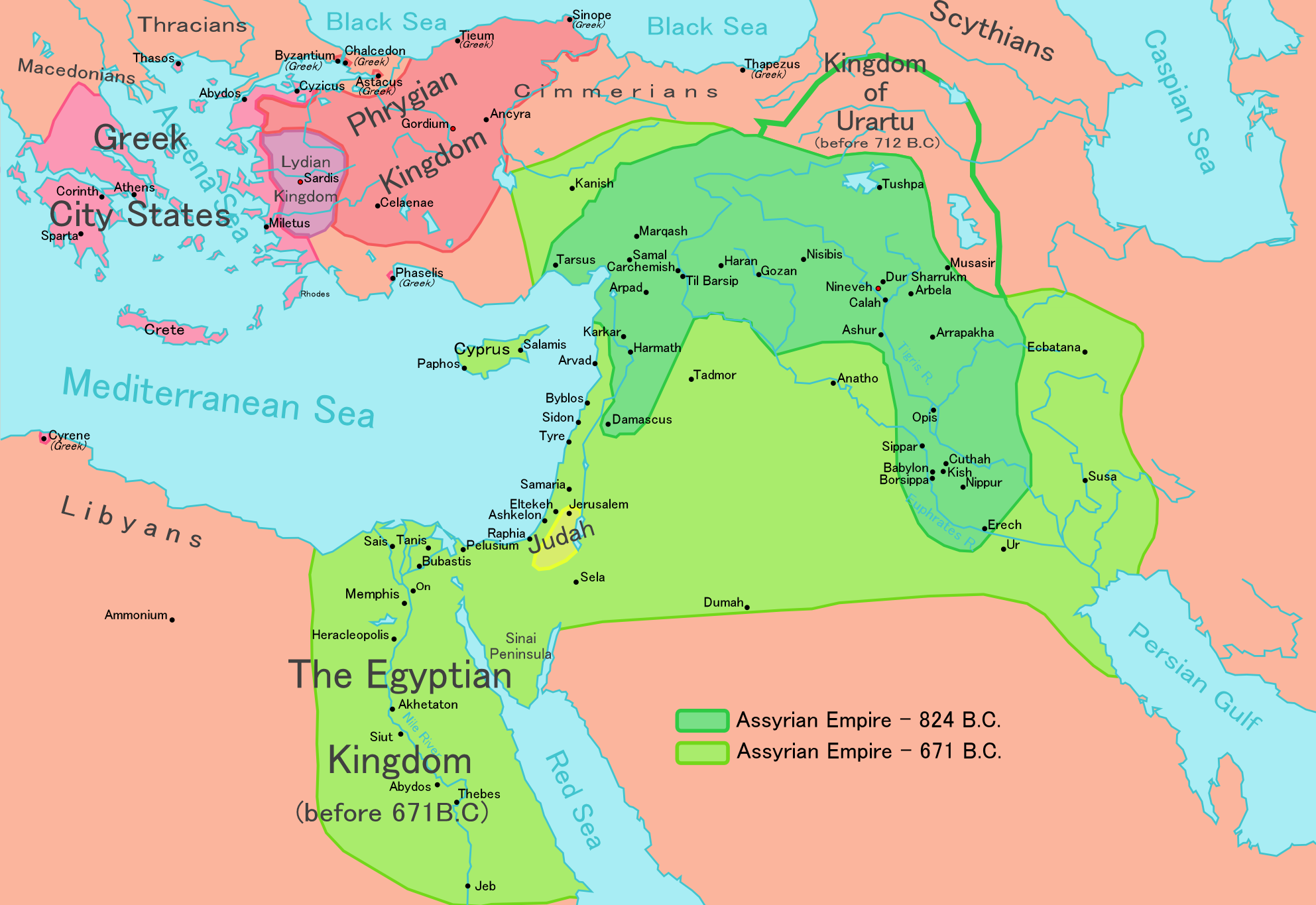
Tiglath-Pileser III, the Assyrian king, took part of Galilee, which was in the northern kingdom, sometime before 731 BC (2 Ki 15:29). Ahaz, who was king of Judah beginning in 735 BC, saw what was happening to the Northern Kingdom and was afraid. Because of this fear, he adopted a pro-Assyrian foreign policy. Pekah king of Israel and Rezin king of Damascus (Aram) attacked Judah because of this pro-Assyrian policy in 735 BC (2 Ki. 16:5, 2 Chr. 28:5-15)
Ahaz was terrified by the Syro-Ephraimite threat, and sent to Tiglath-Pileser for help (Is. 7:2, 2 Ki. 16:7-9). It is here that this passage (9:1-7) lies: about 735 BC.
Isaiah comes to the king and says: you are not depending on God to save you. You are depending on Assyria. You want Assyria to come; well, Assyria will come, all right. He’ll come like a flood, and the waters are going to be up to your neck! (8:8). The problem with King Ahaz was that he was depending on the power of Assyria to defend him and take away his fear instead of on the Lord. He didn’t want to give God control of the situation; he wanted to keep control for himself. This prophecy was fulfilled 30 years later under Sennacherib of Assyria (ca. 704 BC) (Is. 36). He invaded Judah, and was at the gates of Jerusalem, but in the end, he mysteriously withdrew. But that is another story (found in Is. 36-37).
But despite his message of judgment, Isaiah is ultimately hopeful. Judah has leadership that tries to keep control instead of relying on God, but these verses look ahead to a child who will be born and change everything.
Verses 4, 5 and 6 of this passage all begin with the Hebrew word ki. It’s a “key” word. It means “for,” or “because.” The things that happen in verses 2 and 3 happen because of what we find in verses 4, 5 and 6. And they escalate, building up to verse 6, which presents the central idea of this passage: Because this Child is born, everything changes; because the son is given, there is hope in the face of fear.
Four things happen because the child is born. Because the child is born:
Light shines in the darkness (9:2)
Chapter 8 ends with the words, “they will be thrust into utter darkness.” There is ultimately no hope for those who do not consult God. Ahaz wanted to do everything in his own power. He didn’t consult God because he didn’t want to depend on God. He didn’t want God to ask him for anything he didn’t want to give. He would rather rely on his own skills and intelligence. But his own skills and intelligence were not good enough.
But chapter 9 begins with the word, “Nevertheless.” Nevertheless, God will shine a light for those who can’t see for themselves. These people did not create this light for themselves. God gives his presence, his light, to people who are groping in the darkness. They can continue to grope around in the dark, or they can walk by the light.
Joy emerges in the gloom (9:3)
This is an incredible contrast with what has come before. Isaiah has just prophesied destruction, and here he is talking about joy.
The tense these verbs are in is the perfect. “You HAVE enlarged the nation.” God is giving his people hope. Even though there will be judgment, it will be followed by joy. It will surely come. Joy emerges, even in the gloom.
Freedom breaks through the oppression (9:4)
Why is there joy? FOR God has delivered his people from oppression. Too often, Christians think that true oppression, true bondage is to personal sin from which Jesus frees us. Other people say that Jesus came to free people from political oppression. Which one is it? The answer is: both. Jesus came to free people from bondage to sin. The main reason for the conflict between people is first that people are in conflict with God. But we can’t get right with God and act like that is the end of the story. When we love God, we have to love our neighbor. And part of loving our neighbor means participating with God in freeing people from oppression. This means fighting against human trafficking. This means fighting against poverty. There are two yokes that God frees people from. We can’t forget either one.
“Midian’s defeat” is talking about Judges 6-7, where he delivered his people from a real-life oppressor. In case the people of Isaiah’s day didn’t believe him, he points to a concrete example that everyone would recognize: Remember when God came into this hopeless situation and freed you? He did it then, and he can do it again.
Peace overcomes strife (9:5)
How is God going to get rid of oppression? He’s going to get rid of war.
Earlier in this book, Isaiah said that armies would beat their swords into plowshares and their spears into pruning hooks (2:4). But here he goes even further. Not just the weapons, but even the boots and the bloody garments will be burned. There will be absolutely no warfare.
There is joy BECAUSE God has delivered from oppression, and he does that BECAUSE he has brought an end to war. How can this happen? Because of the son with all the names:
Wonderful Counselor – “wonder of a counselor”
wonder – power (as in God showing his wonders in Egypt).
counselor – wise. The kings of Israel and Judah lacked wisdom, but this figure is perfectly wise.
Mighty God – The person who is being talked about is none other than God in human form. He is not just a great person.
Father of Eternity – He is father forever. Many ancient kings called themselves fathers to their people. In the ancient world, fatherhood is about taking care of people. This person will be a father, a protector, forever. Some people have difficulty thinking of God as father. When the Bible talks about God as father, it is not saying that he is a father like any other father, or even a king like any other king. He is the father that other fathers were meant to look like, and the king that other kings were meant to look like. He will protect and take care of his people forever. He will never fail. Earthly fathers fail. Earthly leaders fail. God will never fail.
Prince of Peace – He is not the kind of prince who squashes all defiance. He doesn’t throw his weight around, like the king of Assyria. He doesn’t rely on the strength of others, like the king of Judah. He will base his kingdom on justice and righteousness, rather than violence and coercion. And he will do this forever.
Now that we know what this child does, we can ask: Who is this child? Ahaz’s son Hezekiah was a good king, but he didn’t do all the things that this passage talks about.
No one fits the bill until the night Jesus was born, when the sky filled with angels saying, “Do not be afraid. I bring you good news of great joy that will be for all people.” (Luke 2:10)
Matthew makes this explicit in 4:15-16, when he describes the beginning of Jesus’ public ministry by quoting this very passage.
If we follow Jesus and put our trust in him, this passage applies to us. So because Jesus has been born, and the government is on his shoulders,
We can know light in the darkness.
We can know joy in the gloom.
We can know freedom in the oppression.
We can know peace in the strife.
The theme of this section of Isaiah, is “trust.” King Ahaz needed to trust God rather than his own wisdom. That is still the message for us. Where do you need to give Jesus “the government” today?
When he is given control, everything changes. It isn’t easy. It wasn’t easy in Isaiah’s day. Even when Isaiah confronted him, Ahaz wouldn’t give up control.
It’s scary for us to give up control, but that is because we’re selfish and have trouble trusting.
But Jesus is trustworthy, and giving him control of all of life is the only thing that gives life.
Invite him into the darkness. Invite him into the gloom. Invite him into the oppression. Invite him into the strife. Give him the government. His shoulders are big enough to carry it.
“For unto us.” Because unto us. Everything can be different.
 1. Rich Christians in an Age of Hunger: Moving From Affluence to Generosity by Ronald J. Sider. This book came out in 1977, and is regarded by many as a “classic.” The version I read was the fifth edition, updated in (I think) 2004.
The book comes in four parts: the first part depicts the state of the world today, in which there are billions of poor people and millions of affluent people who could help. The second part shares a biblical perspective on poverty and possessions. The third attempts to answer the question, “What causes poverty?” And the fourth shares practical steps that Christians in rich countries can follow to both simplify their own lives and make wise contributions to making the world a more just and fair place.
This was a challenging book for me. Although I don’t think of myself as affluent, I certainly live in an affluent part of the world and enjoy many more conveniences than those people who have to live on a few dollars a day. The main things that I got out of this book were 1) practical tips on living more simply, while simultaneously fostering community, and 2) a greater understanding of the economics of poverty. Lack of understanding the latter, I think, is a major obstacle that keeps Christians from helping the poor. We think that the foreign aid rich countries give to poor countries is a lot, but most actually give less than 1 percent of their GNP in foreign aid – and much of this aid is tied to their own foreign policy interests. We think that this aid is more than enough to make up for inequalities caused by things like tariffs and the abusive practices of some multi-national corporations, but it is not. This is definitely a book that all Christians in wealthy nations should read. Even if not everyone agrees with Sider’s practical proposals, the problem of poverty is something that all Christians – if they are reading their Bibles and are genuinely seeking to be more like Jesus – are called to address.
 2. Praying With the Church: Following Jesus Daily, Hourly, Today by Scot McKnight. McKnight was raised in a Christian tradition that had no use for daily set prayers, but as an adult he has come to appreciate and even love them. Like McKnight, I was raised in a Christian tradition that did not have set prayers (though we did recite the Lord’s Prayer and the “Gloria Patri” every week in church). As an adult, I have been more and more interested in the practice of daily prayer times as I have come to understand how deep they go in the Christian tradition.
McKnight’s book is a quick read and it comes in two parts: the first deals with Jesus’ own use of set prayers (Jews of his time recited prayers daily, and what we call the “Lord’s Prayer” is Jesus teaching his disciples something to pray every day). The second part serves as an introduction to four prayer books: the Orthodox Manual of Eastern Orthodox Prayers, the Roman Catholic Liturgy of the Hours, the Anglican Book of Common Prayer, and Phyllis Tickle’s modern ecumenical Divine Hours. I would recommend this book to anyone who, like me, wants to have a richer prayer life and who is less familiar with the tradition of set prayers and how to use a prayer book.
 3. The Ascent of a Leader: How Ordinary Relationships Develop Extraordinary Character and Influence by Bill Thrall, Bruce McNichol and Ken McElrath. Throughout my time in graduate school, I felt that it was more important to spend my time reading deep theology books than leadership books. But as I grow closer to (hopefully) taking on more leadership in a church setting, and as I become more aware that it is rarely bad theology that gets pastors kicked out of churches, I’ve become more interested in leadership literature. Earlier this year I read Now, Discover Your Strengths, and I’ve just recently completed The Ascent of a Leader.
The “ascent” the authors talk about is climbing the “character ladder” rather than the “capacity ladder.” The capacity ladder is what leaders are able to do on their own, and it comes with four rungs: discover what I can do, develop my capacities, acquire a title or position and attain individual potential. Climbing up just this kind of ladder can lead to loneliness and failure. Rather, spurred on by environments and relationships of grace, leaders should climb the character ladder: trust God and others, choose vulnerability, align with truth, pay the price and discover destiny. Once you start to climb the character ladder, you can integrate it with the capacity ladder, “leveraging our capacities far beyond what we could have accomplished without character” (143). I found this book to be a good reminder of how important character is in everyday life.
 4. The Blue Parakeet: Rethinking How You Read the Bible by Scot McKnight. I’d heard a lot about this little book in recent months, and when I was at the Covenant’s annual meeting in Portland this summer, I was able to pick it up. The title comes from a time when McKnight was sitting in his backyard and saw a strange blue bird that he had never seen before. Turns out it was a parakeet that had escaped from someone’s cage. The “blue parakeets” of the title are “oddities in the Bible that we prefer to cage and silence rather than to permit into our sacred mental gardens” (208). Issues like Sabbath, foot washing, tithing and women in ministry are blue parakeets that many of us don’t quite know what to do with: do we try to retrieve all practices from biblical times? Do we try to retrieve only what we can salvage for our day and our culture? Do we read through tradition? Or do we read in dialogue with tradition? McKnight counsels us to read the Bible as a Story. We should read this Story in order to get to know the God behind it. And we should discern through God’s Spirit and in the context of our community how to continue living that Story in our own day. McKnight provides an example of discernment in the issue of women in ministry.
This is a wonderful book, and I hope it finds its way into the hands of lots of people. All Christians interpret the Bible in some way, but there are so few books for a popular audience on how to best interpret it. As a result, many are left thinking that the way their pastor or their immediate community interprets the Bible is self-evidently the only way. This is unfortunate.
This isn’t a perfect book, by any means. Since it is short, and meant for a popular audience, McKnight ends up dealing with some complicated issues very briefly. As a result, I doubt whether he will convince many people who, for example, are thoroughly antagonistic to women’s ordination. But since the book is for a popular audience, and no popular book can deal with these issues in great detail, I still highly recommend it.
 5. Gone With the Wind by Margaret Mitchell. I have never seen the movie version of this book, and I was surprised on reading it to find that Scarlett O’Hara is one of the more malevolent and despicable literary protagonists I have ever read about – and I have read Anna Karenina. Like Anna Karenina, the real hero of this book is someone besides the main character: in Anna Karenina it is Levin (who, I’ve heard, Tolstoy modeled after himself), and in Gone With the Wind, it seems to me that the heroine is really Melanie Wilkes. But in both books, the intended hero is far overshadowed by protagonists who are such finely written, true-to-life characters that, despite their badness, they steal the show. It’s a great credit to Margaret Mitchell that she could create such a believable character as Scarlett – even if she is so believable that I genuinely didn’t like her.
 6. The Theology of the Book of Revelation by Richard Bauckham. We have been reading through the book of Revelation in our Bible study, and I have taken it on myself to do background reading and lead the discussion. Part of that background reading has been this fantastic little book (it’s only 169 pages). Bauckham, who retired a couple of years ago from being Professor of New Testament at St. Andrews, digs into the theological content of Revelation and finds that it has perhaps the most developed trinitarian theology in the New Testament. He doesn’t spend a lot of time criticizing various interpretations of the book, but it’s clear that he doesn’t think futurist or historicist interpretations do a very good job of making sense of the imagery in the book. This is a dense little book, and it doesn’t move chronologically through the text. For those who want to read it, I’d recommend reading Revelation first to get a sense of it, then read this book, and then go back and read Revelation again with new eyes.
I preached this sermon yesterday at my church. It was a difficult one to write. I think this is because it was more topical instead of being based on a single Bible passage. That made it harder for me to decide what to put in and leave out. In the end, I may have put too much in. In spite of that, my prayer is that God spoke through a fragile instrument.
p.s. – These are my notes, slightly fleshed-out so that they make sense. Not the entire text of the sermon.
Introduction:
We are in the midst of a series called “A New Kind of Normal,” based on the book by Carol Kent. We are examining places where our lives are not what we would want. We would prefer for things to return to our definition of “normal.” Instead, we sometimes need to redefine “normal” based on our actual experience.
Often when we think of people who are alone, we think of single people, divorced people and widowed people. But those are not the only people who struggle with loneliness. Married people can also be lonely. This sermon is directed toward all people who experience loneliness, whether they are single, divorced, widowed or yes, even married. The sermon is in three parts: the first looks at our experience of loneliness, the second looks at what the Bible says about loneliness, and the third presents two steps to a “solution” for loneliness.
Our experience of loneliness
Loneliness is a big part of our society, and it has become bigger in the last 50 years or so.
The most recent census showed that 25 percent, or 27.2 million of U.S. households consisted of just one person. In 1950, it was just 10 percent.
Robert Putnam wrote a book ten years ago called Bowling Alone, about the loss of community in American life. The book gets its title from the fact that the number of people who bowl in America has gone up in recent years, but the number of bowling leagues has gone down. People today are less likely to form associations with others than they were a generation ago.
Loneliness has even become more prevalent in the last 20 years or so.
A study in the American Sociological Review from 2006 showed that the average American had just 2 friends with whom they could discuss matters important to them. The number of people with NO close friends in 1985 was 10 percent. In 2006 – 25 percent. Another 19 percent said they had just one: their spouse.
This may seem strange, because we have much more connecting technology now than we used to: cell phones, e-mail, Facebook. And yet people are lonely. People have an itch for community, but it’s not being scratched by how we use technology. Why is that?
What the Bible says about loneliness
Let’s look for an answer in what the Bible says about loneliness. If you look up “loneliness” in a concordance, you won’t find much. The Bible was addressed to a culture that was much different from our own. It’s not that people didn’t experience loneliness back then. It’s that if you were on your own, loneliness was the least of your problems. The three most vulnerable types of people in ancient societies were widows, orphans and aliens – people who didn’t have the support structure of family.
But the Bible does have something to say about loneliness. Let’s begin at the beginning. You may want to write these passages down to look at later.
Genesis 2:18
In the beginning, God made Adam, the first human, and put him in the Garden of Eden. After he put him there, God said, “It is not good for man to be alone.” Then, after having Adam look at and name all the animals, God created woman.
Then along came the serpent and convinced them to eat of the Tree of the Knowledge of Good and Evil, which God had told them not to do. Then come the events of Genesis 3:8-13. They hear God coming, and for the first time they hide. They are alienated from God. Adam blames the woman, the woman blames the serpent, and the serpent didn’t have a leg to stand on, as the old joke goes.
The roots of loneliness are right here: because our ancestors suspected God was not working in their best interests, there is now a loss of intimacy between humans and God. Our natural inclination now is to be alienated from God and from other people. Is it any wonder that people struggle with loneliness?
Leviticus 13:45-46
In the rest of the Old Testament, from time to time you see people who have lost family or community. Here in Leviticus, people with leprosy or other skin diseases are told they must live alone. This gives new meaning to the fact that Jesus healed lepers in his earthly ministry. Part of his purpose was to restore community. But we’re getting ahead of ourselves.
1 Kings 19:1-5a, 13b-18
Here we see the prophet Elijah after he had killed 450 false prophets. Despite this great victory, he was afraid of Jezebel and ran away. This is a kind of loneliness that was his own fault. He was not really alone, but he had pity on himself and was afraid of the queen more than he was afraid of God.
The Psalmist’s loneliness: Psalms of Lament. Two good examples: Psalm 88:8, 15-18, 102:1-11. In psalms of lament, the psalmists feel abandoned by God and by other people. So far we’ve seen at least two kinds of loneliness: sometimes loneliness happens because community is taken from us, but sometimes loneliness happens because we are feeling frightened and sorry for ourselves.
New Testament loneliness: Jesus did not experience loneliness for most of his life. The only time he experienced loneliness was on the cross. In Matthew and Mark’s accounts of the crucifixion, Jesus calls out, “My God, my God, why have you forsaken me?” He is quoting the opening of Psalm 22. Jesus was experiencing a distance from his Father that he had never known. Jesus always referred to God as his Father, but here he uses the less intimate term “God.” At the end of Psalm 22, the psalmist is vindicated by God, and Jesus knew that he, too, would be vindicated by his resurrection. All the same, he experienced abandonment on the cross, even if he knew it was temporary.
2 Timothy 4:9-18. The final stop on our tour of loneliness in the Bible has us look at Paul’s loneliness at the end of his second letter to Timothy. Paul is in prison and writes to his protege Timothy toward the end of his life. He expresses the desolation that several of his friends and associates have left him. He knows that God is always with him, but that doesn’t take away the pain of being betrayed and deserted by humans.
So what do we learn from this crash course in what the Bible says about loneliness? We learn that:
1. Loneliness is a result of alienation from God and other people.
2. Loneliness can happen because of self-pity and self-absorption (as in the case of Elijah).
3. Loneliness can happen because we lack a community, or have been abandoned by our friends (as in the case of Paul).
4. Loneliness can happen if we feel abandoned by God.
The “solution” to loneliness: moving from loneliness to solitude with God and from solitude to community.
“Solution” is in quotes because there is no permanent solution to loneliness in this life. It is part of the human experience. Even if we go through long stretches where we don’t experience loneliness, none of us is completely immune.
Some of you may ask “Why isn’t marriage a solution to loneliness?” Two reasons: First, we’re not in the Garden of Eden anymore. Even if we get married, it’s still possible to feel lonely. Loneliness has a lot to do with our expectations of other people. If we expect a marriage partner to ease our loneliness and make us feel good all the time, we are going to be disappointed. Second, not everyone is going to get married. I don’t want to present marriage as a solution for single people, because we will not all experience marriage.
The first step in the “solution” is solitude. When we’re lonely, the biggest temptation is to distract ourselves. We call or e-mail people; we check our Facebook. But the way to make loneliness productive is to turn that loneliness into solitude. We need to go into the desert of loneliness and turn it into a garden of solitude. Henri Nouwen wrote,
“When we live with a solitude of heart, we can listen with attention to the words and the worlds of others, but when we are driven by loneliness, we tend to select just those remarks and events that bring immediate satisfaction to our own craving needs.” – Henri Nouwen, Reaching Out
When we are lonely, we are restless and unhappy, and we reach out to other people in order to have them meet our needs. When we are in solitude, we are content, we are listening to God, and we are able to listen to, care for and be present with people. What does solitude look like? Jesus gives us an example. He often sought solitude with his Father:
Mark 1:35 – “In the morning, while it was still very dark, he got up and went out to a deserted place, and there he prayed.”
Luke 5:15 -”Jesus often withdrew to lonely places and prayed.”
Luke 6:12 – “One of those days Jesus went out to a mountainside to pray, and spent the night praying to God.” Jesus led a very busy life, but always made time for solitude. When we’re lonely, shouldn’t we at least ask ourselves: am I reaching out to people for selfish reasons? Do I need solitude with God right now?
There are lots of ways to practice solitude. Spending daily time in prayer is one. Setting aside regular time to go on silent retreats is another. People who are really experienced with solitude can do it even in the midst of people. Richard Foster wrote:
Solitude is more a state of mind and heart than it is a place. There is a solitude of the heart that can be maintained at all times. Crowds, or the lack of them, have little to do with this inward attentiveness. It is quite possible to be a desert hermit and never experience solitude. But if we possess inward solitude we do not fear being alone, for we know that we are not alone. Neither do we fear being with others, for they do not control us. In the midst of noise and confusion we are settled into a deep inner silence. Whether alone or among people, we always carry with us a portable sanctuary of the heart.” – Richard Foster, Celebration of Discipline
The second step in the “solution” is moving from solitude to community. And it’s really a two-step. We go from solitude to community, then back to solitude then back to community.
The Bible tells us that God’s people ought to be a community that reaches out to the lonely. God’s people ought to be a family:
Matthew 12:46-50 – Jesus: “Whoever does the will of God is my brother and sister and mother.”
John 19:26-27 – Jesus on the cross: “here is your mother,” and “here is your son.”
Acts 2:45-47 – “All who believed were together and had all things in common; they would sell their possessions and goods and distribute the proceeds to all, as any had need.”
Galatians 6:10 – “let us do good to all people, especially those who belong to the family of believers.”
Eph. 2:19 – “you are members of the household of God.”
The early Christians knew this. When there were plagues in the cities of the Roman Empire, nearly everyone cleared out, except for the Christians. They stayed behind to take care of the sick and dying, whether they were biological family or not. Julian the Apostate at one point wrote to his pagan priests, saying that Christians put them to shame because Christians took care of everyone. The reason why pagan priests couldn’t do this as naturally is because their gods didn’t humble themselves and die like outcasts.
Julian’s question to the pagan priests is a good question for us in the 21st century: “Why can’t we do the same thing?” We need to look to Luke 5:12-16 for guidance. Like the leper, we need to turn to Jesus to heal us from sin and the things that make us lonely, whether it is our self-pity, or whether we have been abandoned by others. When Jesus heals us, he always restores us to community. We always go from loneliness to solitude, and from solitude to community.
Now we have reached the final “tour” of the Truth Project, on Community.
Del begins by quoting Matthew 22:33-40, wherein a Pharisee asks Jesus what the greatest commandment in the Law is. Jesus responds (referring to Deut. 6:4-9), “Love the Lord your God with all your heart and with all your soul and with all your mind,” and “Love your neighbor as yourself.” Del also quotes a similar passage from Luke 10:25-29, in which the Pharisee, wanting to “justify himself,” asks, “And who is my neighbor?”
Then Del takes us back through the “spheres” that he has introduced in the last several tours: God, the family, the church, the state, the general economic model and the labor sphere, saying that God has stamped his divine image on each one. Then he says that the sphere of community looks a little different because it doesn’t have any “authority” roles, but only “responsibility” roles. He says maybe this is why we neglect this sphere, because there’s no power in it.
Returning to the passage in Luke, Del says that the Pharisee, in asking who his neighbor was, was looking for a checklist. Instead, Jesus told him what we think of as the parable of the Good Samaritan. Del calls it the “Story of the Good Neighbor.” In telling the story, Jesus didn’t answer the Pharisee’s question; he responded with what the man needed to hear. “He said what a neighbor was, and told him to go be a neighbor.” Del draws the “sphere” of community on the board, with Christ at the top, the neighbor below and to the right, and the needy below.
Del quotes a series of passages from the Old Testament (1 Sam. 2:8, Job 5:11, Ps. 12:5, Ps. 72:4, 138:6, 12:5) and sums them all up by saying that “God has a deep heart for the needy.” Then he asks, “Who are the needy?” It’s the poor, orphans, widows, the sick and prisoners, but it’s also outcasts, the unpopular, the neglected, the left out, the homely, the last and others. Del tells two stories to illustrate how the needy are everywhere: the first is of a girl who everyone made fun of when Del was in school, and the second is of his first school dance, where Del’s dad called his attention to the fact that there were girls whom no one was asking to dance.
Del then quotes another series of Bible passages, and ends by asking, “What other gods have a heart for the lowly?” This causes him to focus on the nature of God. He quotes Matt. 11:28-9, and says that for him, it was easy to think of God as powerful but the idea that God was humble was foreign. This is hard to miss in Jesus, though. At the Last Supper, he washed his disciples’ feet, and in John 14:4-9, he says, “Anyone who has seen me has seen the Father.”
But Del hastens to point out that humility is not timidity. He read a book about Jesus once called Man of Steel and Velvet. This is what Jesus is like.
Then Del plays two videos. The first is of Fr. Robert Sirico, who says that Christian charity is different from philanthropy because of its view of the person as sacred. He quotes C.S. Lewis as saying, “You’ve never met a mere mortal.”
The second video is of Flash, a tattoo artist who has made several appearances in previous video segments. In previous segments, he has come across as rough-edged and hostile to Christianity, but in this one he tells his story of abandonment and abuse, of pain and rejection by the church. He says, “I’ve only met a few Christians who act like what they say they are.”
Del then asks why we are not involved. Sometimes it’s because we don’t care. But if you want to follow Jesus, you must get involved. If we don’t engage the culture, he says, how are we going to understand where people are coming from, their needs? “We have a serious credibility gap.”
Then Del turns to the book of Jonah, in which God calls the prophet to go to Nineveh and prophesy but he runs away. Del says the focus of the story is on Nineveh. God cared about it and wanted to save it. “Should I not be concerned about that great city?” Del asks, “Do you think God’s not concerned with our culture?”
Del says that we are called to transform culture. He says that Christianity changed the world through involvement. He points to the British anti-slave trade campaigner William Wilberforce as an example. He points to five characteristics that Wilberforce had that we can learn from:
1. HIs whole life was animated by a deeply held, personal faith in Jesus Christ.
2. He had a deep sense of calling that grew into conviction that he was to exercise his spiritual purpose in the realms of his secular responsibility.
3. He was committed to the strategic importance of a band of like-minded friends devoted to working together in chosen ventures.
4. He believed deeply in the power of ideas and moral beliefs to change culture through sustained public persuasion.
5. He was willing to pay a steep cost for his courageous public stands and was persistent in pursuing his life task.
There have been many Christians like him, Del says, and we are in good company. So what do we do? What is the next step? Del says that he has no clue. He isn’t going to advise people on what to do. But he does know the one who does: God.
I thought that this was a great “tour” to end on. It would be easy for people to go through this whole curriculum and say, “Well, now I have a Christian worldview. Good for me,” instead of actually having it change the way they live. I liked the way that the title frames the question: “God Cares, do I?” God is not content to sit comfortably in church and scoff at the world; should I be?
I also thought that the video of Flash was very powerful. As noted above, he comes across as being pretty rough around the edges, and in earlier tours he said some harsh and disturbing things. It was important to see the story behind who he is, and show that he is a human, made in God’s image, who God calls us to love and respect.
And finally, I think on the one hand that Wilberforce is a great example of Christian cultural involvement, and on the other it was wise for Del to refrain from saying what people should do next. They should look for God to call them to what he wants them to do.
There are just a few nitpicky things about this tour to point out. The first is that Del again bases a “sphere” on God’s internal relationships, saying that “He stamped that divine image on each [sphere].” I’ve already mentioned a couple of times, especially in Tour 7: Sociology, that I think this is a mistake and unbiblical. We can say that God wants our relationships to be a certain way, but I don’t think there’s enough biblical warrant to say that he wants our relationships in these “spheres” to look like the Trinity.
Second, I liked that Del came across in this tour as concerned about where people are coming from. But I wonder whether this is enough to counteract the scoffing and dismissive tone he adopts elsewhere in the Truth Project. For example, in tour 10, he scoffs at people at Harvard, saying, “I’m not even sure they know what [truth] means.” In an earlier tour, he scoffs at his college philosophy professor, dismissing him by saying, “How foolish!” Del appears conflicted. On the one hand, he seems to have a real heart for people, and knows that “our struggle is not against flesh and blood” (Eph. 6:12). On the other, he seems at times to get carried away into an “Us vs. Them” mentality. I wonder which Del watchers of the Truth Project will listen to more?
Finally, Del says that “we’re called to transform culture.” I don’t think this is the best way to frame things. Culture is a big thing (within our society, you could even speak of several different cultures), and transforming it is really out of our control (I get this idea from Andy Crouch’s book Culture Making, which I read recently). Even making laws can’t transform culture; laws are downstream from culture. Instead of talking about “transforming culture,” I would be more partial to the language of “being faithful” – listening to God’s call, and following him as faithfully as we can. We can make culture, but we can leave the culture transforming up to him.
In tour nine of the Truth Project, Del looks at the State. He begins with a definition of politics from the first edition of Webster’s dictionary, 1828:
The science of government; that part of ethics which consists in the regulation and government of a nation or state, for the preservation of its safety, peace and prosperity; comprehending the defense of its existence and rights against foreign control or conquest … and the protection or its citizens in their rights, with the preservation and improvement of their morals.”
Del then asks his audience whether the state can steal. He sets out to give his answer to this question by telling the story of a couple who had worked throughout their lives on a farm, and when the husband died the state took half of their property. He also gives an example from 1 Kings 21, where King Ahab and Jezebel had Naboth killed so they could take his vineyard. God, speaking through Elijah the prophet, calls this murder and theft. So, Del says, the state can steal.
Then Del gives another example from Daniel 4:29-35, telling the story of Nebuchadnezzar, king of Babylon. Nebuchadnezzar looks out over his kingdom and swells with pride at how he built it all himself, and God judges him for his pride by making him live like an animal for a while. Del asks, “Who is in control here?” The answer is that God is sovereign over kings, and he cites several Bible verses (Proverbs 16:9-10, Proverbs 21:1, Daniel 2:21, Romans 9:17) to that effect.
Del then turns to the question of what the sphere of the state is supposed to look like. He refers to 1 Samuel 8 and asks why Israel asked for a king. Del’s answer is that it was because their leadership (at that time, Samuel’s sons) was corrupt and they wanted to change their form of leadership. Samuel then warned them that if they got a king, that king would take what belongs to God. This is a warning, says Del, that they would become as slaves.
So is the king sovereign over every sphere? Del turns to Abraham Kuyper and Neo-Calvinism’s notion of “sphere sovereignty” to explain this. Basically, sphere sovereignty is the idea that each sphere of life (e.g. the state, the church, the family, labor) has its own responsibilities and authority, and stands equal to other spheres of life (to paraphrase Wikipedia). The question is whether the state has sovereignty over other spheres. Del cites 2 Chronicles 26, the story of King Uzziah going into the temple to burn incense (and being punished with leprosy for it), as an example of the state (the king) meddling with the church (the temple). “This idea of sphere sovereignty,” Del sums up, “is critical to God.” This is why, in cowboy movies set in the Old West, criminals running from a posse can run into a church and the posse can’t follow them in. The churches exist outside the state’s sovereignty.
Then Del cites Romans 13:1-6, pulling out three main ideas: authority, submission and purpose of the state. Del says that delegation of authority is found within the nature of God (John 17:1-2, 1 Corinthians 15:24, 27-28), and various forms of submission are found in the Bible (wives “subject” to their husbands, bondslaves “subject” to their masters, people “subject” to their rulers, all in Titus 2-3). Christians have the duty to pay taxes, respect and honor to the civil magistrate (Romans 13:7, 1 Peter 2:17). The purpose of the state is to punish evil and condone good. The state (in the form of the civil magistrate), says Del, is an agent of God’s wrath. If the state doesn’t know the basis for calling something good or evil, then good becomes whatever is in the state’s best interests.
Del expands on this theme of the state doing what is in its own best interests by talking about pathologies that we have seen develop in various states throughout history. “The problem with pathologies in this sphere,” Del says, “is that they end in mass graves.” The one pathology that Del pays the most attention to is the rise of the state, when the state removes God and takes over sovereignty of other spheres. Del says that without God, this rise of the state continues until we have a global state.
Del concludes that one of the attributes that marked the Roman Empire at its end was an increased desire to live off the state. Del returns to 1 Samuel 8 to say that when we look to the state (or a king) for our salvation and guidance, we are rejecting God.
Del certainly covered a lot in this tour, and as is the case much of the time, I liked a lot of what he said. I agree with Del that God is sovereign over the state and that it is possible for the state to steal. I also agree that one of the effects of a loss of reliance on the transcendent God is that might makes right. There becomes no standard other than self-interest. And I also agree that in our sinful world, the state tends to aggrandize itself.
But as one person in my discussion group put it, I like it when Del is speaking directly from the Bible, but when he doesn’t, not as much. In this tour, he tacitly endorsed the standard conservative American emphases of small government and property rights. In fact, much of this tour was standard conservative fare. Now, it may be possible to make a biblical argument for such things as property rights and limited government, but Del doesn’t make that argument. And any time Christianity is presented as being compatible with a non-Christian ideology (as conservatism is—and liberalism, too), red flags go up for me. Christians may well be on the same side of certain issues as followers of ideologies, but when Christianity is aligned with an ideology without tension and without remainder, that is a major no-no.
Also, he accepted it as a given that sphere sovereignty is there in the Bible and that this is the way all Christians should view various spheres of life. However, not all Christians think that sphere sovereignty is self-evidently the way Christians ought to view the world. Del’s example from 2 Chronicles 26, in particular, can be explained in another way than appealing to sphere sovereignty. Del implies that the reason why King Uzziah broke out in leprosy was because God wanted to keep the spheres of government and religion separate. But as 2 Chronicles 26:16 says, the great sin of Uzziah was pride. He was overstepping his bounds, for sure, but the reason God was angry with him was because he did not think he needed to be consecrated (as the priests were) to offer incense. I don’t think that this would have been a problem if it had gone the other way, or if Uzziah had not been proud. I think of Samuel, in particular, who was a priest but who was intimately involved in the governance of Israel. I also think of David, who was king but danced before the Lord wearing a linen ephod (a priestly garment). At another point in David’s life, he and his men ate consecrated bread that was meant only for priests (1 Samuel 21). David was not condemned for either of these ventures outside of his “sphere.” There doesn’t seem to be as much biblical support for sphere sovereignty as Del would have us believe.
Sphere sovereignty is certainly a legitimate concept through which Christians may interpret the world, but I’m saying that it’s not self-evidently the only biblical one (for example, Catholics have an idea called subsidiarity, which says that a matter should be handled by the smallest authority capable of handling it effectively). Del misleads us when he acts as if sphere sovereignty is the only game in town.
Other than that, this was a good tour. Del’s warning at the end about the dangers of the expansion of the state and the desire to live off the state being a mark of a dying culture was perhaps too apocalyptic for my tastes. I think, for example, about the context of Romans 13. When Paul was writing, the “state” that he was talking about was the Roman Empire. I doubt whether Paul agreed fully with its ideas of what was good and what was evil. If Paul can write “let everyone be subject to the governing authorities, for there is no authority except that which God has established” about the Roman Empire, of all things, I think that Del’s apocalyptic language is a bit overblown. If Paul wants Roman Christians to submit to the rulers of the pagan Roman Empire, how come Del is so agitated about modern states, in many of which Christians at least have a political voice? I don’t want to speculate about what Del’s own politics might be, but I can’t help but wonder whether he has political interests that shape the stark language he uses at the end of this tour.
This past Sunday, I preached at my church. Soon the church will post the audio of it on its Web site, but for now here are my notes. I’ve fleshed them out a bit so you can follow the gist of the sermon:
What do the letters “INFP” mean? They are a Myers-Briggs type, and this is in fact my Myers-Briggs type. I visited a Web site this week that lists famous people who are listed under each personality type. Just for fun, I’ll read some famous INFPs:
Homer (author of the Iliad and the Odyssey)
Mary, mother of Jesus
John, the beloved disciple
Luke, author of the Gospel of Luke and Acts
William Shakespeare
Helen Keller, deaf and blind author
Fred Rogers (Mister Rogers’ Neighborhood)
Dick Clark (American Bandstand)
Neil Diamond, vocalist
Tom Brokaw, news anchor
Julia Roberts, actor
Fred Savage (“The Wonder Years”)
Fictional INFPs:
Anne (Anne of Green Gables)
Calvin (Calvin and Hobbes)
Bastian (The Neverending Story)
E.T.: the Extra Terrestrial
The Myers-Briggs isn’t the only personality test out there. Every time I log in to Facebook, it tells me that another one of my friends has taken a test to, say, find out which Muppet they are. In addition to personality tests, for Christians there are also spiritual gifts inventories. You take them, and you can figure out where you fit in the church: whether you should be prophesying or making coffee.
Why do people love these kinds of assessments so much? I would argue that we want to know that we’re not strange. We want to know that we are unique and that our quirks have a purpose. We want to know where we fit in.
There were no Myers-Briggs types in the ancient world, but here Paul is scratching that itch for significance for the Corinthians. He does it with a twist, though: he says “you are unique, and you matter – but it’s not all about you. You have special gifts, but you fit into a larger body.” The big idea in this passage is not just that we are special, but that God has put us all in the same body, each with unique gifts, and we need each other.
The Corinthians thought the Christian life was all about them. They thought that having spectacular gifts was the sign of true spirituality, and people who didn’t have them weren’t really spiritual. The spectacular gift to beat all spectacular gifts for them was speaking in tongues. So their worship was very disorderly, because the people who spoke in tongues were falling all over themselves to prove how super-spiritual they were, and were ignoring other people. The passage breaks into four parts:
12-13: No Lone Rangers
Paul tries to correct the Corinthians’ error by comparing the church to a body. We are Christ’s body, and we are each parts of that body. What unites us is not our race or our culture or our social status, but our baptism by one Spirit. Take a minute to think about how radical this is – especially in Corinth, where many of the problems the church had had to do with their preoccupation with status. Now take a minute to think about how strange this seems even today. There are, or should be, no race divisions in the church, no distinctions based on status. If the church remembered this throughout its history, modern slavery wouldn’t have happened – or at least the church wouldn’t have been complicit in it. It’s a good thing that some Christians, like William Wilberforce, understood what verses like this meant.
What unites us is that we were all baptized by the same Spirit. What is spirit baptism? It is not necessarily the manifestation of a spectacular gift. This is what happens to all of us when we trust Jesus and begin to follow him. Everyone is baptized once, and from then on they’re part of Christ’s body together with everyone who is now following or has ever followed Christ.
14-20: No Reason to Feel Inferior
What Paul says next is directed to those people who think that because they are not gifted in a particular way, that they are useless. Some people may think, “Well, if the church is a body, then I’m just an appendix. I’m not up front, I can’t play an instrument, I don’t have anything to contribute.” Paul is saying, though, that there are no unimportant parts in Christ’s body. The person who makes the coffee or vacuums the floor is just as important as the one who is preaching.
Also, if everyone had the so-called “important” gifts, then the church couldn’t function. If everyone did the same thing, Paul says we would be like a body covered in eyes.
I used to work at a camp when I was in college, and one summer our staff was pretty dysfunctional. One way this dysfunction manifested itself was in chapel, which we had every day. A lot of the staff wanted to be part of the worship team. A few weeks into the summer, half of the counselors were up on stage during chapel and everyone else was trying to look after their kids plus the kids of everyone on stage! This happened because we let ourselves believe that being part of the worship team was the best thing to do, so everyone wanted to do it. The problem is, when you think that some gifts are more prestigious or better than others, the church becomes dysfunctional.
21-26: No Reason to Feel Superior
Next, Paul defends against the other side of the coin: letting our significance blow up into self-importance. No gift is important on its own. Each person has his or her own proper place in the body, and we all need each other to function properly.
In v. 22, Paul says that the “weaker” parts are actually more necessary – like the internal organs. Your liver and your kidneys might look weak, but you can’t survive without them.
In v. 23, Paul is probably talking about sexual organs. We make sure that they are covered and treated with respect. God has actually given greater honor to those parts of his body that seem inferior. This is the way God works. He lifts up the weak.
In v. 26, Paul says we are knit together. We are supposed to care if someone else in the body is suffering. This applies to the local body, the church, and also to the worldwide body. When a member of the body is persecuted in a distant part of the world, we are supposed to suffer. When a member of the body is dying because of disease or hunger, we are supposed to suffer.
Likewise, when it’s going well for a member of the body, we are supposed to rejoice, because our destiny is tied up with these other members of the body.
27-31: The Best Gifts Build Others Up
Paul is driving the metaphor home here. Just in case anyone missed it before, he’s saying “YOU are the body of Christ.”
When we keep reading, we might think, “Hold on a minute. Paul has been going on about how no gifts are better than others, and now it looks like he’s ranking them.” Paul does give a list of gifts here at the end, and he does say some gifts are better than others, but he has a totally different ranking system from the Corinthians. The Corinthians say that the best gifts are the most spectacular ones; the ones that let you show off how spiritual you are – but he’s saying that the best gifts instead are the ones that build up other people the most. What are the greater gifts? Gifts that build up others, like prophecy (see 14:1-5):
“Follow the way of love and eagerly desire spiritual gifts, especially the gift of prophecy… Those who speak in a tongue edify themselves, but those who prophesy edify the church. I would like every one of you to speak in tongues, but I would rather have you prophesy. Those who prophesy are greater than those who speak in tongues, unless they interpret, so that the church may be edified.”
What does it mean to “desire the greater gifts”? It doesn’t mean that we can ask the Spirit for what we want, and then like a vending machine he will give it to us. Then the focus would still be on us. It means that we should desire above all to build others up and serve the rest of the body.
In America, individual freedom and self-expression are part of our history. Patrick Henry said, “Give me liberty or give me death.” People don’t go to New York City to visit the Statue of Responsibility. They don’t go to Philadelphia to see the Love Bell. Liberty is part of our DNA as a nation. And today, individual liberty and self-expression are becoming more important than ever. Sociologist Jean Twenge wrote a book recently called Generation Me. In it, she writes about how the current generation of young people is more focused on the needs of the individual than ever:
“So much of the “common sense” advice that’s given these days includes some variation on “self:”
Worried about how to act in a social situation? “Just be yourself.”What’s the good thing about your alcoholism/drug addiction/murder conviction? “I learned a lot about myself.”
Concerned about your performance? “Believe in yourself.” (Often followed by “and anything is possible.”)
Should you buy the new pair of shoes or get the nose ring? “Yes, express yourself.”
Why should you leave the unfulfilling relationship/quit the boring job/tell off your mother-in-law? “You have to respect yourself.”
Trying to get rid of a bad habit? “Be honest with yourself.”
Confused about the best time to date or get married? “You have to love yourself before you can love someone else.”
Should you express your opinion? “Yes, stand up for yourself.””
Freedom is better than slavery, but it should never be the number one priority. Biblically, this is the wrong way to go. Instead, love should be our number one priority. Building up others should be our number one priority. Not using our gifts and our freedom the way we want.
Some of us might say, “God has gifted me to play the bagpipes, and I’ll leave the church unless I get to play them during worship.” That’s not what God gives us gifts for. God gives us gifts to build others up, not for making ourselves happy through self-expression.
Being part of the body also helps us to discern what our gifts are. Apart from community, we can deceive ourselves into believing we have gifts that we don’t.
Finally, Remember 1 Corinthians 12:7: A spiritual gift is a “manifestation of the Spirit for the common good.” Paul goes on in chapter 13 to tell us how we should exercise whatever gifts we have. Love isn’t a special gift that some of us have and others don’t. It’s how all of us should exercise whatever gifts we have, no matter what they are. We can’t all have spectacular gifts. We can’t all have gifts that make other people sit up and take notice. But that’s not the point. We can all use our gifts to build one another up in love, and that is more important.
 Elliot Ritzema