I finished reading Andy Crouch’s newest book, Strong and Weak: Embracing a Life of Love, Risk & True Flourishing, this weekend. I was telling my wife about it, and she asked why I had been interested in reading it. I said, “Um, because I read everything Andy Crouch writes?” While there are in fact many things Crouch has written that I have not read, I have been a fan of his ever since his days editing re:generation quarterly, a magazine of Christian cultural criticism, in the early aughts. He has published two previous books, Culture Making (a declaration that Christians ought to make culture, not just critique it), and Playing God (a declaration that power is not so bad after all, and can in fact bring about a lot of good), both of which I devoured.
Strong and Weak is a bit different from those previous two books, though. The hardcover is a smaller format, for one thing, and so it is much shorter. For another thing, while the Amazon classification system put both Culture Making and Playing God into the “Social Issues” category, Strong and Weak is in the “Church Leadership” and “Self-Help” categories. While there are similarities, this book leans more toward leadership issues than cultural critique.
Crouch begins the book by claiming that, to bring about true flourishing, it is necessary for us to have both authority and vulnerability, where authority is “the capacity for meanin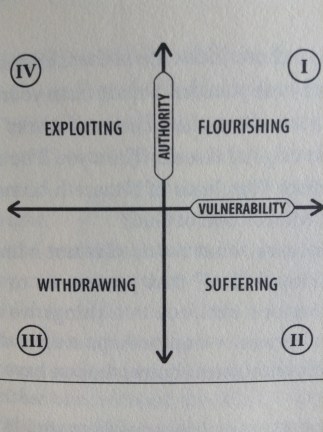 gful action” (35) and vulnerability is “exposure to meaningful risk” (40). He places these on a 2×2 chart that he uses throughout the book. The combination of authority with vulnerability (quadrant I) leads to flourishing; having vulnerability without authority (quadrant II) leads to suffering; having neither authority nor vulnerability (quadrant III) leads to withdrawing; and having authority without vulnerability (quadrant IV) leads to exploiting.
In the first part of the book, Crouch defines more fully each of the four quadrants. The second part of the book is devoted to setting out the path to flourishing, and is chiefly made up of two chapters: “Hidden Vulnerability” and “Descending to the Dead.” Both of these explore paradoxes related to getting into the upper right quadrant. In the first, he writes that “the most important thing we are called to do is help our communities meet their deepest vulnerability with appropriate authority—to help our communities live in the full authority and full vulnerability of Flourishing. And it turns out that in order to do that, we often must bear vulnerability that no one sees” (122). In the second, he writes that “the most transformative acts of our lives are likely to be the moments when we radically empty ourselves, in the very settings where we would normally be expected to exercise authority” (151). In other words, we get to flourishing by going through suffering.
It was appropriate for me to read this book over Easter weekend, as I found it to be a valuable reflection on both the death and resurrection of Christ and his call for his followers to take up their crosses and follow him. This book was simple and profound, and I expect that it will stay with me for a long time as I seek to grow in leadership and help others to flourish.
Note: Thanks to InterVarsity Press for a review copy of this book. I was not asked to give a positive review.
 1. The Reason for God: Belief in an Age of Skepticism by Timothy Keller. I’d been looking forward to reading this since it came out last year, and when I was talking with my cousin (who is not a Christian) over Christmas about a book to possibly read together, I knew this was the one. Since February we have been reading about a chapter at a time, he e-mailing me his thoughts and me responding with my thoughts. It has been a fruitful dialogue, I think, mostly because Keller covers so much in this book. The first half features chapters on various questions/objections that people in North America have about Christianity (e.g., “How Can a Loving God Send People to Hell?”), and the second half features chapters that examine the claims of Christianity. Keller has clearly done a lot of thinking about cultural and philosophical issues and a lot of talking with non-Christians, and it shows. I highly recommend it both for believers who want an overview of modern/postmodern Western objections to Christianity, and unbelievers who want to know what some responses to those objections are.
 2. A Peculiar People: The Church as Culture in a Post-Christian Society by Rodney Clapp. The title of this book says it all, really. Clapp argues that we are in a post-Christian society, and says that the church’s response to this situation should not be to attempt to reassert Christian cultural dominance but to become a culture unto itself. I bought it used, and the previous owner had written a lot of question marks in the margins, and I could see why. It’s much too short for Clapp to really develop his arguments, so I’m not too sure that it’s likely to convince many people who don’t already agree with the thesis. I enjoyed it, but wouldn’t call it a life-changing book. For those who want more fully developed thought in this area, I’d recommend the work of John Howard Yoder or Stanley Hauerwas.
 3. Culture Making: Recovering Our Creative Calling by Andy Crouch. I’m a sucker for books about culture. All you have to do, as an author or publisher, is put the word “culture” in a book title, and you can guarantee that I’ll at least pick it up and look at it. I was already familiar with the work of Andy Crouch, largely through the influence of my Sunday School teacher when I went to Third Presbyterian Church in Richmond, Fritz Kling. Back then (this was seven years ago), Fritz would hand out copies of the magazine of which Crouch was the editor, re:generation quarterly. I remember reading through a few issues and especially liking Crouch’s voice. One time, Crouch even came to Richmond and I went to meet him with Fritz and a group of others. I don’t remember a lot about the meeting except that Crouch talked about highways and how they were a product of and also produced culture. I thought his habit of looking behind the stuff of everyday life and wondering why it was there and what it said about culture was fascinating, and a good habit for me to develop too.
 4. Anne Frank: The Diary of a Young Girl by Anne Frank. Even though many people of my generation read this book when they were in junior high or high school, I did not. Since it has been so powerful for so long and for so many people, I decided to read it.
 5. The Long Loneliness by Dorothy Day. I can’t remember the first time I heard who Dorothy Day was, but I’ve been curious to read this book, her autobiography up to the early ’50s, for a while. The front of my copy of the book calls her a “legendary Catholic social activist,” and I was curious to see how she got started, what motivated her, and what led to the Catholic Worker Movement, which she co-founded.
 Elliot Ritzema