On Wednesday, Mary and I took the day off work and went down to Seattle for a Jeopardy! audition. I took an online test back in January, then a few weeks ago they sent me an e-mail inviting me to the Westin Hotel in Seattle to see me in person.
There were about 21 people there, and we met in a conference room in the hotel at 11:30. We filled out forms, they took Polaroid pictures of us, and then the three contestant coordinators introduced themselves to us. They were pretty high-energy, but I suppose they have to be in order to get us retiring, academic types out of our shells. We watched a video introduction from Alex Trebek, and one of the contestant coordinators explained to us what kinds of clues often appear on the show, and how to look for clues within the clue. We did a few of those all together to practice and get used to the format, and then we took a 50-question written test. I felt really good about the test; there were really only two or three questions that I had no clue on. Once the test was over, we had a few minutes to mingle while they were being graded. We started out asking other people if they knew the answers to the questions we missed, and then settled in to more traditional getting-to-know-you talk, like asking each other where we were from. Most were from Washington, with several from the Seattle area, but others came from as far as Montana, Idaho and Prince George, BC.
Once the contestant coordinators came back, we all took turns coming up front, three at a time, and playing a mock game. We played on a game board on which a new category appeared every time an existing category was finished. After each mock game, the audition staff took a look at our “interesting facts about us” sheets and interviewed us based on that. I was one of the last three people to be called up, and I think I did pretty well. During the game, I gave my first response in a low voice (because I wasn’t too sure about the answer) and they told me to speak up, but after that I did well. They asked me about my job, about teaching in Prague, and what I would do with the money if I won on the show.
Now, I’m in their contestant files for 18 months. I’ll probably be more deliberate about watching the show (I’d like to think especially about how to determine wagering), and I’ll spend some time studying things that come up on the show regularly, like Shakespeare. Even if nothing happens, at least I got a free Jeopardy! pen. Also, for the next 18 months I now have a response for the people who tell me, when I watch Jeopardy! or play a trivia game with them, “You should try out!”
In the sixth Truth Project tour, Del turns to examine history. He introduces the subject by quoting biblical passages (Isaiah 46:9-11, Galatians 4:4-5) that depict God as being in control of history. Del says that he rebelled against this idea for a long time because he wanted to be in control instead.
Then Del puts several numbers on a screen one after the other, and asks his students what those numbers are. His point in doing this is to show that humans are taught to see things in a particular way. “911” is not “nine hundred eleven,” it’s “nine-one-one.” And “9/11” has a definite meaning that it didn’t have 10 years ago. “What you believe in the present is determined by the past,” Del says, and that makes history extremely important.
To illustrate how important history is, Del gives examples of “historical revisionism.” The first example is the book I, Rigoberta Menchu, which was written as an autobiography and later was shown by anthropologist David Stoll to have falsified events. The second example of historical revisionism that Del cites is the “New School Version” of the Mayflower Compact (Del does not give a citation of his source for this revision, but presumably it came from a textbook). The revision of the Mayflower Compact leaves out references to God. Del concludes, “If I can change your historical context, I can change the way you view the present.”
This, Del says, is not new. It is what the serpent did in the garden of Eden. It is what the authorities did after Jesus’ resurrection, saying that his disciples stole the body (Matthew 28:11-15). But in contrast to historical revisionism, Del points out that the Bible is more reliable than any other ancient document based on the number and quality of manuscripts.
The objective behind historical revisionism, Del says, is control. He quotes Marx as saying, “A people without a heritage are easily persuaded.” In contrast, God commands his people to remember their history and what he has done for them. Our problem is that we remember things (like grudges) that we should forget and forget things that we should remember. Del then returns to his initial theme, saying that the thing we should remember is God’s providential ordering of history (Ps. 33:10-11, Acts 4:27-28).
Then Del pits this against postmodernism, which, as Jean-Francois Lyotard said, is “incredulity towards metanarratives.” Del says that this rejection of metanarratives appeals to us because we want to live our own little story. The Truth, on one hand, is that history is God’s story which he orders through providence, and the Lie, on the other, is that there is no metanarrative and that history is a tool. We all suffer from natural myopia, Del says.
He closes with the example of the Pilgrims, who were given strength to endure hardship because, as William Bradford said, “they rested on His Providence and knew whom they had believed.” “You can’t have this perspective,” Del says, “unless you’re caught up in the larger story of God.”
I agree with Del that history is important. I also appreciate Del’s pointing out that we often revise history because we would prefer to believe something else. One thing that came up in our group discussion afterward is that we all revise history at one time or another. The key is to be honest with ourselves when we are faced with that temptation, and ask why we are tempted to revise history. Why are we unwilling to be honest about history? Is it because we want control or power for ourselves? I also agree that for the Christian, remembering the story of God’s interaction with humanity is crucial. History is really his (God’s) story, and if Christians remember that we are part of a story, we are prone to make fewer mistakes.
However, I wish that Del himself were more aware of history. In the previous lesson, I wish that Del had mentioned, for example, B.B. Warfield or Asa Gray, two prominent 19th-century Christians who believed in evolution. If Del were aware of men like that, perhaps he would be less prone to believe that there has always been a conflict between evolution and Christianity, and less prone to demonize those who believe in evolution.
Also, although we have not gotten to it yet, one of the later tours in the Truth Project deals with the founding of the United States. In my review of that tour, I will attempt to point out some places in which Del himself engages in historical revisionism.
History is God’s story, as Del says, but this leads to two caveats: one is that if history is God’s story, we don’t have to be afraid of the truth, even if it contradicts our prejudices or makes us uncomfortable. The second is that if history is God’s story, God is the only one who knows the full story. We can know parts of it, but we ought to be humble because we know there will always be more for us to learn. I wish that Del had made those two things clear.
No, I’m not talking about myself (though “Big E” is a nickname that my brother has had for me for years), I’m talking about “engagement” – which happened to Mary and me yesterday.
Here’s how it went down: we went down to the Skagit Valley Tulip Festival in the morning to look at the fields of tulips.
Then we headed back north to Bellingham on Chuckanut Drive. We had brought food for a picnic, so we stopped at the Larrabee State Park parking lot and walked down to the beach. It was an overcast day, so the beach was totally deserted except for us. We set up for the picnic, and after I was done taking the food out of my backpack (I was already on one knee), I asked Mary to be my wife. And she said yes!
The happy couple
We both called several people that afternoon, updated our Facebook statuses (a necessity in this day and age), and went out to eat that night at an Italian restaurant in downtown Bellingham. All in all, a fantastic day.
1. Brainiac: Adventures in the Curious, Competitive, Compulsive World of Trivia Buffs by Ken Jennings. Lately I’ve had a greater than average interest in the game show Jeopardy! – largely because I took an online contestant test back in January. So just in case, by some miracle, I end up getting on the show, I wanted to know more about it. Therefore, I went to the library and picked up this book by Ken Jennings, who became famous for winning 74 consecutive shows a few years ago.
The book does contain his reflections on his record-breaking run, but it’s more than that. It’s about the history of trivia and why so many people in our culture are obsessed with it. He includes chapters on pub trivia, on the biggest trivia contest in America in Stevens Point, WI, and on the art of composing trivia questions. I found it a fun, quick read – in part because he includes trivia questions in the text.
Earlier this year, I read a book by another Jeopardy! champion, Bob Harris, and one interesting difference between that book and this one was in their depiction of Alex Trebek. Both Harris and Jennings portray Trebek as distant, but that’s where the similarities end. Harris thinks that Trebek is a benign presence, rooting for all the contestants but unable to be too friendly because of the required professional distance between host and contestant. Jennings, on the other hand, shows Trebek to be surly and impatient for the day’s taping to be over so he can get to a Lakers game. I suppose the world will never know what he is really like – but I’m inclined to believe Harris’s characterization. After all, somebody who volunteers his time to World Vision can’t be that self-absorbed, can he?
2. The Language of God: A Scientist Presents Evidence for Belief by Francis S. Collins. This book came out in 2006, while I was studying at Regent. I remember reading chunks of it in the bookstore while browsing, but I never bought a copy because of all the required reading I had to do. Now, curious about how this book handles the science-faith “debate,” I decided to pick it up.
Collins is the former head of the Human Genome Project and an evangelical Christian, so he of all people ought to be able to adjudicate on the mess that we are in in our culture regarding science and faith, specifically when it comes to the issue of evolution. He breaks the book down into three parts. The first is called “The Chasm Between Science and Faith,” and in it he tells his own story of coming to faith from an atheistic background, as well as briefly addressing some popular objections to belief. The second is called “The Great Questions of Human Existence,” and in it he talks about the origins of the universe, the origins of life on earth, and the human genome. The last chapter in this section was a very readable account of his own journey as the head of the Human Genome Project. In this chapter he also sets forth his case for why he thinks that evolution is the best explanation for what we find in our genes.
Part three I found to be the most helpful given the question that I came to the book with: How does Collins view the culture war between science and religion? He says that people have four options when it comes to navigating science and faith. Option 1 is Atheism and Agnosticism. Not surprisingly, Collins finds this option insufficient. Option 2 is Creationism. Despite its popularity among evangelical Christians in America, Collins says that it has a flawed foundation. Clinging to this position makes it easy for opponents of faith to win easy victories, and it also causes many young people to turn away from faith when they discover that scientific data conflicts with Young Earth Creationism. Option 3 is Intelligent Design. I appreciated Collins’ distinction between Creationism and Intelligent Design (ID). ID is newer, and is not necessarily tied to the notion of a young earth. Nevertheless, Collins finds it wanting both scientifically and theologically. I was most interested in his theological objections, namely: it is a “God of the gaps” theory. Science can’t explain how certain things got to be complex through evolution, and so God is invoked. As Collins says, “Advances in science ultimately fill in those gaps, to the dismay of those who had attached their faith to them. Ultimately a ‘God of the gaps’ religion runs a huge risk of simply discrediting faith… Intelligent Design fits into this discouraging tradition, and faces the same ultimate demise.” (193)
The fourth option is theistic evolution, which Collins calls “BioLogos” (clicking on the word will take you to the recently launched Web site of the BioLogos Foundation). This is the option that Collins finds most compelling, and I must admit that I find his argument compelling as well. I mean, when you enlist C.S. Lewis in your cause (as Collins does with a quote from The Problem of Pain on p. 208-9), how can you lose?
The book closes with a chapter that is more specifically from a Christian perspective than what came before. He exhorts believers and scientists to lay down their weapons in the culture war and realize that “Science is not threatened by God; it is enhanced. God is most certainly not threatened by science; He made it all possible.” (233) There is also a great appendix on bioethics, particularly dealing with stem cell research. All in all, a great, readable book, and I recommend it.
3. The Jeopardy! Book by Alex Trebek and Peter Barsocchini. This is another book that I got from the library because of my recent Jeopardy! preoccupation. It’s not a bad book; it tells you all about how they make the show and what the most successful contestants have in common, as well as giving you several questions and answers used on the show. Problem is, it came out in 1990, so it’s pretty outdated.
The fifth tour of the Truth Project is a two-part lecture dealing with science. Del begins with the Bible’s statement, “The heavens declare the glory of God” (Psalm 19), and points out that there has been a tendency since the Fall to look at what is plain (i.e., God’s creation and ordering of the world) and ignore it. Del notes the difficulty of answering the question, “Why is there something rather than nothing?” from a purely naturalistic point of view. He also points out that if what we see in the world is random, then we would have no need to study it. But since we can see that the universe has order, that makes it difficult to claim that it is the product of chance.
Del then turns to look specifically at Darwin’s theory of evolution. He cites several sources as saying that evolution is a fact beyond dispute, then attempts to undermine it by appealing to William Paley’s argument for design. Such modern apologists for evolution as Richard Dawkins define biology as “the study of complicated things that give the appearance of having been designed for a purpose,” and Del thinks that he (and others like him) are ignoring the obvious: namely, that if the universe looks designed, then it must have been designed.
In the second half of the science tour, Del continues to take aim at evolution. He questions it first based on molecular biology, then the fossil record. Before looking at molecular biology, he quotes Darwin as saying, “If it could be demonstrated that any complex organ existed which could not possibly have been formed by numerous, successive, slight modifications, my theory would absolutely break down.” This, Del says, is precisely what has happened through study of molecular biology. He cites Michael Behe as saying that the flagellum and the inner workings of the cell are “irreducibly complex,” meaning that they could not have come about through the kinds of modifications that Darwin wrote about.
Del then turns to question evolution through appeal to the fossil record. He points out the paucity of evidence gathered through the fossil record and scoffs at Stephen Jay Gould’s “punctuated equilibrium,” which was presented as a possible way around the lack of transitional forms. He also argues that the difference between the beaks of the varieties of the Galapagos Finch that Darwin observed can be explained as temporary differences that oscillate back and forth depending on the availability of certain types of food.
Del then wraps up by saying that statements like these made against evolution are met with derisive comments. Why? Because, Del says, we are not just dealing with a scientific truth claim, but a philosophical truth claim. Evolution, he says, is a worldview which people will desperately hang on to because the consequences of rejecting it turn them face-to-face with the reality of a creator. If evolution is true, then there was no Adam and Eve and original sin. If there is no original sin, then there was no reason for Jesus to be a redeemer. And if there was no reason for Jesus to be redeemer, then there was no reason for him to come, and Christianity is nothing.
To his credit, Del realizes that this is a controversial subject. Before the tour started, he included a statement to the viewer asking him or her to hear him out and weigh whether his argument is true. I hope that I was able to give him a fair hearing, and here is what I came away with:
I agree with Del that science has a great deal of difficulty explaining why there is something rather than nothing, and even how life came from non-life. And I agree with Del on the reason for this: namely, that science is not capable of addressing philosophical issues like that. Because of the success of science coming out of the Enlightenment, some began (and continue) to claim that science is omnicompetent – that is, that it can do anything, including providing explanations for philosophical questions like why we are here. Del is right to point out this shift and the difficulty involved in it.
I also think that Del is right to point out the willful ignorance of people like Dawkins and Francis Crick, who say that biology studies things that appear to be designed, but really are not.
However, I’m not so sure that Del is adopting the best strategy by taking on evolution lock, stock and barrel. One reason for this is that there are many intelligent Christians (including many Christians who work in the sciences) who find no contradiction between their Christian faith and a belief in evolution. I am no scientist – the only science courses I took in college were a biology class and a chemistry class, which were enough to satisfy the general education requirement – but if people like Francis Collins, the former head of the Human Genome Project and an evangelical Christian, find no contradiction between their faith and their support of evolution, then I am all right with that. 58% of Catholics, 54% of Orthodox, 51% of mainline Protestants and 24% of Evangelical Protestants believe in evolution
Another reason that I’m not sure that attacking evolution by substituting Intelligent Design is the best strategy is that it seems to me like a “god of the gaps” way of viewing science. If we believe in a “god of the gaps,” we believe that those natural phenomena that we can’t explain otherwise must have been brought about by God. But what happens when we are able to explain those natural phenomena? Our “god” is diminished.
I think that Del is right in many of the things that he says about science, but he has unfortunately chosen the wrong “bad guy.” The bad guy here is not the theory of evolution, which, as I mentioned, many Christians who work in the sciences believe in. No, the bad guy is scientific naturalism, which says that the only real things are the things we can examine through science. This is the worldview that needs to be addressed. In this debate, evolution is just a red herring. Unfortunately, many young people who have been raised in the church are taught to believe that their faith is incompatible with evolution, and then go to college and become convinced that evolution must be true. Then they are faced with a false dilemma between science and faith, and guess which one loses?
In this fourth Truth Project tour, Del shares that this is his favorite, and that he wishes he could do it first. The reason for doing it fourth is that in our culture, we need to take care of other things first. The only way that we can begin to answer the question, “Who is God?” is that he has revealed himself to us through his word.
In addition to “Who is God?”, Del looks at another question: “What is eternal life?” This he answers from John 17:1-3, “Now this is eternal life: that they may know you, the only true God, and Jesus Christ, whom you have sent.” This is not just knowledge of God, but relationship with God.
Del then talks about his own journey of increasing knowledge of God through study of God’s various names. One example that he gives is El Qanna, the Hebrew word for “a jealous God.” God’s jealousy is not the same as our jealousy, however; God’s jealousy is zeal that arises when sin threatens a relationship. Names mean something, says Del. And this is what transforms us, so “should we be surprised that it is here we find the focus of the attack?” That is, God’s nature is being attacked in our culture, as well as God’s Word (i.e., the Bible). Del takes the rest of the tour to address attacks on the latter. He lists various people who have attacked the Bible, including Voltaire, Robert Ingersoll and the Jesus Seminar – which concluded that 82% of the words attributed to Jesus in the Bible were not really spoken by him.
Del’s final segment for this tour was relating a personal crisis that he had in relation to the trustworthiness of the Bible. He was looking at the dates that the kings of Israel and Judah ruled, and saw an apparent contradiction between 2 Kings 8:16 and 2 Kings 1:17. It looked like the Bible contradicted itself when it talked about the beginnings of the reigns of Joram and Jehoram. After reading a book by Edwin Thiele called The Mysterious Numbers of the Hebrew Kings, he concluded that the apparent contradiction was only apparent because Judah and Israel used different dating systems. He challenges his listeners to really believe that the Bible is God’s Word.
I admire Del’s willingness to tackle such a large subject in such a short amount of time. I agree with him that the only reason we can begin to know who God is is that he has chosen to reveal himself. I agree that knowledge of God is not just about intellectual knowledge, but it is about an intimate relationship. I agree with him that names mean something. I agree that God’s character and the Bible are being attacked in our culture, and that this has been going on for a long time. I liked his example of Joram and Jehoram, and I think it’s neat that studying the text in context takes away the seeming contradiction.
I was uneasy, however, at the end of this example of Joram and Jehoram, when Del concluded, “Hallelujah, you can trust the Bible.” It’s not that I don’t think the Bible can be trusted, but I worry whether, based on Del’s example, people will trust in the Bible based on their own ability to explain it. I wish that Del had used as another example a passage that Christians disagree on or are unsure about. This, it seems to me, would be an equally good teaching moment. It would show the audience that we can still trust God’s ability to speak through the Bible even if we can’t always trust our own ability to explain it precisely.
Also, I hate to bring this up again, but I chafed at the word “objective” when it was mentioned during this tour. This time, Del described relationship with God as objective. How, I wondered, could a relationship be objective? It seems that Del is trying to use “objective” as a synonym for “real,” which is confusing – and not the case.
This story, about the “Hungarian Seabiscuit” (a horse named Overdose) made me smile.
But Overdose’s one setback may have done more to cement his reputation in Hungary than his dozen straight victories. At the prestigious Prix de l’Abbaye at Longchamp in Paris, Overdose appeared to win the premier sprint race with a time just shy of the 25-year-old course record.
But the seeming victory was nullified because a malfunctioning gate prevented one of the other horses from starting. Overdose’s team decided he had expended too much effort to be allowed to run again. His rival, Marchand D’Or, went on to win the race, and later the title of best European sprinter.
Tivadar Farkashazy, a Hungarian television commentator and journalist, compared the debacle to the Treaty of Trianon, signed in 1920 at Versailles, which whittled Hungarian territory down to a fraction of its size and remains a source of national outrage.
“Again the tough luck, again in France,” said Mr. Farkashazy, who has also written a book about the horse.
It is so appropriate that the Treaty of Trianon is mentioned. In Hungary today, you can walk around and see bumper stickers on cars that have an outline of Hungary – not the way it looks today, but the way it looked in 1914 – before that cursed Trianon!
Last week, as many of you know, I went to Boston to visit my friends Neal and Danielle. I know them from when I taught English in Budapest in 2003-2004, and they have lived just north of Boston for nearly four years, but this was the first time that I made it over for a visit.
On Wednesday, the first full day I was there, Neal just had an evening class (he is a student at Gordon-Conwell Theological Seminary), and I wanted to see as much of New England as possible, so he was kind enough to drive me north through part of New Hampshire and into southern Maine. Here are a few pictures from that day:
Couldn’t go to New England without getting some clam chowder and fried clams
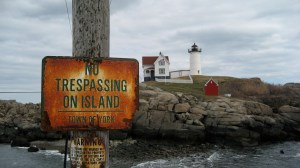
The best state motto of all the state mottoes – and a picture of something that doesn’t exist anymore. A lighthouse near York Harbor, Maine
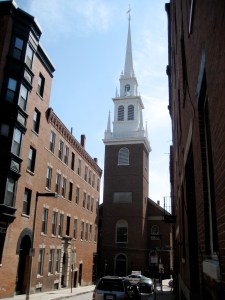
Thursday, Danielle had to work, and Neal had no classes, so the two of us took the train down into Boston and walked most of the Freedom Trail backwards. We skipped the U.S.S. Constitution and the Bunker Hill monument (though we saw them both across the water) and started right in with Copp’s Hill Burying Ground (no cemeteries in Boston, apparently – just burying grounds) and the Old North Church.
The Old North ChurchStatue of Paul Revere on the Paul Revere Mall
Then we stopped to have some deliciousness at Mike’s Pastry, looked through Faneuil Hall, and stopped at the Park Service Visitor’s Center next to the Old State House.
The old and the new
Then we walked by the Old South Meeting House (no longer a church, hence you have to pay to go in, hence we didn’t go in), a memorial to the Irish potato famine, the old city hall (now a steakhouse!), and looked at the King’s Chapel Burying Ground, our second old burying ground of the day.
John Winthrop’s grave
The third old burying ground of the day was the Granary Burying Ground, and it probably had the biggest share of well-known people taking their eternal repose. John Hancock is there, as well as Paul Revere, Samuel Adams, the five victims of the Boston Massacre, “Mother Goose,” and Benjamin Franklin…..’s parents.
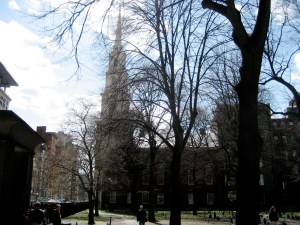
Granary Burying Ground, with Park Street Church
As a geeky evangelical, I was glad to see Park Street Church, which I had heard about before. in 1829 it was the place where William Lloyd Garrison made his first public speech condemning slavery. Billy Graham led a crusade from there in 1949. Harold Ockenga, co-founder and first president of the National Association of Evangelicals, Fuller Theological Seminary and Gordon-Conwell Theological Seminary, was minister there from 1936 to 1969.
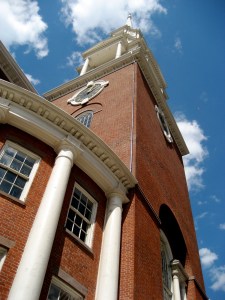
Park Street Church
Then we found ourselves on Boston Common, and went up to the State House adjoining the Common and took a tour.
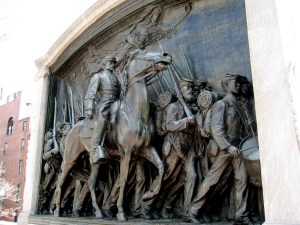
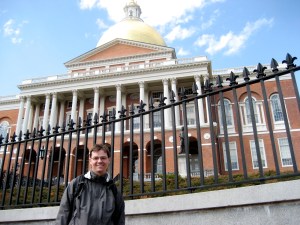
The Shaw MonumentMe at the State House
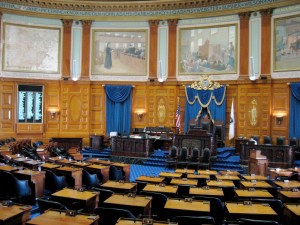
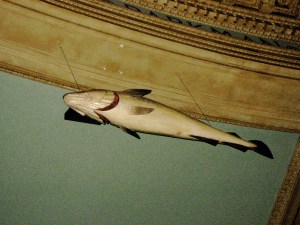
The tour was interesting. It was fun to hear all about Massachusetts political history and look at the little things they put in their state house to give it a uniquely Massachusetts character. One of those things is the Sacred Cod, which (so the story goes) was given to the House of Representatives by someone from the fishing industry who didn’t want lawmakers to forget that important part of the Massachusetts economy. Now, the House of Representatives can’t meet without the Cod present (which put them in a pickle when a few Harvard students stole it in 1933. It was returned unharmed).
The House ChamberThe Cod, now out of reach
After the tour of the State House, we wandered around Boston Common for a bit. We took a look at the pub which was the inspiration for the TV show Cheers, but didn’t buy anything there (though the Red Sox were playing the Rays on TV at the time, and I was tempted). I have a policy against buying things off a menu where no price is given (for the drinks, anyway).
Here’s to expensive drinks!
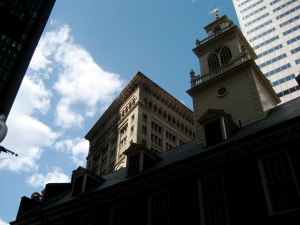
After taking a rest at the “Make Way For Ducklings” statue in the Public Garden, we continued west to Trinity Church, which is right next to the Hancock Tower.
Trinity Church
I’d never heard of Trinity Church, but I had heard of its most famous pastor, Phillips Brooks. I heard of him first as the author of the short book Your God is Too Small, but most people would know him better as the author of the Christmas Carol “O Little Town of Bethlehem.”
Then we looked inside the Boston Public Library, across Copley Square from Trinity Church, and called it a day.
The next day, Good Friday, Neal and Danielle both had to do some work. So I took the train in by myself and took the “T” (their abbreviation for the subway) to Cambridge to have a look at Harvard.
Hahvad Yahd
In some ways, Cambridge struck me as just a typical university town, except older. I was impressed by the bookstores, though.
Memorial Hall, Harvard
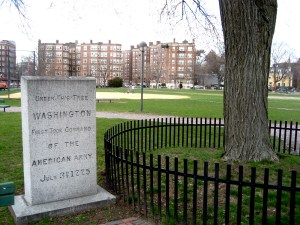
I wish I’d kept track of how many signs I saw indicating that George Washington had been somewhere or done something. He apparently did a lot of things in New England, and there seems to be a plaque commemorating just about all of them.
Another Plaque for George
In the evening I went to a Good Friday service at Neal and Danielle’s church. The service was structured around the seven last words of Jesus from the cross, and Neal talked about the first one: “Father forgive them, for they don’t know what they are doing.”
The next day was Saturday, and Neal and I drove down to Rhode Island and Connecticut, checking out the scenery and reading from John Hodgman’s book The Areas of My Expertise. We stopped at an old mill in Pawtucket, RI, which is the birthplace of the Industrial Revolution in America. The weather was nasty, though, so we passed on the tour of the mill and watched a film in the visitor’s center instead.
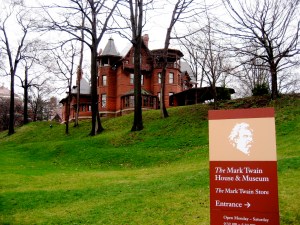
Then we went on through Providence and eastern Connecticut (passing Foxwoods, a huge casino, along the way) on our way to Hartford. Ever since Mary and I watched the Ken Burns documentary on Mark Twain, I’ve wanted to see the house he had built for his family there. It was impressive, and an interesting tour, but unfortunately they don’t allow tourists to take photos inside. Here are a couple of the exterior:
Where Twain was happiest Where he wrote his most famous books
After the visit to Hartford, we went back to Massachusetts and had dinner with Danielle and two of Neal and Danielle’s friends. The next morning, Easter morning, Neal took me to the airport and we had Dunkin’ Donuts on the way. It was a wonderful trip, and I’m very thankful to Neal and Danielle for being such great hosts.
“The boy gathers materials for a temple, and then, when he is 30, concludes to build a woodshed.” – Henry David Thoreau
“After thirty, a body has a mind of its own.” – Bette Midler
“Age is an issue of mind over matter. If you don’t mind, it doesn’t matter.” – Mark Twain
“The child thinks of growing old as an almost obscene calamity, which for some mysterious reason will never happen to itself. All who have passed the age of thirty are joyless grotesques, endlessly fussing about things of no importance and staying alive without, so far as the child can see, having anything to live for. Only child life is real life.” – George Orwell
“I’m thirty years old, but I read at the thirty-four year old level.” – Dana Carvey
“The body is at its best between the ages of thirty and thirty-five; the mind is at its best about the age of forty-nine.” – Aristotle
“All that I know I learned after I was thirty.” – Georges Clemenceau
You may recall that although I am technically a substitute school bus driver, I have been driving the same route for the last five months. It is widely regarded by the other drivers as a “difficult” route, student-wise, but I’ve really come to enjoy it. I’ve gotten to know the students and their personalities, and while most days it is still no walk in the park, I recently got to the point where I actually looked forward to taking these kids to and from school.
Then, about a week ago, they decided to let the regular driver of the route go. Letting her go meant that the route could finally go “up for bid,” which means that it is posted for three days, and all the other drivers have the chance to take it if they want it.
Well, two days went by and I was feeling pretty good about being hired on to keep it. It seemed like an ideal situation: I’m the next substitute in line to be hired, and I would be hired to take on the same route that I’ve already been driving for the last five months. Then, on the afternoon of the last full day it was posted, another driver signed up for it.
It was disappointing, but I can understand why. He’s a retired guy, and when he rode along with me yesterday morning to learn the route, he told me that in recent months his retirement has been hit hard by the stock market. Instead of driving the 4-hour route he had taken just to have a little money to support his boating habit, he decided to move up to a 6.5-hour route because he actually needed the money.
So yesterday was my last day. And I got the same feeling that I’ve gotten on other momentous occasions that I recognized as momentous occasions. On the last day of school, or of a job, or living someplace, I become removed from what I’m doing. I always think, “This is the last time I am doing this. An era is coming to an end, for better or worse. Even though I’m looking forward to what is next, I feel like mourning what is going away.” While I do everything for the last time, it feels almost unreal, as if I am floating.
That happened yesterday, especially in the afternoon. I knew that I had to tell the students on both runs that they were getting a new driver, but it took me a while to get up the nerve to say it. When I finally did, there were a lot of questions, and several students seemed genuinely unhappy (though there were many for whom it was hard to say what they were thinking. They could have been sad, or cynical, or they could not have cared). Even though it certainly was a “difficult” route, I will miss taking those kids to and from school every day.
 There were about 21 people there, and we met in a conference room in the hotel at 11:30. We filled out forms, they took Polaroid pictures of us, and then the three contestant coordinators introduced themselves to us. They were pretty high-energy, but I suppose they have to be in order to get us retiring, academic types out of our shells. We watched a video introduction from Alex Trebek, and one of the contestant coordinators explained to us what kinds of clues often appear on the show, and how to look for clues within the clue. We did a few of those all together to practice and get used to the format, and then we took a 50-question written test. I felt really good about the test; there were really only two or three questions that I had no clue on. Once the test was over, we had a few minutes to mingle while they were being graded. We started out asking other people if they knew the answers to the questions we missed, and then settled in to more traditional getting-to-know-you talk, like asking each other where we were from. Most were from Washington, with several from the Seattle area, but others came from as far as Montana, Idaho and Prince George, BC.

 1. Brainiac: Adventures in the Curious, Competitive, Compulsive World of Trivia Buffs by Ken Jennings. Lately I’ve had a greater than average interest in the game show Jeopardy! – largely because I took an online contestant test back in January. So just in case, by some miracle, I end up getting on the show, I wanted to know more about it. Therefore, I went to the library and picked up this book by Ken Jennings, who became famous for winning 74 consecutive shows a few years ago.
 2. The Language of God: A Scientist Presents Evidence for Belief by Francis S. Collins. This book came out in 2006, while I was studying at Regent. I remember reading chunks of it in the bookstore while browsing, but I never bought a copy because of all the required reading I had to do. Now, curious about how this book handles the science-faith “debate,” I decided to pick it up.
 3. The Jeopardy! Book by Alex Trebek and Peter Barsocchini. This is another book that I got from the library because of my recent Jeopardy! preoccupation. It’s not a bad book; it tells you all about how they make the show and what the most successful contestants have in common, as well as giving you several questions and answers used on the show. Problem is, it came out in 1990, so it’s pretty outdated.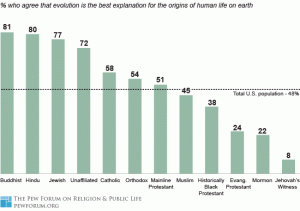







 Elliot Ritzema