Category: Travel

  • Beth Shemesh and Desolation

    Beth Shemesh and Desolation

    I’ve been writing reflections on the pilgrimage to Israel I took in June of this year. To read all of them, click here.

    June 20, AM

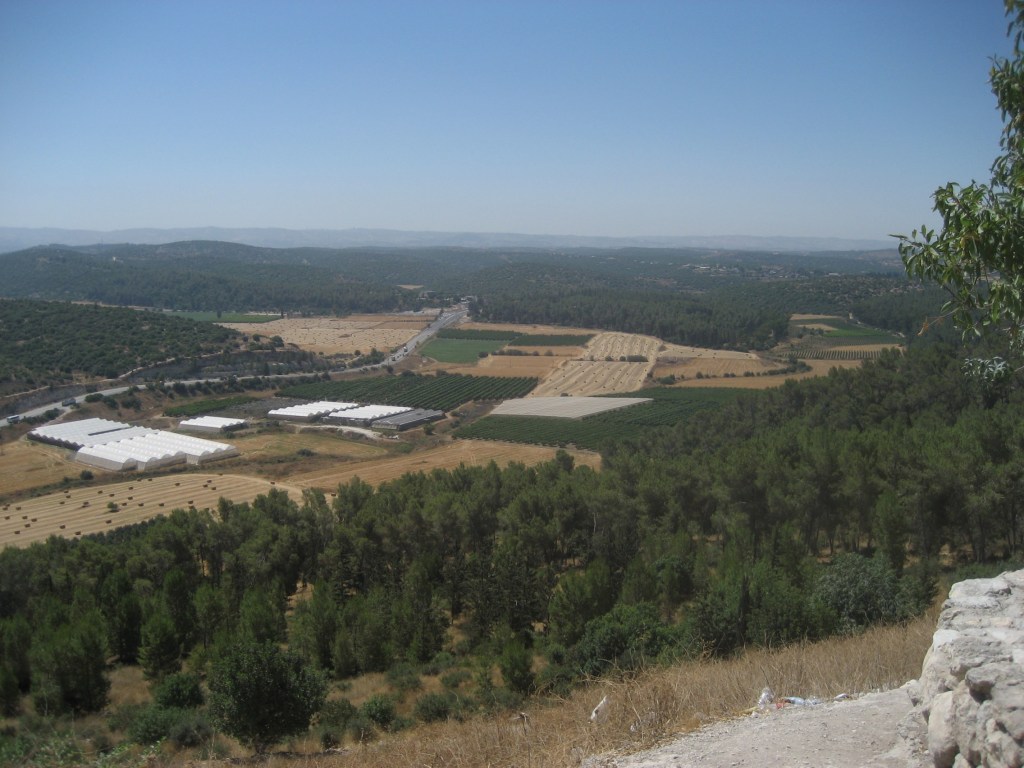
    On the morning of our second day in Israel, we left Azekah and went to Beth Shemesh, another site in the Shephelah (“lowlands”) of Israel. The name beth shemesh means “house of the sun,” and it’s possible that there was a temple (“house”) dedicated to the Canaanite sun god there at one time. It lies on the Valley of Sorek, an east-west valley that connects the coastal plain with the Judean mountains. In the Old Testament, after the Philistines captured the ark of the covenant in the time of Samuel, they put it on a cart pulled by two cows. The cows headed east up the Valley of Sorek and stopped at Beth Shemesh (1 Sam 6:1–14). Later, in the eighth century BC, Amaziah king of Judah and Jehoash king of Israel fought each other at Beth Shemesh (2 Kgs 14:8–11). About 50 years after this, the Philistines captured Beth Shemesh (2 Chr 28:18). There is a destruction layer at the site that likely dates to the campaign of the Assyrian king Sennacherib in 701 BC.

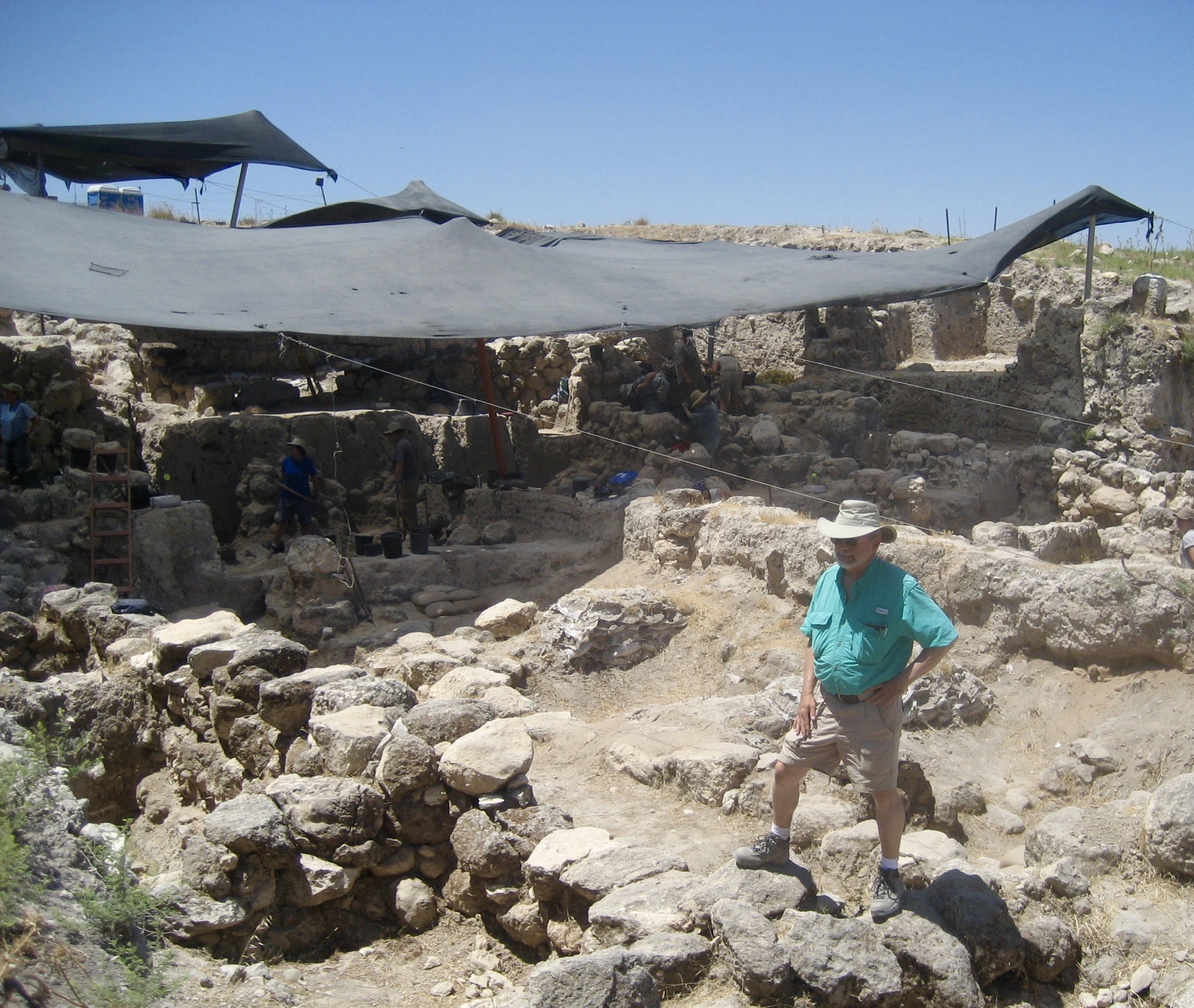
    As at Azekah, to get to Beth Shemesh we got out of the bus on the side of the road and walked. We went along the Valley of Sorek and climbed a small hill to the site, where there is an active archaeological dig. We were welcomed by Dr. Dale Manor of Harding University, the field director of the dig. According to his website, he “was wearing the fedora before Indiana Jones” (it doesn’t say how long he has been fighting Nazis).
    Is222
    Dr. Manor telling us about Beth Shemesh

    He told us a few things about the site: An Egyptian palace was here, owned by a woman who was mentioned in the 14th century BC Amarna Letters. A scarab found here names Amenhotep III. At a higher level, there is a temple from the time of the judges (ca. 1100 BC) that is still in the process of being excavated. Recently, two store jar handles were recovered that say lemelek (“belonging to the king”) on them. These probably date to the time of Hezekiah (eighth century BC).

    After hearing from Dr. Manor, our group went into an underground cistern. There our group leader, Tim, talked to us about Samson, who lived in the area. Zorah (his birthplace) was across the Valley of Sorek to the northeast (Judg 13:2; 16:31). Timnah was down the valley to the west, in Philistine territory (Judg 14:1–6). Farther down the valley was Ashkelon (Judg 14:9). Tim talked about Samson’s mighty exploits, but also his failure to remain faithful to God. As he had at Azekah, Tim talked about the Shephelah as a place of pressure and conflict, and encouraged us to think about how we should act in our own “shephelahs.” These are places in our lives where we face tensions and temptations, where it’s easy to become tired and worn down.

    My dad, who was also on the trip, wrote a blog post a few days ago about our visit to Beth Shemesh. He mentioned that in contemplating the idea of personal shephelahs he thought of Canadian philosopher Charles Taylor’s book A Secular Age. I thought of this as well. (It’s almost as if we are related. Also, we might have read some of the same books.)

    Part of Taylor’s argument is that we live in a time of cross-pressures. Both religious and atheist forms of fundamentalism get all the press, but most of us live in a middle area where we wrestle with faith, doubt, and longing. We have gone, Taylor says, “from a society where belief in God is unchallenged and indeed, unproblematic, to one in which it is understood to be one option among others, and frequently not the easiest to embrace.” But it doesn’t all work in one direction: believers are tempted to doubt, and doubters are tempted to believe. While the world may be disenchanted for many people—faith is regarded as something childish to leave behind, like belief in monsters and fairies—a lot of them still experience a sense of loss at this disenchantment, and a sense that what they are left with may not be enough to make meaning of life.
    Is224
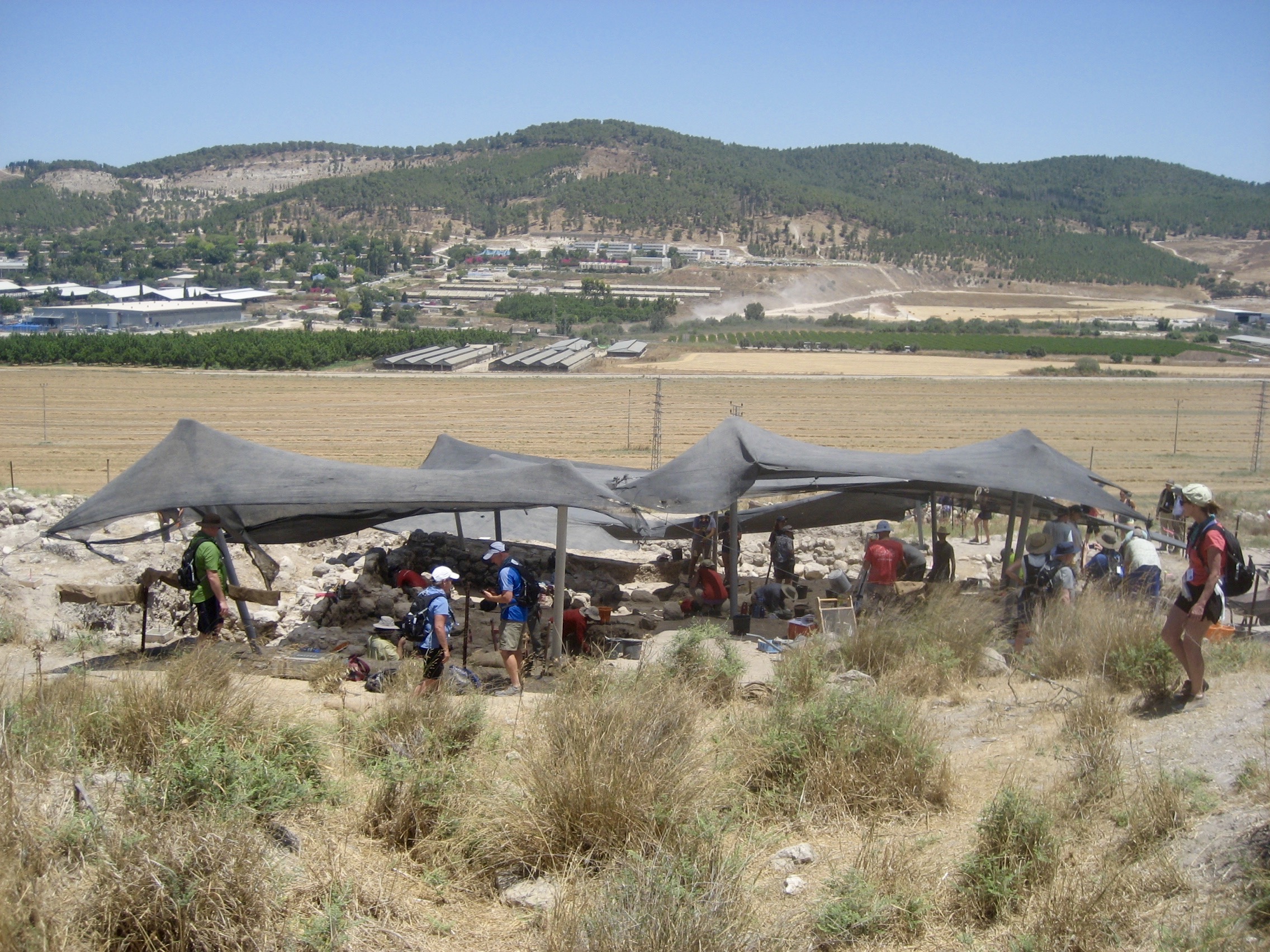
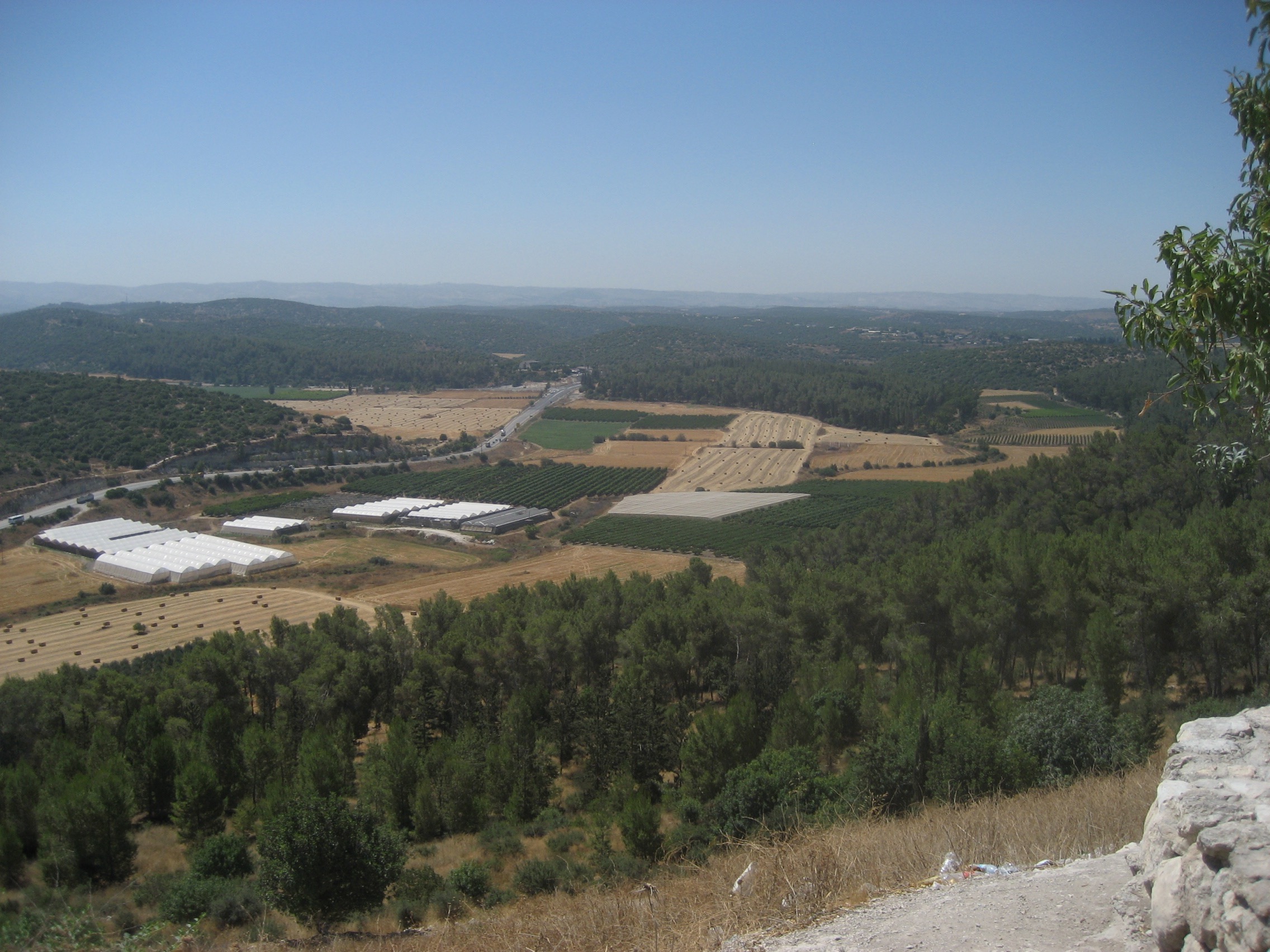
    Beth Shemesh, overlooking the Valley of Sorek

    When Tim asked us on this day, “What will you do in your Shephelah?” I thought of the cross-pressures of faith, doubt, and longing in a secular age. I also thought of Gordon Smith, who taught a class on spiritual discernment when I was at Regent College. It was a popular class; lots of people at Regent were looking for guidance on what to do in the next chapter of their lives. In his teaching on discernment, Smith took two concepts from Ignatius of Loyola’s Spiritual Exercises: consolation and desolation.

    In his book The Voice of Jesus, Smith writes that consolation is “our emotional response to a set of circumstances that reflect the power and goodness of God” (139). In contrast, desolation is “an emotional response to the multiple ways in which we experience a broken world” (138–39). Desolation is a valid response, since the world is in fact broken in many ways. But the rule for discernment, Smith says, is this: Act on a decision only in consolation. When we are in desolation, we cannot trust ourselves to see clearly and act rightly. “We can trust ourselves and act in confidence only when we know that our hearts are in tune with the Spirit” (139).

    Samson, it seemed, acted often out of desolation. He was angry, vengeful, lustful, and continually reacted in destructive ways. As I go through my own shephelahs, I want to remember that they are a normal part of life. Everyone lives in them at times. But I also want to remember that they are not the place to make major decisions. When I am tired, worn down, or feeling tempted, I need to continue on the path I am on—the path I started to follow when I was seeing more clearly—and not change course in response to feelings of desolation.
  • Azekah and Action

    Azekah and Action

    I’ve been writing reflections on the pilgrimage to Israel I took in June of this year. To read all of them, click here.

    June 20, AM

    Our first stop on our second day (the first full one) was Azekah. As we had at Gezer, we hiked up to the site without knowing what it was, this time getting off the bus by the side of the road. Our group leader, Tim, wanted to start off the trip by getting us acquainted with various locations in the Shephelah, the foothills between the coastal plain to the west and the Judean mountains to the east. The word shephelah means “lowland”; some Bibles translate it that way, while others treat it as a proper name. For a few hundred years while Israel was trying to establish itself in the land, it was a place of pressure and conflict.

    Is208
    The Valley of Elah, looking southwest from Azekah

    While Gezer was on the Aijalon Valley, Azekah overlooked the Valley of Elah. The Philistines occupied the coastal plain at the western end of the valley, and camped near Azekah when David fought Goliath (1 Sam 17). Even after the Israelites were more established, the Shephelah continued to be an area of conflict. After the kingdom was divided, Azekah became a town along the Judean border with the northern kingdom of Israel, and Rehoboam fortified it against his northern neighbors (2 Chr 11:5–10). An Assyrian inscription claims that Sennacherib conquered Azekah during his invasion of Judah in 701 BC (2 Kgs 18–19).

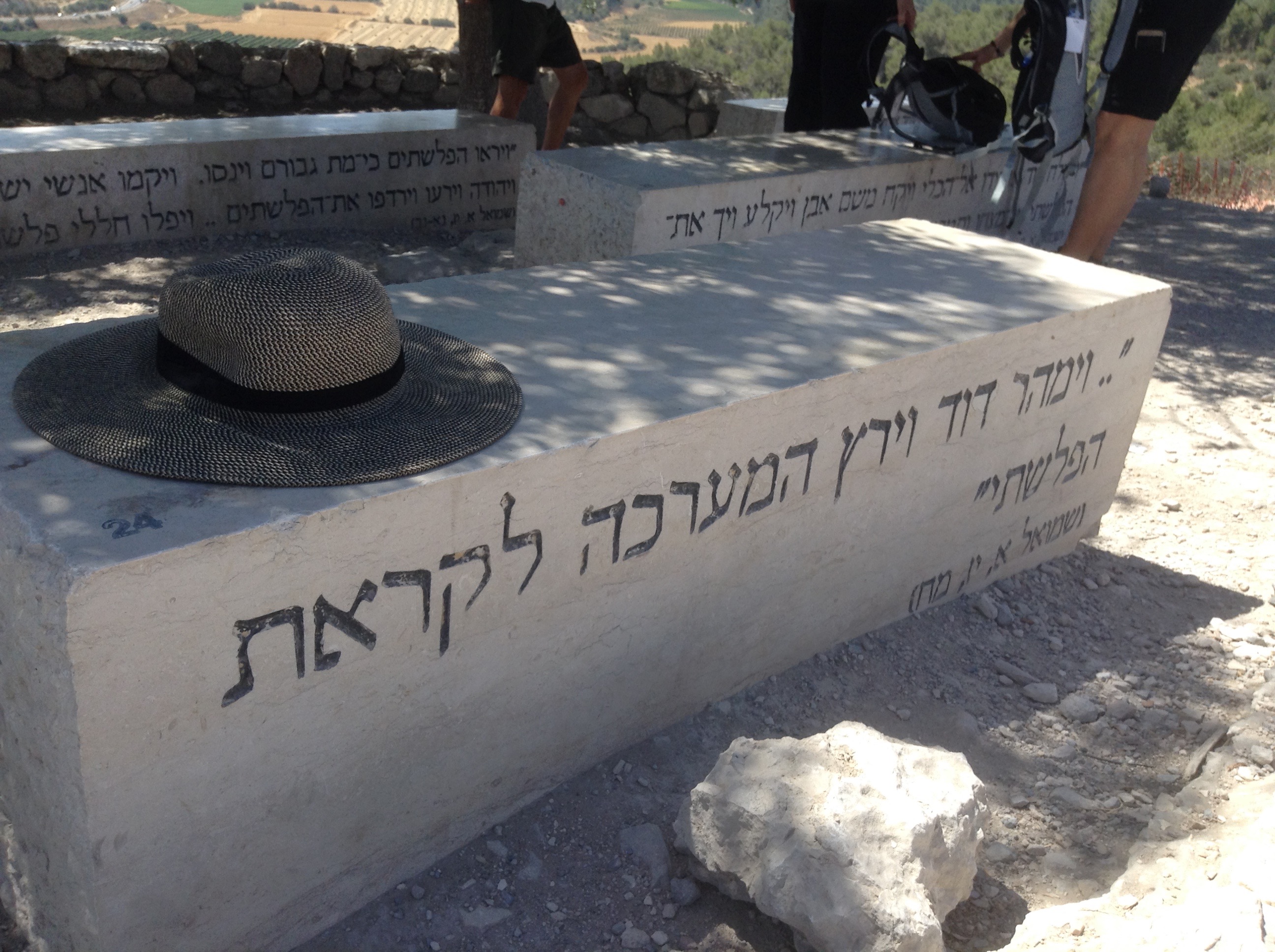
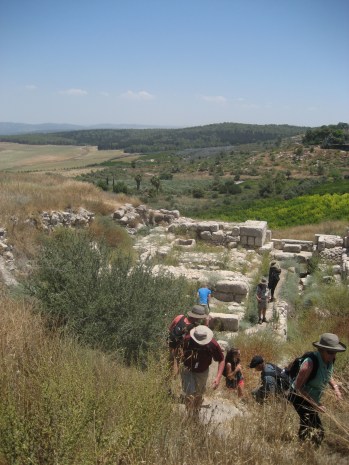
    As we looked south over the Valley of Elah, Tim talked to us about David and Goliath while we sat on benches where the words of 1 Samuel 17 were inscribed in Hebrew. In listening to this story that I had heard many times, what struck me this time was that Samuel had already anointed David king, although to all appearances he was still a young shepherd. David’s brothers had been present when David was anointed king, and yet they treated him as their pesky little brother. David had faith in both God’s own character and what God had said about him, even though it seemed like very little had changed: nothing was different about his outward circumstances, and the Philistines still looked more powerful than the Israelites.

    Is209Here I reflected on the ways I so often refuse to believe that God is able and desires to act in the world. The ways I feel inadequate, like I don’t belong, like I have little to contribute, when these things are not an accurate representation of reality at its deepest level. The ways I insist on gathering more data when I know it would be better to act; I would just rather not risk being vulnerable.
    At the end of his talk, Tim asked, “God has given each of us a pouch with stones. What will you do with those stones?” The stones I have are not those that other people have. Am I okay with that? Am I content to believe that it isn’t so much about the stones at all, but the God who guides them?

  • Gezer and Memorial Stones

    Gezer and Memorial Stones

    I’ve been writing reflections on the pilgrimage to Israel I took in June of this year. To read all of them, click here.

    June 19, AM

    On our first day in Israel, we drove to a gravel parking lot and walked down a dusty white gravel trail toward Gezer. We didn’t know it was Gezer. As would be the case throughout the trip, our group leader, Tim, didn’t tell us where we were until we got there. Instead of looking ahead to the site, I could only think about what I was experiencing in the moment: “Gosh, it’s hot. The sun sure is bright on this path. I should’ve brought contacts so I could wear sunglasses right now. I did not quite get the chemical taste out of my water pack,” etc.

    Is108We climbed up a hill and got to Gezer, which was on the border between the coastal plain and the Judean foothills (Shephelah). It was on a trade route between Jerusalem and the Via Maris along the Aijalon Valley, which runs east-west. You can look out from the site and get a broad view of the coastal plain to the west. There is a gate that dates to the time of Solomon. It is similar to those found at Hazor and Megiddo, which Solomon also fortified (1 Kgs 9:15–17). Solomon almost certainly went there, either to sit as judge or to check on the progress of the fortifications. There is a destruction layer that dates to around 950 BC, which is what one would expect from the biblical account, in which the Egyptian pharaoh conquered it and gave it to Solomon. Another destruction shortly thereafter may date to the raid of Pharaoh Shishak around 924 BC (1 Kgs 14:25). There is another destruction layer dating to around 732 BC, which would come from the conquest of the Assyrian king Tiglath-Pileser III. The Gezer Calendar was found there; it may be the earliest-known specimen of Hebrew writing, and would also be a cool name for a band.
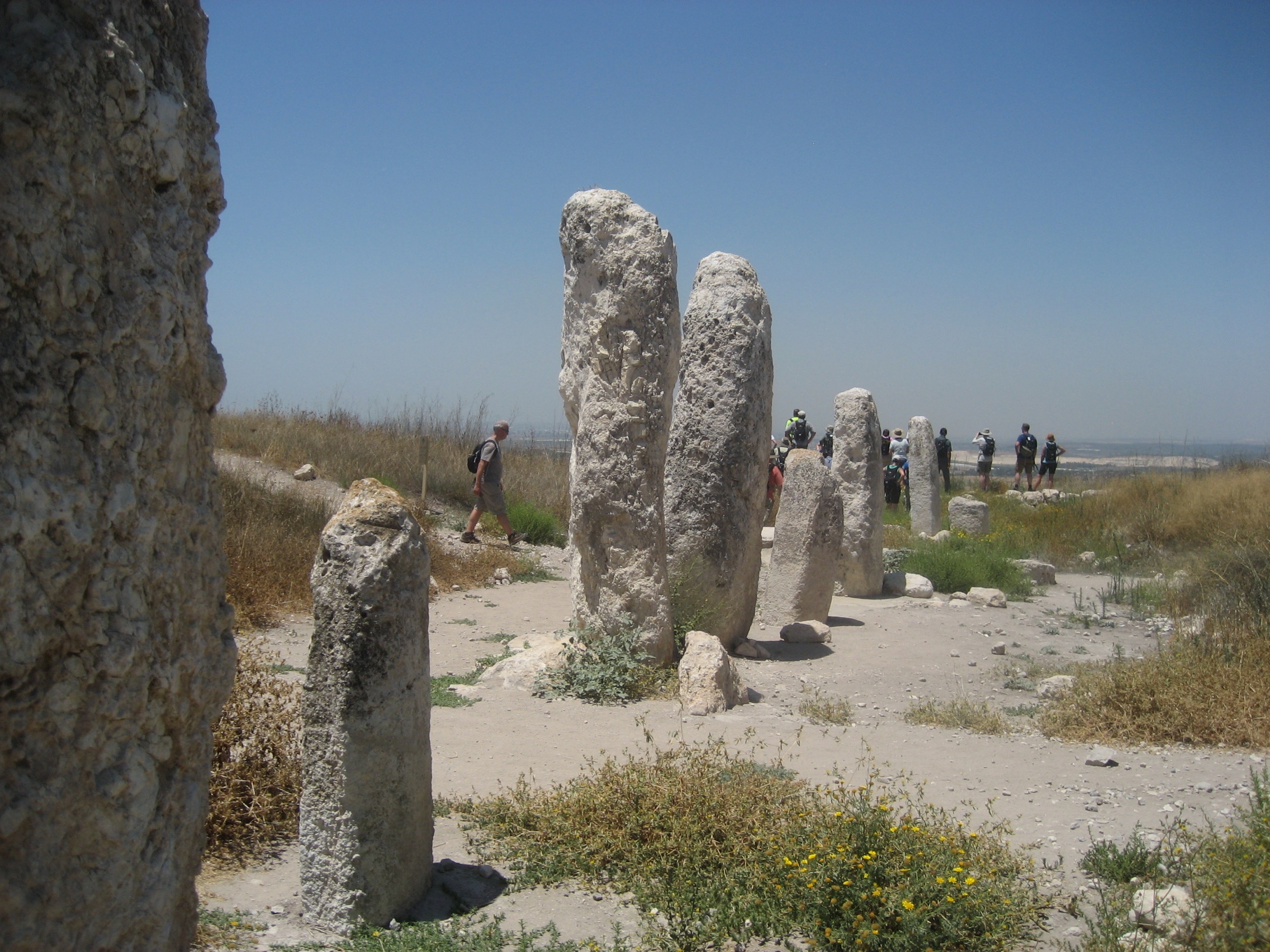
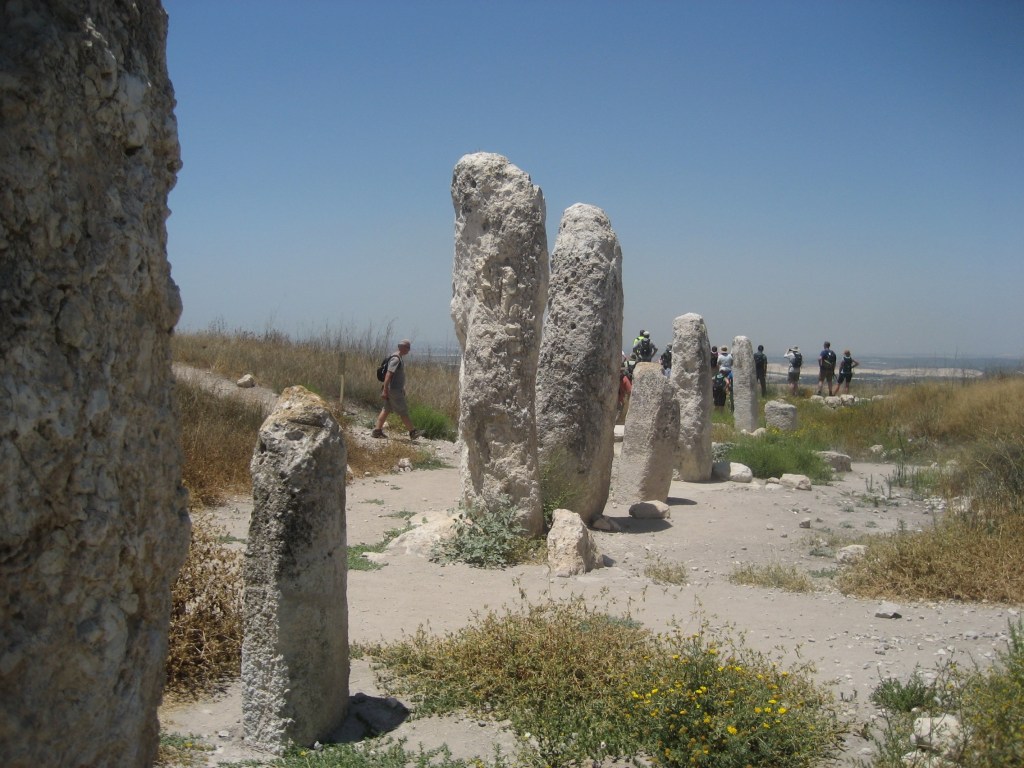
    Also in this area is a series of massebot (sg. massebah), memorial stones. These were set up by Canaanites and predate the Israelite period, and so may be a predecessor to the famous “high places” that are mentioned throughout the Old Testament. Sometimes setting up massebot is depicted as a good thing (Gen 28:18–22; 35:14; Exod 24:4; Isa 19:19), and sometimes bad (Exod 23:24; Lev 26:1; Deut 7:5; 1 Kgs 14:23), depending on whether their purpose was associated with true worship or idolatry. On the positive side, they can serve as a reminder of a place and time where people have experienced God.

    Is118This trip was itself a massebah. It will serve as a reminder of what God has done. But memorial stones and other reminders of God’s actions can be misused. In 2 Kgs 18:4, King Hezekiah smashed the massebot in his kingdom, and also broke apart the bronze snake that Moses had lifted up in the wilderness. Its original purpose had been good, but the people began to burn incense to it, looking to it as a means to control their environment. This was idolatry, and the snake was no longer a reminder of what God had done. It had to be destroyed.

    I’m reminded also of Peter’s response to seeing Jesus transfigured on the mountain and being joined by Moses and Elijah. He says to Jesus, “Let us put up three shelters—one for you, one for Moses and one for Elijah.” (Luke 9:33). Instead of taking it for what it was—a singular experience of seeing the glory of God—he wanted to prolong the moment. On this trip I met God, but I knew it had to end. I can treasure the experience, but must not seek to prolong or relive it. I met several people I may not see again; and with those I will see, even on a weekly basis, it will not be the same as it was on the trip. But the good news is that though this particular experience of God has come to an end, God has not left.

    So I will set up a memorial stone in my heart (and maybe in my yard). I will always remember it is there, always be grateful for the experience, and continue to tell others about what it means. And I will move on to the place I will meet God next.

  • On Pilgrimage

    I’ve been writing reflections on the pilgrimage to Israel I took in June of this year. To read all of them, click here.

    During the second half of June this year, I went on a pilgrimage to Israel and the West Bank. Our group of about 32 people was deliberate about not being tourists, even though we did ride around in a bus and go to some of the places tourists go. But we wanted our trip to be a pilgrimage. Tourists don’t gather together and recite the Shema every morning, as we did. Tourists roll right up to a site and park next to the gift shop; they don’t find a place by the side of the road to get out and hike toward an archaeological site. Tourists don’t sing praise choruses at the sites they visit, and when they go to the Jordan for a baptism, they find a place where the water is deep and controlled and they cycle people in and out like a fast food restaurant.

    Like many Protestant Christians, I have a complicated relationship with the idea of pilgrimage. I do not believe that going on a pilgrimage to Israel makes you objectively closer to God. I don’t believe that certain relics associated with those places have a special holy status. If you are a Christian, you have the Holy Spirit inside you, which is as close to God as you ever need to be. And while I know not all Christians agree with me, I do not believe that there is anything special about the land now that makes it especially holy. Jesus came to bring God’s kingdom so that it would spread throughout the earth and make all of it God’s dwelling place again; the idea of a particular “holy land” flies in the face of that.

    And yet there is something about standing in a place, or near a place, where something significant happened that fires the imagination and can change your life. Visiting certain places can be sacramental—that is, outward signs of an invisible grace. Like the bread of communion or the water of baptism, in themselves they are ordinary things, but they can be given spiritual significance. As is so often the case, New Testament scholar N. T. Wright says it better than I ever could (in his book on pilgrimage, The Way of the Lord: Christian Pilgrimage Today):

    On the one hand, certain places remain special because of their association with Jesus himself, or with one of those who, indwelt by his Spirit, has lived out the life of Christ. On the other hand, the God we know in Jesus claims the entire world, and all its nations, as his own; and wherever this God is worshipped … in that spot another part of God’s created space, as well as another moment of God’s created time, is quietly claimed as his own. Our Christian living, and our Christian pilgrimages, thus take place in the space and time in between the life of Jesus and God’s restoration of the whole creation. Like the sacraments themselves, pilgrimage looks back, in great acts of remembrance, and on to the time of final redemption.[1]

    A few pages later he sums up this idea that pilgrimage can be sacramental:

    There is every reason to regard the act of pilgrimage in itself as a metaphor, or even a sacrament, for and of the pilgrim’s progress through the present life to the life that is to come. Like all sacraments, it is open to the abuse of being treated magically, as though going to a particular place automatically gains you grace, heavenly Brownie points. But the abuse does not remove the use. Our present journey really can become a means of grace, if we approach it in the right way.[2]

    I was first conscious of this experience of the sacramentality of pilgrimage when I visited Krakow while I was in my early 20s. I had been living in Prague, steadily beaten down by the spiritual darkness there, and went to visit Krakow during spring break. It also happened to be Holy Week. Everything was light; there was dancing, there were flowers, there was joy, there was laughter. On that trip I became fascinated with John Paul II, former bishop of Krakow, and the relationship he had with that city, both being shaped by and shaping its culture. I also went back to visit again six months later because there was something about being in that place that fed my spirit.

    So while I resist the idea that certain places are objectively holier than others, I do believe that it is easier to experience the presence of God in some places because of what has happened there. It is also easier to experience the presence of evil in some places because of what has happened there. National and city borders may be somewhat arbitrary, yet I have spoken with people—not flaky people who are into weird spiritual practices but orthodox Christians—who could tell when they cross a border or enter a space by the change they feel in their spirit. I have experienced this myself.

    Over the next several weeks, I’m going to post my reflections on sites we visited. I don’t know how many posts there will be or how long it will take. Because we were pilgrims and not tourists, I am not going to write a blow-by-blow account of where we went and what we saw. I have that information elsewhere, and I’ll tell you if you want. Rather, I want this to be personal, inward: What did I feel being in this space at this time? What has God shown me about him and myself through that experience? How can this experience help me to love God with all my heart, soul, and might, and my neighbor as myself, as the Shema says?

    [1] Tom Wright, The Way of the Lord: A Pilgrim Journey in Life and Faith (London: Society for Promoting Christian Knowledge, 1999), 8.

    [2] The Way of the Lord, 11.

  • A Pilgrimage to Krakow: A Review

    I fell in love with Krakow when I was teaching English in central Europe from 2002–2004. Part of it was the timing of my first visit. In Prague, where I was living, the Soviet-era project of state-sponsored atheism was largely successful. In Krakow, the Catholic Church had resisted the story told by communism, insisting instead that religion was not something that could be banished to the private sphere and that all humans had inherent dignity by virtue of their being created in God’s image. So when I arrived during Holy Week of 2003, the festive and loving atmosphere in Krakow helped to bring about the spiritual refreshment I needed.

    51kbspwg85l-_sx331_bo1204203200_Even though I am not a Catholic, the city had such an impact on me that I returned about six months later. On that visit, my curiosity about the city led me to buy a biography of John Paul II in a bookstore on the main square. John Paul II had been the archbishop of Krakow when he was elected pope, and I wanted to learn more about the relationship between the man and the city.
    I wish that City of Saints: A Pilgrimage to John Paul II’s Krakow had been available then. George Weigel, the author of Witness to Hope, a massive biography of John Paul II, has written (along with Carrie Gress and Stephen Weigel) a wonderful introduction to the city and its surrounding area that focuses on sites that are important to the life of Karol Wojtyla, the man who would become pope. The book is more of a hagiography than a biography; it is written for pilgrims who are looking for edification rather than those who are merely interested in gathering facts. The chapters progress roughly chronologically according to the life of John Paul II; they begin in Wadowice, the small town outside Krakow where he was raised, and end in Zakopane, the town in the Tatras Mountains where a church was built in 1997 out of gratitude for his surviving an assassination attempt 16 years earlier. Each chapter comes in two parts: First, Weigel writes about the significance of a particular place for the life of John Paul II; then, Carrie Gress gives more historical information about the place. Throughout, Stephen Weigel’s black-and-white photographs show what each place looks like; the only color photos are in the middle.

    The older I get, the less interested I am in traveling to various places just to have fun and see interesting sights—I am more interested in pilgrimages. Of course, as a Protestant, I have a different idea of pilgrimage than many Catholics might. My idea of pilgrimages is less about going to places that are regarded as “holy” and more about going to places that have particular significance in world history or in my own history. In that sense, I do agree with Weigel when he writes that “read as His-story, history comes into focus as the history of salvation: a history that begins not with randomness but with purpose; a history that ends not with oblivion but with a great, cosmic, eternal party, the Wedding Feast of the Lamb, described in the twenty-first chapter of the book of Revelation” (117). While I might question whether there are particular places that should be regarded as holier than others, I agree that traveling to and reflecting in particular places can foster a greater understanding of and connection to the salvation history that lies behind and within world history.

    I normally end reviews by saying who I would recommend this to, and this is a difficult one to recommend broadly. The main target audience seems to be Catholics who will soon be traveling to Krakow. But there may be other Christians who, like me, have visited Krakow and want to know how it came to be such a special place, or who want to know more about the relationship between John Paul II and his “beloved Krakow.”

    Note: Thanks to the publisher for a review copy of this book. I was not asked to give a positive review.

  • Chelanigans

    Over Memorial Day weekend, Mary and I went to Chelan, WA. It’s a wonderful town in central Washington, on the south end of Lake Chelan. It is also – as we found out while booking our accommodations – party central for college students during Memorial Day weekend. Mary’s younger sister and her boyfriend were well aware of this when we told them that we were going. They introduced us to the word “Chelanigans.” I was never clear on whether that word refers to what happens in Chelan over Memorial Day weekend, or the people who go to Chelan looking for a good time. Maybe it’s both.

    It was not without reservations, then, that we got into the car for the drive to Chelan. Our mood got better as we went, though, for two reasons: we were listening to the audiobook of Stuff Christians Like, which is hilarious, and the weather kept getting better as we headed east. It was cloudy and damp west of the mountains, but cleared up the farther we got over Stevens Pass.

    On our way through the mountains, we stopped in Leavenworth. Leavenworth is a small town with a great idea: attract tourists by turning itself into a mock Bavarian village. The whole Bavarian village idea came along well after the town was named “Leavenworth,” but aside from that, the resemblance is uncanny. We enjoyed the nice weather by strolling past the shops, and then stopped for a very German lunch: a schnitzel, a reuben and some beer.

    We pulled into Chelan later that afternoon, and it was as described: many groups of people in their late teens and early 20s walking around downtown in their swimsuits. I couldn’t help but notice that there was very little mixing of the sexes in the groups we saw (I suppose they had to get a little more alcohol in them to work up the courage for that). There were also a few catcalls, the point of which I’ve never understood. I’ve never understood the point of walking around town in your swimsuit either, even when I was in college. In short, I completely failed to understand how what these college students were doing could be called a good time. Maybe I’m abnormal in that respect.

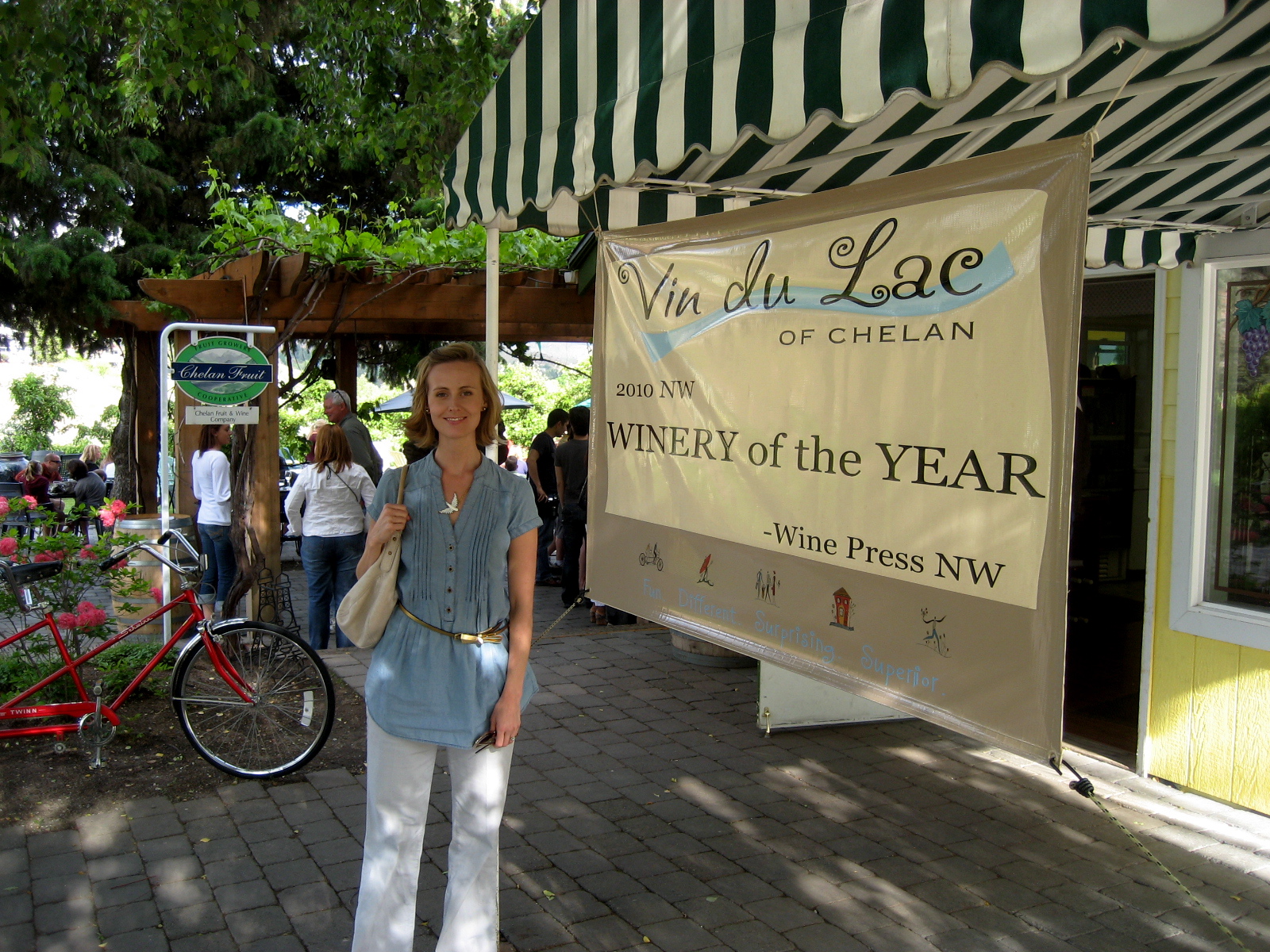
    Anyway, the party scene was pretty easy to avoid. After checking in at the B&B, we went to dinner at the Vin du Lac winery, which was full of old fogeys like us. We tasted wine, we listened to some live music, we bought a bottle of Riesling for Mary’s dad for Father’s Day. Then we went back to the B&B, watched part of a movie, and went to sleep.

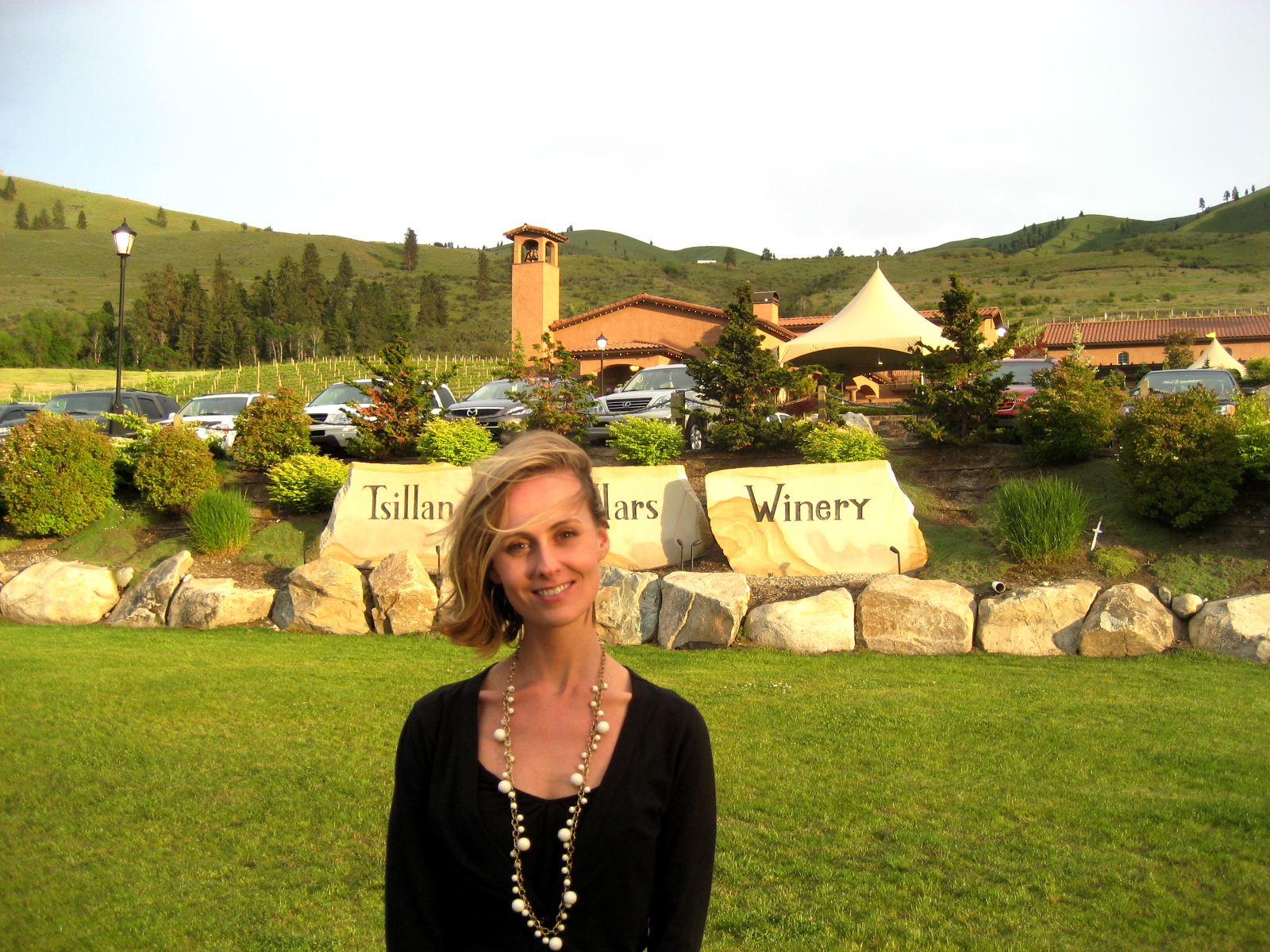
    The next morning, we walked to Starbucks and read for a while, then walked back for breakfast. Then we drove to Manson (which is a few miles up the north side of the lake) to have a look around. We went to a wine tasting at the Lake Chelan winery and bought some cider. Then we went back to Chelan to have lunch at the Campbell House Restaurant, which we followed up with some ice cream. That evening, we tasted wine and had dinner at Tsillan Cellars. According to its Web site, this is the “crown jewel” of Chelan wine country, so unlike the first two wineries we had to pay a few dollars to do wine tasting here. It was a wonderful experience, though.

    After breakfast the next morning, we drove back. Turns out a lot of people were headed back west on Highway 2, because traffic was bumper-to-bumper for quite a ways. The weather also steadily worsened as we went west. Bummer. It takes more than that to ruin a good weekend, though. I’m sure we will be back sometime. But probably not Memorial Day weekend.

  • Back From Boston

    Last week, as many of you know, I went to Boston to visit my friends Neal and Danielle. I know them from when I taught English in Budapest in 2003-2004, and they have lived just north of Boston for nearly four years, but this was the first time that I made it over for a visit.

    On Wednesday, the first full day I was there, Neal just had an evening class (he is a student at Gordon-Conwell Theological Seminary), and I wanted to see as much of New England as possible, so he was kind enough to drive me north through part of New Hampshire and into southern Maine. Here are a few pictures from that day:

    Couldn't go to New England without getting some clam chowder and fried clams
    Couldn’t go to New England without getting some clam chowder and fried clams

    The best state motto of all the state mottoes - and a picture of something that doesn't exist anymore.
    The best state motto of all the state mottoes – and a picture of something that doesn’t exist anymore.

    A lighthouse near York, Maine
    A lighthouse near York Harbor, Maine

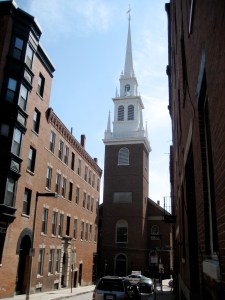
    Thursday, Danielle had to work, and Neal had no classes, so the two of us took the train down into Boston and walked most of the Freedom Trail backwards. We skipped the U.S.S. Constitution and the Bunker Hill monument (though we saw them both across the water) and started right in with Copp’s Hill Burying Ground (no cemeteries in Boston, apparently – just burying grounds) and the Old North Church.

    The Old North Church
    The Old North Church
    Statue of Paul Revere on the Paul Revere Mall
    Statue of Paul Revere on the Paul Revere Mall

    Then we stopped to have some deliciousness at Mike’s Pastry, looked through Faneuil Hall, and stopped at the Park Service Visitor’s Center next to the Old State House.

    The old and the new
    The old and the new

    Then we walked by the Old South Meeting House (no longer a church, hence you have to pay to go in, hence we didn’t go in), a memorial to the Irish potato famine, the old city hall (now a steakhouse!), and looked at the King’s Chapel Burying Ground, our second old burying ground of the day.

    John Winthrop's grave
    John Winthrop’s grave

    The third old burying ground of the day was the Granary Burying Ground, and it probably had the biggest share of well-known people taking their eternal repose. John Hancock is there, as well as Paul Revere, Samuel Adams, the five victims of the Boston Massacre, “Mother Goose,” and Benjamin Franklin…..’s parents.

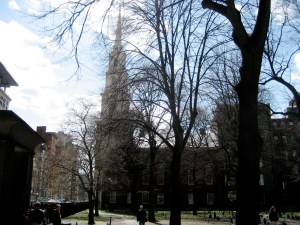
    Old Granary Burying Ground, with Park Street Church
    Granary Burying Ground, with Park Street Church

    As a geeky evangelical, I was glad to see Park Street Church, which I had heard about before. in 1829 it was the place where William Lloyd Garrison made his first public speech condemning slavery. Billy Graham led a crusade from there in 1949. Harold Ockenga, co-founder and first president of the National Association of Evangelicals, Fuller Theological Seminary and Gordon-Conwell Theological Seminary, was minister there from 1936 to 1969.

    Park Street Church
    Park Street Church

    Then we found ourselves on Boston Common, and went up to the State House adjoining the Common and took a tour.

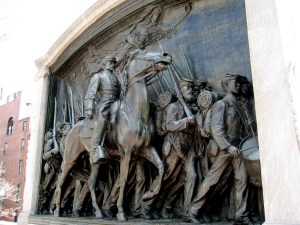
    The Shaw Monument
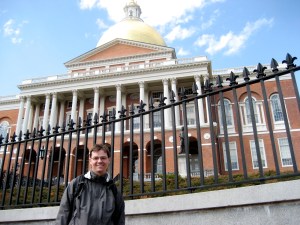
    Me at the State House
    Me at the State House

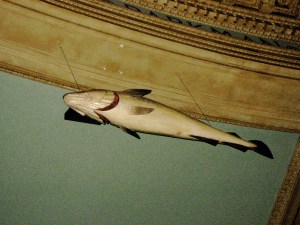
    The tour was interesting. It was fun to hear all about Massachusetts political history and look at the little things they put in their state house to give it a uniquely Massachusetts character. One of those things is the Sacred Cod, which (so the story goes) was given to the House of Representatives by someone from the fishing industry who didn’t want lawmakers to forget that important part of the Massachusetts economy. Now, the House of Representatives can’t meet without the Cod present (which put them in a pickle when a few Harvard students stole it in 1933. It was returned unharmed).

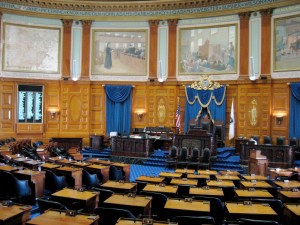
    The House Chamber
    The House Chamber
    The Cod, now out of reach
    The Cod, now out of reach

    After the tour of the State House, we wandered around Boston Common for a bit. We took a look at the pub which was the inspiration for the TV show Cheers, but didn’t buy anything there (though the Red Sox were playing the Rays on TV at the time, and I was tempted). I have a policy against buying things off a menu where no price is given (for the drinks, anyway).

    Here's to expensive drinks!
    Here’s to expensive drinks!

    After taking a rest at the “Make Way For Ducklings” statue in the Public Garden, we continued west to Trinity Church, which is right next to the Hancock Tower.

    Trinity Church
    Trinity Church

    I’d never heard of Trinity Church, but I had heard of its most famous pastor, Phillips Brooks. I heard of him first as the author of the short book Your God is Too Small, but most people would know him better as the author of the Christmas Carol “O Little Town of Bethlehem.”

    img_2386

    Then we looked inside the Boston Public Library, across Copley Square from Trinity Church, and called it a day.

    The next day, Good Friday, Neal and Danielle both had to do some work. So I took the train in by myself and took the “T” (their abbreviation for the subway) to Cambridge to have a look at Harvard.

    Hahvad Yahd
    Hahvad Yahd

    In some ways, Cambridge struck me as just a typical university town, except older. I was impressed by the bookstores, though.

    Memorial Hall, Harvard
    Memorial Hall, Harvard

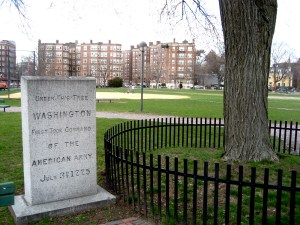
    I wish I’d kept track of how many signs I saw indicating that George Washington had been somewhere or done something. He apparently did a lot of things in New England, and there seems to be a plaque commemorating just about all of them.

    Another Plaque for George
    Another Plaque for George

    In the evening I went to a Good Friday service at Neal and Danielle’s church. The service was structured around the seven last words of Jesus from the cross, and Neal talked about the first one: “Father forgive them, for they don’t know what they are doing.”

    The next day was Saturday, and Neal and I drove down to Rhode Island and Connecticut, checking out the scenery and reading from John Hodgman’s book The Areas of My Expertise. We stopped at an old mill in Pawtucket, RI, which is the birthplace of the Industrial Revolution in America. The weather was nasty, though, so we passed on the tour of the mill and watched a film in the visitor’s center instead.

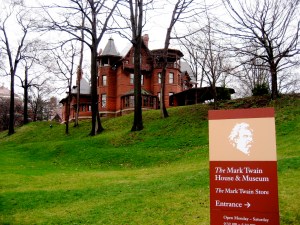
    Then we went on through Providence and eastern Connecticut (passing Foxwoods, a huge casino, along the way) on our way to Hartford. Ever since Mary and I watched the Ken Burns documentary on Mark Twain, I’ve wanted to see the house he had built for his family there. It was impressive, and an interesting tour, but unfortunately they don’t allow tourists to take photos inside. Here are a couple of the exterior:

    Where Twain was happiest
    Where Twain was happiest

    where he wrote his most famous books
    Where he wrote his most famous books

    After the visit to Hartford, we went back to Massachusetts and had dinner with Danielle and two of Neal and Danielle’s friends. The next morning, Easter morning, Neal took me to the airport and we had Dunkin’ Donuts on the way. It was a wonderful trip, and I’m very thankful to Neal and Danielle for being such great hosts.

    The End.

  • It’s a Festivus Miracle!

    Miraculously, I made it to Michigan for Christmas. On Sunday, dozens of flights from Seattle were cancelled, and thousands of people spent the night at the airport, mostly because airlines ran out of de-icing fluid (Here’s an article about it). Fortunately, I went to the airport late Monday night, and the change was amazing. Sure, there were still a few people passed out under blankets, and there were a few people on my flight who had been delayed for over 24 hours. But the shuttle I took to the airport was not delayed at all (even though on their Web site they said they were running 60 minutes late), my flight was not delayed at all (even though the first leg of the trip was through Minneapolis), and even the last leg of my flight was only delayed for about 45 minutes.

    When I say that “it’s a Festivus miracle,” I’m of course referring to the Seinfeld episode called “The Strike,” about Festivus. To me, calling something a Festivus miracle is saying that it is an instance of things turning out pretty well that may or may not have included divine intervention. Since part of celebrating Festivus is the “Airing of Grievances,” it is time to complain about my flying experience. Surprisingly, there isn’t all that much to complain about this time, but I usually am disgusted. And it wasn’t until I read this op-ed piece in the New York Times that I found out why flying is so typically an unpleasant experience these days. Here’s a quote:
    I have experienced the decline of service along with the rest of the flying public. But I believe I have felt it more acutely because I remember the days when to fly was to soar. The airlines, and their employees, took pride in how their passengers were treated. A friend who flew for Pan Am and I have a friendly rivalry over which airline was better. Friendly, yes. But we each believe we worked for the best.

    We tell stories about cooking lamb chops and dressing them in foil pantaloons; we debate the beauty of my Ralph Lauren uniform versus her Oleg Cassini. I like to tell her how we would have the children on board serve the after-dinner mints — delicious pale-green circles with T.W.A. stamped on them, arranged on a silver tray. We remember the service we provided — dare I say cheerfully? Happily? Proudly? And when my friend and I part ways, although we hold on to our allegiances, we know that all of our passengers were served well.

    After-dinner mints? My flight to Minneapolis didn’t even have beverage service. Okay, maybe this was because it was a red-eye flight and they figured everyone would be sleeping. Fine. So where’s my sleep mask?

    Now that I’m finished with the airing of grievances, I’m done celebrating Festivus for the year. On to Christmas!

  • Bozeman to Bellingham

    It is now about a month and a half since my brother and I drove my car to Washington, but now I am finally writing about our last day.

    We left Bozeman in the morning without knowing exactly where we were going to spend that night. When we first planned the trip, we were thinking about staying with friends in Coeur d’Alene, ID. But as the day went on, and we were in Coeur d’Alene by the early afternoon, we decided to just go for it and drive all the way to Bellingham.

    From Bozeman, we drove west through Butte. A friend had told me about something interesting they had in Butte: a huge statue of the Virgin Mary up on a mountain, called “Our Lady of the Rockies.” You can see it as you drive through town, but it is kind of hard to pick out at first. It is possible to go up onto the mountain and see the statue close up, but you have to pay to take a tour bus from Butte because the road is not open to everyone. So we had to settle for stopping at the Butte visitor’s center and buying a postcard. I did manage to take a couple of pictures from the car, but we were moving, and she was far away, so the pictures are blurry and badly lit. She kind of looks like the Abominable Snowman. Maybe I could sell them to the National Enquirer:

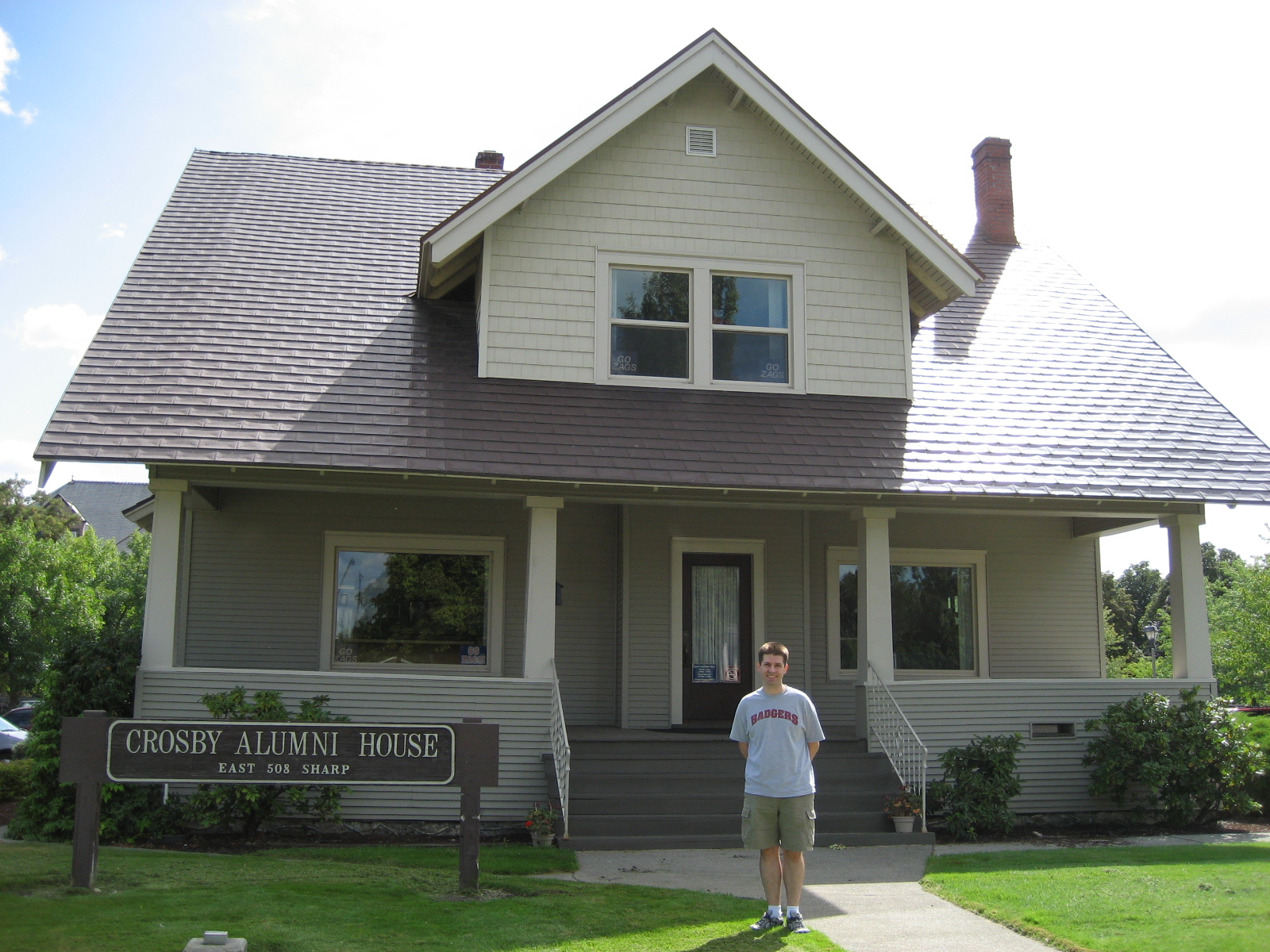
    Our next stop, after stopping for lunch at a rest area in far western Montana and noting how much colder it was becoming, was Spokane. My brother is a big Bing Crosby fan, and Bing grew up in Spokane, so we wanted to see what the city had done to commemorate its favorite son. His childhood home, it turns out, is now at the edge of the campus of Gonzaga University, on Sharp Avenue. It now functions as an alumni center. We stepped in and looked around; it looks remarkably like a regular old house, with some Bing memorabilia on the walls.

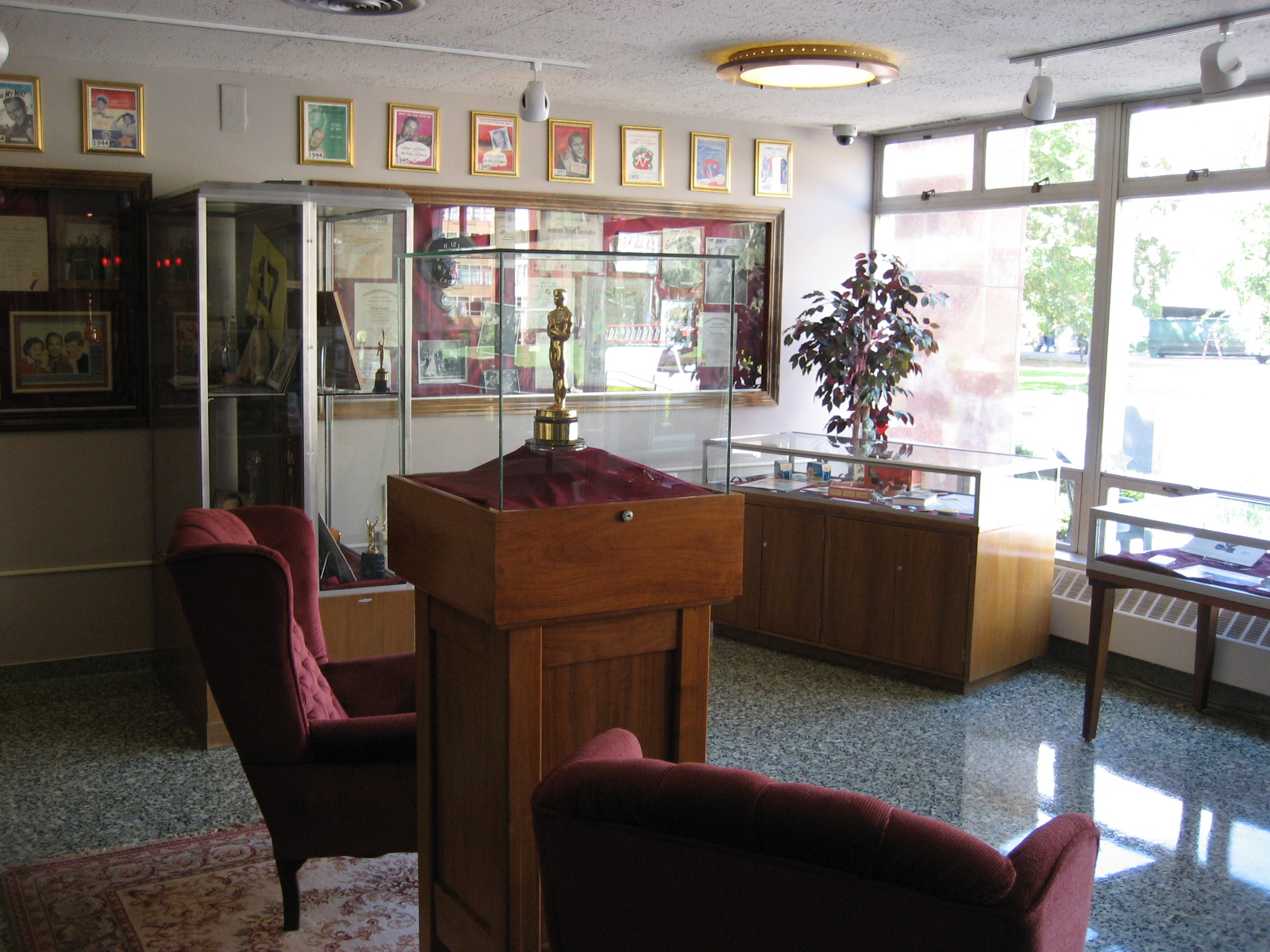
    Then we went further in to campus and visited the Crosby Student Center. This building, built in 1957, was originally the school library. Now it is a student center, and houses part of the university’s collection of “Crosbyana” – Bing memorabilia.

    Here is the “Crosbyana” room. Mary, my girlfriend and archivist extraordinaire, notes that there is way too much direct sunlight, and way too much memorabilia close to the heater. Go see this memorabilia while it lasts.

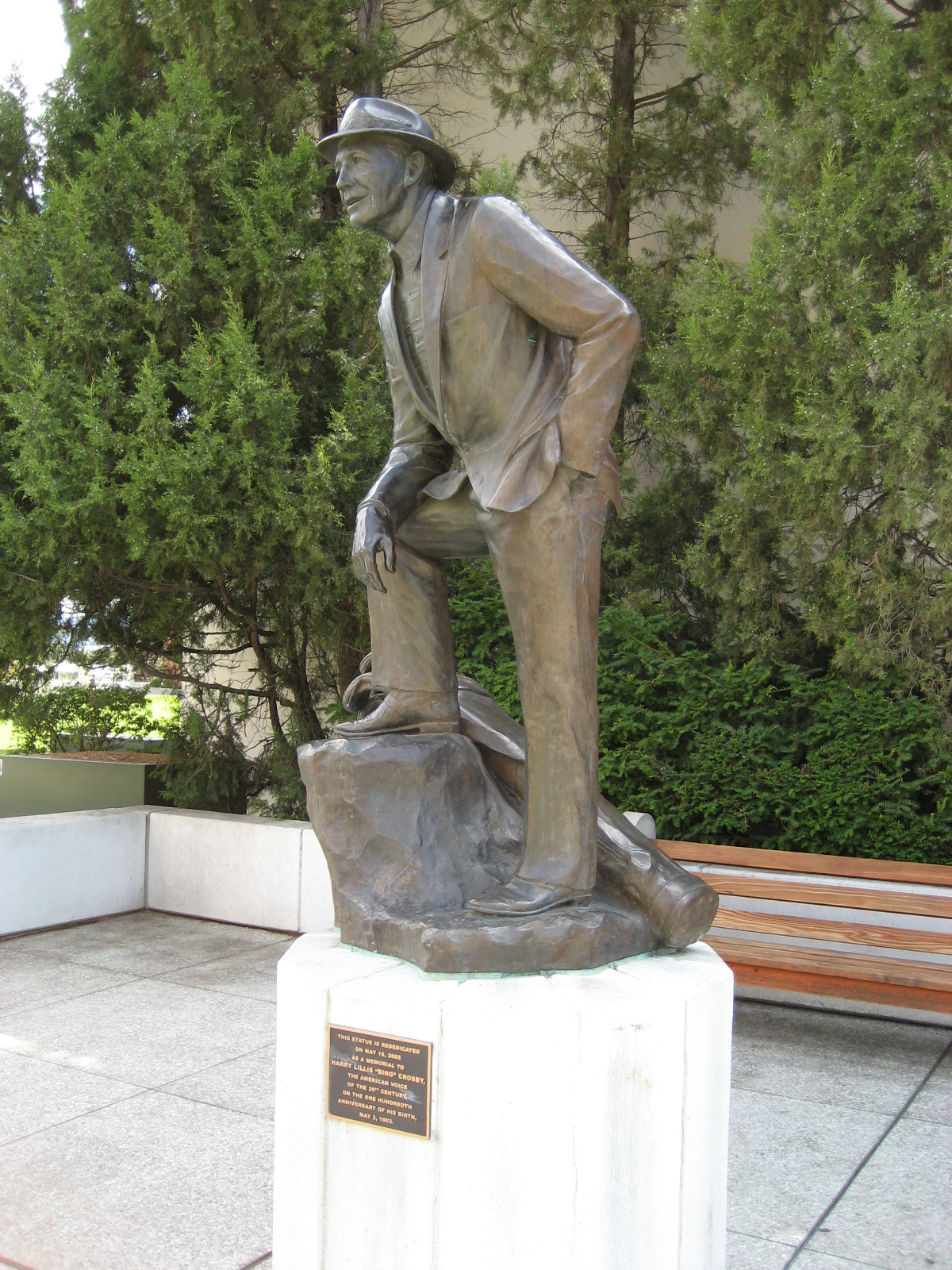
    There is a statue of Bing, the quintessential man of leisure (note the golf clubs at his feet) outside the building. He is supposed to have a pipe in his mouth, but it has been repeatedly stolen. I guess they just don’t replace it anymore.

    Before we left, we wandered over to the church and took a picture or two:

    Then we got in the car, drove across the lovely state of Washington (with a brief stop at the Columbia River Gorge), and up to Bellingham. When we got over the Snoqualmie Pass into western Washington, it began to drizzle and didn’t stop until we got up to Bellingham. Apparently, despite it being August, western Washington wanted to show off its typical weather pattern for my brother, who was just visiting for a day. On the morning after that day, we drove back down to Seattle, he flew back to Wisconsin, and our road trip was ended.

  • Rapid City to Bozeman

    Soon I will get around to reviewing the books that I read in September, but I don’t have the time to do that right now. Here, then, is another post about the road trip I took with my brother in August.

    The first thing we did when we woke up in Rapid City was go to Mt. Rushmore.

    Scratch that.

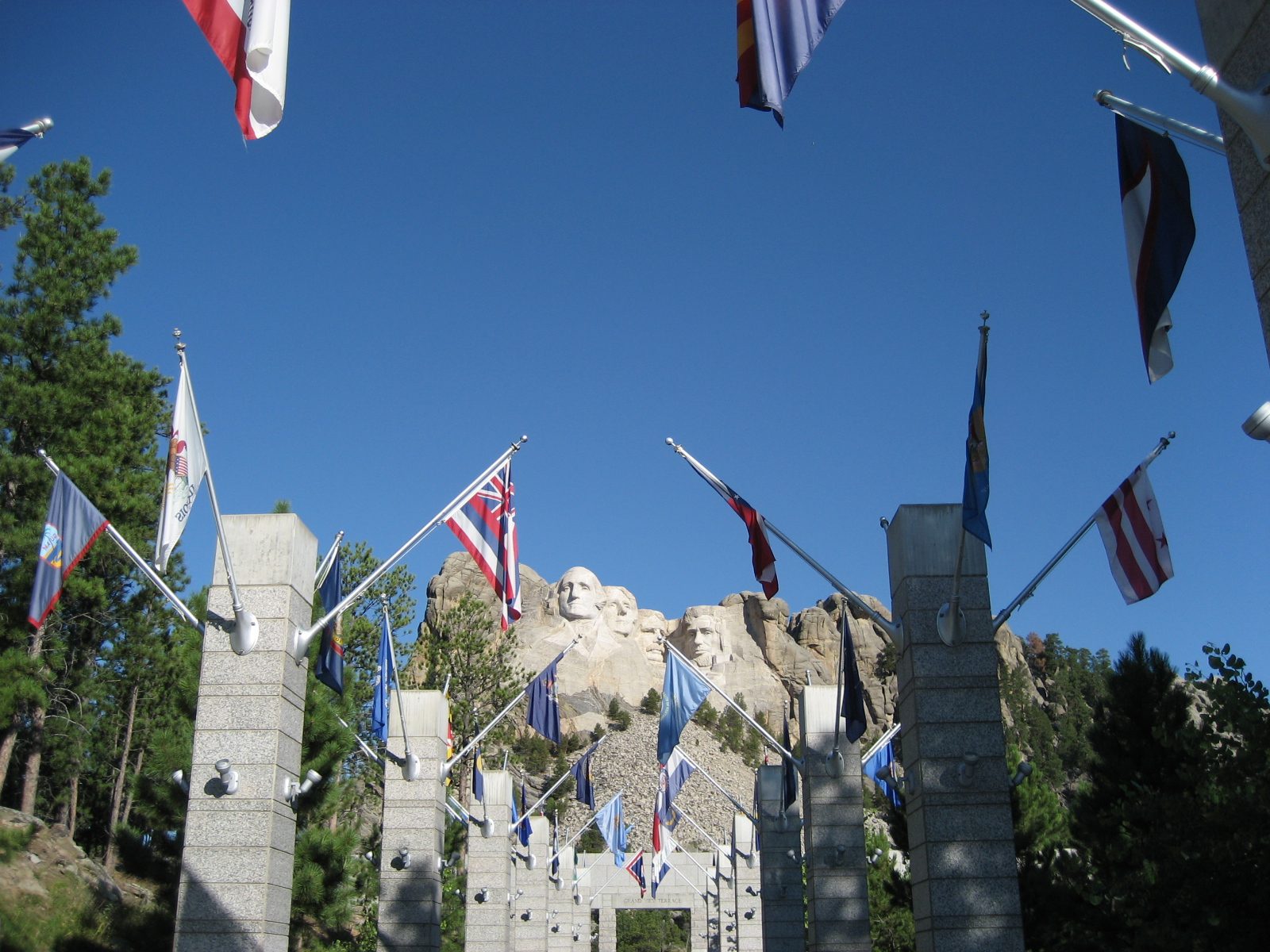
    The first thing we did when we woke up in Rapid City was eat a continental breakfast at the hotel. Then we plugged Mt. Rushmore into the GPS and it led us southwest of town, past dozens of tourist traps, to Mt. Rushmore — the biggest tourist trap of them all. (I don’t mean to seem disrespectful, but after all, it was conceived to increase tourism in South Dakota. If that isn’t the definition of a tourist trap, what is?) We got there early, just after 8. It turns out this was a good call, since by the time we left, about an hour later, the place was packed.

    As you can see, it was a beautiful clear day.

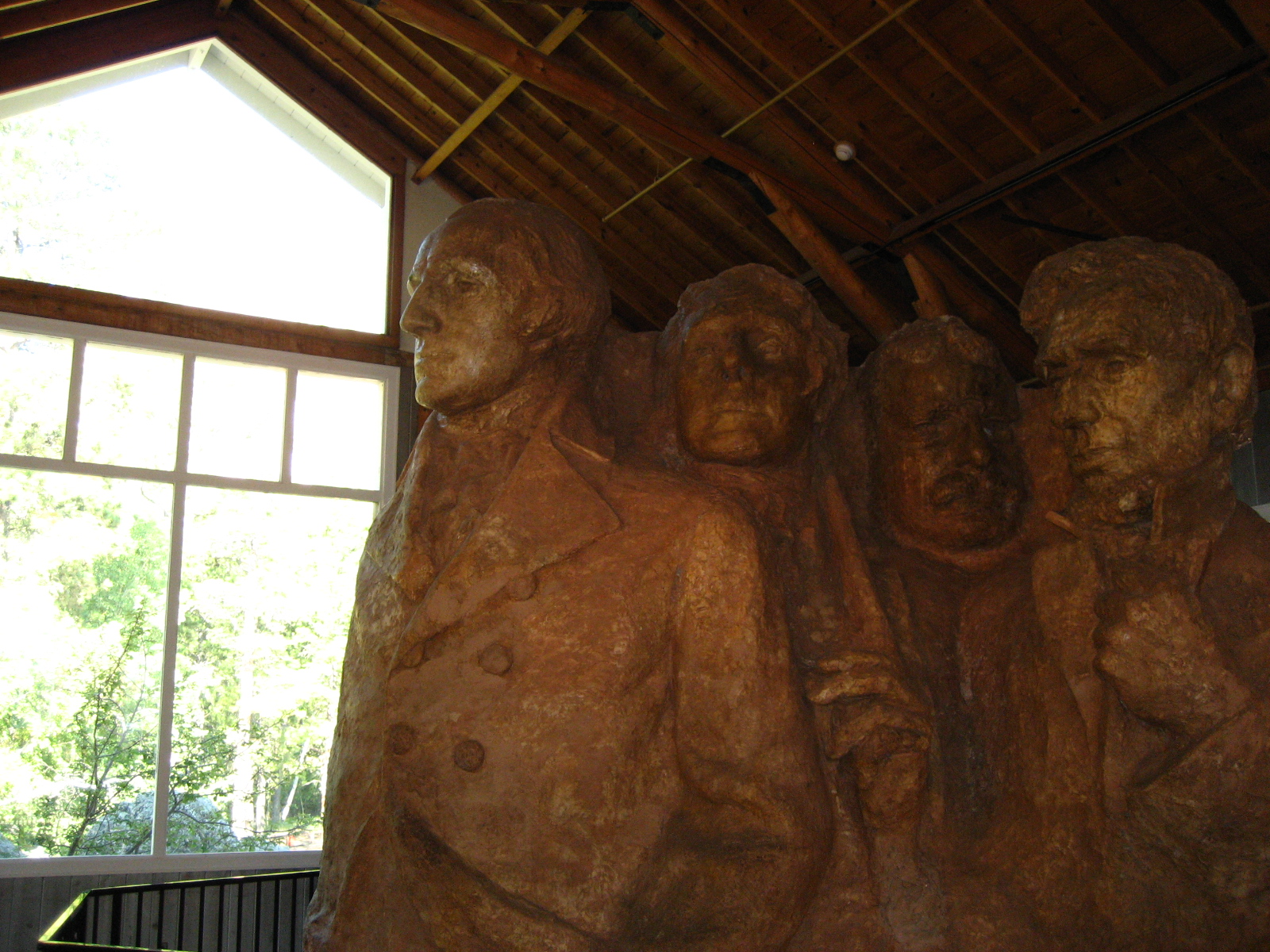
    Here is what Gutzon Borglum wanted the mountain to look like originally:

    There was a very patriotic soda machine outside the men’s restroom:

    When we were done looking around, we went back to the parking lot. We weren’t playing the license plate game on this trip, but we probably could have seen just about all the states in the parking lot. We decided not to go to the Crazy Horse monument for two reasons: 1) it is more expensive, and 2) it isn’t finished. If it were just one or the other, we might have gone. But the double whammy of expensive incompleteness kept us away.

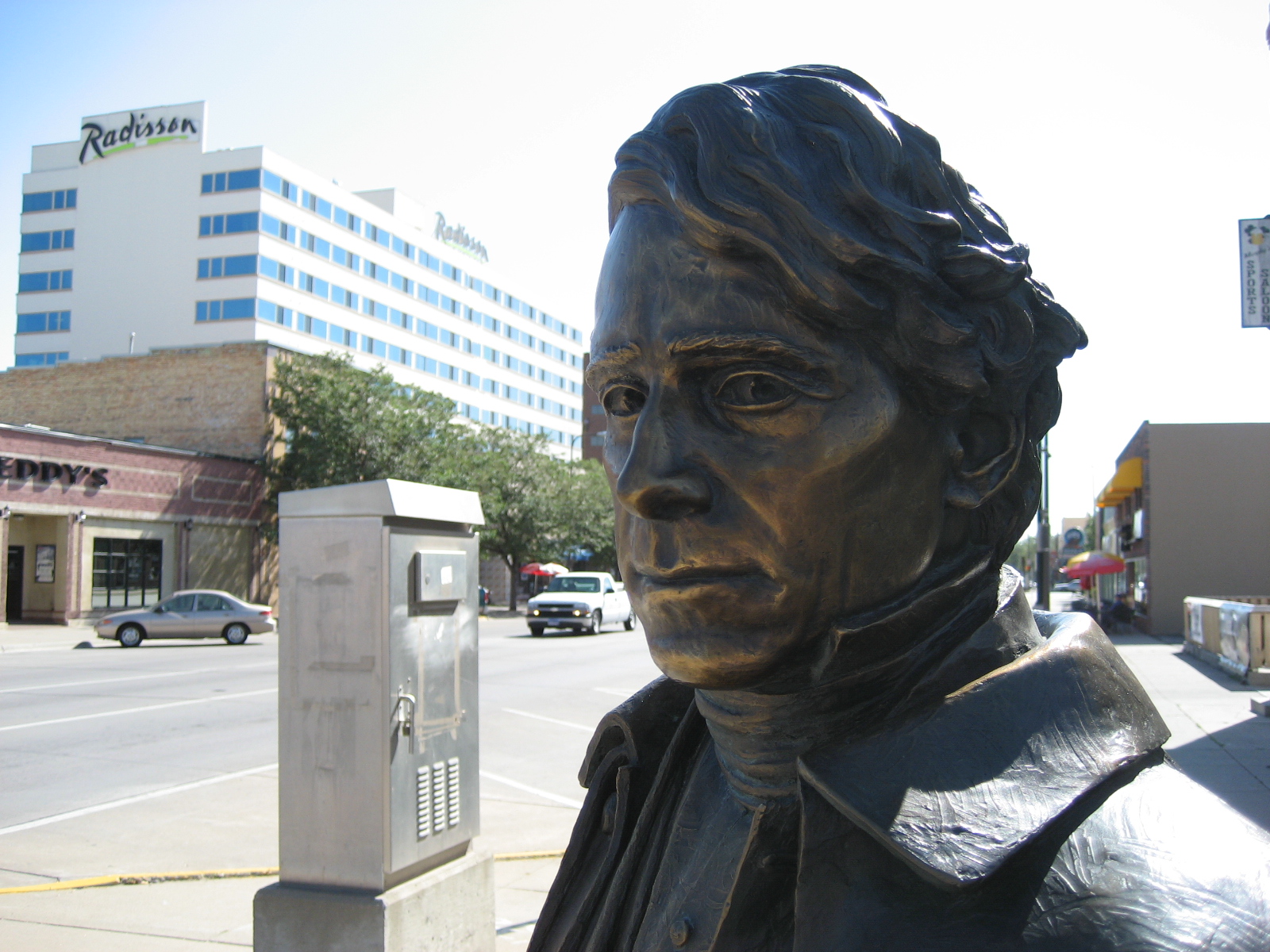
    So we drove back through town on the way to the highway. Rapid City does something that I, in my historically nerdy way, think is really cool. They have (almost) life-sized statues of U.S. presidents on the street corners downtown. We saw many of them driving by, but we just had to stop and take pictures of a couple. Here is Teddy in his Rough Riders uniform:

    Across the street, Franklin Pierce was hanging out (across the street you can see my car parked in front of Teddy’s Bar):

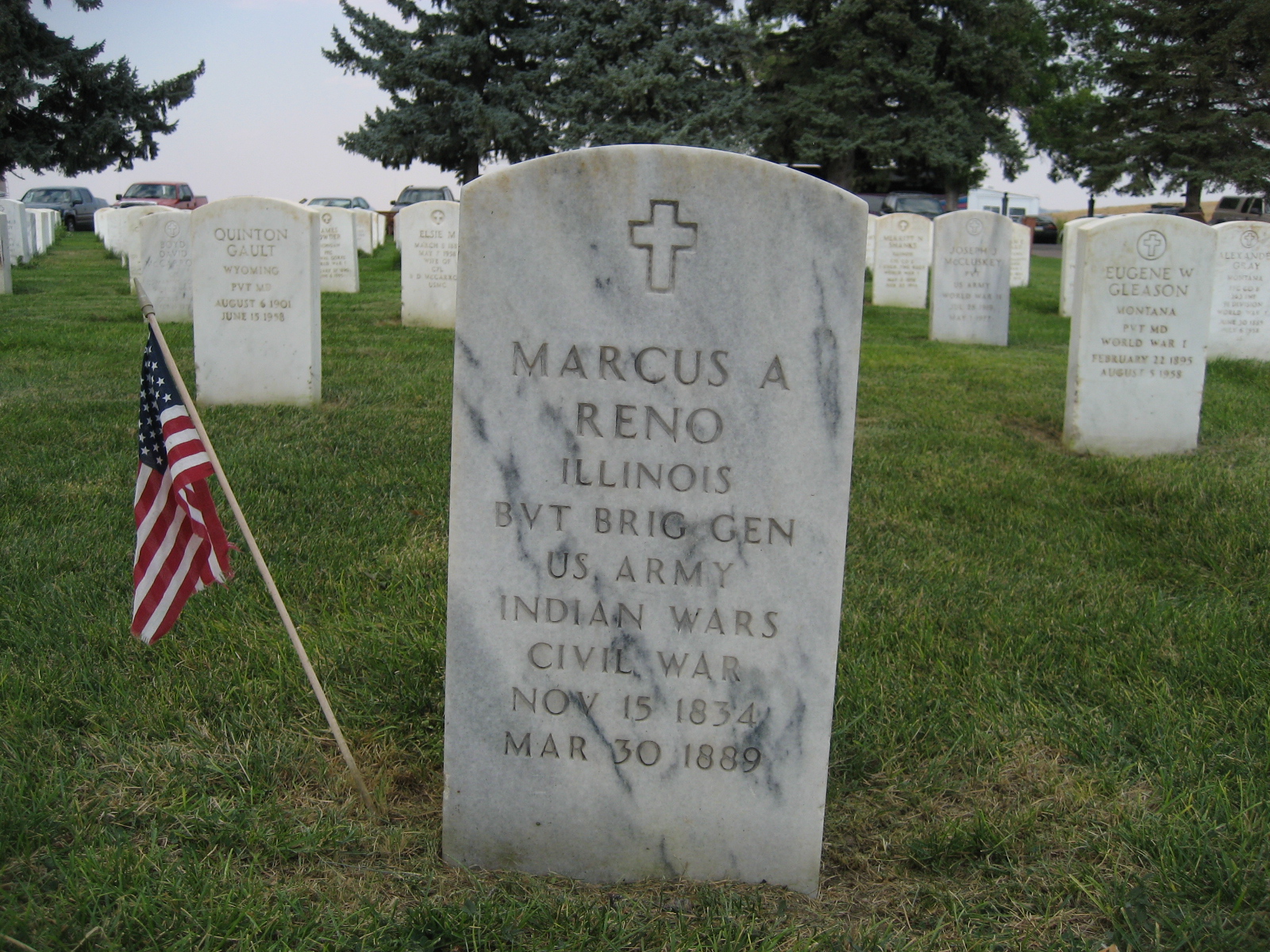
    After that stop, we left Rapid City and headed through the northeast corner of Wyoming and into Montana. In Montana, we stopped at the Little Bighorn National Battlefield. Here is where Custer’s second in command is buried:

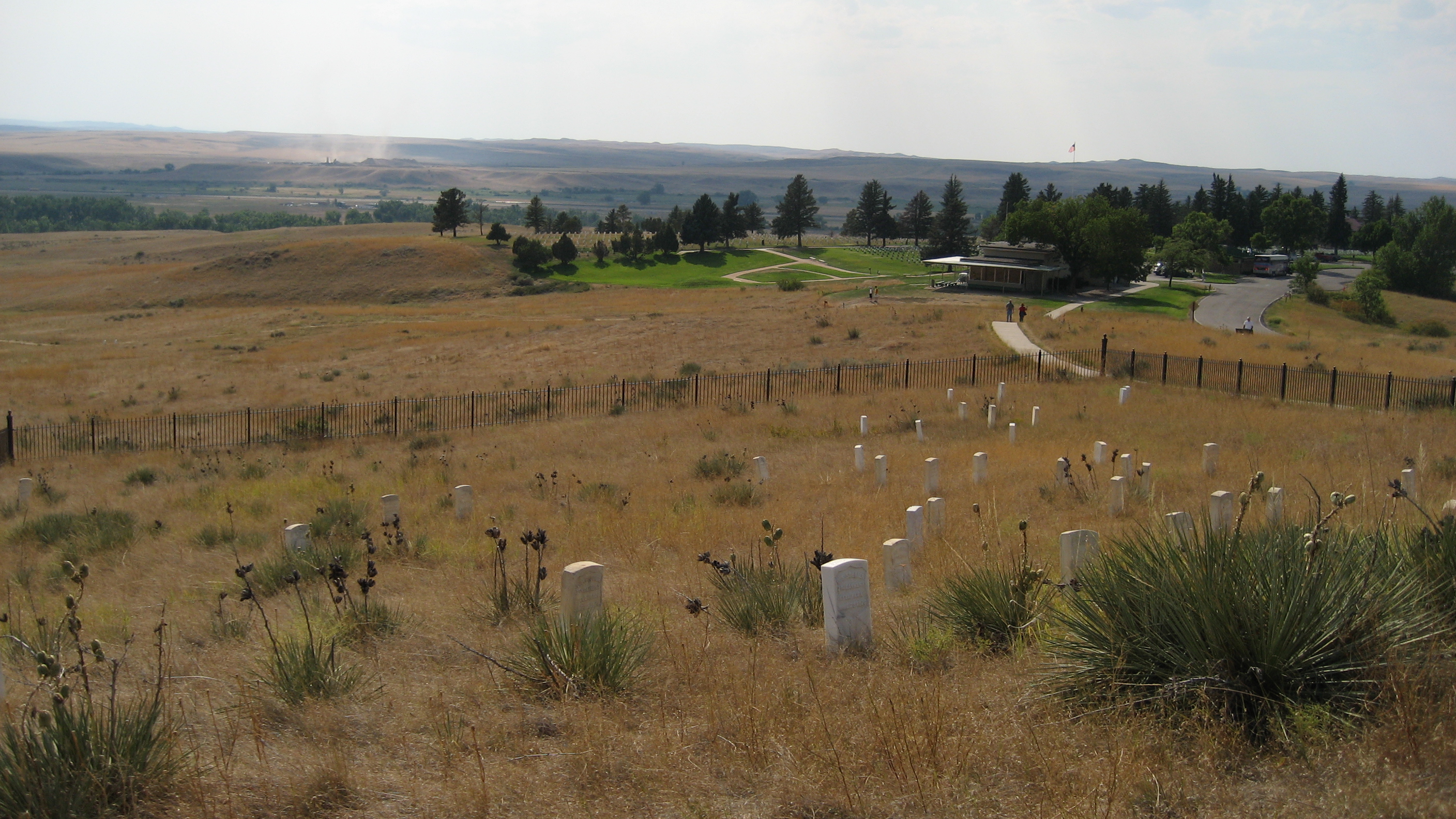
    The black tombstone in this picture marks where Custer fell and was originally buried:

    Here is the memorial to the U.S. soldiers. Most of them are buried under this memorial, but the bodies of the officers were taken elsewhere. Custer, for example, is buried at West Point.

    Here is part of the native memorial, which is not far away from the other one:

    And finally, here is a view from Last Stand Hill toward the visitors’ center:

    After stopping at the battlefield, we drove through Billings to Bozeman, where we spent the night.