I have never gone to L’Abri, the Christian community and study center that Francis Schaeffer founded in Switzerland, but I was greatly influenced by it growing up. My mom had been there in the ’70s when she was sorting through what she believed, and in our house there were several of Schaeffer’s books. I went to a L’Abri conference in Greensboro, NC with her in the late ’90s, and listened to the lecture tapes I got there for several years afterward.
Os Guinness is an English social critic who was a leader at L’Abri in the late ’60s. He has gone on to do a variety of things since then, but his connection with L’Abri is what originally turned me on to his books. I think the first one I read was The Call: Finding and Fulfilling the Central Purpose of Your Life (1998), which came out while I was in college and helped me sort through what I was thinking about career and vocation. In the last several years he has written a book every year: A Free People’s Suicide (2012, and my current favorite of his), The Global Public Square (2013), Renaissance (2014), Fool’s Talk (2015), and this year Impossible People: Christian Courage and the Struggle for the Soul of Civilization.
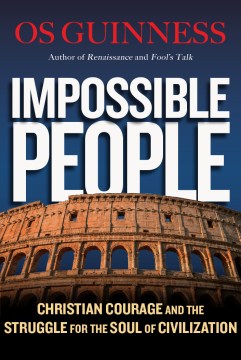 This latest book is a call to Christians in the West to be the “impossible people” of the title. The term “impossible man” was used to describe the medieval reformer Peter Damian, who attacked evil within the church. While some in his time criticized him for being purely negative, his great passion was for faithfulness to the gospel. He was later recognized for this positive passion and was canonized. Guinness calls Christians to have this same passion for faithfulness: “Living before the absolute presence of God, we are called to be faithful, and therefore unmanipulable, unbribable, undeterrable and unclubbable. We serve an impossible God, and we are to be God’s impossible people. Let us then determine and resolve to be so faithful in all the challenges and ordeals the onrushing future brings that it may be said of us that we in our turn have served God’s purpose in our generation. So help us God” (223).
Those who have read Guinness’s earlier book Renaissance: The Power of the Gospel However Dark the Times may wonder how this book relates to that one, since the subject matter appears similar. Guinness makes this comparison:
Impossible People is a companion to my earlier book Renaissance, which came first for a reason. In that book I explored the reasons for our response of assured faith in the gospel—which must be forever unshakeable—and it concluded with hope. I deliberately reversed the normal order of “challenge and response” and put the response before the challenge. Such is the character and record of the gospel of Jesus that we may trust it absolutely however dark the times and however bleak the challenge. Doom, gloom, alarmism and fear are never the way for the people of God. We are to have “no fear.” Impossible People addresses the challenges we face and subjective side that is our response to these challenges—the gospel carries its own inherent transforming power, but we need to trust it, obey it and live it—against all the odds and at any cost. (33)
Guinness spends the bulk of the book, six chapters, enumerating various challenges Christians face in the West: secularism, modernity, spiritual warfare, social constructionism, atheism, and generationalism. Then he spends a final chapter setting forth some tools Christians should use to discern and engage the times they live in.
Guinness is a skillful writer, and I enjoy everything he writes. This book was no exception, yet I am also ambivalent about it. I agree with him about many of the challenges he sees facing the church in the West, but I think splitting the “challenge and response” into two books has caused him to focus unduly on one side in this book. There seemed to me to be not enough space spent on the proper response Christians ought to have to these various challenges. The book felt incomplete in that regard. Also, since each of the challenges he enumerates is complex and could warrant a separate book on its own, I thought some of his critiques were too broad-brushed and lacked the power to resonate with anyone but those who were already convinced.
So if you want to read Guinness’s thoughtful take on the current cultural climate, I would recommend reading Renaissance first (read my review of that book here). Then, if you’d like more detail, read Impossible People.
Note: Thanks to the publisher, InterVarsity Press, for a review copy of this book. I was not asked to give a positive review.
 Those core commitments are:
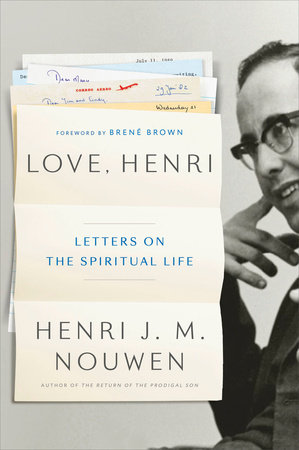 , Gabrielle Earnshaw began archiving his correspondence. Now, to commemorate the twentieth anniversary of his death, she has collected some of these letters and released them as
  J. Daniel Hays has written a useful little book for people who are curious about the physical spaces where God was worshiped in the Bible:
 What the Dog Saw
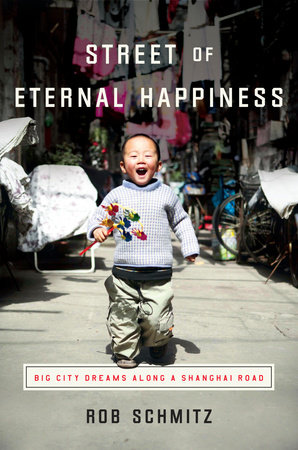 The book comes in 15 chapters, with 2–3 each dedicated to telling the stories of various people along the street. There is CK, the young entrepreneur who sells accordions and is struggling to get a sandwich shop off the ground. There are the residents of Maggie Lane, the area behind Schmitz’s apartment building, who don’t want their homes to be demolished and the area redeveloped, but are continually harassed by unscrupulous developers. There is Zhao, who left her husband, came to Shanghai, and was eventually able to open a flower shop, but is now trying to pass on her will to succeed to her two sons. There is the family of Wang Ming, a businessman who used to live along the street. He might have become rich if he lived today, but in the ’50s he was condemned as a capitalist and sentenced to hard labor while his wife was left to raise their seven children. And my favorite are Auntie Fu and Uncle Feng, the bickering couple who are kept on the brink of financial ruin by Auntie’s attraction to get-rich-quick schemes.
 works, such as the famous Fear and Trembling and Either/Or, are written under assumed names, and it isn’t always clear to what extent what he says in those works is what he really thinks.
 The source of some metaphors are obvious. But sometimes you think a metaphor comes from one sport and it really comes from another, like “hat trick” (cricket, not hockey) and “second wind” (boxing, not running). The most interesting aspect to the book is the occasional metaphor that doesn’t sound like it could trace its origin to sports at all, but does. For example, the phrase “catbird seat” to describe a particularly advantageous situation can be traced to famed baseball broadcaster Red Barber. Shakespeare got the phrase “there’s the rub” from lawn bowling. And “my bad” comes from Sudanese NBA player (and English-language learner) Manute Bol.
 In 2015, the book came out in a revised and expanded edition, and I’ve been reading that edition over the last several months. While I have spent lots of time studying the ancient history of the area, I knew relatively little about its more recent history. And while, as mentioned above, this book is not a history book, I found it to be an enlightening window on the day-to-day lives of people who live under a great amount of pressure. Shipler organizes the book into three parts:
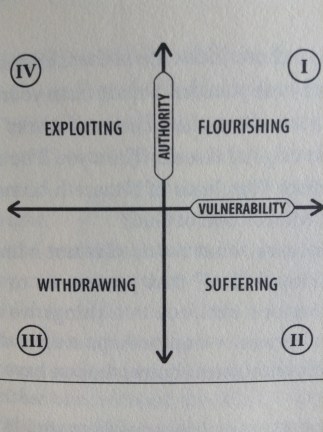 gful action” (35) and vulnerability is “exposure to meaningful risk” (40). He places these on a 2×2 chart that he uses throughout the book. The combination of authority with vulnerability (quadrant I) leads to flourishing; having vulnerability without authority (quadrant II) leads to suffering; having neither authority nor vulnerability (quadrant III) leads to withdrawing; and having authority without vulnerability (quadrant IV) leads to exploiting.
 Elliot Ritzema