Category: Books

  • How to Build and Maintain a Vision: A Review

    Andy Stanley is the pastor of a group of churches in the Atlanta area that started with North Point Community Church, and he is on the list of pastors whose recorded sermons I periodically listen to (Tim Keller and John Ortberg are the others). In 1999 he wrote a book, Visioneering: Your Guide to Discovering and Maintaining Personal Vision, that was later reissued in a revised and updated version.
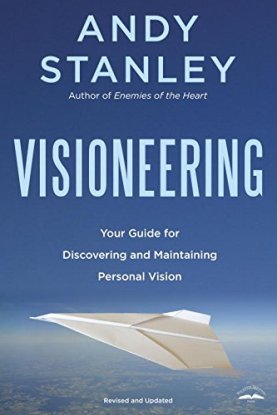
    41mstogyjlThe book is loosely structured around the biblical book of Nehemiah, following Nehemiah’s transition from cupbearer to the king of Persia to governor of Judea as he sought to make the vision of rebuilding the walls of Jerusalem a reality. The “visioneering” of the title is “the course one follows to make dreams a reality. It is the process whereby ideas and convictions take on substance. … If I were to boil it down to a formula, it would look something like this: VISIONEERING = INSPIRATION + CONVICTION + ACTION + DETERMINATION + COMPLETION” (9). It is moving from what is to what can be in any area of life, big or small, in your career, family life, or church.

    Along with the book of Nehemiah, the book is also structured around the 20 building blocks that Stanley says are involved in pursuing a vision:

    1. A vision begins as a concern.
    2. A vision does not necessarily require immediate action.
    3. Pray for opportunities and plan as if you expect God to answer your prayers.
    4. God is using your circumstances to position and prepare you.
    5. What God originates, he orchestrates.
    6. Walk before you talk; investigate before you initiate.
    7. Communicate your vision as a solution to a problem that must be addressed now.
    8. Cast your vision to the appropriate people at the appropriate time.
    9. Don’t expect others to take greater risks or make greater sacrifices than you have.
    10. Don’t confuse your plans with God’s vision.
    11. Visions are refined—they don’t change; plans are revised—they rarely stay the same.
    12. Respond to criticism with prayer, remembrance, and if necessary, a revision of the plan.
    13. Visions thrive in an environment of unity; they die in an environment of division.
    14. Abandon the vision before you abandon your moral authority.
    15. Don’t get distracted.
    16. There is divine potential in all you envision to do.
    17. The end of a God-ordained vision is God.
    18. Maintaining a vision requires adherence to a set of core beliefs and behaviors.
    19. Visions require constant attention.
    20. Maintaining a vision requires bold leadership.

    This is the sort of book that is more rewarding the more you put into it. In fact, I read the original version a while back and was not particularly struck by it. It had some good advice, but wasn’t life-changing. This time, I spent more time trying to apply what Stanley was saying to my own life (there are application questions at the end of every chapter, as well as a group discussion guide at the end), and I found it to be much more useful. I recommend this book to anyone, particularly any Christian, who has some idea of where they would like to be, but is looking for practical steps on how to get there.

    Note: Thanks to the publisher for a review copy of this book through Blogging for Books. I was not asked to give a positive review.
     

  • Faithful No Matter the Cost: A Review

    I have never gone to L’Abri, the Christian community and study center that Francis Schaeffer founded in Switzerland, but I was greatly influenced by it growing up. My mom had been there in the ’70s when she was sorting through what she believed, and in our house there were several of Schaeffer’s books. I went to a L’Abri conference in Greensboro, NC with her in the late ’90s, and listened to the lecture tapes I got there for several years afterward.

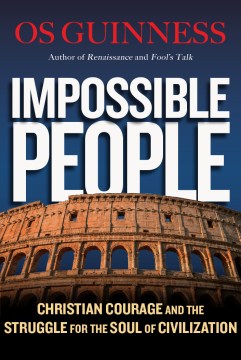
    Os Guinness is an English social critic who was a leader at L’Abri in the late ’60s. He has gone on to do a variety of things since then, but his connection with L’Abri is what originally turned me on to his books. I think the first one I read was The Call: Finding and Fulfilling the Central Purpose of Your Life (1998), which came out while I was in college and helped me sort through what I was thinking about career and vocation. In the last several years he has written a book every year: A Free People’s Suicide (2012, and my current favorite of his), The Global Public Square (2013), Renaissance (2014), Fool’s Talk (2015), and this year Impossible People: Christian Courage and the Struggle for the Soul of Civilization.

    9780830844654This latest book is a call to Christians in the West to be the “impossible people” of the title. The term “impossible man” was used to describe the medieval reformer Peter Damian, who attacked evil within the church. While some in his time criticized him for being purely negative, his great passion was for faithfulness to the gospel. He was later recognized for this positive passion and was canonized. Guinness calls Christians to have this same passion for faithfulness: “Living before the absolute presence of God, we are called to be faithful, and therefore unmanipulable, unbribable, undeterrable and unclubbable. We serve an impossible God, and we are to be God’s impossible people. Let us then determine and resolve to be so faithful in all the challenges and ordeals the onrushing future brings that it may be said of us that we in our turn have served God’s purpose in our generation. So help us God” (223).

    Those who have read Guinness’s earlier book Renaissance: The Power of the Gospel However Dark the Times may wonder how this book relates to that one, since the subject matter appears similar. Guinness makes this comparison:

    Impossible People is a companion to my earlier book Renaissance, which came first for a reason. In that book I explored the reasons for our response of assured faith in the gospel—which must be forever unshakeable—and it concluded with hope. I deliberately reversed the normal order of “challenge and response” and put the response before the challenge. Such is the character and record of the gospel of Jesus that we may trust it absolutely however dark the times and however bleak the challenge. Doom, gloom, alarmism and fear are never the way for the people of God. We are to have “no fear.”  Impossible People addresses the challenges we face and subjective side that is our response to these challenges—the gospel carries its own inherent transforming power, but we need to trust it, obey it and live it—against all the odds and at any cost. (33)

    Guinness spends the bulk of the book, six chapters, enumerating various challenges Christians face in the West: secularism, modernity, spiritual warfare, social constructionism, atheism, and generationalism. Then he spends a final chapter setting forth some tools Christians should use to discern and engage the times they live in.

    Guinness is a skillful writer, and I enjoy everything he writes. This book was no exception, yet I am also ambivalent about it. I agree with him about many of the challenges he sees facing the church in the West, but I think splitting the “challenge and response” into two books has caused him to focus unduly on one side in this book. There seemed to me to be not enough space spent on the proper response Christians ought to have to these various challenges. The book felt incomplete in that regard. Also, since each of the challenges he enumerates is complex and could warrant a separate book on its own, I thought some of his critiques were too broad-brushed and lacked the power to resonate with anyone but those who were already convinced.

    So if you want to read Guinness’s thoughtful take on the current cultural climate, I would recommend reading Renaissance first (read my review of that book here). Then, if you’d like more detail, read Impossible People.

    Note: Thanks to the publisher, InterVarsity Press, for a review copy of this book. I was not asked to give a positive review.

  • What Draws Young People to Churches: A Review

    It happens all across America: churches start out doing well, but they stop paying attention and pretty soon everyone is over 40. Or 50. Or 60. The congregation decides they need to do something to draw young people, but they don’t know what to do. So they look for some kind of silver bullet like starting a new program or hiring a new staff member, but it doesn’t work.

    If this sounds like your experience, Brad Griffin, Kara Powell, and Jake Mulder of the Fuller Youth Institute are here to help. They conducted a study of churches that have found ways to grow young instead of old, and the resulting book, Growing Young: 6 Essential Strategies to Help Young People Discover and Love Your Church, spells out the core commitments of those churches.

    9780801019258Those core commitments are:

    1. Unlock keychain leadership. They have leaders who will share their authority with young people, inviting them to grow in their responsibilities.
    2. Empathize with today’s young people. Older members remember what it was like to be young, and they also try to understand the challenges young people today face that they didn’t. Then they do all they can to help young people work through the challenges of finding identity, belonging, and purpose.
    3. Take Jesus’ message seriously. They proclaim Jesus as “the centerpiece of the story of God” and seek “to live out his message in everyday relationships” (129). In other words, these churches are theologically robust; they don’t preach the moralistic therapeutic deism that distracts people in our culture.
    4. Fuel a warm community. They didn’t just create programs for young people to connect in their church; their entire church gave young people an authentic and welcoming feeling. Structures were not enough for these churches. The people were also warm and inviting.
    5. Prioritize young people (and families) everywhere. Churches can make the first four commitments and still grow old. Churches that grew young also made young people and families a priority. They committed resources and attention to them throughout the life of the congregation, including in their worship gatherings, staffing, and budget.
    6. Be the best neighbors. These churches were not antagonistic toward culture, but sought out ways to both live faithfully and serve their neighbors. This is difficult, since the values of those outside the church and those inside it often conflict, but churches that grow young never stop asking, “Who is my neighbor?” and committing to serve them.

    When I got this book in the mail, it was thicker than I thought it would be. It is packed with the authors’ research findings, as well as stories from the churches they studied (side note: one of the churches they studied was the District Church in Washington, DC, one of whose pastors is my friend Aaron Graham. It was especially fun and interesting for me to read stories about what they are doing there.) Each chapter ends with ideas for action, as well as reflection questions to help you and your church’s leaders think about where your church is now and how it could change.

    This book is particularly relevant for pastors and church leadership teams. Youth pastors and student ministry volunteers can and will benefit from it too, but part of the message of the book is that churches who do well at engaging young people don’t limit that engagement to a youth program or young adult ministry. The entire church needs to prioritize young people, and the “keys” (i.e., authority) to do that come from the lead pastor and leadership team.

    Note: Thanks to the publisher, Baker Books, for a review copy of this book. I was not asked to give a positive review.

  • Henri Nouwen’s Letters on the Spiritual Life: A Review

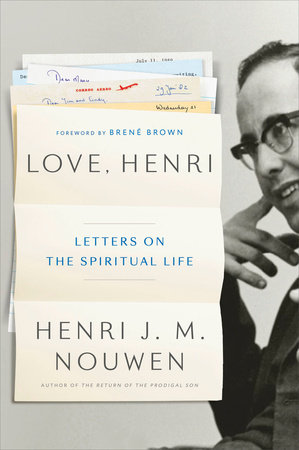
    Four years after the Catholic priest and spiritual writer Henri Nouwen died9781101906354, Gabrielle Earnshaw began archiving his correspondence. Now, to commemorate the twentieth anniversary of his death, she has collected some of these letters and released them as Love, Henri: Letters on the Spiritual Life (not to be confused with the essential oils company “Love Henri,” which I just learned about while writing this).

    These letters span about twenty-two years of Nouwen’s life, from 1973, when he was teaching at Yale Divinity School, to his death in 1996 when he was pastor to the L’Arche community near Toronto. Each is prefaced with a brief intro that explains who the recipient was and the occasion of writing. Together, they depict a man who took friendship and his role as a pastor seriously, who cared deeply for people and wanted them to draw close to God. For example, he wrote this at the end of a letter evaluating a student’s paper:

    By becoming one with us, God revealed himself as God to us. Thus the experience of our humanity as a forgiven weakness leads us to the heart of God’s love for us and to the center of His forgiving presence in our life. Therefore I think that your story is the story with which you can come to know God’s story better, and it is His story that makes our story worth living. (41)

    While he wrote many books, he regarded his ministry of being present to people as the heart of his calling:

    When I think about my life and my work, I think about it more as a way of being present to people with all I have. I have always tried to respond as honestly as I possibly could to the needs and concerns of the people who became part of my life, and I have tried to respond with whatever my own life has taught me. … I do not remember ever having to sit down “to write a book.” The publications that you know are more a result of speaking with people, sharing my own life with them and trying to give words to what often remains hidden under the threshold of our consciousness. (72)

    As I read this book I learned much about the value of friendship, the need for vulnerability, and the nature of spiritual direction. These are letters from a man who reflected deeply on the spiritual life and who was deliberate about pointing his friends to the love of God in Christ. While he had many struggles of his own throughout his life—and these also come out in the letters—he always seemed to make time to help a friend in need. In fact, he wanted to use his own struggles to help others by being open about them. In this way, he thought, they would be “a source of consolation and healing.”

    I was also struck by the value of archival work (my mind went in this direction in part because my wife trained as an archivist). I’m thankful to Gabrielle Earnshaw (and Sue Mosteller, Henri Nouwen’s literary executrix) for taking the time and effort to select and introduce these letters. They have given readers a wonderful gift.

    Note: Thanks to the publisher for a review copy of this book.

  • The Story of God’s Dwelling Place: A Review

    If you’ve been following this blog over the last couple of months, you know I went on a trip to Israel this summer. On that trip I gained a newfound interest in the physical details of places in the Bible. The more I know, for example, about what Jerusalem looked like in the first century, the easier it is to visualize the events that happened there.

    9780801016202J. Daniel Hays has written a useful little book for people who are curious about the physical spaces where God was worshiped in the Bible: The Temple and the Tabernacle: A Study of God’s Dwelling Place from Genesis to Revelation. It relies on recent research into archaeology as well as biblical studies and ancient history, and it also manages to be a very useful book even for the reader without a lot of background knowledge.

    From creation until the incarnation of Christ, according to Hays, the story of God’s dwelling place is a story of decline. As many other scholars have argued, Hays writes that the garden of Eden was itself a temple designed as a place where humans could have communion with God. God walked with them there until their sin caused them to be evicted from God’s presence. Later, after the exodus, the tabernacle enabled God to dwell among his people again, but his glorious presence was limited to the holy of holies. Only the high priest could go there, and then only once a year.

    Hays continues to document this decline in Solomon’s temple. Yes, God’s presence did inhabit Solomon’s temple, but there are many subtle indications in the biblical account that all was not well, even before the end of Solomon’s life when his idolatry is named explicitly. There are significant differences between the way Moses oversaw the building of the tabernacle and the way Solomon oversaw the building of the temple. For example, Solomon relies on a Canaanite craftsman to build the temple. And whereas the tabernacle was built using the voluntary contributions of the Israelites, Solomon built his temple with taxes, tribute, and forced labor.

    This decline continued after the time of Solomon. God’s glory left the temple before its destruction by the Babylonians in 586 BC, which the prophet Ezekiel narrates in a vision (Ezek 8-11). The temple was rebuilt 70 years later, and 500 years after that Herod the Great expanded it in a grandiose manner. But Hays argues that God was not present in the temple in the years between the departure of God’s glory and the arrival of Jesus. This is why, for example, the Roman general Pompey could enter the holy of holies in 63 BC and suffer no ill effects. Although God returned to the temple in Jesus, the days of the physical temple were numbered when the religious leaders of his day rejected him. The Romans destroyed the second temple in AD 70, but even before then Jesus and his followers had begun speaking about God’s dwelling place in a new way. Jesus had spoken of himself as the temple, and his followers like Paul spoke of the church as a temple in which God dwelled by his Spirit. The latter chapters of Revelation look forward to a time when God’s presence will dwell more openly among his people, and there will be no need for a physical temple (Rev 21:22).

    Is10074
    The southern steps, where the main entrance to the temple complex was in Jesus’ day

    The Temple and the Tabernacle contains numerous full-color photographs of architectural sites and artifacts, as well as artistic renderings of what the temple and tabernacle looked like. The only negative thing I can say about this book is that I would have preferred a hardcover. I know that it would have driven up the price, but it has quality paper and full-color photos; it would have been nice to package them in something more sturdy than a paperback.

    With that small critique aside, the content of this book is first-rate. It teaches readers about the physical aspects of God’s dwelling places in the Bible, educating us in their symbolism. But it does more than that. It teaches about the character of God, pointing out his persistent desire to dwell among his people in spite of their rebellion against him.

    Note: Thanks to Baker Books for a review copy of this book. I was not asked to give a positive review.

  • Bite-Sized Gladwell: A Review

    I like reading Malcolm Gladwell for the same reason I like reading G. K. Chesterton or a good mystery novel. He has a way of looking at reality in a counterintuitive way that sheds fresh light on particular issues and also helps readers to adopt an attitude of curiosity about their own surroundings.

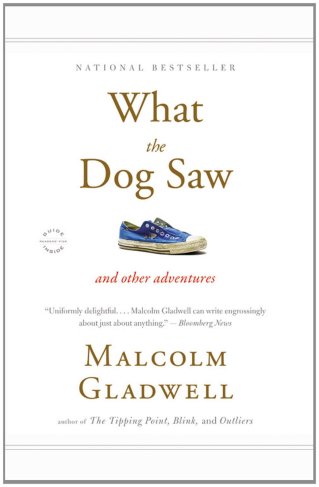
    617zHlRH92LWhat the Dog Saw is a collection of Gladwell’s articles from the New Yorker that were published in the ’90s and early 2000s. The movements of the articles generally follow a few standard beats:

    • Movement 1: Here is a well-known event or common phenomenon.
    • Movement 2: Most people think about this even or phenomenon in one way.
    • Movement 3: This event or phenomenon is actually very similar to this other event or phenomenon that superficially looks very different.
    • Movement 4: As a result, we shouldn’t look at the initial event or phenomenon in the usual way. We should look at it this other way instead, which gives us greater insight into what is going on.

    While not all of Gladwell’s articles follow this formula slavishly, it does pop up with surprising regularity.

    For example, take the article “Most Likely to Succeed,” about the process of hiring people when you don’t know who would be best for the job. Gladwell begins with “the quarterback problem,” which is that playing quarterback on a college level is more dissimilar to playing quarterback as a pro than other positions in football. There is nothing like being an NFL quarterback. As a result, it is hard to predict whether a good college quarterback will turn out to be a good pro. The quarterback problem is like the problem of predicting whether teachers will be successful once they get into the classroom: “No one knows what a person with the potential to be a great teacher looks like” (319). It is also like the problem of trying to predict whether someone will succeed as a financial advisor. In the case of financial advisors this problem has been largely solved, however, not by raising standards but by lowering them: allowing more people into the field, and judging them after they have begun their jobs rather than before. For quarterbacks, this means trying out several on the pro level rather than just looking for the best college player and paying them a lot of money before they have taken a snap. For teachers (the real focus of the article), this means starting teachers in an apprenticeship system in which they are rigorously evaluated. It also means paying good teachers a lot more than mediocre ones.

    As you can see, there is variation in the formula (here Gladwell compares three seemingly dissimilar things rather than just two), but it is largely there. Reading his articles doesn’t feel formulaic, though; he is telling stories to illustrate points, and stories are always interesting. The effectiveness of his writing stands or falls, though, on whether he is accurate in his choice of two (or more) seemingly dissimilar things to compare. Is this thing really like that other thing in the way Gladwell suggests? It all seems very plausible when you are reading him, and maybe he is right much of the time, but I do have my occasional doubts.

    Regardless, I enjoy reading Gladwell because he is creative and almost paradoxical in his choice of things to compare, and it is exciting to follow along as he takes something that seems counterintuitive at first and makes it appear inevitable. The great benefit of reading him is that it helps me in my own life to stay curious and not take conventional wisdom for granted.

    As a final note, I read part of this book and listened to part of it as an audiobook. The audio version is read by the author, and he does a great job. And did you know he has a podcast?

  • Trying to Get By in Shanghai: A Review

    Rob Schmitz is the China correspondent for NPR’s Marketplaceand he lives on a street in Shanghai whose name translates into English as “Street of Eternal Happiness.” In 2012–2013 he reported a series of short stories on the people he met along the street, which lies in the former French Concession. Later, he reworked and expanded that material into a book: Street of Eternal HappinessThe stories Schmitz tells come together to give us a picture of what it’s like for people of various ages and backgrounds to navigate the political, cultural, and financial realities of modern-day China.

    9780553418088The book comes in 15 chapters, with 2–3 each dedicated to telling the stories of various people along the street. There is CK, the young entrepreneur who sells accordions and is struggling to get a sandwich shop off the ground. There are the residents of Maggie Lane, the area behind Schmitz’s apartment building, who don’t want their homes to be demolished and the area redeveloped, but are continually harassed by unscrupulous developers. There is Zhao, who left her husband, came to Shanghai, and was eventually able to open a flower shop, but is now trying to pass on her will to succeed to her two sons. There is the family of Wang Ming, a businessman who used to live along the street. He might have become rich if he lived today, but in the ’50s he was condemned as a capitalist and sentenced to hard labor while his wife was left to raise their seven children. And my favorite are Auntie Fu and Uncle Feng, the bickering couple who are kept on the brink of financial ruin by Auntie’s attraction to get-rich-quick schemes.

    These cameos show us as well as any book on history or economics what it is like to live in China today: to experience a growing economy that grants increasing opportunity, but also has corruption and injustice. To live with a government that sometimes seems to be granting more freedom, but also sometimes seems to be out of step with the realities of the everyday life of the country’s people. I would recommend this book to anyone who is interesting in learning about what it is like to live in modern-day China. The stories make it a fascinating read even for those, like me, who are relatively unfamiliar with Chinese culture and history.

    Note: Thanks to the publisher for a review copy of this book. I was not asked to give a positive review.

  • A Christian Missionary to Christians: A Review

    The nineteenth-century Danish philosopher Soren Kierkegaard was a Christian, but subsequent Christian readers have expressed divergent opinions about him. Francis Schaeffer, for example, associated Kierkegaard with the so-called “leap of faith” and condemned him for encouraging irrationality. Dave Breese, in Seven Men Who Rule the World from the Grave, expresses a similar view. On the other hand, Kierkegaard is viewed more positively by thinkers like C. Stephen Evans and Merold Westphal, and exerted an influence on such later Christian theologians as Karl Barth.

    And if you decide to wade through opinions from secondary sources and judge for yourself (as it were) whether Kierkegaard is worth reading, where do you start? Many of his 9780830840977works, such as the famous Fear and Trembling and Either/Or, are written under assumed names, and it isn’t always clear to what extent what he says in those works is what he really thinks.
    Thankfully, Mark Tietjen has written Kierkegaard: A Christian Missionary to Christians, an accessible introduction to Kierkegaard that summarizes some of his thought and points out some of the ways in which he is still relevant to our own time. But how can you be a Christian missionary to Christians? Tietjen explains:

    One of Kierkegaard’s stated aims is to reintroduce Christianity into Christendom. In a sense Kierkegaard is a Christian missionary to Christians. This odd predicament necessitated, he believed, an indirect approach. If someone already believes he or she is a Christian, then the direct charge “you ought to become a Christian” will make little sense and likely offend or alienate one’s audience. So Kierkegaard decides he will take an indirect approach and provisionally grant his contemporaries their Christianity, and he will write some books from a non-Christian point of view with the hopes of generating introspection among the “Christians” of his day (42).

    In other words, Kierkegaard was troubled by the fact that so many people in nineteenth-century Denmark, called themselves “Christians” because they mentally assented to a list of doctrines when they really were not Christians at all. His response was to make Christianity more difficult, and also to point out how the ways these alleged Christians were living actually diverged from real Christianity. In his book, Tietjen points out how Kierkegaard went about this with regard to the subjects of Jesus Christ, the human self, Christian witness, and the life of human love. Along the way, he sets the record straight with regard to the criticisms of Schaeffer, Breese, and others. Kierkegaard was not endorsing irrationality when it came to faith or saying that truth was unattainable. Rather, he saw that what was missing from the Christianity of his time was inwardness—the personal, whole life commitment to follow Jesus. According to Tietjen, “Despite this emphasis on passion or inwardness or the subjective side of Christian faith, Kierkegaard does not denigrate or minimize Christian doctrines or what his pseudonym calls objective truth. In fact, Kierkegaard assumes Christian truth to be true. He simply takes seriously the biblical view that the faith that transforms a human life reaches beyond the mind to one’s heart, soul and strength—to one’s passions” (41).

    This is a wonderful book for those who have had some sense that Kierkegaard still has something to say, but aren’t sure where to start in his writings. Especially in places where it is assumed that what makes you a Christian is that you were raised in church or even mentally subscribe to a list of doctrines, Kierkegaard continues to call out that Christianity is both harder and better than this. And his style of indirect communication gives us an example of how to approach those who think they know what Christianity is but don’t.

    Note: Thanks to InterVarsity Press for a review copy of this book in exchange for an honest review.

    Also, here are a few resources for learning more about this book:

  • “My Bad,” and Other Sports Metaphors: A Review

    I taught English as a second language for a couple of years just after college, and my students could never get enough of idioms and metaphors. By the time they had me as a teacher, most of them had been studying the basics of the language for a while; they really wanted a native speaker to tell them the origin of strange sayings such as “pee like a racehorse” and how to use it in the right context.

    I wish I had Josh Chetwynd’s The Field Guide to Sports Metaphors back then. Chetwynd has collected the origin stories of dozens of metaphors that come to us from athletic pursuits, organized them according to sport, and put them between the covers of a neat, small hardback.

    9781607748113The source of some metaphors are obvious. But sometimes you think a metaphor comes from one sport and it really comes from another, like “hat trick” (cricket, not hockey) and “second wind” (boxing, not running). The most interesting aspect to the book is the occasional metaphor that doesn’t sound like it could trace its origin to sports at all, but does. For example, the phrase “catbird seat” to describe a particularly advantageous situation can be traced to famed baseball broadcaster Red Barber.  Shakespeare got the phrase “there’s the rub” from lawn bowling. And “my bad” comes from Sudanese NBA player (and English-language learner) Manute Bol.

    I read this book straight through, but it would work much better as a reference. Reading it from beginning to end, some of the origin stories can start to seem repetitive and I needed the occasional surprise to keep me going. I’d recommend this book to anyone who has ever wondered about why we use the metaphors and idioms we do, especially sports fans.

    Note: Thanks to the publisher for a review copy of this book in exchange for my honest opinion.

  • The Israeli-Palestinian Conflict in Shades of Gray: A Review

    David K. Shipler,a New York Times reporter based in Jerusalem during the early 1980s, won the Pulitzer Prize in 1987 for  Arab and Jew: Wounded Spirits in a Promised Land. His book, rather than attempting to give a history of the conflict, was an honest look at the relationships between Arabs and Jews. It contained interviews with many people who were deeply involved in the conflict, yet it refused to advocate for one side over the other. In his preface to the first edition, Shipler wrote:

    This is not a book about the diplomatic, political, or military dimensions of the Arab-Israeli conflict. Nor is it a chronicle of Israel’s domestic evolution. Those elements are presented only insofar as they shed light on the subject at hand. Rather, the purpose here is to examine the attitudes, images, and stereotypes that Arabs and Jews have of one another, the roots of their aversions, and the complex interactions between them in the small territory where they live together under Israeli rule: the strip of land between the Jordan River and the Mediterranean Sea (xxviii).

    9780553447514In 2015, the book came out in a revised and expanded edition, and I’ve been reading that edition over the last several months. While I have spent lots of time studying the ancient history of the area, I knew relatively little about its more recent history. And while, as mentioned above, this book is not a history book, I found it to be an enlightening window on the day-to-day lives of people who live under a great amount of pressure.  Shipler organizes the book into three parts:

    First, the broad forces that contribute to aversion, namely the engines of war, nationalism, terrorism, and religious absolutism. … Second, the catalogue if images, each of the other, some held in parallel, some unique to the Arab-Jewish relationship, some reminiscent of stereotypes between other groups in other societies. Third, the complexities of interaction, from cultural and religious affinity to the idealistic efforts of a few Jews and Arabs to reach across the gap of ignorance.” (15–16)

    The conflict boils down to this: both Jews and Arabs want to live in the land between the Jordan River and the Mediterranean, and both believe they have a legitimate claim to that land. Beyond that, there are what seem like a million shades of nuance. There are not just Arabs who live in the West Bank and Gaza but also Arabs who are citizens of Israel. There are Bedouins. While most Palestinian Arabs are Muslim, there is a minority of Christians among them. There are also different kinds of Jews—the Ashkenazim and the Sephardim, who emigrated from different places and generally have different statuses within Israeli society.

    Shipler presents the nuances of the conflict so well that by the end of the book I could only arrive one conclusion: it’s complicated, it’s a mess, and I don’t know what ought to be done. There are no clear good guys and bad guys in this book. Jews may have the political power in their society, and so it is easy to conclude that Arabs are the only victims. On the other hand, Israeli Jews are also surrounded by hostile neighbors and are haunted by memories of their own victimhood in the Holocaust. What does Shipler himself think should be done? He doesn’t offer particular policy proposals, but rather points toward empathy:

    Because I am a writer, and I write about what people think, I naturally believe that it helps to know the other side’s viewpoint, even if you don’t accept it. So in the Israeli-Palestinian conflict, the narrative of the other needs to be heard. Jews see the creation of Israel as a rebirth founded on historical justice. That does not mean that it was a rebirth for Palestinians. That they see it as al-Nakba, the catastrophe, doesn’t mean it was a catastrophe for Jews. But the two narratives must somehow be spliced together, not to endorse the other side’s story but to recognize it, to acknowledge it, to say, okay, yes, you had that experience. We had our experience. We honor your story. We honor your experience. You honor ours. That is the hardest task, much more difficult than drawing lines on a map. (682)

    This is a long book at 700+ pages (200 or so more than the first edition), so I could only recommend it to committed readers with a bit of time on their hands. It’s not beach reading, unless you go to the beach to contemplate the tragedies of intractable cultural conflict (I know there are some of you out there). But it is a worthwhile read, and contains many wonderful stories and vignettes from various slices of society in Israel and the West Bank. Readers who have already decided that they are on one side or the other will more than likely not find it satisfying. However, those who, like myself, are newcomers to the conflict and are looking only to listen will find in this book a wonderfully thorough introduction to the Israeli-Palestinian conflict.

    Note: Thanks to the publisher for a review copy of this book. I was not asked to give a positive review.