Blog

  • Book Review: The Yiddish Policeman’s Union

    Last week I finished reading a novel by Michael Chabon called The Yiddish Policeman’s Union. I’d never read anything by him before, but I remember my old roommate Neal recommending his Pulitzer Prize-winning novel The Amazing Adventures of Kavalier & Clay when I lived in Hungary. I first was drawn to this book last year when I saw its brightly colored jacket and read about its intriguing premise in an airport bookstore. Since the author was recommended by a friend with good taste, and it is set in southeast Alaska, where I have spent some time, I decided to give it a try.

    The southeast Alaska of this book is nothing like the southeast Alaska I know, however. Chabon’s is a completely fictional world in which the state of Israel never got off the ground in 1948, and Jews were settled in the District of Sitka with a 60-year lease from the United States. The novel is set just a few months before Reversion, when the lease will be up and the Jews of Sitka will be wanderers once more. It is also a detective novel strongly influenced by noir – an appropriate choice since it is so dark during the Alaskan winter. This book is Raymond Chandler meets Chaim Potok meets James Michener’s Alaska. Some of the best books I have read mash up aspects of the world in creative and unexpected ways, and so I was looking forward to this one.

    What I liked about the book is that Chabon certainly does have a way with words, but in a way that doesn’t necessarily scream, “I’m a literary novelist!” It’s a tough thing to write creative prose and not call attention to the fact that you are writing creative prose. Chabon showed more restraint than many other writers of so-called literary fiction I have read, and I appreciated that. I also appreciated that the book had more of a plot than much literary fiction, which often seems to coast along for pages on turns of phrase alone. Chabon was not above writing a detective novel with an interesting plot. And while the plot was not as fast-paced as your typical popular paperback mystery, it was much better written, which ought to count for something.

    In the end, though, the plot was where I found fault with the novel (and if you’re planning on reading it, don’t read any further, because I’m going to disclose some things). It starts out with a body found in a hotel, with detective Meyer Landsman and his half-Tlingit partner, Berko Shemets, trying to find out whodunit against the wishes of their superiors. The story leads into the depths of Hasidic organized crime, and the identity of the corpse is revealed as a chess-playing, heroin-addicted man who was once hailed as a potential Messiah, but who faded into the shadows because he couldn’t handle the pressure. He was later found by a group who wanted to rebuild the Temple in Jerusalem, and who needed him to lead them. This group was in cahoots with the U.S. government, which is run by Christian dispensational premillennialists who think it is necessary for the Temple to be rebuilt so Jesus will return.

    I won’t get into how the man died, because that is less important to me than who the “bad guys” are revealed to be. First, I found this coalition of Orthodox Jews and Left Behind -reading Christians a little too far-fetched to be true. It’s not that there aren’t such Christians out there; there are lots of Christians, particularly in North America, who have that kind of eschatology. You could even say (and you would probably be right) that dispensationalists have had an influence on U.S. foreign policy. However, those who would seriously espouse violence to bring about a supposed Second Coming have never been more than a lunatic fringe. The idea that, even in an alternative universe, they would control the government and destroy the Dome of the Rock lacks plausibility. It also comes across to me as a thinly veiled satirical snipe at said Christians.

    But more than that, this plot twist reveals that we Christians in the United States have a PR problem. If we are known more for theories about the End Times than for, say, love for one another, then it seems we’re not getting the right message across. Michael Chabon may be just one person, but he had to get his ideas from somewhere, and he certainly has a lot of influence through his books. I’m not mad that he turns wacky Christians into a contrived plot device; I’m just sad that enough Christians have that wacky theology to give Chabon a target. I would recommend this book for its fine writing and better-than-average plot. However, even in a richly textured and plausible alternative world, the deus ex machina of Christians who run the government and use explosives to hasten Jesus’ return was a little too unbelievable.

  • “The Lesions are Free”

    I got this e-mail from a church e-mail list that I am on. I don’t know whether the humor was deliberate or not, but it was too funny not to pass on:

    Hello there get your dancing shoes on!!!!!

    This Thursday night here at the church from 7:00 to 9:30
    MaryAnne will be teaching Swing Dancing, the lesions are free.

    Bring along a few friends and have a go on the dance floor.

    CHILDCARE WILL BE PROVIDED!!

    I’m so glad I don’t have to pay for my lesions anymore.

  • Leadership Summit

    On Thursday and Friday this week, I went to the annual Leadership Summit put on by Willow Creek Church of Chicago. There is a large event held at their campus in Chicago, and they broadcast it live to various other locations around North America. One of the places where they broadcast it is Cornwall Church in Bellingham, and one of the churches that sends people there is my church, Bellingham Covenant. The associate pastor asked me last week if I wanted to go, and I said yes. I found myself on Thursday afternoon (I missed the morning sessions because of a prior commitment) watching the summit take place on a big screen.

    I thought it was great, honestly. Ever since I was in college at the University of Richmond, with its Jepson School of Leadership Studies, I’ve tended to become a bit suspicious whenever I hear the word “leadership” bandied about too readily. Perhaps it is because I met too many Leadership Studies majors who weren’t necessarily good leaders; they were really just overbearing. Perhaps it is because I got the impression that studying leadership was an easy way to breeze through college after hearing it derisively called the “group project major.” Perhaps its because too many uses of the word “leadership” smack of elitism.

    Whatever the reason, I have often scoffed whenever I heard people talk about leadership, its training or techniques. It may be that that impulse will never completely go away. But I will tell you that my experience at the Leadership Summit was overwhelmingly positive, and I am actually hoping to go again next year. I had heard of a few of the speakers involved, but interestingly enough, the sessions that I was most impacted by involved people I had never heard of. Here are just a few highlights for me:

    On Thursday afternoon, Bill George talked about “finding your true north.” What really stuck out to me about what he said was his emphasis on character and humility in leadership. Instead of getting people to follow them, leaders are meant to empower others.

    After an interview with the founder of “Teach for America,” Wendy Kopp, John Burke and Efrem Smith spoke on leading in new cultural realities. Burke spoke mostly about our postmodern environment, and Smith about our multicultural environment. In both their talks, I was struck by the need for church leaders to abide in Christ, and to interact in a non-antagonistic way with our culture. Some culture is good, some is bad, and some is neutral. We need to embrace as much as we can of the good and neutral stuff, lest we make it more difficult than necessary for people to become Christians.

    On Friday, the two people who stuck out to me the most were Craig Groeschel and Catherine Rohr. Groeschel is the pastor of lifechurch.tv, a multi-site church in Oklahoma and a few other states. He’s a great communicator, but what stuck out to me the most about him was his honesty and transparency. Rohr founded the Prisoner Entrepreneurship Program, which equips Texas prison inmates with “values-based entrepreneurial training” in order to reduce recidivism and help them to re-enter society productively. Her story, and the stories of the graduates of her program, was inspiring.

    Even though I still think the word “leadership” can be abused, I found that what I learned at the Leadership Summit was valuable. Maybe leadership doesn’t have to be a dirty word, after all.

  • Alexander Solzhenitsyn Dies at 89

    Yesterday morning, I read in the newspaper that Alexander Solzhenitsyn died on Sunday in Moscow. He was most famous as an author and dissident in the Soviet Union, and in my estimation was one of the greatest men of the twentieth century.

    I first heard about Solzhenitsyn in college, when I read his most famous book, One Day in the Life of Ivan Denisovich for a Twentieth Century Russian Lit class. I was fascinated by the man and his story, and decided to read a lot more of his work. I have bought several of his books at used book stores, but up to now the only other full-length book of his that I have read is A Warning to the West, which contains five speeches that he delivered in the United States and Britain after he was exiled from the Soviet Union in the ’70s.

    I like Solzhenitsyn so much because of his accurate diagnosis of the problems of our age, and his fearlessness in denouncing those problems. He was so fearless in the face of opposition because, as he stated in his 1970 Nobel Prize acceptance speech, he believed that “One word of truth outweighs the world.” Chuck Colson has written an article in the August edition of Christianity Today that draws parallels between Solzhenitsyn and the prophet Jeremiah. Unfortunately, like Jeremiah, after a while many people stopped listening to Solzhenitsyn because he always seemed to have bad news.

    After he was exiled from the Soviet Union in 1974, he moved to the United States and spent the next 18 years in Vermont. Although he was celebrated for his defiance of the Soviet Union, his honeymoon with the West didn’t last long. The substance of his famous 1978 Harvard commencement speech was, “Communism may be bad, but the West isn’t doing so well itself.” He denounced the West for falling into a “despiritualized and irreligious humanistic consciousness.” While there is no official state censorship as in the Soviet Union, Westerners are slaves to fashionable ideas. I think that much of that 1978 address still holds up, and can still serve as a warning to us to abandon unrestrained materialism and freedom without accountability. Here is Solzhenitsyn’s conclusion to that speech, which could also serve as a fitting coda for his own life:

    If humanism were right in declaring that man is born only to be happy, he would not be born to die. Since his body is doomed to die, his task on earth evidently must be of a more spiritual nature. It cannot be unrestrained enjoyment of everyday life. It cannot be the search for the best ways to obtain material goods and then cheerfully get the most of them. It has to be the fulfillment of a permanent, earnest duty so that one’s life journey may become an experience of moral growth, so that one may leave life a better human being than one started it. It is imperative to review the table of widespread human values. Its present incorrectness is astounding. It is not possible that assessment of the President’s performance be reduced to the question how much money one makes or of unlimited availability of gasoline. Only voluntary, inspired self-restraint can raise man above the world stream of materialism.

    It would be retrogression to attach oneself today to the ossified formulas of the Enlightenment. Social dogmatism leaves us completely helpless in front of the trials of our times. Even if we are spared destruction by war, our lives will have to change if we want to save life from self-destruction. We cannot avoid revising the fundamental definitions of human life and human society. Is it true that man is above everything? Is there no Superior Spirit above him? Is it right that man’s life and society’s activities have to be determined by material expansion in the first place? Is it permissible to promote such expansion to the detriment of our spiritual integrity?

    If the world has not come to its end, it has approached a major turn in history, equal in importance to the turn from the Middle Ages to the Renaissance. It will exact from us a spiritual upsurge: We shall have to rise to a new height of vision, to a new level of life where our physical nature will not be cursed as in the Middle Ages, but, even more importantly, our spiritual being will not be trampled upon as in the Modern era.

    This ascension will be similar to climbing onto the next anthropologic stage. No one on earth has any other way left but — upward.

  • June/July 2008: Books Read

    Last month I didn’t post my monthly brief reviews of books I read. The reason for this is that I didn’t read any books during the month of June. I took Herodotus’ The Histories with me on the cruise that I was on from June 3 to June 19, and read a bit of it after I got back, but didn’t finish it by the end of the month. Here it is, along with the other things I had my nose buried in during July:

    1. Herodotus, The Histories. (The 1954 Aubrey de Selincourt translation) Herodotus is known as the “Father of History” largely because of this book, which is regarded as the first work of what we would today call “history.” It is ostensibly a history of the Greco-Persian wars that took place in the early fifth century B.C. However, it is sometimes difficult to follow the narrative because Herodotus interrupts himself so often. He doesn’t begin talking about the wars until well over halfway through the book. Instead, he sets the stage by giving histories of the Persians, the Greeks, the Scythians, and the Egyptians, among others, and passing along every story he has ever heard, whether true or not, about everyone and everything in the ancient world. As a source for information about the ancient world, it is invaluable. This is how we know almost all of what we know about, for example, the famous battles of Marathon and Thermopylae. As a narrative, though, it drags.

    2. F.F. Bruce, The Canon of Scripture. I’ve been talking with the pastors of my church about teaching an adult Sunday School class in September on how we got the Bible. As part of my background research on this topic, I read this book. Even though it came out almost 20 years ago, I think that it holds up well. First he writes about the Old Testament, and gives details about why some books were included by everyone, other books (the Apocrypha) were included by some, and still others were left out by everyone. He then does the same for the New Testament. I’d recommend this book to anyone who is curious about how the canon of Christian scripture was formed. Don’t read this book if you’re looking to have your ears tickled with titillating conspiracy theories about how the church “silenced” its enemies.

    3. David Sedaris, Dress Your Family in Corduroy and Denim. I first heard of David Sedaris from his 2001 book Me Talk Pretty One Day. His comic, autobiographical essays are hilarious, though I’d only recommend them for adults (some of the essays have foul language or mature subject matter). One thing I particularly appreciate about Sedaris is the essays about his childhood, growing up in Raleigh, NC. Even though he is older than I am, I resonate with many of his observations about southern culture from my own North Carolina childhood. One of my favorite essays in this collection is “Rooster at the Hitchin’ Post,” about his brother Paul’s wedding. Here is a sampling:

    My brother had chosen the [hotel] not for its sentimental value but because it allowed the various family dogs. Paul’s friends, a group the rest of us referred to as simply “the Dudes,” had also brought their pets, which howled and whined and clawed at the sliding glass doors. This was what happened to people who didn’t have children, who didn’t even know people who had children. The flower girl was in heat. The rehearsal dinner included both canned and dry food, and when my brother proposed a toast to his “beautiful bitch,” everyone assumed he was talking about the pug.

    4. Lesslie Newbigin, Proper Confidence: Faith, Doubt and Certainty in Christian Discipleship. This book is a short one (104 pages), but an excellent one. It is one of the best books on religious epistemology I’ve ever read, and I think that it is sorely needed as many churches are struggling with how to be missionaries in our “postmodern” world. Newbigin relies a great deal on Michael Polanyi’s idea of “personal knowledge,” and applies it to Christian discipleship and missions.

    5. Paul Wegner, A Student’s Guide to Textual Criticism of the Bible. I’ve had this book for over a year now, and finally got around to it because of the aforementioned Sunday School class I plan on teaching soon. This book has a different subject matter from the Bruce book above. Instead of asking how we got the canon, this book introduces the science and art of textual criticism, which is dedicated to determining as closely as possible what the original biblical texts said. The book can be a little technical (it is a “student’s guide,” after all), but I think that it will be a great resource. It has many charts and illustrations to help the reader get a sense of what the author is talking about, and the end of each chapter has a reading list for further study. It is also organized thoroughly, so you can find what you’re looking for easily. This is a worthwhile addition to my library of biblical reference books.

  • New Job: School Bus Driver

    For those of you who have not heard yet, I have a job. When school starts on September 3, I will be a substitute school bus driver for the Ferndale School District. This seems like a job that will fit well with the internship that I am doing part-time at my church, since I will have off evenings and weekends. Even though I will be a substitute without a regular route, I hear that most substitutes get to drive quite a lot. The pay is also quite good compared to, say, working as a teller in a bank, which was another job I was considering.

    Even though school doesn’t start for another month, I have been going to training for the past week. Soon (probably next week) I will take a driving test to get my school bus endorsement, and I will be able to take buses out whenever I want to run errands – er, I mean, get used to driving routes.

  • My New Career as a Plasma Donor

    After I had been unemployed and looking for work for a few weeks, I decided to take matters into my own hands and donate plasma.

    When you donate plasma, unlike when you donate blood, those who take your plasma do not rely exclusively on your sense of altruism. When you donate blood, it is your good deed for the day, and you are rewarded with some orange juice and crackers to ensure that you don’t pass out on the way home. Plasma donors, on the other hand, get cold hard cash for their time and bodily fluids. Around here, they will pay you $20 if you donate once in a week, and $35 if you donate another time during that same week.

    Ethically, some people may have problems with donating plasma for money. I, on the other hand, do not. After all, the plasma donation process takes quite a bit longer than the blood donation process: about an hour and 15 minutes each time, including the pre-donation screening. I feel that they are paying me for my time as much as for my plasma. And it’s not as if they use the stuff to make water beds, or anything. Plasma TVs are not made from it. Your plasma is used to treat diseases.

    I began my career as a plasma donor by making an appointment and going in to the plasma donation center for them to size me up. They took a blood sample and ran tests, gave me a (non-invasive) physical, and asked me many, many questions. Most of these questions had to do with whether I had made it a habit of playing fast and loose with my bodily fluids, sexually or otherwise. Since I have not, it was easy to answer “no” to them. And since I am in good health and not on any medications that might disqualify me, I was given the green light to donate.

    After drinking plenty of fluids and going to the bathroom, I went into the room where you donate. In this room, there are rows of people lined up on special chairs that elevate your feet, and a machine between each chair that does the actual sucking of plasma. There are several attendants whose job it is to stick you with a needle, get the machine started, and keep an eye on you if anything goes wrong.

    I had been told that the actual plasmapheresis process could take an hour, and that they encouraged you to bring something to listen to or something to read, so I brought with me a magazine, a book, and my iPod, just to give myself some options. If I felt fine throughout the process, I would read the book. If a little woozy or distracted, the magazine. If more woozy and distracted, I would turn to the iPod.

    When it came time to stick me, I offered them my right arm, since I am left-handed and regard my right arm as helpful, but essentially expendable. Unfortunately, one of the problems with my right arm is that its veins are smaller than those in my left. On this day, the vein was too small for the needle to find it. And don’t think that the attendant didn’t try: he stuck it in, fished around a bit, and in the end cast his jealous eye toward my abundantly veined left arm. The machine was still to the right of the chair, but he pulled the cord across my body, stuck my left arm, and the process began.

    The process was fascinating to me, a first-time plasma donor. You can see the blood going out of your arm, but instead of filling up a bag, as I had seen it do so many times when I was donating blood, the cord split in two before it got to the machine. A yellowish liquid began filling up a bag, while my blood filled up a plastic container on the front of the machine. There was a row of four red lights and four green lights on the side of the machine, and I had to keep squeezing my hand to keep the green lights lit up so the machine would keep pumping blood out. It was a little like a pinball machine.

    Then, after about 8 minutes, the plastic container filled up with blood and the cuff that had been squeezing my upper arm deflated. The blood then began to go back into me. I can imagine that some people might have difficulty with this concept. It’s one thing to see your blood outside your body, but then to see it be put back inside – that’s something else entirely. I didn’t feel much, aside from a slightly cool sensation that came from the anti-clotting stuff they put in the blood as it goes back in. It was a strange sensation the first time, since for my whole life up to that point, cool sensations caused by liquids entering my body had always been caused by liquids that I had put in my mouth.

    After the plastic blood container was emptied out, the cuff inflated, the green lights lit up, the machine made a ka-CHUNK sound, and the blood and plasma were coming back out again. I kept an eye on the machine for a little while longer, but in the end decided that the machine would alert me if anything unusual was happening. Since the needle was in my left arm and the machine was on the right, I thought that holding a book or magazine might become complicated, so I listened to a lecture that I had on my iPod for the rest of the time.

    The blood container filled up and emptied out seven or eight more times, and the plasma bag was full. The final step was the machine putting a saline solution through the needle to hydrate me. Again, I got the strange sensation that I was drinking something without drinking something. At the end, they bandaged up my left arm (the right was already bandaged) and sent me out. I checked out, and found that my plasma donation credit card had been credited with $30 (including the coupon I had cut out and given them). All in 2 hours’ work.

    I’ve been back twice since then, and the last time I got the big payoff: $35. It would be nice if I could continue doing it, or maybe if it could turn into a full-time job, but I don’t think so. In the first place, they only allow you to do it twice a week. And in the second place, while it’s nice to do when you’re unemployed, it does cut into your day and have an effect on the rest of your day. You’re not supposed to lift heavy things, and I didn’t feel so sure I should go running after giving plasma. In the end, my career as a plasma donor will likely be short-lived.

  • Helpless Cruiser Syndrome

    Since I just got back from a cruise last month, this article jumped out to me when it appeared in my news reader:

    “Art Auctions on Cruise Ships Lead to Anger, Accusations and Lawsuits”

    The bad news is that lots of people go on cruises and buy pieces of art at auction that are apparently worth a lot less than they are told on the ship. The good news for Princess (the only cruise line I have any sort of loyalty to) is not part of the problem mentioned in the article.

    I feel sorry for these art buyers that they feel swindled, but I also wonder why they decided to make such large purchases on a cruise ship where it’s hard to make phone calls or get on the Internet to do research. I know I’m in a much lower income bracket than most cruisers, but I usually spend LOADS of time online researching purchases that I regard as substantial. And obviously these people regard their art purchases as being substantial, because they were upset enough to demand refunds and file lawsuits when they found out that the art was not worth as much as they thought.

    There is an explanation for all this, however. When on a cruise, some people seem to fall victim to what I will call “Helpless Cruiser Syndrome” (HCS) I saw it all the time as a tour guide. People can be extraordinarily intelligent and resourceful in real life; but have everything taken care of for you on board for a few days, and even the most resourceful people can become remarkably sheep-like.

    Cruises can be fun, but beware of HCS. Otherwise, you’ll end up paying a pretty penny for something like this:

  • Day 16 – Travel

    On our final day in Rome, we took our bags to the train station and boarded a train that took us out to Da Vinci Airport. We flew from Rome to New York. We had the obligatory wait on the tarmac at JFK and missed our flight to Seattle. However, there was another flight to Seattle leaving three hours later, so it gave us time to get our bags, go through customs, eat a little dinner and say goodbye to my dad, whose flight to North Carolina left first. Then Mary and I boarded our plane for Seattle and encountered something I’d never encountered before: built-in waiting time on the ground. Airlines know how crowded it is at JFK, and so they actually include an hour of waiting in line to take off into the flight time.

    But we did get in the air, and arrived in Seattle at about 11:00 at night. We had missed the shuttle that we were going to take up to Bellingham, but fortunately we could re-schedule it for the next day with no fees. We spent the night with some friends who live in Seattle, and then took the shuttle to Bellingham at 10 on the morning of June 20.

    It was a fantastic trip; my only regret is that we weren’t able to spend more time in each port. But that is the nature of cruising. It is hard to complain because we got to go on a wonderful new ship and see some fantastic ports. In all, we saw ten UNESCO World Heritage Sites (five in Greece, three in Italy, one in Croatia and one in Vatican City). I visited two countries that I had never been to before (Greece and Turkey). I got to travel with two great people who are easy to travel with. For the most part, we all agreed on the things that we wanted to see and do. I couldn’t have asked for a better trip to celebrate my graduation, on the one hand, and my dad’s 60th birthday, on the other.

    (It is now Choose Your Own Adventure time. If you would like to end on a positive note, stop reading here. If you would like to hear about what has been going on since we got back, read on.)

    It has now been almost a month since the trip finished. When Mary and I got back, we decided not to go to Alaska to work this summer, as we had been planning on doing. With unpleasant new developments in the company that we had worked for, we decided it was time to move on and remember the good times as they were. So we were left in Bellingham, looking for jobs.

    And we’re still looking. Turns out lots of people want to live in Bellingham, despite the fact that it is incredibly difficult to find a job here. Every day I expect to find a Ph.D flipping my burger or serving my latte. Mary and I have been surfing all the job boards we know of: Craigslist, the Bellingham Herald, WorkSource, Western Washington’s student job board, etc., etc. The result: Bupkus.

    But hope springs eternal. I’ve got a good lead on a job or two, but I will mention no names until I actually start working. I’ve been spending my newfound spare time studying for an adult Sunday School class I hope to teach at my church in the fall. The weather has been great. I finally know what people are talking about when they continually sing the praises of the summers around here. If I knew it was this nice, I sure would have grumbled a lot less during the drizzly, dark, purgatorial winters. God, after all, is faithful. I can’t end any better than that.

  • Day 15 – Rome (part 2)

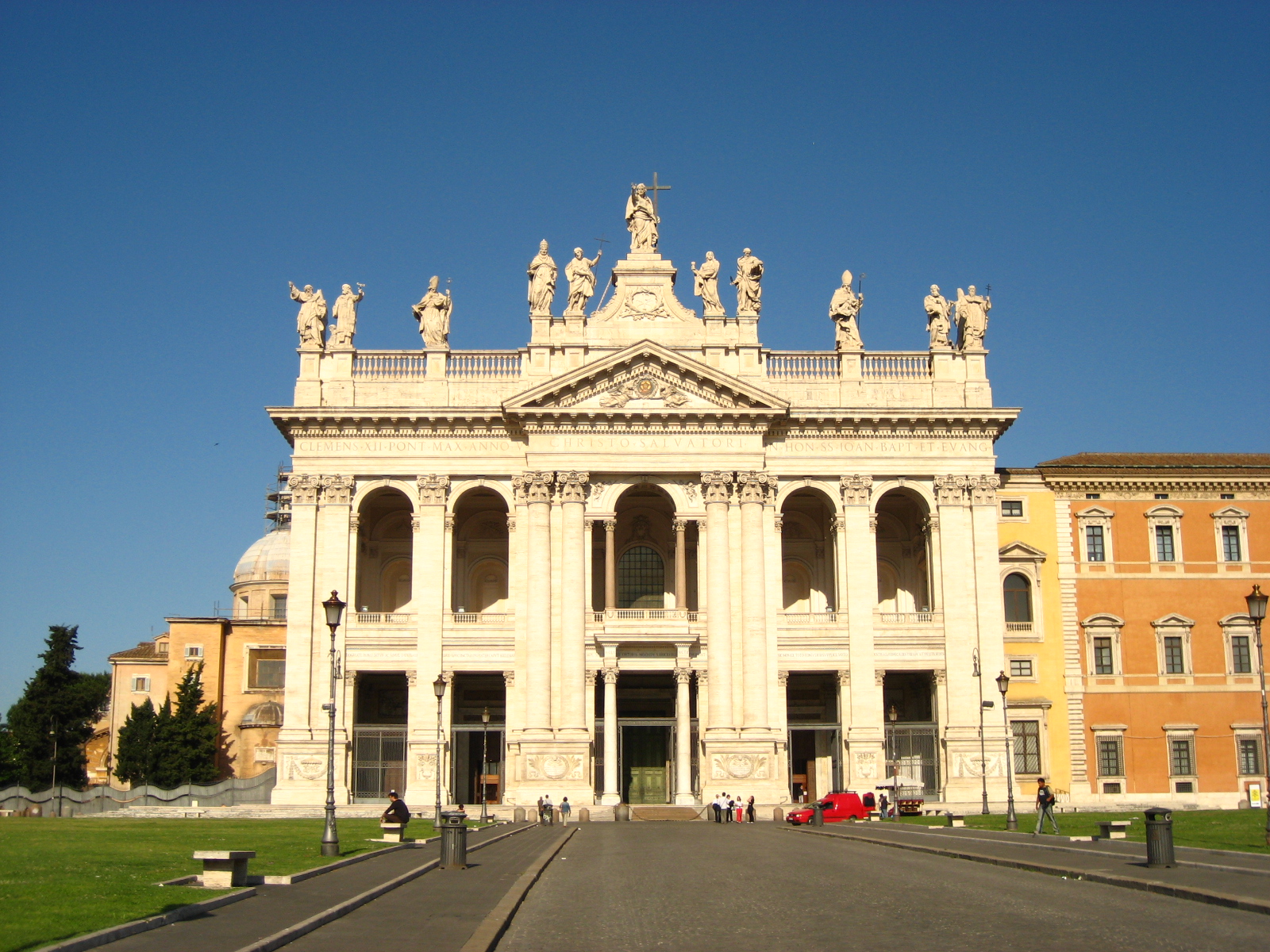
    On Wednesday, June 18, we got up in Rome and had breakfast at the little cafe next to our B&B – a creme-filled croissant and a cappucino. My kind of breakfast. Then we were off to the major sight in Rome that was geographically closest to us: the Basilica of St. John Lateran. The nun who spoke to us the day before at the Pontifical North American College had recommended that we get to the papal audience a couple of hours early, like 8 a.m. But we decided that we would leave the best seats for the actual Catholics, and show up at around 10 for the 10:30 audience.

    So at 8, instead of arriving in Vatican City, we were walking up to St. John Lateran. Of the four basilicas in Rome, it is oldest and ranks the highest. Even though the Pope lives right next to St. Peter’s in Vatican City, his cathedral church is this one – it’s older than St. Peter’s, and the popes even lived in a palace next door until 1309, when the papacy temporarily moved to Avignon, France.

    As you can see, the weather was wonderful. And once we got inside, there were very few other people there. There were a few other tourists like us, and a few people who apparently were just stopping in to pray on their way to work. After being in crowded churches for most of our first day in Rome, this was a welcome change.

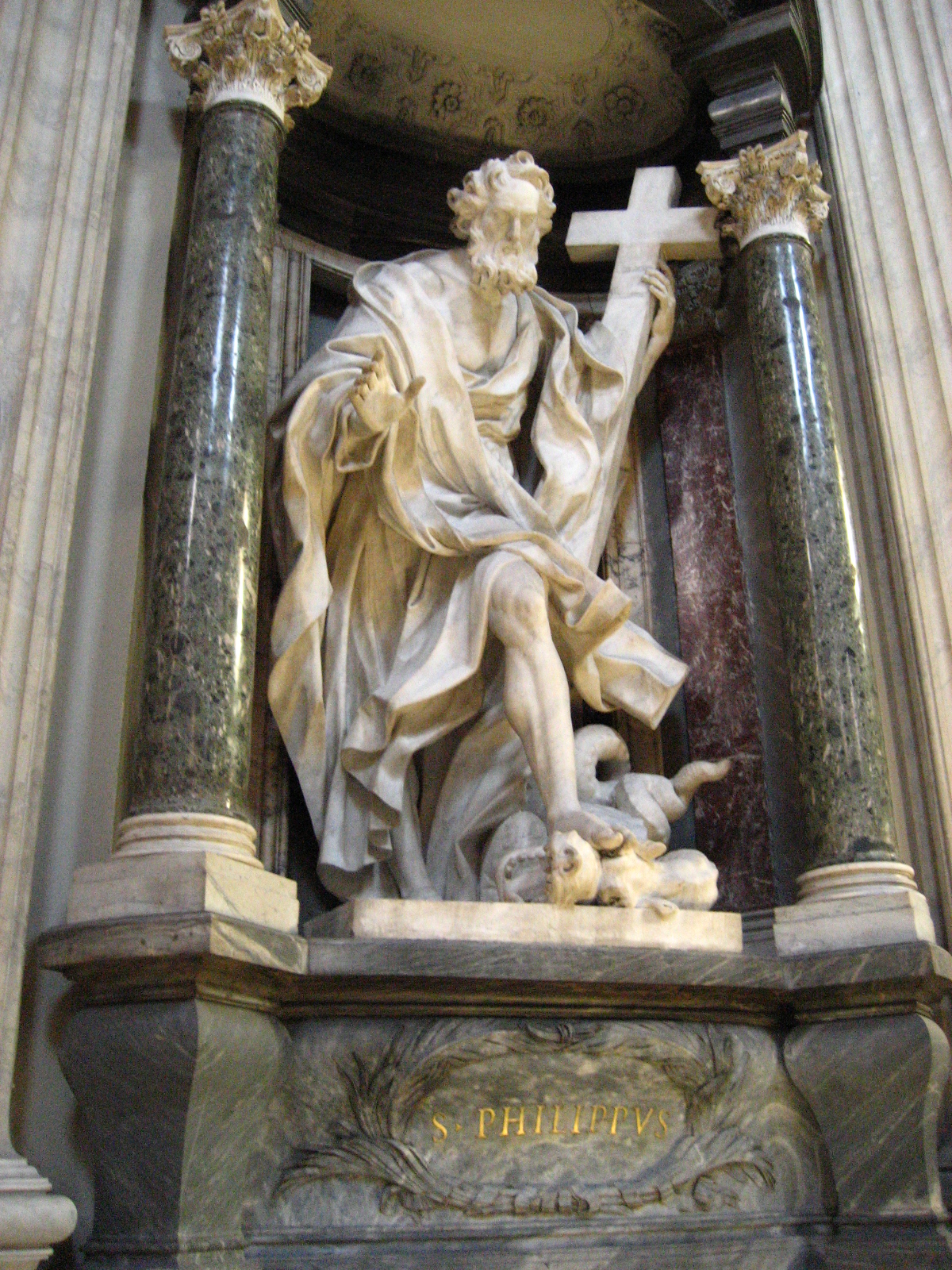
    Even though the church is a very old one, its current construction is Baroque. One of my favorite things about it was the statues of apostles in the nave, like this one, of Philip:

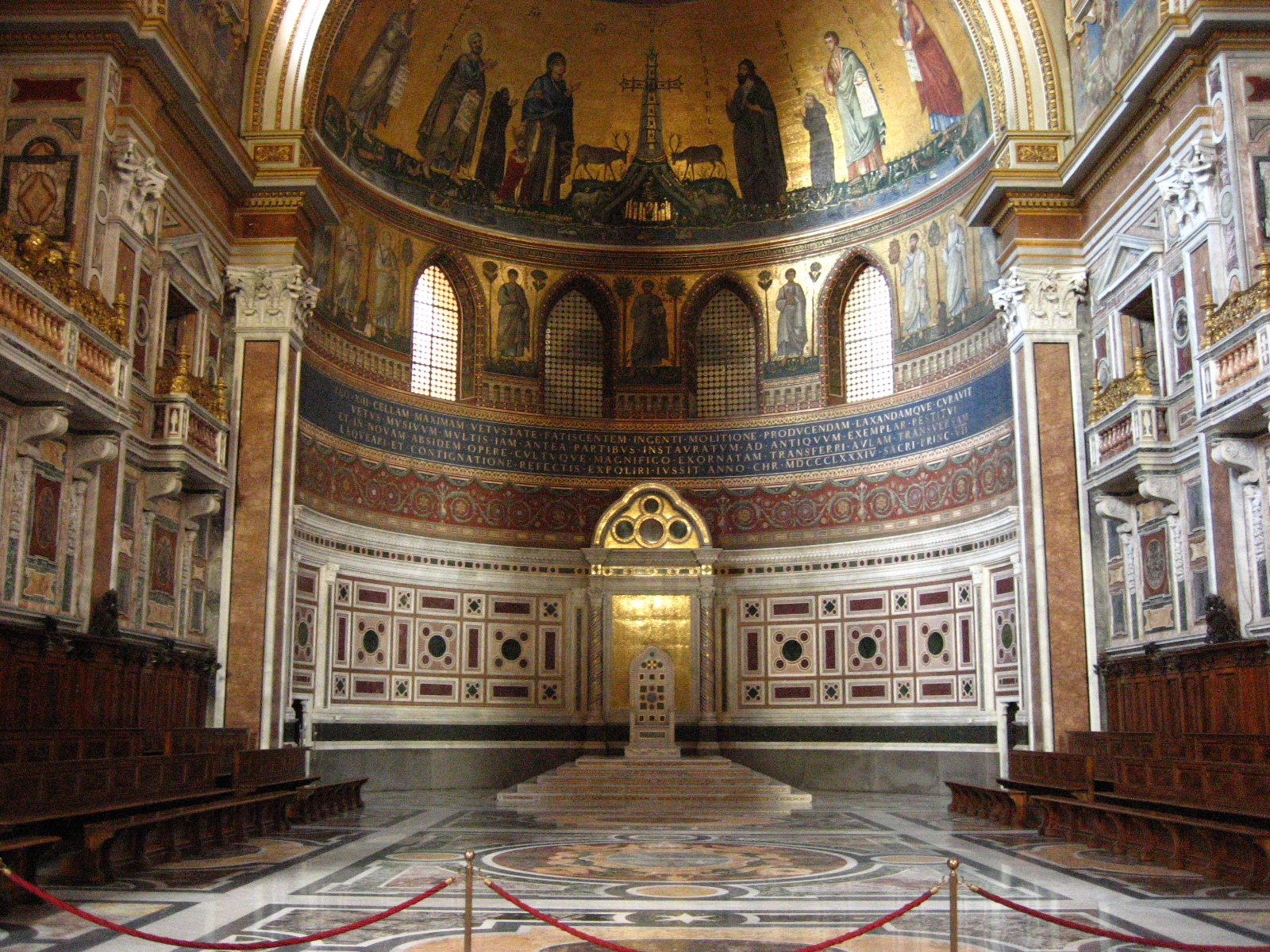
    Here is the papal cathedra, located in the apse:

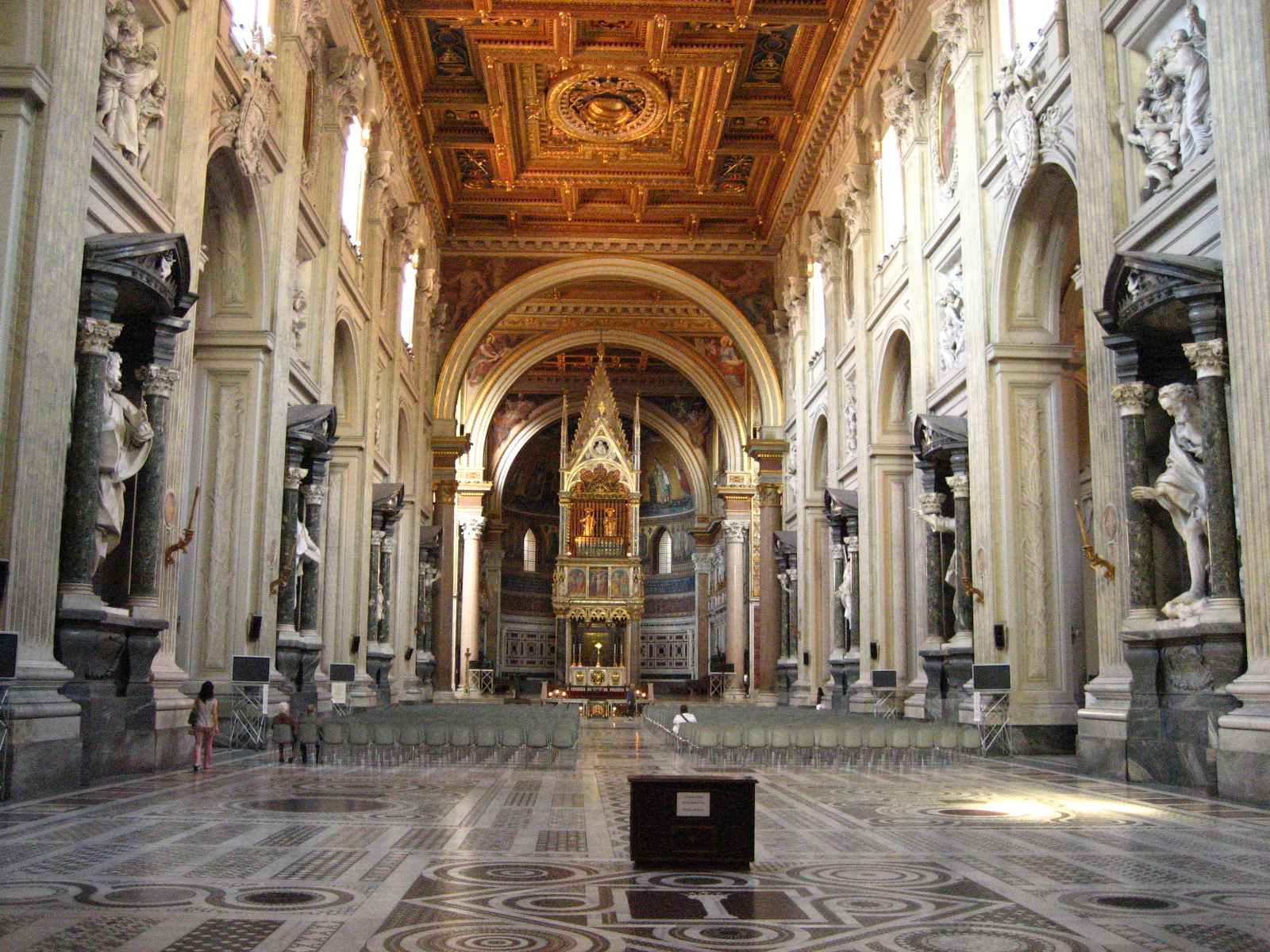
    Here is a picture of the nave, with the statues on either side:

    After St. John Lateran, we hopped on the metro and went to Vatican City for the papal audience. Whenever he is in town, Benedict gives papal audiences every Wednesday morning. Tickets are free, and we got ours from the Pontifical North American College in Rome. This was the second papal audience I’d been to. The first one, on the trip to Rome when I was 15, was when John Paul II was pope. He was not feeling well at the time, so instead of coming down into the square, he appeared in the window of his apartments above the square and gave his lesson and blessing from there.

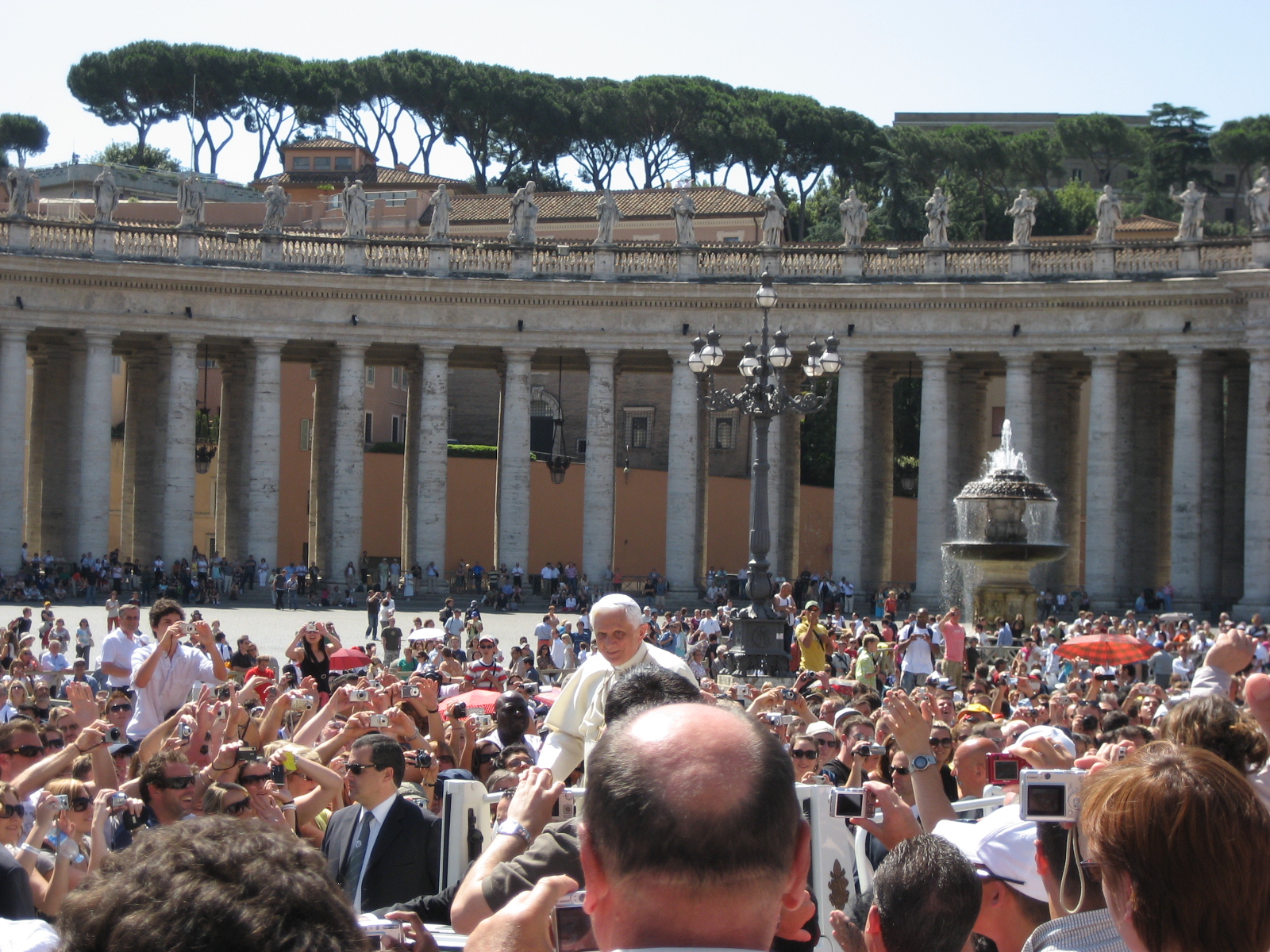
    This time, it was different. At about 10:30, (the scheduled start time) lots of people began to stand up and look around for Benedict to appear. A few minutes later, he zoomed out from the left hand side of St. Peter’s in his Popemobile, waving and smiling. He goes through and around the crowd once or twice, but no one knows which way he’s going to go for security reasons. We didn’t have the best seats for seeing him when he came by (because we hadn’t gotten there at 8), and here is a picture I took from standing on my seat:

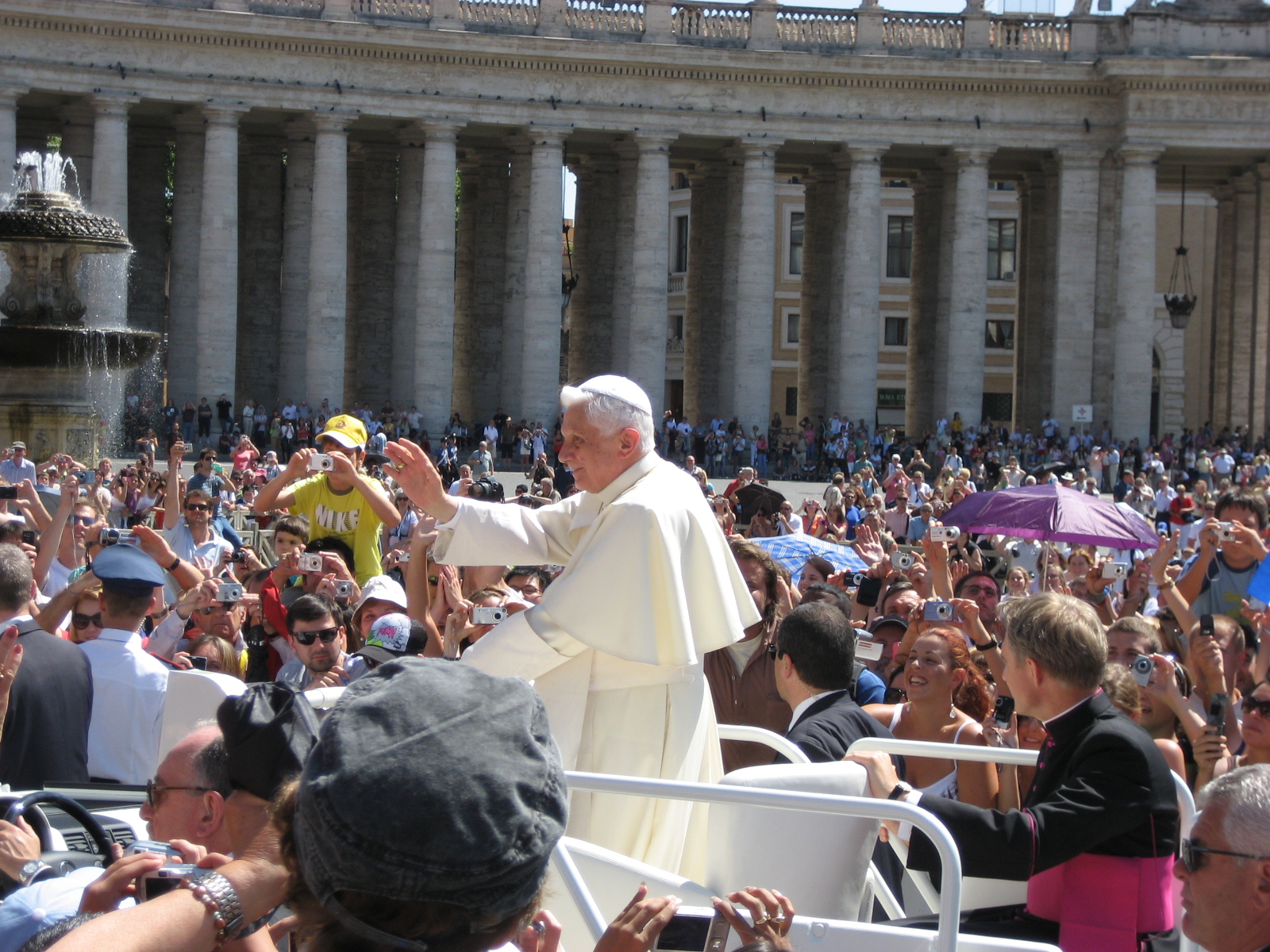
    After that, though, his route around the square took him to the very back of the area designated for papal audience spectators. There weren’t many people back there, obviously, so I was able to head back and get a couple of much closer pictures:

    After his trip around the square, he sat down under a canopy in front of St. Peter’s and proceeded with the audience. The scripture reading was from the book of Wisdom (sooooo Catholic), and the substance of his message dealt with the example of Isidore of Seville. He gave it first in Italian, then a shorter version of it in several different languages. I can’t remember exactly, but I think the order was German, English, French, Spanish, Portuguese and Polish. Do you want to read the whole thing? Of course you do. Here it is, courtesy of the Vatican Web site. We left after the English portion (and before the blessing of young people, sick people, newlyweds and objects), because we had a lot to do, beginning with the Vatican Museum.

    The Vatican Museum is one of those museums that seems too big to do justice to in one day. I’ve never been to the Louvre, but I have been to the Hermitage in St. Petersburg, and it took three visits before I felt like I had even seen everything. We couldn’t see everything in the Vatican Museum, so we had to make do with the highlights. We started off with the Pinacoteca (Art Museum), and got to see some great Raphael paintings as well as a Caravaggio, a da Vinci, and lots of other great stuff. Then we went to the Ancient Christian part of the museum, and saw a whole lotta tomb reliefs and a few statues. Then we wanted to see the Raphael Rooms, but couldn’t find them at first. We resigned ourselves to following the hordes of people surging toward the Sistine Chapel (the last thing anybody sees before they exit, and presumably the only thing many people come in to see)… We passed by a long corridor with maps on the wall, and a few other long corridors, and we were getting close to the end… But wait! Is that a sign for the Raphael Rooms? Why yes, it is!

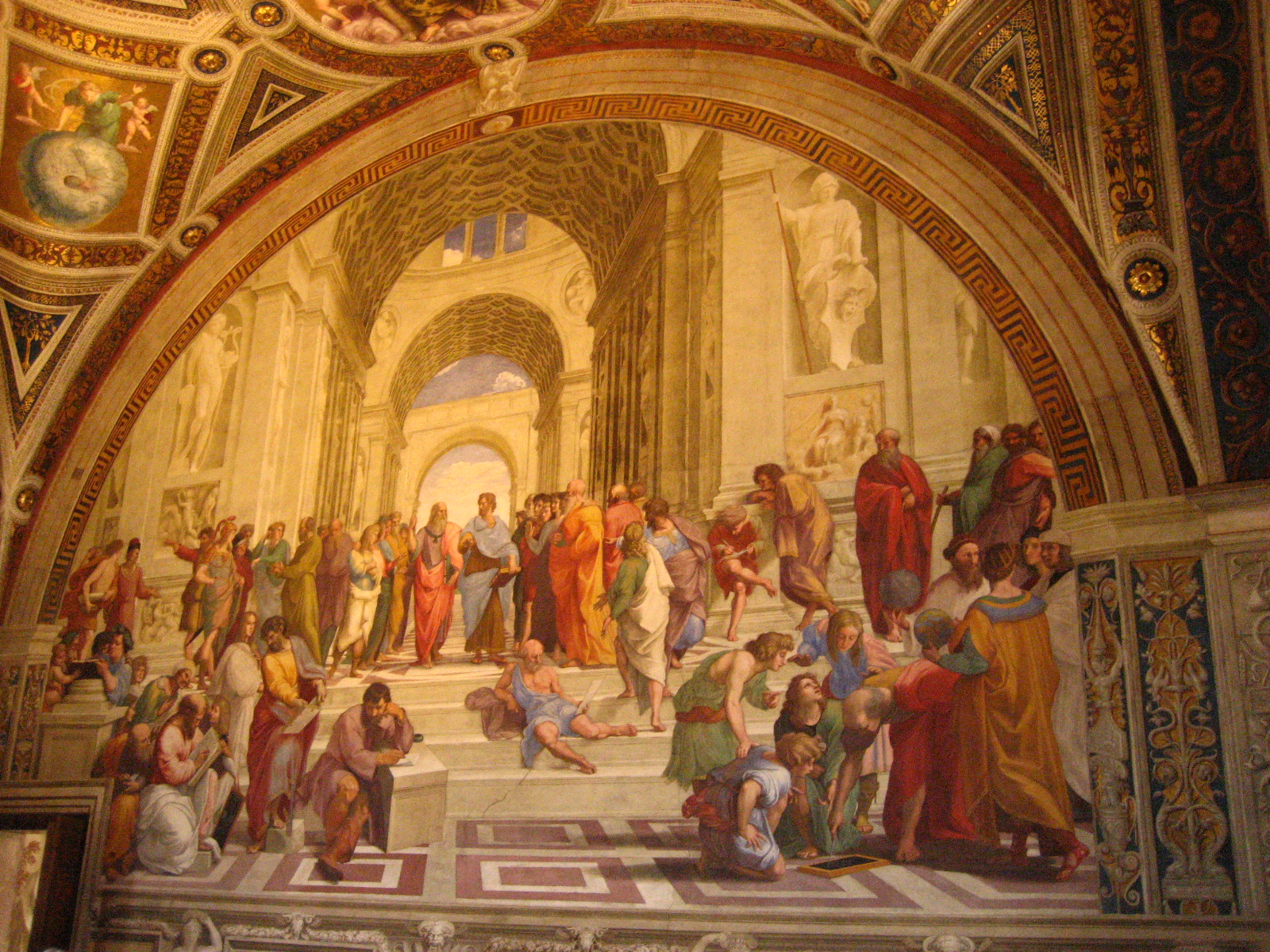
    So we went into these rooms, and this was really the highlight of the museum for me. This is a series of rooms that Raphael and his school painted frescoes in, and they weren’t crowded at all. The most famous of these frescoes was the one that he painted second, in the room that was once the library of Julius II. It’s called The School of Athens, and depicts Plato and Aristotle in the middle of a crowd of philosophers.

    I couldn’t get a good shot of the whole thing head-on, but there are other pictures of it online.

    After the Raphael Rooms, we went through the museum’s collection of modern religious art. I thought this was quite good, too, even though I don’t go in much for modern art. But the reason why I don’t go in much for modern art is because so much of it comes across as being so meaningless to me. If it has a religious theme, as these works did, it has a meaning, so I thought it was good. This is me, the art critic.

    After that, we went into the Sistine Chapel. Beautiful, of course. But crowded. And the ceiling is high up, and the Last Judgment is too big to take in in less than a few minutes. When I was there, I was more impressed by thinking of all the papal enclaves that have taken place there over the years. But maybe that was because I’d seen the paintings before.

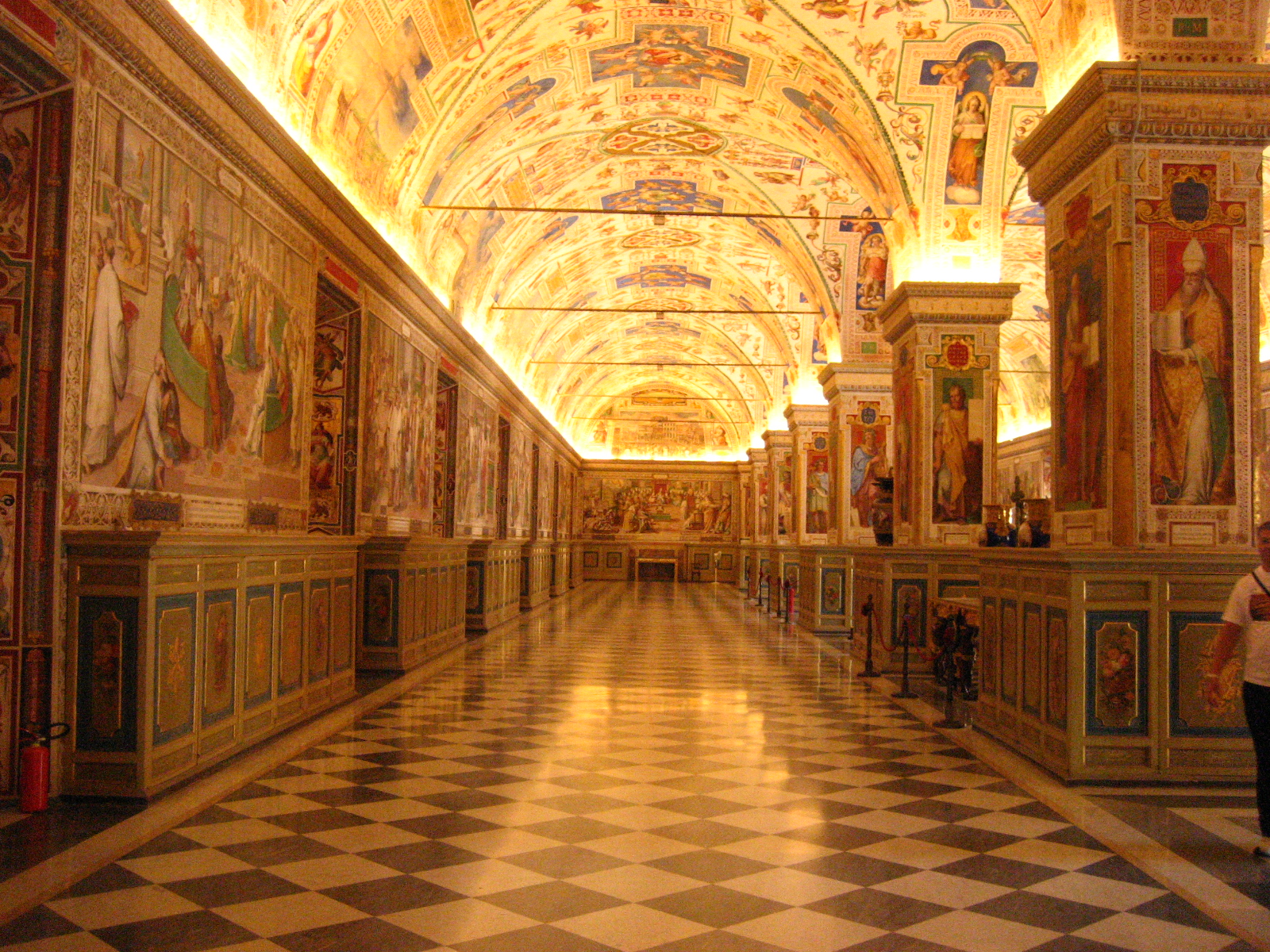
    When we came out of the Sistine Chapel, we went through a long corridor back out of the museum, and stopped by the Archives.

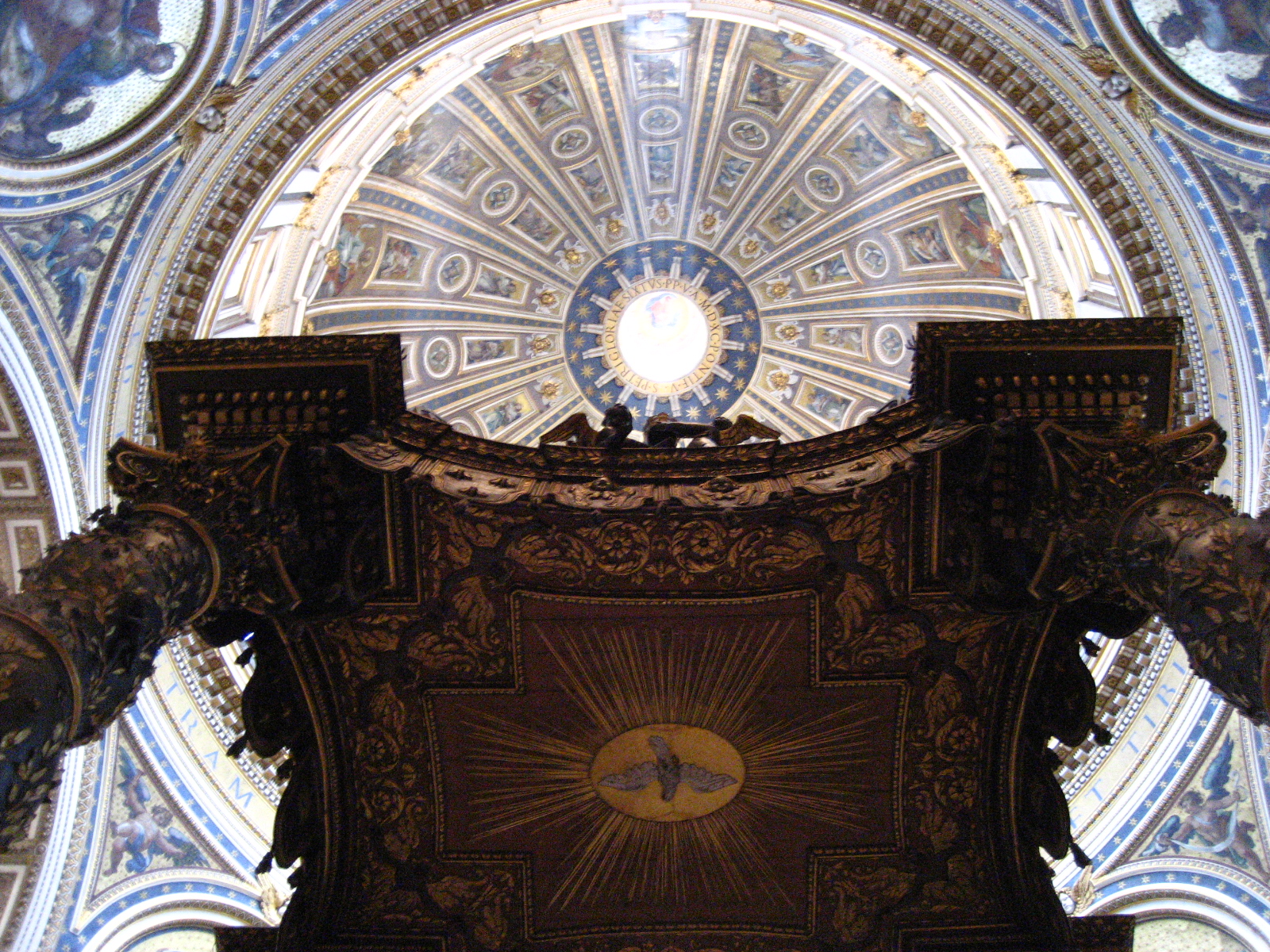
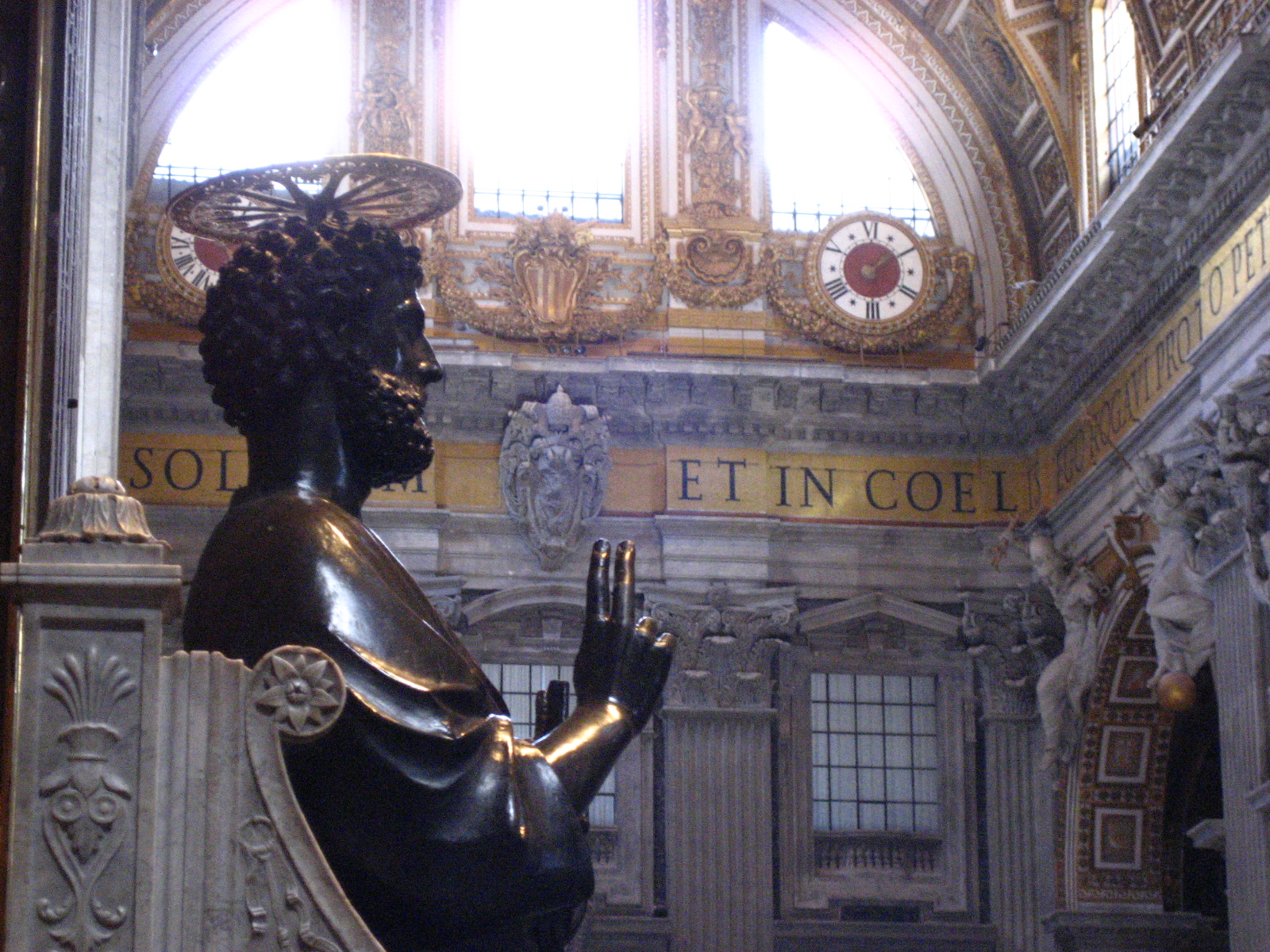
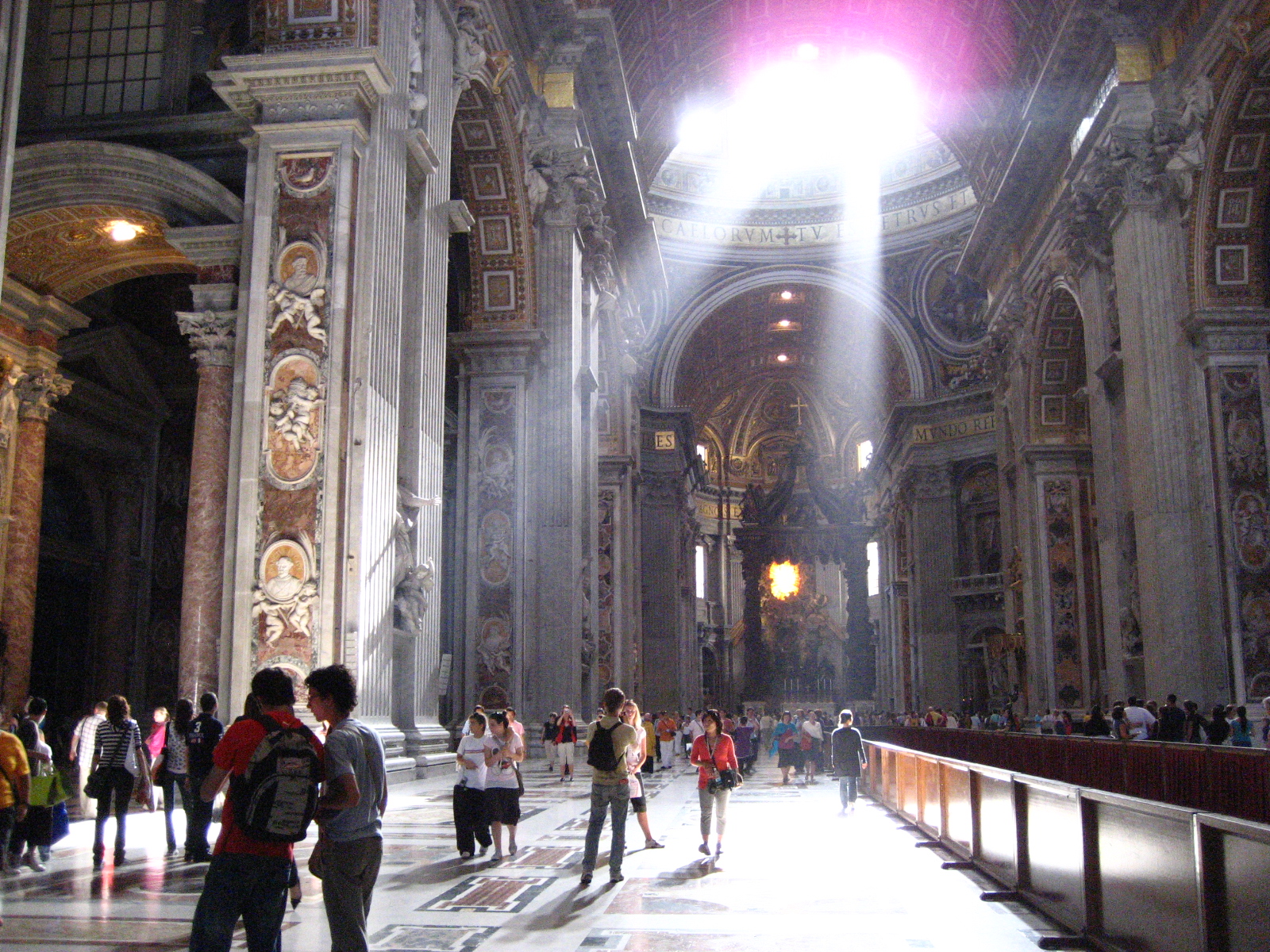
    Once out of the museum, we went back to St. Peter’s Square and got in line to go into St. Peter’s. I didn’t remember a line to get in when I was there before, but when we got to the front of the line we saw what the hold up was: security. Once through, we got to stroll on in. The lighting was particularly beautiful on account of the sun setting:

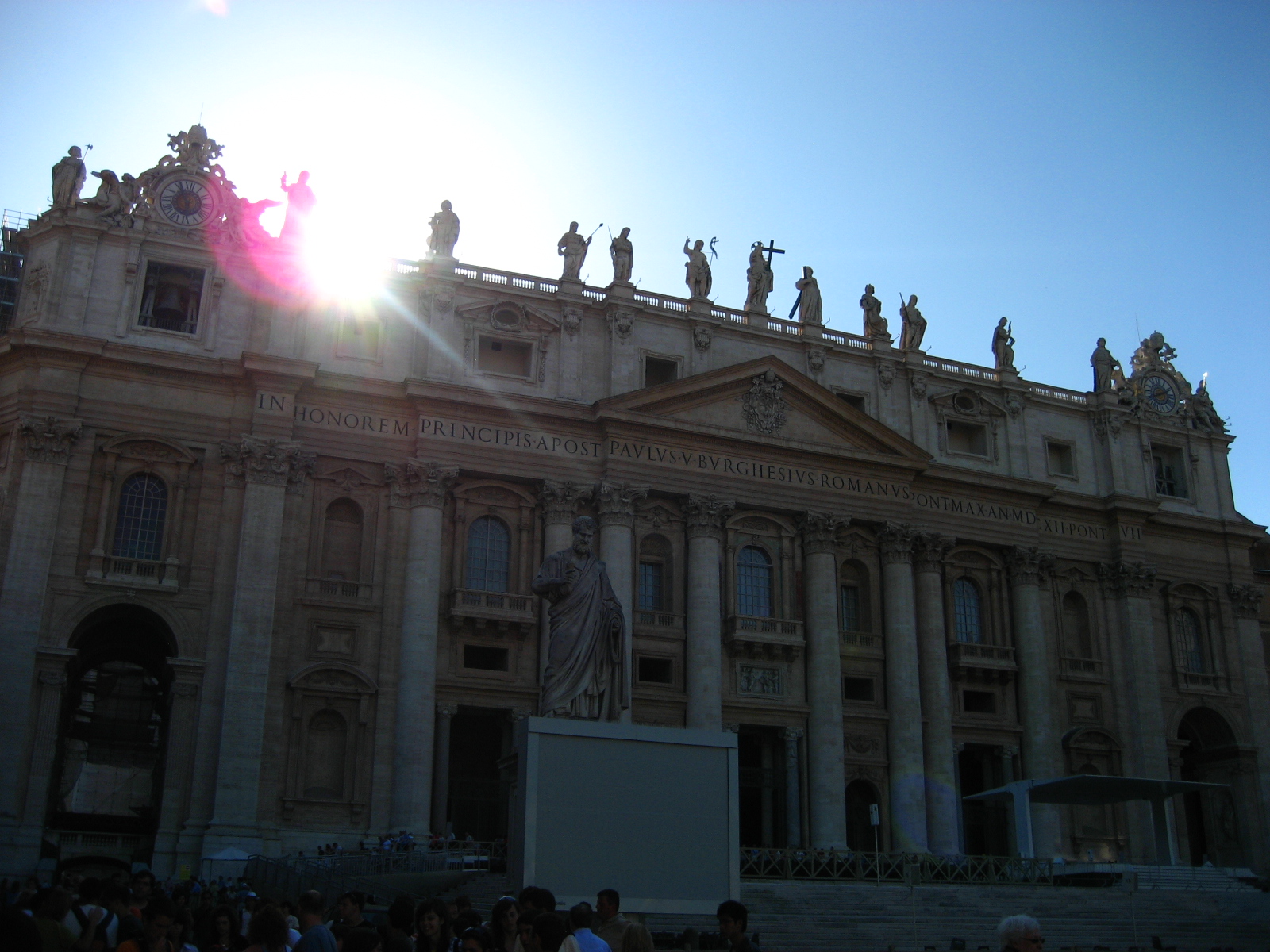
    When we got back outside, I took another picture:

    Before we went home on our last day before we flew back, we decided to swing by the Spanish Steps – just because they’re a big tourist stop in Rome. We did. There were a lot of people there. It was OK, but not my favorite part of the day. Perhaps I was just tired.