Blog

  • More Euro-signage

    The post last week on funny signs from Europe caused me to look on my computer for some more pictures of signs that I saw when I lived overseas. Unfortunately, I didn’t take a lot of digital pictures of funny signs, but fortunately, my roommate Neal did. Here is a link to a page on his web site where he posted his collection of funny signs, and here is a tasty sample to get you over there:

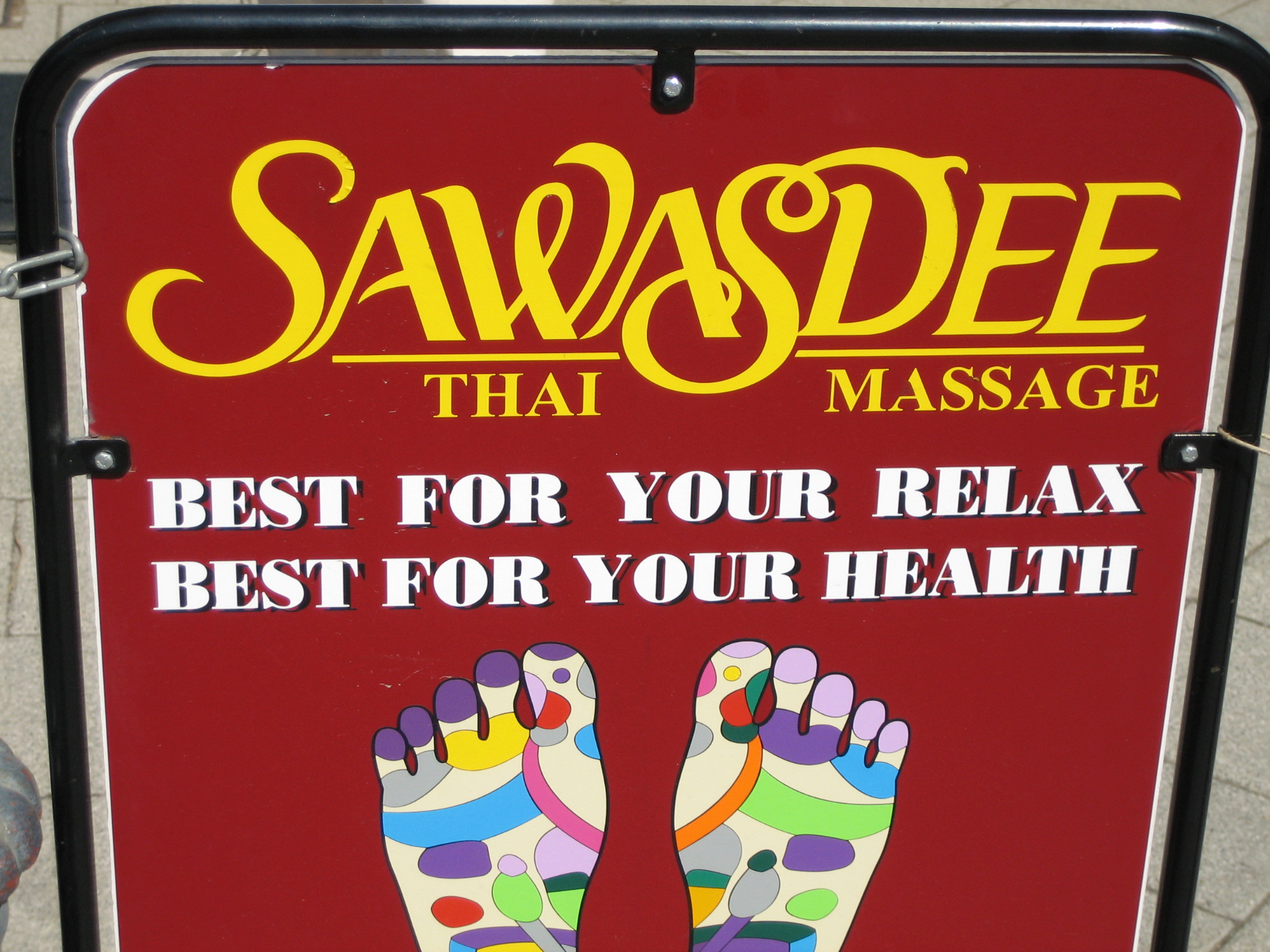
    And here are a couple of pictures that I took:

    I’ve never had a Thai massage, but I hear it’s great for my relax.

    “Come to our Kung Fu class, and learn how to punch people in the neck.”

  • Euro-signage

    My friend Julia is touring around Europe right now, and mentioned in her latest blog post that she’d been seeing a lot of entertaining signs on her travels.

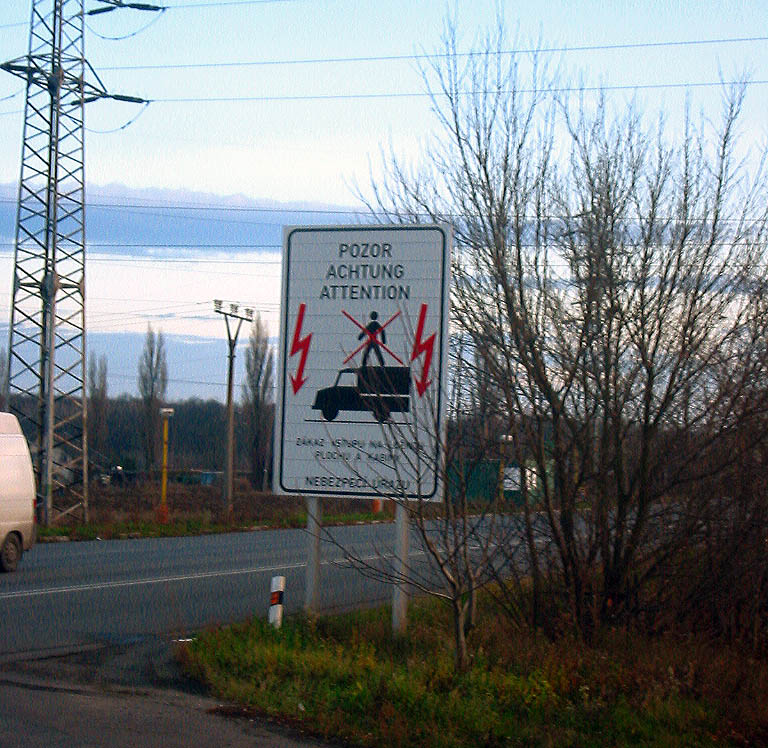
    This took me back to my days in Eastern Europe, where I saw this sign at the Czech border on the way to a Thanksgiving retreat:

    Apparently, the message is: “Don’t stand on the roof of your car, or you will be electrocuted by high tension wires.”

    A lesson we all could learn.

  • 2008 Pastor’s Conference

    Since I graduated, you may be wondering what I have been doing with my time. As I mentioned in an earlier post, for a few days all I did were things that I never found time to do when I was in classes – like doing my taxes and going to the eye doctor. But now that most of that is taken care of, how am I spending the month of May?

    Well, last week I had a great opportunity to attend the 2008 Regent Pastor’s Conference. They have a conference in May every year. I wasn’t planning on going (because I couldn’t afford to pay for it), but I was asked by the conference coordinator to help out by doing the sound for it. So I was able to attend all the sessions for free, and eat lunch for free, all because I sat in the back of the room and fiddled with knobs on a sound board all day (well, it was more complicated than that, but the point is that I got to attend the conference because I did something that wasn’t terribly taxing).

    The theme of the conference this year was With Eyes Lifted Up: The Pastor as Pray-er. There were three speakers: Bruce Hindmarsh, Marva Dawn, and Darrell Johnson. I was particularly excited to hear Marva Dawn speak, because both Bruce and Darrell are on the faculty at Regent and I have had classes with both of them. But Marva I had heard good things about, but had never heard before. It turns out she is a very engaging speaker. She does like to go off on tangents, but I find that I don’t mind speakers who go on tangents if they’re not teaching a class. I mean, it’s one thing for a professor to only get halfway through an outline and then hold you responsible for the entire thing, and it’s another for a conference speaker to tell inspiring and entertaining stories every now and then. She never got through what she wanted to get through in any of her talks, but I didn’t mind so much. Bruce and Darrell were also quite good. I’m so thankful that I was able to go; it was a real blessing to be a part of the conference.

    So that is what I did last week. This week: painting. My roommate Tony is painting a house, and he would appreciate help, so this week I’ll be painting with him and a couple of other guys. We’ll be enjoying the lovely Vancouver spring weather, which has just started getting warm…

  • An Evangelical Manifesto

    Last week, a document called the “Evangelical Manifesto” was released (you can read it here). It is, as the Web site states, an “open declaration of who Evangelicals are and what they stand for.” The Steering Committee for the manifesto includes Timothy George, Os Guinness, Richard Mouw and David Neff. Signatories include Leith Anderson (president of the National Association of Evangelicals), Stuart Briscoe, Leighton Ford, Justo Gonzalez, Max Lucado, Mark Noll, Alvin Plantinga, Ron Sider, Kevin Vanhoozer, Miroslav Volf, and lots of other Evangelicals you may or may not have heard of.

    There are three headings to the document: We Must Reaffirm Our Identity, We Must Reform Our Own Behavior, and We Must Rethink Our Place in Public Life. Each section contains some things that are, to my mind, both controversial and uncontroversial. An example of the uncontroversial, from the first section, is: “Evangelicals are Christians who define themselves, their faith, and their lives according to the Good News Jesus of Nazareth.” All right. But then, the document continues:

    Evangelicalism must be defined theologically and not politically; confessionally and not culturally. Above all else, it is a commitment and devotion to the person and work of Jesus Christ, his teaching and way of life, and an enduring dedication to his lordship above all other earthly powers, allegiances and loyalties. As such, it should not be limited to tribal or national boundaries, or be confused with, or reduced to political categories such as “conservative” and “liberal,” or to psychological categories such as “reactionary” or “progressive.”

    (more…)

  • Mark Twain and the Problem of Evil

    Over the last couple of nights, Mary and I watched a documentary on Mark Twain, directed by Ken Burns (who also brought us documentaries called Baseball, The Civil War, and Jazz). Mark Twain has been one of my favorite authors for a while – ever since I was a teenager and read The Adventures of Tom Sawyer and Huckleberry Finn. When I lived in Prague in 2002, I was looking around my school’s English library one fall day and found a biography of him (Mr. Clemens and Mark Twain by Justin Kaplan) and all of his essays in one volume. I read both of them that year.

    What fascinates me about Mark Twain is not just that he was a fantastic writer, but he led an intriguing and eventful life. He was born in a small town in Missouri, as everyone knows, and variously worked as a printer’s assistant, a riverboat captain, a prospector, and a journalist (among other things) before he began to earn money from his books. His was also a tragic life: even though he was a brilliant writer and made a comfortable living from his books, he was obsessed with investment schemes that would make him still richer. These invariably failed, and made it necessary for him to write and lecture constantly to get out of debt. (more…)

  • April 2008: Books Read

    I graduated last Monday night, and my parents were in town to see it. Up until then, I’d been pretty busy with various things that I had left to the side while in the thick of the semester: going to the doctor, doing my taxes, etc. From now until I leave for the cruise on June 3, I don’t have as much to do. So I’m getting back into blogging regularly. Here are the books I finished during the last month:

    1. A Little Guide to Christian Spirituality: Three Dimensions of Life With God by Glen Scorgie. This book was the second of the two textbooks I was assigned to read for my Christian Spirit class. I actually read it in March, but forgot about it because I’d read it so quickly. Unlike Thirsty for God, the other textbook for the class, this is not a historical survey of Christian spirituality, but is a popular-level introduction to the Christian take on that much-used but little-understood word “spirituality.” The three dimensions referred to in the title are the relational, transformational, and vocational. I’d recommend this book to anyone who is interested in what spirituality means for Christians. The very short answer to that question is that, for Christians, spirituality is life in the Spirit – not just any spirit, but the Holy Spirit.

    2. The Shoes of the Fisherman, by Morris L. West. When I was finished with classes, I felt like reading a novel, and so I picked this one up off my shelf. My mom had given it to me a few years ago, but I never made the time to read it. It is a novel about a pope from Russia, published in 1963. Some say that it foreshadowed the election of John Paul II, who was the first Slavic pope. It’s unclear whether West did this deliberately, but one thing that he definitely did do on purpose is include a character reminiscent of Pierre Tielhard de Chardin. This character, a Jesuit, is called to Rome over the course of the book, wins the love and confidence of the pope, and then has his work on evolutionary biology condemned by the Catholic Church. In all, I found the book thoughtful and thought-provoking, though the plot was very slow-moving. It took me a while to get into it, and to care about some of the characters. By the time that happened, the book (just 288 pages) was over.

    3. After Virtue, by Alasdair MacIntyre. This book I began back in January, when it was discussed by the Ethics Reading Group I was a part of this semester. I made it through all but the last three chapters, then I was overcome by the busyness of the semester. After I finished classes, I went back and finished. I found this an interesting and provocative read. My friend Eric has written over on his blog that After Virtue is “a critique of modernity from the inside.” I think this is a fair assessment. MacIntyre stands back from modernity and criticizes its accounts of ethics, and I think that he is brilliant in his critique. But in the end, MacIntyre is a western liberal who longs for Aristotle, and chooses to go back. He is part of modernity even in his critique of modernity. He argues for teleological ethics in this book, but when the book ends, the reader finds out that MacIntyre has not actually given us a telos. He argues for ethics situated in a community, but in the end his readers are left wondering where to find such a community. This is in part why so many Christians have been attracted to this book. When MacIntyre wrote the book, he was not a Catholic, but in subsequent years he converted to Catholicism. He was on the doorstep of the church when he wrote the book, and he leaves his readers there as well. His work is philosophical rather than theological. But it has left itself open to theological interpretation, and writers like Stanley Hauerwas and Jonathan R. Wilson (who teaches at Carey Theological College and participated in the Ethics Reading Group) have taken up this task in the years since After Virtue was written. One book that I would like to read in the coming month is Wilson’s Living Faithfully in a Fragmented World: Lessons for the Church from MacIntyre’s ‘After Virtue.’

  • Constitution Found in Ancient Monastery

    As some of you know, I like to write pieces of satire from time to time, especially when I get frustrated. It’s a laughing-to-keep-from-crying thing. For the past four years, one of these has appeared in the April Fool’s edition of the Et Cetera, Regent’s weekly paper. For your reading enjoyment, here is the brief (just under 300 words) one that appeared this year:

    Religious Right Finds Copy of Constitution in Monastery

    Conservative US Christians have long maintained that the United States Constitution is a document based on biblical principles. Now, it seems, they have proof.
    Last week, archaeologists excavating the ruins of an ancient monastery in Upper Egypt found a nearly complete copy of the founding document of the United States of America, until now universally thought to have been written in Philadelphia in 1787. It appears to have originally been written as a “rule,” or a governing document for a monastery or order of monks.
    “This is a tremendous find,” gushed Constantine Cash, president of the political lobbying group Council on Family Worship. “Now, maybe people will realize that America was founded as a Christian nation, and we’ll be able to tear down that pesky wall between church and state.”
    However, the claim that what we now know as the Constitution was written in the 3rd-5th centuries by a group of monks is not likely to go uncontested.
    Archaeologist Morton Prinsterer, for example, is skeptical of this new find. “In the first place,” he says, “this document is written in English. In the second, it looks like a copy of the Constitution that you can buy in museums and archives, with a few words crossed out.” The change of “We the People,” the first words of the document, to “We the Monks” was, in Prinsterer’s opinion, not the work of an ancient writer.
    “Nonsense,” responded Cash. “It’s obvious that the Founding Fathers took this document and used it to create a Protestant Christian country, then put it back exactly the way they found it. Why is that so hard for people to believe?”

  • Finished!

    This past Friday, I handed in my Christian Spirit take-home final, the very last thing that I had to write in order to complete the requirements for my Master’s in Divinity.

    Which means, I’m done! All I have left to do now is graduate next Monday, April 28. My parents are both coming out to visit, which will be a lot of fun. They have both come out to Vancouver before, but it will be nice to have them there for graduation, and so they can meet more of my friends. I will be hanging around in Vancouver during May, saying goodbye, organizing my notes, doing my taxes finally, slowly packing up, getting rid of any furniture or clothing that I don’t think I’ll use anymore, and generally enjoying spring in Vancouver. In June, Mary, my dad and I will be going on a cruise. In July, Mary and I will head up to Skagway, AK for one last summer of tour bus driving.

    After that, well… I’ll let you know soon in another post. Or you can talk to me in person and I will tell you what is likely to happen.

    But for right now, I’m celebrating! God has been more than faithful these past four years, and I am thankful to have completed my degree.

  • Googlegangers

    I just read this article from the NY Times about people who look for other people with the same name on the Internet. The name for the people you find who have the same name as you are called “Googlegangers” (the “a” is supposed to have an umlaut over it, but I can’t figure out how to do that and don’t want to spend the time).

    Much of the article is about the attraction that people have to people like them: names, birth dates, ethnic group. It also mentions that there can be a kind of rivalry among people with the same name; it mentions a Jon Lee who wants to be the first Jon Lee to turn up in a Google search trying to stay “ahead” of other people with his name.

    I’ve never met anyone with the same name as I have, and if I ever search for my name on Google (which, I’ll admit, I’ve done), I’m the only one. It probably comes from having a Dutch last name that isn’t incredibly popular, and a first name with Hebrew origins that (according to this web site) ranked a lowly 388th among most popular boy’s name in the United States in 2006 (What was the most popular one? Jacob).

    I have the opposite of affinity with people with the same name as me, I think. I’ve got a lot invested in being unique, and if I were to suddenly find another “Elliot Ritzema” out there, I think I’d be disappointed.

  • March 2008: Books Read

    March was a very busy reading month, but I didn’t have much to show for it in terms of books actually completed. Most of the time I was doing research for papers, and it’s not typical for me to read whole books for that. But here is the list of books:

    1. Stories of Karol: The Unknown Life of John Paul II, by Gian Franco Svidercoschi. (more…)